Montessori Practical Life Activities for 2-Year-Olds
The best practical life activities for a 2-year-old are the boring ones: pouring water between two cups, wiping a spill, carrying a napkin to the table, putting shoes in a basket, tearing lettuce. Nothing on that list needs a shelf, a tray, or a branded box. What those activities need is a child who can repeat them without you hovering to correct every movement, and a setup that survives being done badly forty times in a row.
That last part is where most parents overspend. Practical life is the one corner of the Montessori world where the marketing has outrun the method. You can buy a beautiful wooden transfer set for $60, or you can hand a 2-year-old a chipped bowl and a spoon and get the same developmental outcome. Dedicated tools earn their place when they fix a real problem – the broom is too tall, the pitcher is too heavy, the stool wobbles – and not before.
This is a buying guide, so there are products below. But the honest answer to “what should I buy” is usually “less than you think, and later than you think.”
At age two, children are often eager to do things for themselves, making practical life activities especially valuable for building independence and coordination. From simple household tasks to Montessori materials that support these skills, our Montessori Practical Life Toys: Complete Guide covers the wider practical life approach and how to choose appropriate activities.
What Practical Life Means at Age 2
Practical life in the Montessori sense is not a subject. It is the ordinary work of running a household, handed to a child in pieces small enough to complete. At 2, that means participation rather than competence. Your child is not learning to fold laundry. They are learning that laundry is something people do together, and that they are one of the people.
A 2-year-old learns this through imitation and repetition, not instruction. Watch one carry a cloth to a spill and you will see the whole sequence: they saw you do it, they want the cloth, they want the motion. What they do not yet have is the sequence control to do it cleanly, which is why the wipe often makes the puddle bigger. That is the activity working, not failing.
The outcomes that actually matter at this age are unglamorous and mostly invisible:
- Hand strength and grip – wringing a cloth, gripping a small pitcher, holding a spoon
- Coordination and balance – carrying something liquid without spilling it
- Sequencing – fetch cloth, wipe, put cloth in basket
- Concentration – a genuine, unbroken two to five minutes on one task
- Self-care – pulling up pants, washing hands, finding their own shoes
- Language – the words that come with the task: pour, empty, wipe, wet, full
- Confidence – “I did that” is the entire point
What you should not expect is a polished result. A Montessori-inspired activity at 2 is adapted to the child in front of you, not run as a classroom exercise with a pass or fail. If your child pours water on the floor and then looks pleased, the activity happened. The floor is a separate problem.
The Best Practical Life Activities for 2-Year-Olds
Organize these by what they accomplish in a house, not by what aisle they came from. The categories below are also roughly the order of difficulty, easiest first.
Pouring, Scooping, and Transferring
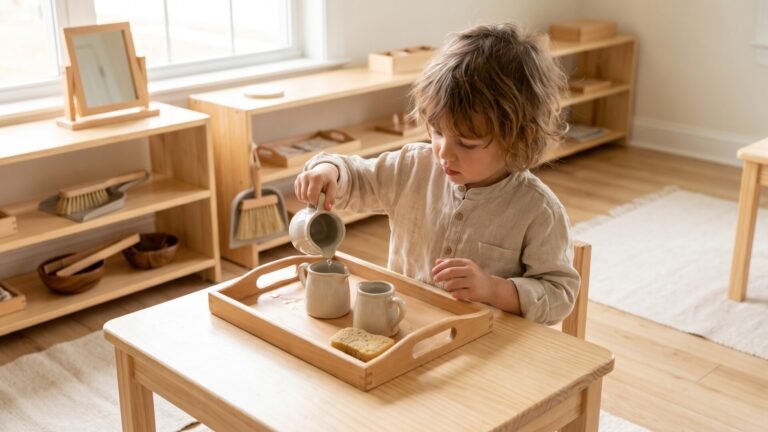
Start dry. Large pom-poms, chunky wooden balls, big pasta shapes, or a pile of washcloths moved from one bowl to another. Dry transfer lets a child practice the wrist and grip motion without the consequence of a puddle, which means they will repeat it more.
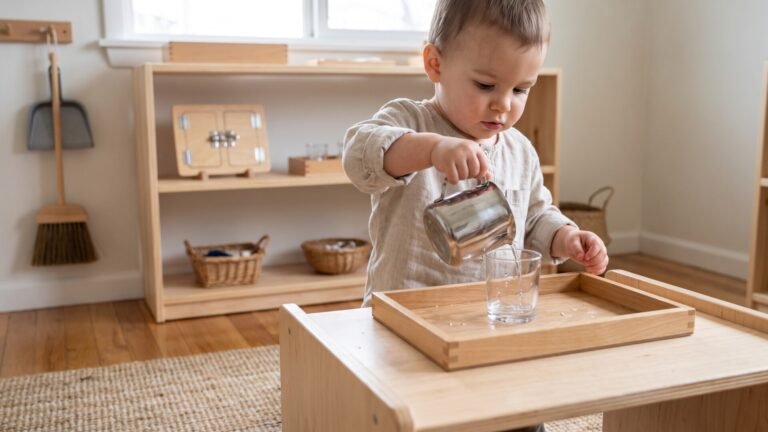
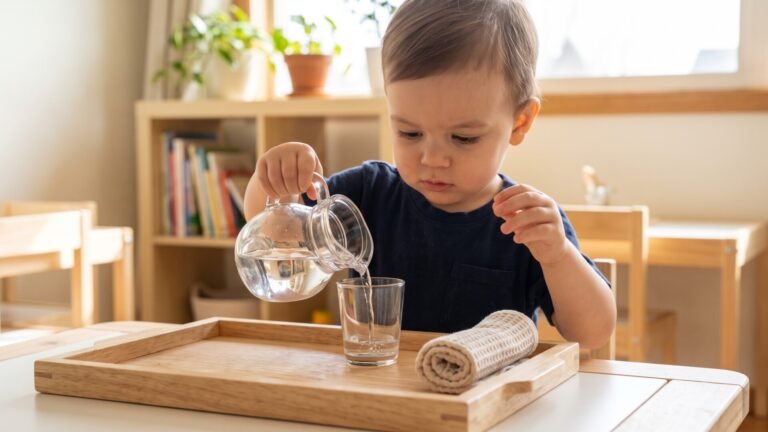
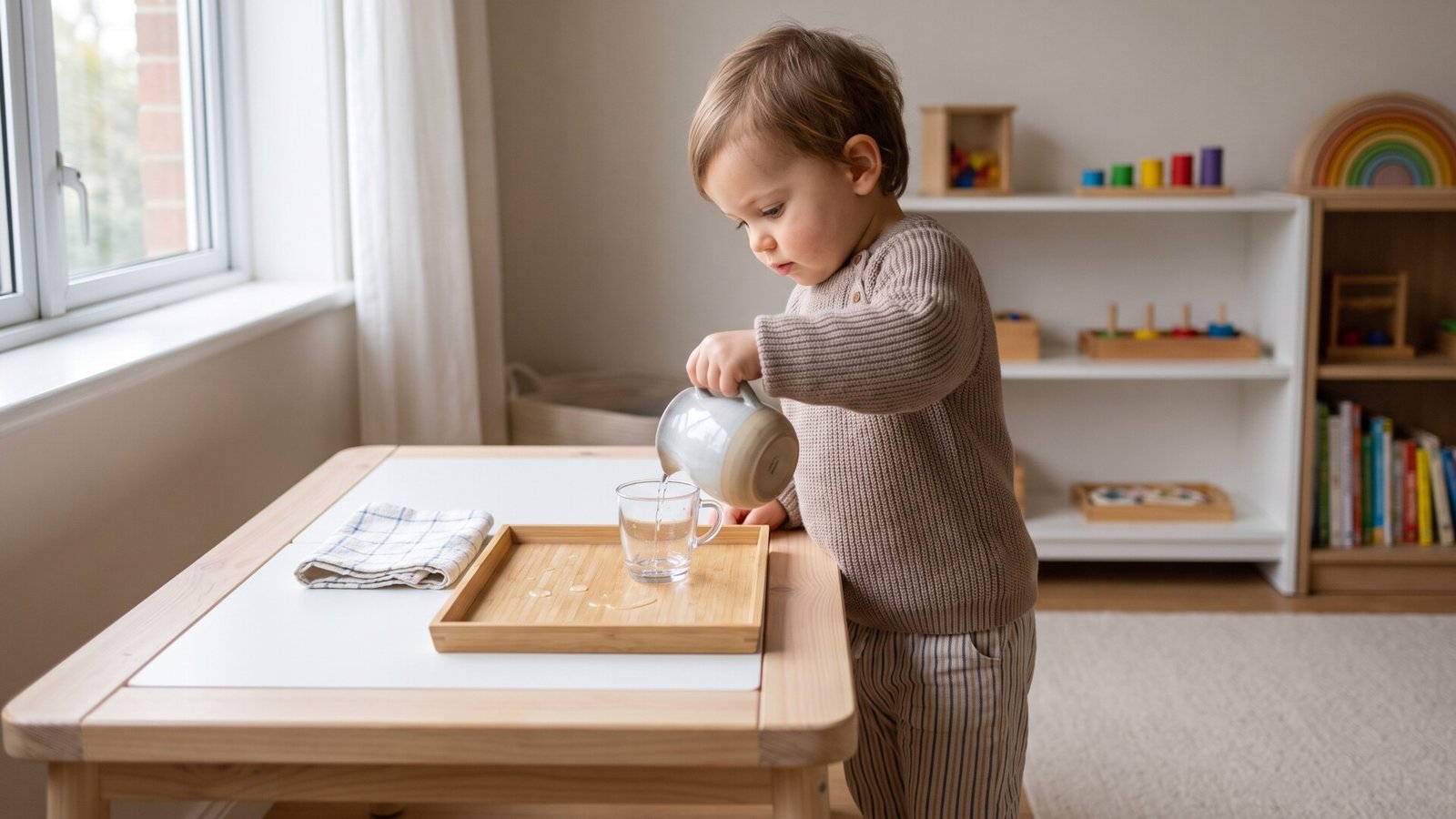
Once dry transfer is reliable, move to pouring between two small pitchers, filling a cup at snack time, scooping food into a bowl, or transferring with a spoon or child-safe tongs. Wide containers, a small amount of material, and a tray underneath make the difference between an activity and a cleanup job. A shallow tray with a lip catches most of it.
Two things to hold onto here. First, avoid anything small enough to be a choking hazard – this is the category where that risk lives, and it applies to food as much as to objects. Second, supervise all of it, including the food-based versions. A 2-year-old with a bowl of dried beans is a 2-year-old who will eventually test whether they are edible.
Washing and Cleaning
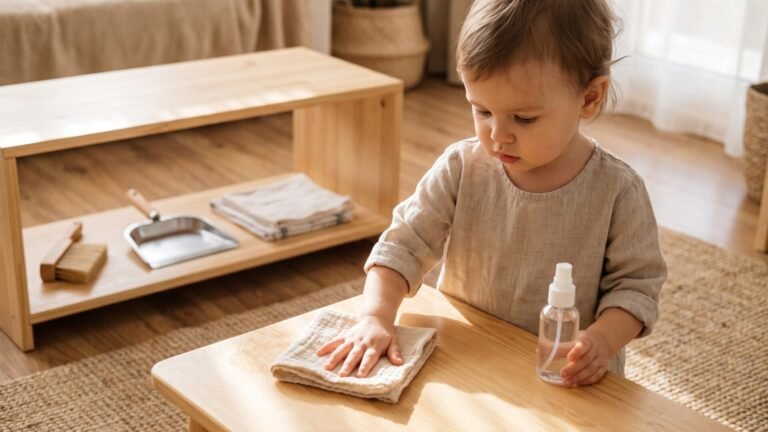
Cleaning tasks work better than almost anything else at this age because the result is visible. The table was sticky, now it is not. The crumbs were on the floor, now they are in the dustpan. A 2-year-old can see that they changed something, which is exactly the feedback loop that keeps them coming back.
Good candidates: wiping a table, washing a plastic toy in a bowl, scrubbing a washable surface, sweeping crumbs, carrying a small dustpan, dropping laundry into a basket. Set up one cloth, one small container, a limited amount of water, and a defined work area. A spray bottle is tempting and usually ends badly – the child sprays the wall, the dog, and their own face.
Child-sized tools are worth buying only when they genuinely function. A small broom that actually moves crumbs is useful. A miniature mop with a foam head that smears water around is a prop. Oversized novelty cleaning sets create frustration and take up the same closet space as the real thing.
Food Preparation
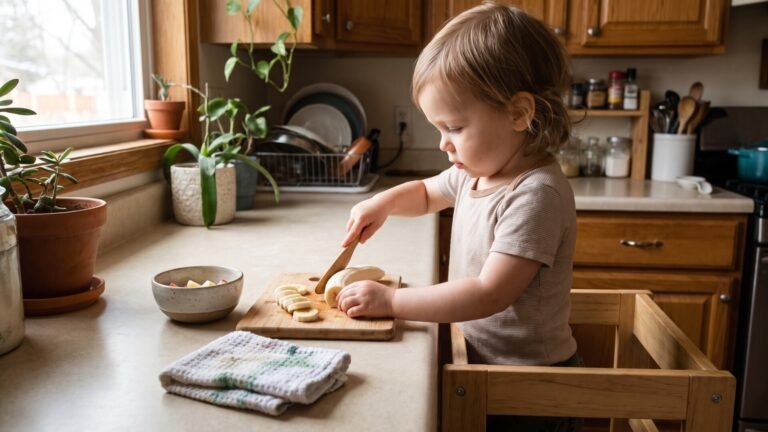
Kitchen work is the highest-value practical life category and the one that requires the most from you. Spreading soft cheese or jam on a cracker, washing produce, peeling a banana, tearing lettuce, stirring batter, moving cut fruit from a board to a bowl, carrying a lightweight cup to the table – all of these are real contributions to a real meal.
The skill is dividing your task into steps a 2-year-old can complete. You cut the fruit; they transfer it. You hold the bowl; they stir. You peel the banana halfway; they finish it. Giving a child an entire task that is beyond them produces tears, and giving them a fake version produces boredom.
Knives, hot surfaces, appliances, and anything that could choke require close adult supervision and should be excluded unless the manufacturer and you both consider them appropriate for your child. For more on this category, see Montessori Kitchen Helpers / Learning Towers for 2-Year-Olds and Montessori Kitchen Activities for Toddlers.
Dressing and Self-Care
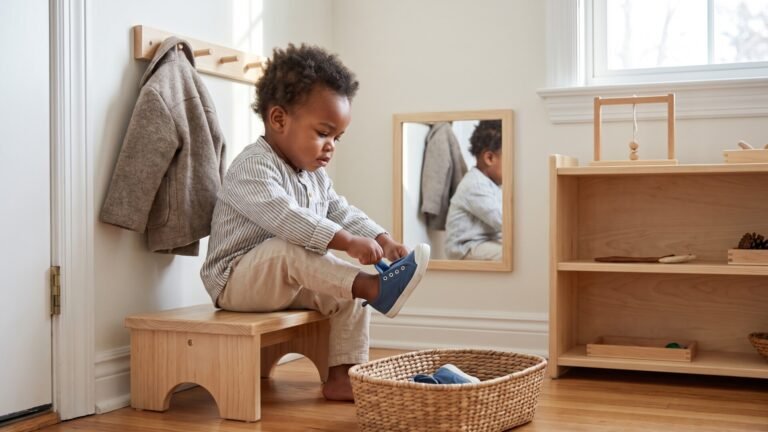
Hand washing, brushing teeth with your help, putting shoes in their spot, pulling up simple elastic-waist clothing, dropping dirty clothes in the hamper, using a tissue. None of it is exciting. All of it is the foundation of a child who can eventually manage themselves.
Dressing frames – the wooden frames with buttons, zips, and laces – are optional. They are lovely objects and some children enjoy them, but real clothing usually provides better transfer because it is the thing they actually need to learn. A frame teaches the motion; a jacket teaches the motion and the reason. If you have a child who responds well to focused practice, a frame is a reasonable addition. If not, skip it. Montessori Dressing and Self-Care Activities covers this in more depth.
The goal is participation and gradual progress, not a 2-year-old completing every step alone. You are still doing most of it. You are just doing it with them rather than to them.
Caring for Plants, Pets, and Belongings
Watering a plant with a small container, carrying a soft pet brush while you supervise, returning books to a shelf, putting toys into labeled or clear storage, setting napkins on the table. These build responsibility without handing a 2-year-old anything safety-critical.
The line to hold: family participation, not chores. A 2-year-old can water a plant. A 2-year-old cannot be responsible for whether the plant survives, and should not be given a task that fails dangerously if they forget it. Feeding a pet is fine with you standing there; it is not fine as their job.
Start with one predictable daily responsibility rather than a chore chart. One thing, done at the same time each day, is worth more than six things done sporadically.
How to Set Up Practical Life Activities Without Creating a Mess
The setup is most of the work, and it is where a little money genuinely helps. Low shelves, trays, baskets, child-height hooks, and a stable stool all reduce how much you have to intervene, which is the entire point.
Use the one task, one outcome rule. A 2-year-old should be able to look at the setup and know what to do, and see when it is finished. A tray with a bowl of pasta and an empty bowl says “move this to there.” A shelf with eleven activities says nothing.
When you demonstrate, move slowly, use few words, and do not correct every movement. Show the pour once, then hand it over. If your child loses interest, put it away and offer it again in a few days. Repeated correction teaches a child that the activity belongs to you.
For small homes, rotate. Keep three or four activities accessible and store the rest. Wet activities belong near a sink or on a washable surface, not on a rug, and not on the good table. A cheap plastic mat under the work area will save you more time than any product in this article.
Buying Factors: When Dedicated Montessori Materials Are Worth It
Dedicated materials earn their cost in four specific ways. If a product does not do one of these, you can probably skip it.
Fit and control. Small pitchers, lightweight brooms, child-sized tongs, stable stools, and easy-grip brushes make independence realistic. A 2-year-old cannot pour from a gallon jug, and a full-size broom is a toy they will abandon. This is the strongest argument for buying.
Safety and construction. Check stability, smooth edges, and whether the manufacturer states non-toxic materials. Washable components matter more than you think – anything in this category will be licked, dropped, and left wet. Avoid anything with loose parts unsuitable for a 2-year-old.
Durability and replacement cost. Solid wood and sturdy plastic survive years of this. Thin novelty sets crack, warp, or get outgrown in a season, and then you buy again. Paying more for something that lasts is genuinely cheaper here.
Storage and frequency of use. Buy for activities your family will repeat several times a week, not for a shelf that photographs well. If you cannot picture using it on a Tuesday, it is decor.
Practical Life Products Worth Considering
These are tools for a purpose, not a required set. Most families need one or two of them at most.
Melissa & Doug Wooden Household Chores Set
| Feature | Details |
|---|---|
| Age Range | Marketed for young children; verify current manufacturer guidance |
| Key Features | Pretend cleaning tools, child-sized role-play setup |
| Price (approx) | Usually around $30-$50 |
| Noise | Silent |
| Lost by March | Several small pieces |
The verdict: A useful bridge between pretend play and real participation, particularly for children who copy adults constantly. It is worth more when you pair it with actual wiping, sweeping, or sorting than when it lives on a playroom shelf.
Best for: Children who imitate household routines, and families who want an approachable starter set.
Pros: Encourages role-play and imitation. Gives cleaning a visible place in play. Cheaper than assembling the same number of separate tools.
Cons: Some pieces are more pretend than functional. It takes up real storage space. It will not replace a working broom and cloth.
[Affiliate: Check current pricing on the Melissa & Doug chores set]
Little Partners Learning Tower
| Feature | Details |
|---|---|
| Age Range | Designed for young children; verify current height, weight, and safety guidance |
| Key Features | Stable raised platform for supervised kitchen participation |
| Price (approx) | Often around $150-$250 |
| Noise | Silent |
| Floor space | Significant |
The verdict: This is the highest-impact purchase in the category, because it changes what your child can safely reach and see. It is also the one most often bought and then not used. It is worth it only if your family genuinely wants the child at counter height several times a week and you have somewhere to keep it.
Best for: Families who cook often and want the child involved rather than nearby.
Pros: Supports real participation. Stays useful past age 2. Encourages observation and shared routine.
Cons: Expensive. Needs careful placement and constant supervision. Eats floor space in a small kitchen.
[Affiliate: Check the current Little Partners learning tower listing]
Learning Resources Helping Hands Fine Motor Tool Set
| Feature | Details |
|---|---|
| Age Range | Check the current manufacturer recommendation; supervise closely |
| Key Features | Child-sized tongs, tweezers, scoops, transfer tools |
| Price (approx) | Usually around $15-$30 |
| Noise | Silent |
| Storage | A drawer |
The verdict: A practical, cheap way to add grip practice to transferring, sorting, and simple food work. The value depends entirely on what you put in front of it – large, safe materials, short sessions, a real purpose. Turn it into a worksheet and your child will be done in a week.
Best for: Fine-motor practice and low-cost tabletop transfers.
Pros: Covers several activity types. Compact and affordable. Works with bowls and trays you already own.
Cons: Some tools are too difficult for younger 2-year-olds. Small parts need supervision. Plastic will not survive everything.
[Affiliate: Check the Helping Hands tool set on Amazon]
Hape Cleaning Set
| Feature | Details |
|---|---|
| Age Range | Commonly intended for young children; verify current guidance |
| Key Features | Child-sized broom, dustpan, mop, or related accessories |
| Price (approx) | Usually around $25-$45 |
| Noise | Silent |
| Actually works? | Depends on the tool |
The verdict: Reasonable for a child who keeps asking to sweep. The only test that matters is whether the tools pick up crumbs or move water on your floors. If they do not, a household dustpan and cloth is better value.
Best for: Toddlers who repeatedly reach for the broom.
Pros: Makes real cleaning accessible. Encourages movement and coordination. Fits a predictable routine.
Cons: Performance varies by tool and surface. Some sets are bought for looks. Adds clutter if cleaning is not a genuine interest.
[Affiliate: Check the Hape cleaning set pricing]
Smiling Tree Toys Wooden Sorting and Transfer Tray
| Feature | Details |
|---|---|
| Age Range | Choose versions suited to your child’s current abilities |
| Key Features | Wooden tray or materials for sorting and controlled transfer |
| Price (approx) | Often around $25-$60 depending on the set |
| Noise | Silent |
| Lost by March | Small components |
The verdict: A specialist wooden option for families who prefer natural materials and a curated shelf. It is most useful when the tray supports a real action – transferring, sorting – rather than becoming another thing you have to reset.
Best for: Compact, attractive tabletop work in a minimalist setup.
Pros: Easy to present on a shelf. Supports repeated hand practice. Fits a Montessori-style room.
Cons: Costs more than the homemade equivalent. Age fit depends on contents. Small pieces vanish.
[Affiliate: Check Smiling Tree Toys options]
Open-Ended Household Starter Kit
| Feature | Details |
|---|---|
| Age Range | Adaptable for 2-year-olds with supervision |
| Key Features | Small tray, cloth, bowl, child-sized cup, spoon, brush, basket |
| Price (approx) | Around $10-$40 using what you own |
| Noise | Silent |
| Storage | Whatever you already have |
The verdict: Usually the best value in the entire category. It covers pouring, wiping, transferring, washing, and tidying without committing to a branded set. Buy dedicated tools only after your child has shown sustained interest in one specific routine.
Best for: Budget-conscious families, small homes, and anyone testing whether practical life sticks.
Pros: Cheapest and easiest to customize. Uses items with real household relevance. Creates less toy clutter.
Cons: You do the setup. Household items may not fit small hands. Breakables and hazards must be removed.
[Affiliate: Browse household starter items on Amazon]
Comparison Table
| Option | Approx. Price | Best Use | Space Needed | Long-Term Value | Best For |
|---|---|---|---|---|---|
| Household starter kit | $10-$40 | Pouring, wiping, transferring | Low | High | Best budget choice |
| Helping Hands tool set | $15-$30 | Fine-motor transfers | Low | Medium | Tabletop activities |
| Hape Cleaning Set | $25-$45 | Sweeping and cleaning | Medium | Medium | Cleaning-focused toddlers |
| Melissa & Doug Chores Set | $30-$50 | Imitation and pretend play | Medium | Medium | Role-play learners |
| Smiling Tree Toys tray | $25-$60 | Sorting, controlled transfer | Low | Medium | Minimalist shelves |
| Little Partners Learning Tower | $150-$250 | Kitchen participation | High | High if used often | Frequent kitchen helpers |
What Most Parents Get Wrong About Practical Life at Age 2
The most common mistake is buying the shelf before the routine. A row of beautiful trays looks like Montessori, but it replaces household participation with staged activities. Your child ends up doing transfer exercises in a corner instead of carrying a napkin to the table, and the transfer exercise is the weaker version of the same skill.
The second mistake is treating completion as the measure. A 2-year-old who spreads half the cheese on the cracker and half on their hand has still done the activity. Partial participation builds familiarity and coordination. If you wait for a clean result before counting it, you will quit before your child does.
The third is a misreading of independence. Independence at 2 does not mean unsupervised. You still manage the risk, the materials, the timing, and the cleanup. The child manages the task. Those are different jobs and both are necessary.
The activities that stick are the ones with a natural place in the day. Wiping an actual spill, washing actual fruit, carrying an actual napkin. A tray that only comes out when you remember it is competing with everything else in the house, and it will lose.
Which Activities Still Make Sense After Six Months?
ToyGuideHub Replayability Analysis
The question that decides whether any of this was worth buying is not “did my child enjoy it” but “is it still in rotation next spring.” For practical life, the answer splits cleanly along one line: does the activity solve a problem the child recognizes?
Real household tasks win this by a wide margin. Wiping a spill, washing fruit, carrying a cup, putting shoes away – these recur on their own. The child does not need you to set them up, because the day sets them up. That built-in repetition is why a $4 cloth and a $6 dustpan routinely outlast a $60 activity set. They are not better materials. They are attached to a real moment.
Open-ended tools hold up well too, because they do not depend on a single activity. A set of child-sized tongs works for transferring pasta, sorting fruit, moving ice cubes, and picking up blocks. The tool stays relevant as the child’s abilities change, which is the definition of long-term value.
Pretend cleaning sets have a shorter arc. They tend to peak in the first month, when the imitation drive is strongest, and then fade as the child realizes the real broom is right there and does the job better. That does not make them worthless – a child who plays with a pretend mop for three weeks and then graduates to the real one has used it correctly. But do not expect it to be the thing they reach for in month six.
Transfer trays are the most variable. A tray that supports a clear action – move this here – can last months. A tray that requires you to reset it, refill it, and present it every time will get used three times and then live on the shelf. The reset burden is what kills these, not the child’s interest.
Learning towers are the exception that justifies the price. If your family cooks most nights and the child is at the counter several times a week, a tower’s cost per use drops fast. A $200 tower used four times a week for two years is a few cents per use. The same tower used twice a month is an expensive piece of furniture. The product is fine. The question is whether your kitchen actually works that way.
Run the same math on anything else here. A $20 tool used twice a week for six months is roughly 40 cents per use. A $60 set used three times is $20 per use. That is not a precise measurement – it is the shape of the decision, and it usually points the same direction: fewer things, used more often.
What kills replayability, in order: too many pieces, difficult cleanup, adult-heavy setup, materials the child outgrows quickly, and activities with no visible result. Every one of those is a setup problem, not a child problem.
So start with three activities, not ten. One daily-care task (hand washing, shoes away). One tabletop task (transferring, pouring). One movement task (carrying, sweeping, wiping). Run those for a month and see which ones your child returns to on their own. Buy more only for the ones that survive.
How to Choose the Right Setup for Your Child
Best for Small Spaces
A tray, a cloth, a small bowl, a child-sized cup, and one transfer tool. Favor activities that pack away after use – nothing here needs a permanent shelf. The household starter kit is the whole answer for most apartments.
Best Budget Pick
The open-ended household starter kit, full stop. Add one inexpensive tool set only if your child genuinely struggles with ordinary utensils. The Helping Hands set is the usual choice at around $15-$30.
Best for Kitchen Participation
A stable learning tower, but only with a safe location, close supervision, and an honest expectation of frequent use. If any of those three is missing, do floor-level food preparation instead. A child at a low table tearing lettuce is getting most of the benefit for none of the cost.
Best for Cleaning Enthusiasts
One usable child-sized broom, dustpan, brush, or cloth. Not a decorative multi-piece set. Test it on your actual floors before you commit – if it does not pick up crumbs, it is a prop.
Best for Fine-Motor Practice
Simple spoon transfers, large-item sorting, and appropriately sized tongs. Purpose matters more than difficulty. A child moving pasta from one bowl to another is doing more for their hands than a child struggling through a graded exercise.
Best for Montessori Homes
A small rotation of real household tools, low storage, and predictable routines. Dedicated wooden materials are optional. If you want them, buy one or two good ones rather than a full shelf.
Safety and Parent Guidance
Every activity here involves water, food, tools, pets, stools, or loose pieces, and all of them require active adult judgment and supervision. That is not a disclaimer, it is the operating condition.
Follow the manufacturer’s age, weight, and safety instructions for learning towers and activity sets. A tower is not a containment device and should never be treated as one. On choking prevention: avoid small objects and food items that are unsafe for your child’s developmental stage, and keep loose materials out of reach when the activity is not supervised. This applies to dried beans, pasta, and small wooden pieces as much as to anything else.
Practical safeguards that cover most of it: non-slip surfaces, small amounts of water, unbreakable containers, no hot liquids, no sharp tools, and immediate cleanup of spills. Keep the work area near a sink or on a washable surface.
Stop when your child is tired, frustrated, or putting materials in their mouth. Adjust, simplify, or pause the activity rather than pushing through. If you are unsure whether something is appropriate for your child, check the manufacturer’s guidance and use your own judgment about your child specifically.
Conclusion
Start with what you own. A tray, a cloth, a small bowl, a cup, a spoon, and a basket cover pouring, wiping, transferring, washing, and tidying – which is most of practical life at this age. Add dedicated tools only when they remove a genuine barrier: the pitcher is too heavy, the broom is too tall, the stool is unstable. That is the whole buying rule, and it will save you more money than any roundup.
If you do buy, here is where the money is best spent. Best overall: the open-ended household starter kit, for value, flexibility, and real-life relevance. Best budget: the Learning Resources Helping Hands Fine Motor Tool Set, paired with safe large materials. Best premium: the Little Partners Learning Tower, for families who will genuinely use it in the kitchen several times a week. Best for cleaning: the Hape Cleaning Set, if the tools actually work on your floors and your child is motivated. Best for Montessori-style presentation: the Smiling Tree Toys wooden sorting or transfer tray, used sparingly alongside real household tasks.
The one thing worth carrying into the shop: the best practical life activity is the one your child can repeat safely and you can maintain without resenting the setup. Everything else is a shelf. Check current pricing and availability through our recommended partners, and compare each product’s current age and safety guidance before choosing.
Frequently Asked Questions About Practical Life Activities For 2-Year-Olds
Are practical life activities appropriate for every 2-year-old?
The category adapts to different abilities and interests. Start with simple participation – carrying, wiping, placing, stirring – and build from there. Do not treat independence milestones as a competition between children, because they vary widely at this age.
How long should a practical life activity last?
A few focused minutes can be enough. Repetition across days and weeks matters far more than the length of any single session. If your child is done in three minutes, they are done.
Do I need Montessori toys for practical life activities?
No. Household tools often provide the strongest connection to real life. Dedicated products help with fit, stability, presentation, or repeated use – and only when they do one of those things.
Is a learning tower safe for a 2-year-old?
Safety depends on the specific model, correct assembly, your child’s size and abilities, and active adult supervision. Follow the manufacturer’s instructions and never treat a tower as a containment device or a substitute for watching your child.
What are the easiest practical life activities to start with?
Wiping a table, putting laundry in a basket, transferring large objects, washing produce with help, putting toys away, and carrying a napkin or a lightweight cup. All of these use things you already own.
How do I know whether a practical life toy is worth buying?
Ask four questions. Can my child use it safely? Does it support a task we repeat? Is the cleanup manageable? Could something I already own do the same job? If the answers point away from buying, do not buy.
Should a 2-year-old do chores independently?
The goal is shared participation, not unsupervised responsibility. Adults handle hazards, demonstrate the task, and gradually step back as the child gains ability. A 2-year-old is never running a chore alone.