Best Practical Life Activities for Toddlers
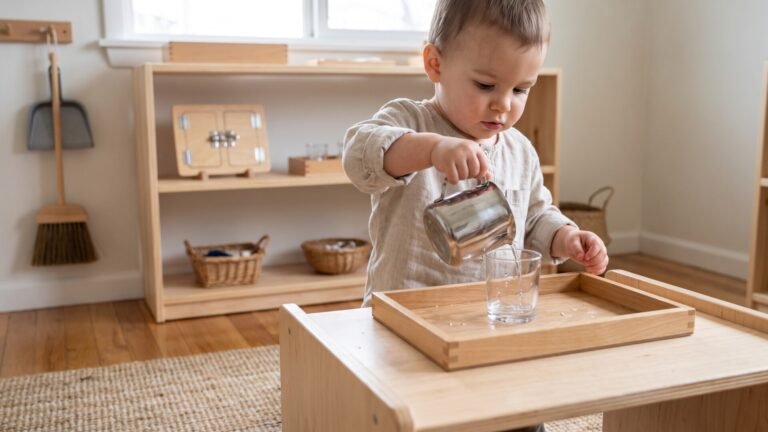
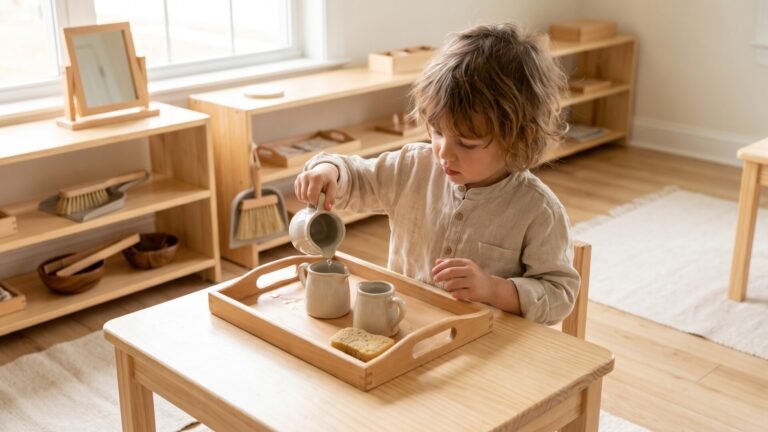
Most parents come to practical life activities through a photo. A toddler in a linen apron, pouring dried beans from one ceramic pitcher to another, on a wooden tray, in a room with no visible plastic. It looks calm and intentional and expensive.
Here is the correction. The pouring is not the point, and the pitcher is not the point. What makes practical life work is repetition of a real, manageable task that your child can start, struggle with briefly, and finish without you taking over. A toddler who wipes the same table every day for a month learns more than one who gets a new themed tray every week. The equipment is optional. The routine is not.
The best practical life activities for toddlers are transferring, washing, wiping, simple food preparation, dressing practice, tidying, and small care tasks – matched to whatever your child can currently do with effort. You can start today with two bowls and a spoon. You can also spend $300 on a learning tower, and that is fine, as long as you know which of those two purchases is doing the work.
Practical life activities give toddlers opportunities to practice real-world skills such as pouring, transferring, cleaning, dressing, and helping around the home. These activities work especially well alongside Montessori practical life materials, so for a complete overview of the toys and activities that support independence, explore our Montessori Practical Life Toys: Complete Guide.
Why Practical Life Activities Matter for Toddlers
Practical tasks ask a toddler to do several things at once: hold something steady, follow a sequence, remember where it goes, and finish. That is coordination, sequencing, and concentration, practiced in the kitchen rather than on a worksheet.
The language is a real benefit too. “Pour,” “empty,” “wipe,” “fold,” “carry,” “careful” arrive attached to an action your child is performing, which is how words stick. A child who has rinsed a hundred grapes knows what rinse means.
What you should not expect is a guaranteed developmental outcome. Plenty of toys and programs market themselves as building focus or fine motor skills, and the honest position is that ordinary tasks give children good practice at ordinary things. That is enough. You do not need a study to justify letting your two-year-old put the shoes in the basket.
Independence means participating, not completing
The word gets used as if the goal is a toddler who does everything alone. It is not. Independence at this age means your child does the part they can do, in the order it happens, with you nearby rather than in charge.
A two-year-old carrying a napkin to the table is participating. A two-year-old “setting the table” while you hover and correct every placement is not learning much except that they are doing it wrong. Pick the version where they can succeed.
Repetition beats novelty
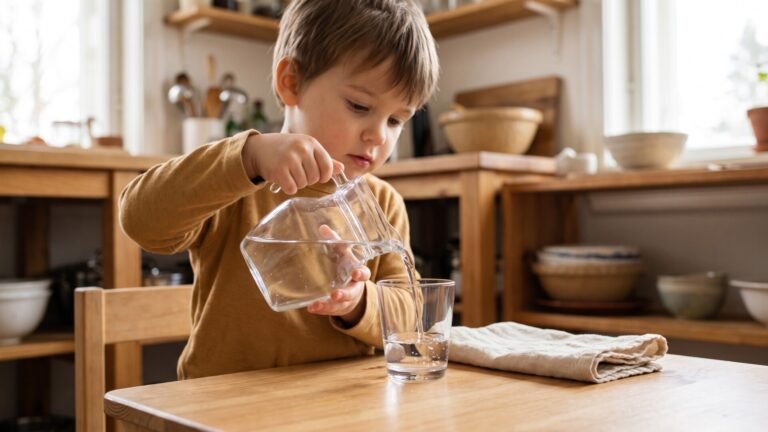
Toddlers will pour the same water into the same cup fifteen times. This is not a failure of imagination. It is how the skill gets built, and it is why a shelf full of rotating activity trays can actually reduce practice.
If your child returns to one task for a week, that is the system working. Resist the urge to introduce something new because you are bored. You are allowed to be bored. They are not.
Practical guidance for the parent standing there
Offer two choices, not five. Demonstrate slowly and without narration – a running commentary gives them too much to track. Then step back and let the task take the time it takes.
The hardest part is not rescuing. When the water goes on the floor, the instinct is to grab the pitcher. Give it three seconds. Often they will correct it themselves, and that correction is the entire lesson.
How to Choose Activities That Toddlers Will Actually Use
The activity that gets used is the one your child can almost do. Not the one they can already do easily, which gets abandoned, and not the one that requires four separate hard steps, which ends in tears and a parent finishing it.
Match the task to readiness, not the calendar
Age ranges on product pages are a starting point, not a schedule. What matters more is whether your child can stand steadily, grip a handle, follow a two-step instruction, and stop when you say stop.
If your child cannot yet stop on command, they are not ready for a task involving water, small parts, or anything breakable. That is not a developmental verdict. It is a supervision calculation, and it changes month to month.
Use the one-small-challenge rule
An activity should contain exactly one thing that is hard. Pouring water is hard. Pouring water from a heavy pitcher into a narrow-necked bottle while standing on a stool is three hard things, and it will fail.
Start with a wide container, a small amount of material, and a stable surface at the child’s chest height. Add difficulty only when the current version has become boring.
Design for low parent hassle
This is where most beautiful setups fall apart. If the tray is heavy, the child cannot carry it. If the cloths are in a high cupboard, you have to fetch them every time, and you will stop.
Keep materials where the child can reach them, keep quantities small, and keep the whole setup to something you can reset in under a minute. A practical life activity that takes you five minutes to prepare will not survive a Tuesday.
Buy tools selectively
Most of what you need is already in a kitchen drawer. Buy when a product solves a specific problem: your child cannot reach the sink safely, the broom is too tall to be useful, or the storage situation is genuinely chaos.
Do not buy because a kit looks complete. A kit with twenty pieces where your child uses three has made your life harder, not easier.
Best Practical Life Activities for Toddlers
These run roughly from simplest to most equipment-dependent. You do not need all of them. Pick the one your child is already trying to do – usually the thing you keep taking away from them.
Pouring, scooping, and transferring
Start with hand transfer: large pom-poms, chunky wooden pieces, or big felt balls moved from one bowl to another. For a child still mouthing objects, use items too large to fit fully in the mouth and stay within arm’s reach the whole time.
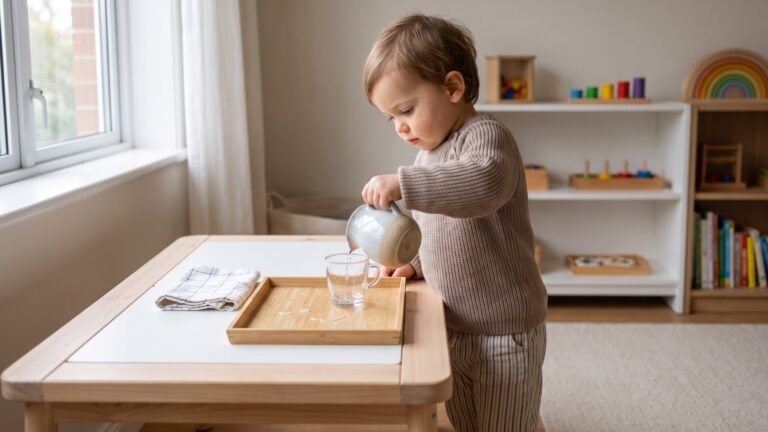
Then move to a spoon, then a scoop, then tongs, then a small pitcher with water. This progression can take a year and does not need to be rushed. A small tray, two sturdy bowls, and a short-handled spoon will outperform most dedicated activity sets because you can refill and reset them instantly.
Dry beans and small pasta are popular but are a choking hazard for children still putting things in their mouths, and they scatter impressively. If you use them, use them on a tray with a mat underneath and accept that you will be finding them in June.
Skills practiced: grip, hand-eye coordination, wrist control, sequence, cleaning up after yourself.
Readiness signs: can sit at a table without sweeping everything off it, can stop when asked.
Supervision: constant for anything small enough to swallow. Small parts and young toddlers do not mix.
Washing hands, toys, and produce
Washing is the highest-value practical life activity and the cheapest. Handwashing, scrubbing a plastic toy in a basin, and rinsing sturdy fruit all combine a clear sequence with immediate sensory feedback and a visible result.
A stable step stool at the sink is more useful than most activity toys you can buy. If your child cannot safely reach the tap even with a stool, bring the water to the table in a small basin instead. Do not improvise a climbing solution.
Control the mess with a small basin, a limited amount of water, an absorbent mat, and a smock. Two inches of water in a shallow tub is plenty. A full sink is not.
Safety: water should be comfortably warm, never hot. Put a non-slip mat under the basin, mop up spills immediately, and never leave a toddler alone near water, even shallow water, even for a moment.
Simple food preparation
Spreading soft cheese on a cracker, tearing lettuce, stirring batter, washing fruit, and moving ingredients from a bowl to a pan are all real contributions. They also happen to be the tasks toddlers ask for most.
A small cutting board, a toddler apron, a mixing bowl, and a blunt child-safe utensil cover almost everything. You do not need a multi-piece cooking kit. You need the child standing at a height where they can actually work, which is where a learning tower or helper stool earns its place – see our guide to Montessori Kitchen Helpers and Learning Towers for 2-Year-Olds.
Keep the toddler’s part short and let adults handle heat, sharp blades, and appliances. A recipe with six steps will end in frustration. A recipe where the child does one step and then eats the result works.
For more on this, our Montessori Kitchen Activities for Toddlers covers the full range of what is realistic at the counter.
Dressing and self-care
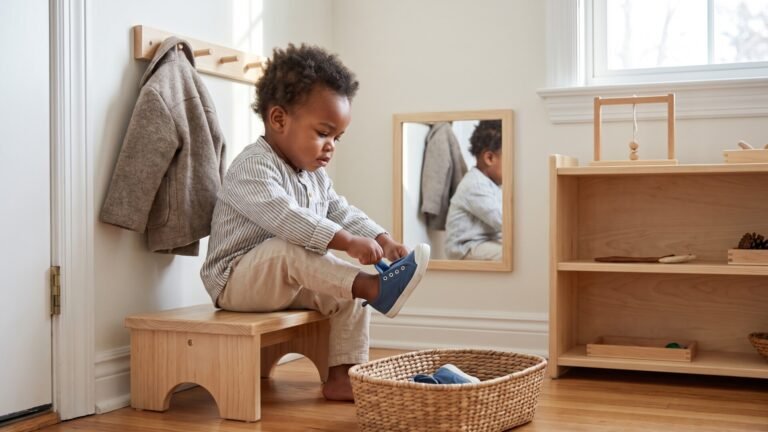
Putting on loose shoes, pulling off socks, dropping clothes in a hamper, practicing a large zipper, wiping a face, and choosing between two shirts are all practical life work.
The single biggest factor is whether the clothing is accessible and uncomplicated. A low hook, a small basket, and clothes without fiddly fasteners will do more than any dressing frame. Dressing frames are useful if your child genuinely enjoys repeating the motion, and useless if they do not.
Timing matters more than technique. Dressing practice works when nobody is late. If you are trying to get out the door, do it yourself and practice later. Our Montessori Dressing and Self-Care Activities guide goes deeper on this.
Cleaning and tidying
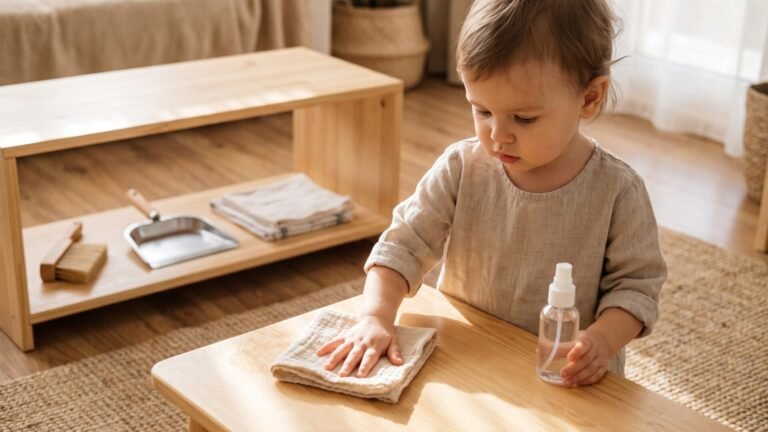
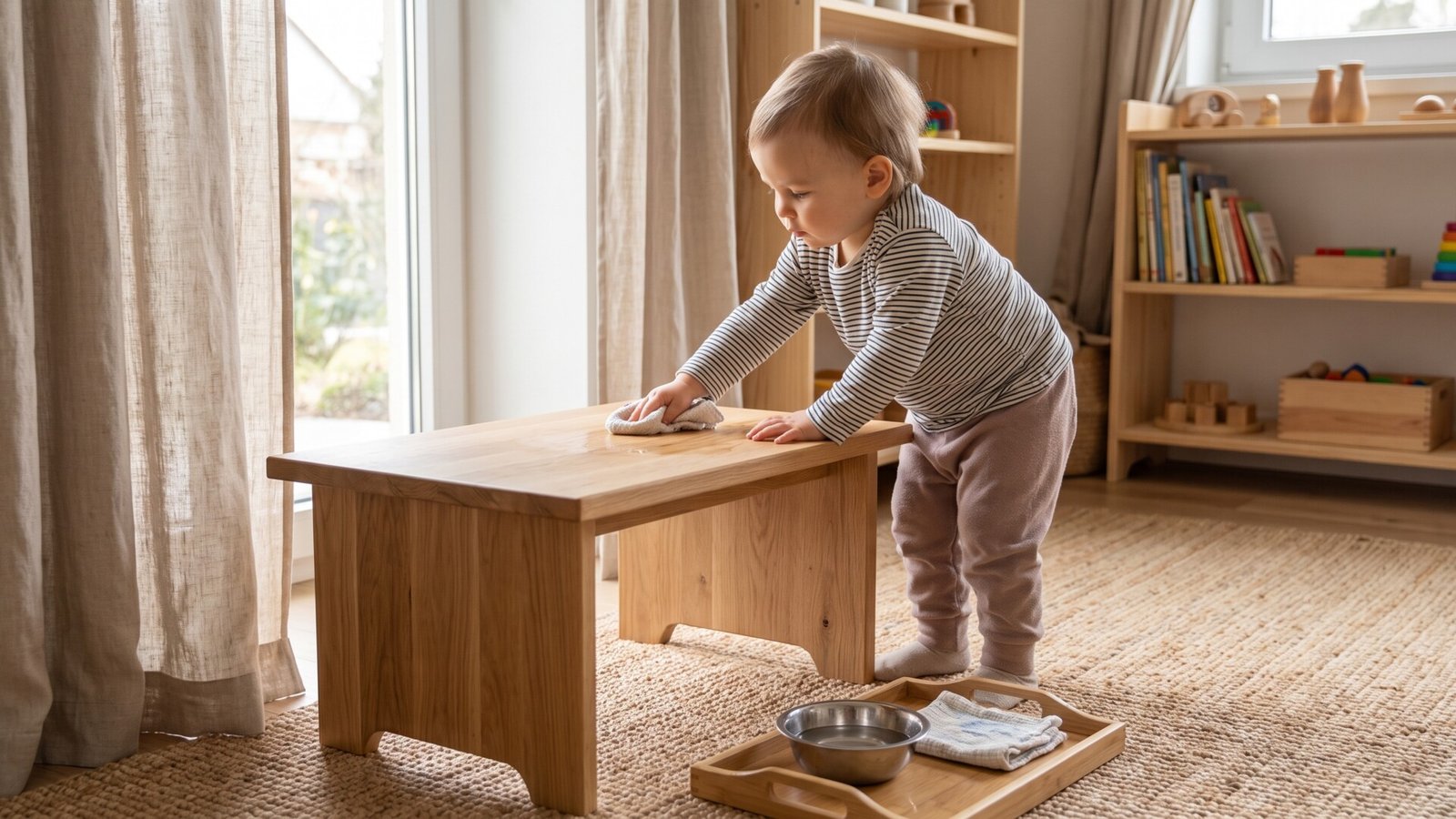
Wiping a spill, sweeping crumbs, dusting a low shelf, returning books, and sorting laundry are the activities most likely to still be happening in a year, because they never stop being needed.
Child-sized tools increase participation, but judge them on grip, weight, and stability rather than how cute they are. A miniature broom that is too light to move crumbs is a prop. A small dustpan and brush that actually work is a tool.
Keep a washable cloth and a small dustpan where your child can reach them, and a clearly defined place for toys to go back to. “Put it away” fails when there is no obvious away. Our Montessori Cleaning Activities for Young Children covers the setup in detail.
Caring for plants, pets, and belongings
Watering a small plant with a controlled amount of water, placing napkins on the table, carrying something lightweight, and putting shoes or a backpack in their spot all connect an action to a consequence your child can see.
Pet care stays an adult responsibility. A toddler can carry an empty scoop or place a toy near the dog. They cannot be responsible for anything safety-critical, and they should not be given that impression.
A small watering can, a tray, or a labeled place for personal items is worth buying only when it solves a real access problem. Otherwise a cup and a shelf will do.
Product Shortlist: Tools That Make Practical Life Easier
The activity matters more than the brand. Buy the smallest thing that removes a genuine obstacle, and skip the rest. Prices below are approximate and move around.
Little Partners Learn ‘N Climb Adjustable Learning Tower
| Feature | Details |
|---|---|
| Age Range | Follow manufacturer guidance; generally for toddlers who stand steadily, with close supervision |
| Key Features | Adjustable standing platform, brings child to counter height, enclosed structure |
| Price (approx) | $200-$300 |
The verdict: A learning tower makes supervised kitchen participation genuinely easier by putting your child at working height instead of at your hip. It also eats a significant amount of floor space and does not remove any of the safety risk – it just changes the geometry.
Best for: Families who cook most days and have somewhere to store it that is not the middle of the kitchen.
Pros: Real access to real tasks; adjustable across several stages; holds value reasonably well secondhand.
Cons: Expensive; bulky; heavy to move; you still have to watch them the entire time.
[Affiliate: Check current pricing and availability through our recommended partners]
Guidecraft Kitchen Helper Stool
| Feature | Details |
|---|---|
| Age Range | Check current manufacturer guidance; use only when the child can stand securely |
| Key Features | Enclosed standing design, counter access, supportive sides |
| Price (approx) | $150-$250 |
The verdict: A mid-range alternative for parents who want dedicated kitchen access without a full activity station. Compare stability, footprint, and how easy it is to move before you compare anything cosmetic.
Best for: Families who want counter participation and a slightly smaller footprint than a full tower.
Pros: Purpose-built for kitchen work; often more compact; solid construction.
Cons: Still needs constant supervision; storage is awkward; features vary by model, so check the current version.
[Affiliate: Check current pricing and availability through our recommended partners]
Melissa & Doug Cleaning Set
| Feature | Details |
|---|---|
| Age Range | Commonly marketed for young children; verify current age guidance |
| Key Features | Child-sized cleaning tools, storage stand, role-play format |
| Price (approx) | $30-$50 |
The verdict: Worth it if your toddler is motivated by having their own recognizable set of tools. Not worth it if what you actually need is a cloth and a dustpan, which cost almost nothing and work better.
Best for: Toddlers who already copy you while you sweep.
Pros: Encourages participation; slots into existing routines; gives the tools a home.
Cons: More expensive than household substitutes; some children lose interest once the novelty passes; check the tools for stability and small parts.
[Affiliate: Check current pricing and availability through our recommended partners]
Lovevery The Helper Play Kit
| Feature | Details |
|---|---|
| Age Range | Designed for a specific toddler stage; verify the current range before ordering |
| Key Features | Development-focused materials, manipulation activities, curated presentation |
| Price (approx) | $80-$120 per kit, depending on the current offering |
The verdict: A curated kit removes the work of choosing activities, which is a real benefit for parents who are short on planning time. It is not a substitute for actual household participation, and the cost only makes sense if most of the box gets used.
Best for: Parents who want a guided rotation and will actually run it.
Pros: Reduces decision fatigue; varied hands-on items; good for structured play.
Cons: Premium price; some items will be ignored; encourages buying before you have watched what your child is drawn to.
[Affiliate: Check current pricing and availability through our recommended partners]
Smiling Tree Toys Wooden Practical Life Set
| Feature | Details |
|---|---|
| Age Range | Verify the specific product’s current recommendation |
| Key Features | Wooden construction, simple manipulation or household-task practice, open-ended use |
| Price (approx) | $25-$60 |
The verdict: A simple wooden tool earns its place when it supports one repeated real action – scooping, sorting, transferring, fastening. Judge it on smooth construction and sizing, not on how it looks on a shelf.
Best for: Families who want a low-tech, durable option for focused practice.
Pros: Simple and screen-free; supports repetition; stores easily.
Cons: Suitability varies by product; may duplicate what you already own; wooden parts still need checking for cracks and splinters.
[Affiliate: Check current pricing and availability through our recommended partners]
IKEA FLISAT Children’s Stool or Comparable Stable Step Stool
| Feature | Details |
|---|---|
| Age Range | Use per manufacturer guidance and only with appropriate supervision |
| Key Features | Low-cost access to routines, compact footprint, simple design |
| Price (approx) | $15-$35 |
The verdict: A stable step stool may deliver more practical value than any specialized activity toy, because it unlocks handwashing, counter access, and putting away belongings. It is not a learning tower and should not be used as one.
Best for: Budget-conscious families who want to remove an access problem.
Pros: Cheap; versatile; easy to move and repurpose.
Cons: Far less support than a tower; can tip if poorly positioned; supervision is essential every time.
[Affiliate: Check current pricing and availability through our recommended partners]
What to skip
Skip large practical life kits sold on piece count. Your toddler will use the cup, the spoon, the cloth, and the basket. The other nineteen pieces are your problem now.
Skip fragile decorative tools, tiny accessories, and anything that imitates adult equipment without improving grip, stability, or safety. A miniature version of a thing is not automatically a child’s version of it.
Skip anything with unclear age guidance, unclear materials, or unclear safety instructions. And no activity should ever require independent access to knives, heat, cleaning chemicals, or standing water.
Comparison Table
| Option | Approximate Price | Best Use | Parent Hassle | Space Demand |
|---|---|---|---|---|
| IKEA FLISAT stool or comparable | $15-$35 | Sink access and simple routines | Low to moderate | Low |
| Melissa & Doug Cleaning Set | $30-$50 | Sweeping and tidying practice | Low | Moderate |
| Smiling Tree Toys practical life set | $25-$60 | Focused wooden manipulation tasks | Low | Low |
| Lovevery The Helper Play Kit | $80-$120 | Curated activity rotation | Moderate | Moderate |
| Guidecraft Kitchen Helper Stool | $150-$250 | Supervised kitchen participation | Moderate | Moderate |
| Little Partners Learn ‘N Climb Tower | $200-$300 | Frequent kitchen involvement | Moderate to high | High |
What Most Parents Get Wrong About Practical Life Activities
They mistake presentation for usefulness. A beautiful tray is worthless if your child cannot carry it, does not understand what to do with it, or needs you to correct every step. Presentation is for the parent. Function is for the child.
They introduce too much at once. One or two available activities produce more repetition than a shelf of six. A shelf of six produces more tidying, most of it yours.
They confuse independence with speed. A toddler taking ten minutes to put shoes away is doing the work. A toddler hurried through it by an adult is watching. The ten minutes is the activity.
They buy equipment before identifying the bottleneck. Ask what is actually stopping participation. Is it access, grip, storage, safety, motivation, or your own lack of time? Only one of those is solved by a product, and it is rarely the one people buy for.
If the problem is that your child cannot reach the counter, buy the stool. If the problem is that you do not have twenty minutes at 6pm, no product fixes that, and it is fine to do practical life on the weekends instead.
Which Activities Still Make Sense After Six Months?
This is the ToyGuideHub Longevity Analysis. It is an editorial framework, not a lab result. I am scoring each option on five things: how often it gets used, whether it adapts as your child’s abilities change, how much space it takes up when not in use, how well it survives a toddler, and whether it supports more than one routine.
The pattern is consistent, and it is not the pattern people expect. The cheapest items win.
Cloths, bowls, baskets, a small stool, a child-sized brush, and a short-handled spoon stay useful for years because they are not tied to a stage. A bowl is a bowl when your child is two and when they are five. The task changes; the object does not. These items also cost so little that replacing them is not a decision.
The learning tower sits at the other end. It has a genuinely long useful window – many families get three or four years out of one – but only if two conditions hold. You cook or work at the counter most days, and you have somewhere to put it that is not in the way. If either fails, it becomes a large wooden object you move twice a week and eventually sell. The resale demand is decent, which softens the mistake, but only partly.
The cleaning set is a middle case. It gets heavy use for a few months if your child is in a copying phase, then tapers. The storage stand is the part that keeps it viable, because the tools have a home. Without that, the broom ends up behind the fridge and the set is finished.
Curated kits have the shortest realistic lifespan as a system. Individual pieces from a kit often survive and get used for a long time, but the kit as a rotation usually collapses once the child’s interests become obvious – which takes about six weeks. You are paying for the selection, and selection is the part you can do yourself by watching your child for a fortnight.
Dressing materials are the most variable. A low hook and a basket last indefinitely. Dressing frames get used intensely or not at all, and there is rarely a middle.
The practical verdict: spend first on access and safety, because those are the barriers that stop everything else. Then spend on tools that remove a recurring annoyance – a brush that actually sweeps, a stool that does not wobble. Only after that should you consider themed activity sets. The best purchase is the one that gets used several times a week without creating a new cleanup job. If a product adds cleanup, it will be quietly retired by March.
How to Set Up a Practical Life Routine at Home
Keep it small. One tray or basket, a limited amount of material, and an obvious place for it to go back to. You are not building an activity shelf. You are building two or three things your child can do without asking.
Introduce one task at a time. Demonstrate it slowly, without talking much, and show both the beginning and the end – where the material comes from and where it goes back. The return is half the activity and the half most parents skip.
Use real routines wherever possible. Wipe the actual spill. Carry the actual napkin. Put the actual shoes in the actual basket. Isolated practice on a tray is fine, but it competes with a screen for attention. A real task with a real result does not.
When your child struggles, adjust the environment before you conclude the activity is wrong. Less water. A bigger container. A shorter sequence. A more stable surface. Most “my toddler won’t do this” problems are setup problems.
Choosing the Right Option for Your Family
Best for small spaces
A small basket of household tools, a low stool where it is safe, a cloth, a child-sized brush, and a compact tray. Skip the learning tower and the multi-piece sets unless you will genuinely use them weekly.
Best for kitchen participation
The Little Partners Learn ‘N Climb Adjustable Learning Tower if you have the space and cook often. The Guidecraft Kitchen Helper Stool if you want something more compact at a lower price, subject to current safety guidance.
Best budget pick
An IKEA FLISAT stool or comparable stable step stool, two sturdy bowls, a cloth, a small spoon, and a basket. This combination supports more real routines than most inexpensive novelty kits, and it costs less than one of them.
Best for cleaning and tidying
The Melissa & Doug Cleaning Set when your child wants their own tools. For the lowest-hassle version, start with a washable cloth and a small dustpan and add the set later if the interest holds.
Best for curated activities
Lovevery The Helper Play Kit, if convenience and a guided rotation are worth the premium to you. Confirm the included activities match your child’s current stage before ordering, because the kit is built around a specific window.
Best for Montessori-style homes
Open-ended household tools, child-accessible storage, limited choices, and repeated real tasks. The branded label matters far less than control, order, appropriate challenge, and whether your child can actually do the thing.
Conclusion
If you take one thing from this, take the cheap version first. A stable stool, a basket, a cloth, two bowls, and a short-handled spoon will carry more practical life activity than most of what you can buy, and they will still be in use when your child is five.
The premium purchase that genuinely earns its price is the Little Partners Learn ‘N Climb Adjustable Learning Tower, and only for families who cook and work at the counter often enough to use it several times a week. The Guidecraft Kitchen Helper Stool is the sensible mid-range version of the same idea. The IKEA FLISAT stool or a comparable stable step stool is the budget pick and, for a lot of families, the correct one.
The Melissa & Doug Cleaning Set is worth it for a toddler who wants their own tools, and the Lovevery The Helper Play Kit is worth it if you would rather buy a curated rotation than build one. Neither is necessary.
Practical life is repeated participation in real routines, not a collection of Montessori-branded equipment. You can start this afternoon with what is already in your kitchen, and you would not be doing it wrong.
[Affiliate: Check current pricing and availability through our recommended partners], then choose the smallest setup that removes a real obstacle to your toddler’s participation – and stop there.
Frequently Asked Questions About Practical Life Activities For Toddlers
What are the best practical life activities for toddlers?
Pouring, transferring, washing, wiping, tidying, simple food preparation, dressing practice, and caring for personal belongings. Start with whatever your child is already trying to imitate, and make one step of it manageable.
Are practical life activities safe for a 2-year-old?
They can be appropriate when adapted to your child’s abilities and closely supervised. Keep toddlers away from heat, sharp knives, cleaning chemicals, unsecured furniture, and unsupervised water, and follow the manufacturer’s age and safety instructions for any product.
Do toddlers need Montessori practical life toys?
No. Bowls, cups, cloths, baskets, spoons, and ordinary routines provide plenty of practice. Dedicated products are worth buying when they improve access, stability, sizing, storage, or motivation – not because they carry a Montessori label.
Is a learning tower worth the money?
It can be, for a family that includes a toddler in supervised kitchen tasks most days and has safe storage space. It is a poor purchase if your child rarely works at the counter, or if the tower is awkward to position and monitor.
How long should a toddler practical life activity last?
There is no required duration. A short task repeated often beats a long activity that ends in frustration. Stop or simplify when your child loses control, becomes unsafe, or no longer understands what the goal is.
What should I do if my toddler makes a mess?
Treat the cleanup as part of the activity when it is safe and reasonable. Use small quantities, trays, washable surfaces, and simple tools. Never give a child more material than they can realistically manage, because the cleanup becomes yours and the activity stops being worth it.
How many practical life activities should be available at once?
One to three. More choices reduce repetition and make setup harder for you. A small, consistent selection is easier for a toddler to remember and easier for you to reset.
Do I need a learning tower if I have a step stool?
Only if your child needs full-body support at counter height. A step stool handles sink access and low surfaces. A tower encloses the child so they can work at counter height without you holding them. Different problems, different prices.
At what age should I start?
When your child can stand steadily, follow a simple instruction, and stop when you say stop. That is usually somewhere in the second year, but it varies, and age ranges on product pages are a starting point rather than a schedule.