Montessori Toys for Different Developmental Stages
Six months after you set up the shelf, the expensive wooden thing is still pristine. The $18 shape sorter is missing its triangle. The stacking rings are scattered through three rooms and one couch cushion. And the toy your child actually reaches for every single morning is the cheap one you almost didn’t buy.
That pattern is not random, and it is not your fault. It is what happens when you buy Montessori toys by age label instead of by the child in front of you. The catalog says 3 to 6 years. Your three-year-old cannot yet hold the pencil grip, and your six-year-old solved it in a week. The label was never about your kid.
This guide is about matching the challenge to the child. Not the birthday. Not the wood grain. Not the word “Montessori” printed on the box.
What Makes a Montessori Toy Age-Appropriate?
Montessori-inspired play leans on a few practical ideas: hands-on exploration, real-world skills, sensory discovery, movement, concentration, and solving a problem without an adult hovering. A toy fits that description when a child can pick it up, work at it, and put it back without you running the show.
Age ranges on the box are guidelines, not predictions. A child’s motor skills, attention span, language, and interest matter more than a birthday. Two four-year-olds can be eighteen months apart developmentally and both be perfectly normal.
Here is the part most buying guides skip. A toy does not become Montessori because it is wooden, beige, or sold with the word on the label. A plastic construction set that a child designs and rebuilds can do more developmental work than a decorative wooden object that sits on a shelf looking tasteful. Material and color are not the mechanism. Purposeful play is.
So the framework for this whole article is three questions:
- Does the challenge match what the child can currently do, with a little stretch?
- Does the toy have a purpose the child can pursue independently?
- Will it still be used in six months, or is it a one-week novelty?
Buy for repeated use, not novelty. That single shift saves more money than any sale.
Montessori Toy Priorities by Developmental Stage
Before the specific picks, here is the map. The needs change more than the products do.
| Developmental Stage | Main Play Priorities | What to Look For |
|---|---|---|
| Infants 0-12 months | Movement, grasping, tracking, sensory exploration | Lightweight objects, high contrast, graspable shapes, safe supervised exploration |
| Toddlers 1-3 years | Coordination, practical life, simple matching, cause and effect | Large pieces, simple puzzles, stacking, transferring, dressing and household skills |
| Preschoolers 3-6 years | Concentration, sequencing, language, pretend work, fine motor control | Multi-step activities, realistic tools, classification, counting, open-ended building |
| Early elementary 6-9 years | Reasoning, planning, creativity, real-world problem-solving | Strategy, construction, research, STEM exploration, increasingly complex challenges |
Buying for the next stage too early usually backfires. A toddler handed a preschool puzzle does not rise to the occasion; they get frustrated, dump the pieces, and lose interest in the whole category. You have spent the money and taught the child that this kind of toy is not for them.
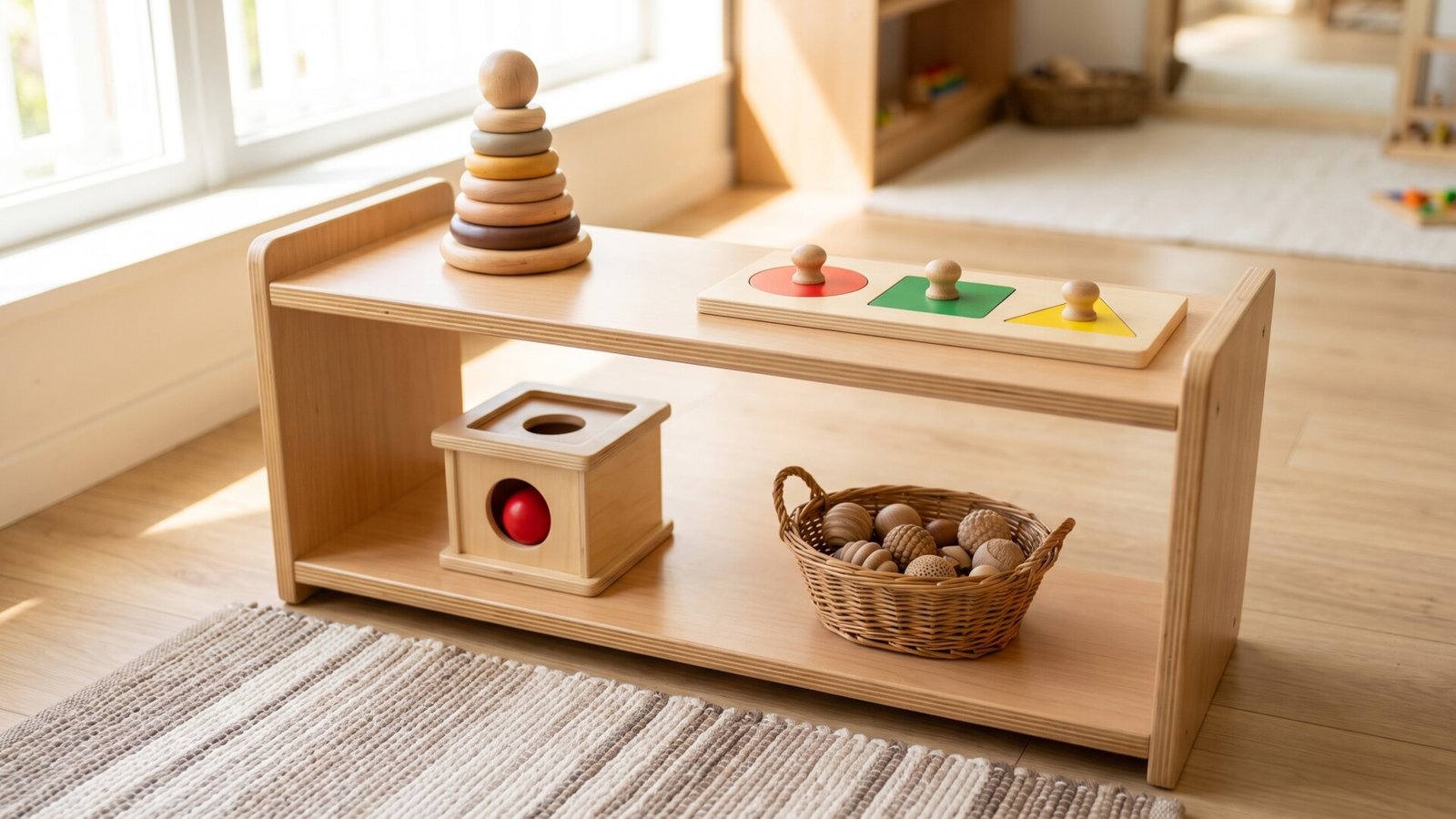
Most families also need fewer toys than they think, arranged in a rotation. The most useful toy is often the one that can be presented simply now and more complexly later. A stacking toy is random handling at fourteen months and deliberate size-ordering at two and a half. Same object, two different developmental jobs.
For the full age-specific breakdowns, the cluster has dedicated articles: Montessori Toys for Infants 0-12 Months, Montessori Toys for Toddlers 1-3 Years, Montessori Toys for Preschoolers 3-6 Years, and Montessori Toys for Early Elementary Children 6-9 Years. This piece is the overview that helps you choose between them.
Best Montessori Toys for Infants 0-12 Months
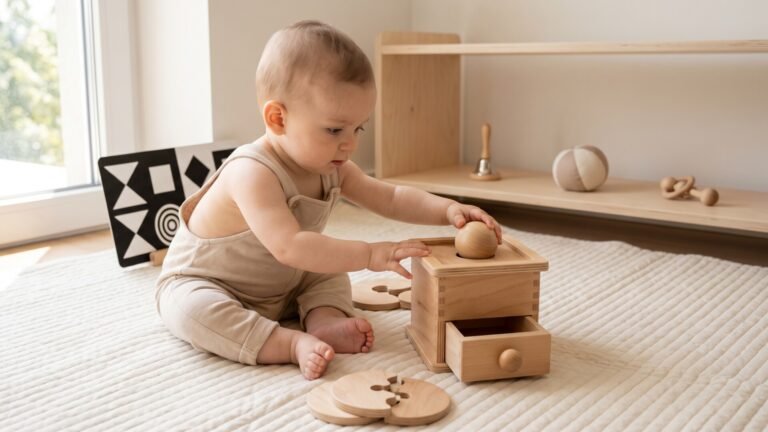
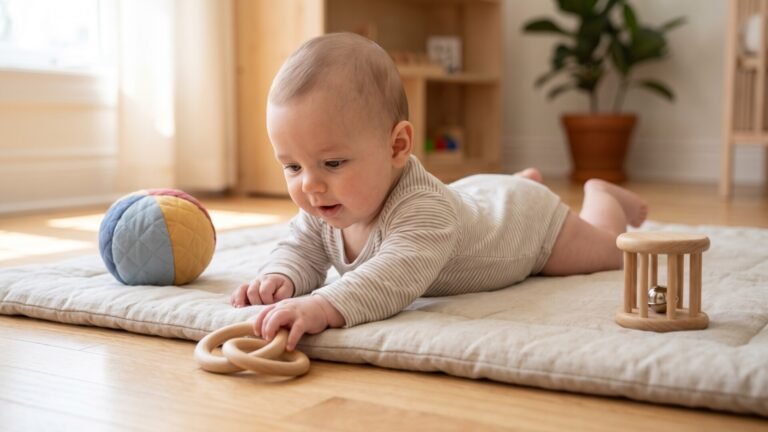
Infant play is mostly about the body: reaching, grasping, tracking a moving object, and discovering that an action produces a result. You do not need an activity center with twelve functions. You need a few well-made objects within reach.
Hape Penguin Music Wobbler
| Feature | Details |
|---|---|
| Age Range | Typically suitable for babies who can sit and interact; check the manufacturer’s current guidance |
| Key Features | Cause-and-effect movement, grasping, visual tracking, sound |
| Price (approx.) | $20-$35 |
The Verdict: A push-and-wobble toy teaches the simplest possible lesson: I did that, and it happened again. It earns its place once a baby can sit or reach purposefully, not during the earliest months.
Best For: Babies beginning to explore cause and effect.
Pros:
- Encourages reaching and repeated experimentation
- Compact and easy to rotate in and out
- More interactive than a passive decoration
Cons:
- Short useful window for some children
- Sound can be a lot in a quiet room
- Needs supervision and an age-rating check
The noise note: it makes sound when moved, which is the point, but there is no volume control. If you have a low tolerance for repeated chimes, this is a daytime toy, not a crib toy.
PlanToys Baby Car
| Feature | Details |
|---|---|
| Age Range | Usually intended for babies and young toddlers; verify the current label |
| Key Features | Simple rolling movement, graspable form, open-ended exploration |
| Price (approx.) | $15-$25 |
The Verdict: A basic rolling object beats a feature-heavy electronic toy as a first vehicle. It supports reaching, grasping, tracking, and the early motivation to move toward something.
Best For: Families who want a simple first open-ended toy.
Pros:
- Easy to grasp and push
- Supports several early motor skills at once
- Takes up almost no storage space
Cons:
- Limited complexity
- Not for mouthing unless the manufacturer confirms it is safe
- Often loses its pull after the first year
Montessori Baby Ball or Grasping Toy
For this one, look at a specialist wooden Montessori ball or a soft grasping ball from an approved retailer. Pick the exact model only after confirming the maker’s current age guidance, because these vary a lot.
| Feature | Details |
|---|---|
| Age Range | Often designed for early infancy, depending on construction |
| Key Features | Grasping, passing between hands, tactile exploration |
| Price (approx.) | $10-$30 |
The Verdict: A well-made grasping toy earns its keep because it serves one clear purpose with no batteries and no instructions. The entire buying decision is construction: choose a form that cannot shed parts or create a choking hazard.
Best For: Early sensory and hand-control practice.
Pros:
- Low cost next to larger activity toys
- Supports repeated open-ended exploration
- Easy to store and rotate
Cons:
- Must be checked carefully for loose parts
- Some designs are too hard for very young babies
- The benefits are easy to overstate if the toy is poorly matched
What Infants Actually Need
Infants need movement, safe sensory exploration, reaching, grasping, rolling, and tracking. They do not need formal lessons, and no toy teaches a baby to read. Place only a few toys within reach and rotate them when interest fades.
Keep floor-based play supervised. Avoid toys with small detachable pieces, long cords, loose magnets, or accessible battery compartments, and follow the manufacturer’s age guidance. Inspect toys regularly for cracks, splinters, loose components, and damaged finishes, especially anything that gets mouthed.
For the full infant breakdown, including sensory and travel options, see Montessori Toys for Infants 0-12 Months.
Best Montessori Toys for Toddlers 1-3 Years
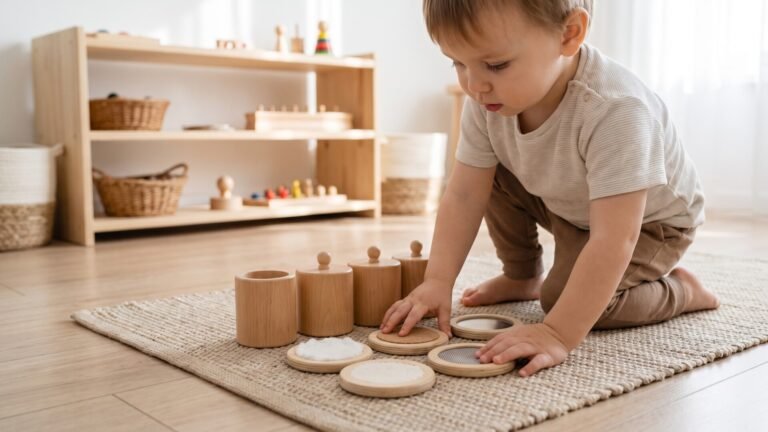
Toddler play turns outward. They want to do what you do: open, close, pour, stack, match, carry. This is the age where practical life stops being a concept and starts being a toddler following you around with a cloth.
Melissa & Doug Wooden Shape Sorting Cube
| Feature | Details |
|---|---|
| Age Range | Commonly aimed at toddlers; the current product label takes priority |
| Key Features | Shape matching, visual discrimination, fine motor coordination |
| Price (approx.) | $15-$25 |
The Verdict: Shape sorters work when they are simple enough to solve by experimenting. They support concentration and problem-solving, provided you do not turn it into a test or correct every attempt.
Best For: Early matching and fine motor practice.
Pros:
- Affordable entry point
- Clear purpose and easy storage
- Gets reused as skills improve
Cons:
- Some toddlers lose interest quickly
- Pieces must be large enough for the stated age
- Little open-ended play once mastered
The eight-month verdict: the cube survives, but its job changes. By next summer it is a dumping-and-filling container more than a sorter. That is fine. It is still in rotation.
PlanToys Wooden Stacking Toy
| Feature | Details |
|---|---|
| Age Range | Toddler years, depending on the specific design |
| Key Features | Stacking, hand-eye coordination, size comparison |
| Price (approx.) | $20-$35 |
The Verdict: Stacking grows with a toddler from random handling to deliberate ordering. A sturdy, uncomplicated design beats a stacker with lights, sounds, and competing features every time.
Best For: Toddlers developing control, sequencing, and persistence.
Pros:
- Supports repeated practice
- Small footprint
- Works in free play or a short demonstration
Cons:
- Frustrating before the child is ready
- Wooden finishes need inspection over time
- Some children outgrow basic stacking fast
Melissa & Doug Latches Board
| Feature | Details |
|---|---|
| Age Range | Usually intended for toddlers and preschoolers |
| Key Features | Opening and closing latches, fine motor control, practical-life simulation |
| Price (approx.) | $20-$30 |
The Verdict: A latch board gives a child a safe version of a real-world task, which is why it holds children who are obsessed with doors, clasps, and mechanical actions. It works best when the latches are challenging but not impossible.
Best For: Toddlers who want to practice practical-life movements.
Pros:
- Builds hand strength and coordination
- Encourages concentration
- More purposeful than most novelty boards
Cons:
- Hardware can loosen under heavy use
- Some latches need an adult demonstration
- Less portable than a small puzzle
The storage reality: it is a flat board, roughly the size of a placemat. It slides behind a shelf or under a couch. In a small apartment, that matters more than you would think.
Toddler Buying Guidance
Prioritize large, easy-to-handle pieces and one obvious challenge at a time. Look for toys that let the child repeat an action independently: pouring, transferring, matching, stacking, opening, closing, and simple dressing.
Skip advanced puzzles, tiny counters, and delicate practical-life tools just because the listing says Montessori. And remember the unglamorous truth: real household participation, wiping a low table or moving laundry from the dryer, often provides more meaningful practical-life practice than any toy version. The toy is the rehearsal. The real task is the performance.
For the full toddler range, see Montessori Toys for Toddlers 1-3 Years and our guide to sensory toys.
Best Montessori Toys for Preschoolers 3-6 Years
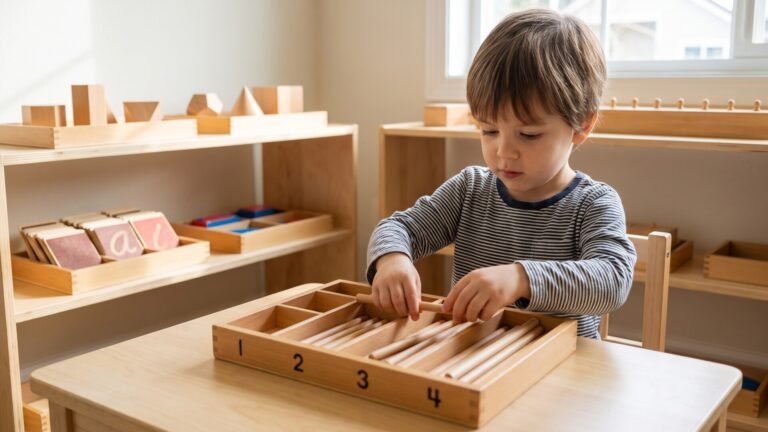
Preschool is where concentration stretches. Children can follow multiple steps, sequence events, use language to plan, and work on fine motor control for longer. This is the age where the right toy can hold attention for twenty minutes, which is a genuine developmental leap.
Montessori Wooden Number Rods or Counting Materials
| Feature | Details |
|---|---|
| Age Range | Usually preschool and early school years, depending on the set |
| Key Features | Counting, quantity awareness, sequencing, early math language |
| Price (approx.) | $25-$60 |
The Verdict: Counting materials are worth it when they connect number symbols to real quantities instead of drilling rote memorization. Choose a set with clear guidance and enough pieces for repeated hands-on work.
Best For: Children beginning structured early math exploration.
Pros:
- Makes quantities visible and concrete
- Supports multiple activities as skills develop
- Bridges play and early learning
Cons:
- Needs adult presentation for best results
- Some sets are poorly finished or incomplete
- Useless if treated as flashcards
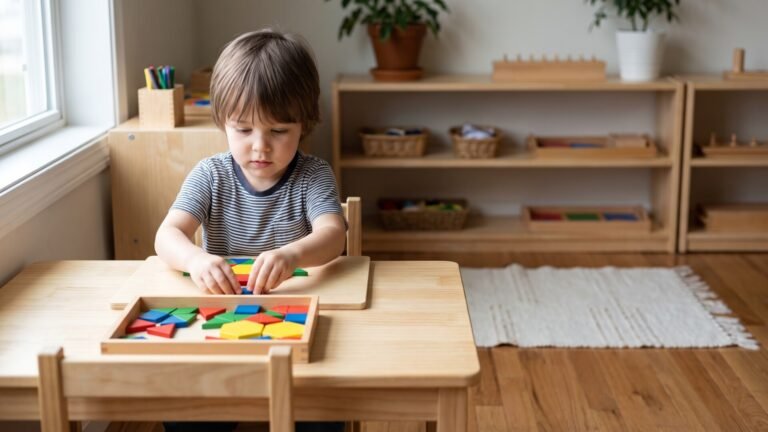
Melissa & Doug Wooden Pattern Blocks or Design Puzzle
| Feature | Details |
|---|---|
| Age Range | Preschool and early elementary, depending on the set |
| Key Features | Spatial reasoning, pattern recognition, fine motor control |
| Price (approx.) | $15-$30 |
The Verdict: Pattern and design puzzles offer a strong mix of independent work and creative variation. They suit preschoolers who like visual challenges but are not ready for long rule-based games.
Best For: Spatial reasoning and quiet concentration.
Pros:
- More than one correct approach
- Easy to use independently after a demonstration
- Often stays useful past the preschool years
Cons:
- Pieces get misplaced
- Some designs are too hard for younger preschoolers
- Less appealing to children who need to move
Wooden Practical-Life Dressing Frame
| Feature | Details |
|---|---|
| Age Range | Commonly preschool age, depending on the fastening type |
| Key Features | Buttons, zippers, snaps, buckles, dressing practice |
| Price (approx.) | $20-$45 |
The Verdict: Dressing frames let a child isolate one difficult fastening skill without the pressure of getting dressed in a hurry. Worth considering when a child shows interest in self-care, but they supplement real clothing rather than replace it.
Best For: Preschoolers building independence with dressing.
Pros:
- Targets one everyday skill at a time
- Encourages persistence and hand control
- Good for children who like repetitive tasks
Cons:
- Quality varies widely
- One frame may teach only one fastening
- Real clothing remains the meaningful practice
Skip this if your child is already dressing themselves without help. You would be buying a rehearsal for a skill they have.
Preschool Buying Guidance
Choose activities with several possible levels: sorting by color, then category, then pattern; counting objects, then comparing quantities; building a simple structure, then planning a larger one. That built-in progression is what separates a toy that lasts two years from one that lasts two weeks.
Favor realistic tools and materials when safe and practical: child-sized cleaning tools, gardening tools, cooking equipment, art supplies. And do not confuse “quiet” with “Montessori.” Active movement, outdoor work, and collaborative building support development just as well as shelf work.
One more test before you buy: can the child return the materials independently? A beautiful activity that requires constant adult setup has low real-world value, no matter how good it looks on the shelf.
For more, see Montessori Toys for Preschoolers 3-6 Years and [Internal: learning toys by age].
Best Montessori Toys for Early Elementary Children 6-9 Years
By six, children can plan ahead, revise a failed attempt, explain their reasoning, and work on a project across several sessions. The toys that fit are the ones that reward thinking, not just handling.
LEGO Classic Creative Brick Box
| Feature | Details |
|---|---|
| Age Range | Commonly aimed at children 4 and older; the child’s building ability matters more |
| Key Features | Open-ended construction, planning, spatial reasoning, creativity |
| Price (approx.) | $25-$60 |
The Verdict: LEGO is not a traditional Montessori material, but open-ended construction fits Montessori-inspired play when children design, revise, and solve problems rather than following only fixed instructions. The best value comes from a collection that stays useful for years.
Best For: Children who enjoy designing and rebuilding.
Pros:
- Strong long-term replay value
- Works for independent and collaborative projects
- Easy to expand gradually
Cons:
- Small pieces need age-appropriate use and storage
- Sets can push instruction-following over invention
- Large collections get hard to organize
The barefoot note: this is the toy you will step on. Buy a storage bin at the same time. A clear one with a lid, not a decorative basket. You will thank yourself by February.
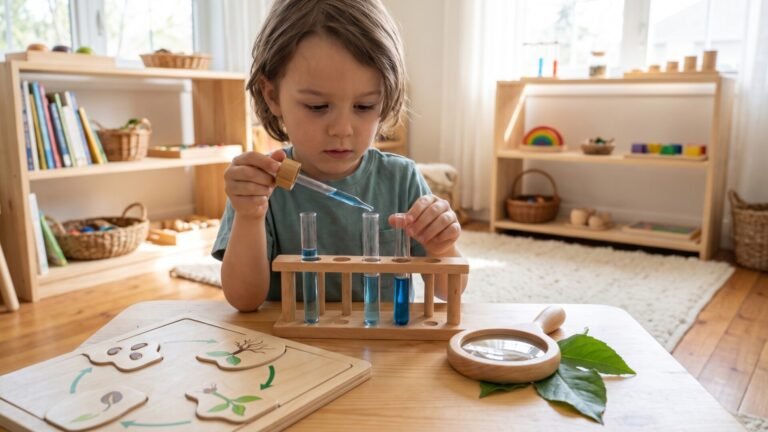
Learning Resources STEM Explorers: Geodes
| Feature | Details |
|---|---|
| Age Range | Typically intended for elementary-age children; verify the current label |
| Key Features | Observation, classification, investigation, hands-on science |
| Price (approx.) | $15-$30 |
The Verdict: Science kits earn their place when they give a child something to observe, compare, and explain, rather than a single visual trick. Look for kits that invite follow-up questions and repeated investigation.
Best For: Children moving from sensory exploration to structured scientific thinking.
Pros:
- Connects hands-on activity to science vocabulary
- Clear starting point for independent work
- Can lead to further research and projects
Cons:
- Some activities are consumable or one-time
- Adult help may be needed
- Interest depends on the child’s topic preferences
ThinkFun Gravity Maze
| Feature | Details |
|---|---|
| Age Range | Typically suited to children around 8 and older, subject to the current label |
| Key Features | Logic, spatial planning, sequencing, problem-solving |
| Price (approx.) | $25-$40 |
The Verdict: A logic game is a strong fit for older children who like a defined challenge and clear feedback. It is less open-ended than most Montessori materials, but it builds concentration and independent reasoning when the difficulty is well matched.
Best For: Children who like puzzles with a clear goal.
Pros:
- Encourages planning before action
- Offers graduated challenge
- Compact and easy to store
Cons:
- Less suitable for children who dislike fixed rules
- Frustrating at the wrong difficulty
- Pieces need to stay organized
For the full elementary range, see Montessori Toys for Early Elementary Children 6-9 Years, plus our guides to [Internal: building toys] and [Internal: STEM toys by age].
What Most Buyers Get Wrong About Montessori Toys
Buying by label instead of ability. A toy marked for ages 3-6 may still be too hard or too easy for a specific child. The label describes a broad average, and your child is not an average. Watch what they can currently do, then buy one step beyond it.
Assuming wooden means developmental. Material and color do not determine play value. A simple plastic construction or coding toy can offer more meaningful problem-solving than a decorative wooden object. You are buying a mechanism, not a finish.
Buying the complete shelf at once. Too many choices reduce concentration. A child facing fifteen activities picks up none of them properly. Rotate: keep a handful out, store the rest, and swap when interest drops.
Confusing independence with no adult involvement. A parent may need to demonstrate the activity, prepare the environment, set boundaries, or model how materials are returned. That is not a failure of the toy. It is the setup cost, and it is usually paid once.
Paying a premium for the aesthetic. The beige-and-wood look photographs well. It does not make a toy work better. If the price jump is for appearance rather than construction or skill progression, you are buying shelf decor.
Which Toys Still Make Sense After Six Months?
This is the part the product pages will not tell you. Below is a ToyGuideHub Longevity Analysis, scoring each category on a consistent 1-5 scale. These are editorial planning scores based on design and likely use, not laboratory testing. A 5 means the category tends to survive real family life; a 1 means it tends to vanish into a storage bin by spring.
| Category | Replay Value | Skill Progression | Durability | Storage | Adult Setup |
|---|---|---|---|---|---|
| Grasping and rolling toys (infant) | 2 | 2 | 4 | 5 | 1 |
| Stacking toys | 3 | 4 | 4 | 5 | 1 |
| Shape sorters | 2 | 3 | 4 | 4 | 1 |
| Latch boards | 3 | 3 | 3 | 4 | 2 |
| Practical-life dressing frames | 3 | 4 | 3 | 4 | 2 |
| Counting materials | 4 | 5 | 4 | 3 | 3 |
| Pattern blocks and design puzzles | 4 | 4 | 4 | 3 | 2 |
| Open-ended construction (LEGO Classic) | 5 | 5 | 4 | 2 | 1 |
| Logic games (Gravity Maze type) | 4 | 4 | 4 | 4 | 1 |
| Science kits | 3 | 4 | 3 | 3 | 3 |
Read the table by column, not by row. The categories that score high on replay value and skill progression are the ones that justify spending more. The infant grasping toys score low on replay because they do their job and then they are done. That is fine. They cost $10 to $30, and a short useful life is acceptable at that price.
Open-ended construction wins on longevity because it has no ceiling. A six-year-old builds a house; an eight-year-old builds a house with a working door and a plan for the roof. The same bricks serve both. Practical-life materials and pattern work also hold up, because the child keeps finding harder versions of the same task.
Now compare cost per use rather than purchase price. A $20 toy used several times a week for two years beats a $60 toy used twice. The expensive one is not the premium product. The expensive one is the one nobody touches.
The hidden ownership costs are where budgets quietly leak. Missing pieces. Loose hardware on latch boards. Consumable science materials you have to rebuy. Adult supervision time. Messy cleanup. And the point at which a child outgrows the activity entirely, which arrives earlier than the box suggests.
The analysis resolves to three rules. Buy fewer, better-matched toys. Choose at least one that can grow more complex as the child does. And never pay a premium for appearance alone.
How to Choose the Right Montessori Toy for Your Home
Different homes need different answers. Here is the short version by situation.
Best Choice for Small Spaces
A shape sorter, stacking toy, pattern puzzle, or logic game. All of these store flat or compact, and storage simplicity raises the odds your child can access and return the toy independently. A toy that needs you to unpack it every time will not get used.
Best Choice for a Tight Budget
A simple stacking toy, shape sorter, wooden puzzle, or a carefully chosen LEGO Classic set. Basic materials often provide better value than large activity centers, because the money goes into construction and repeat use rather than buttons and speakers.
Best Choice for Independent Play
Graduated puzzles, pattern blocks, LEGO Classic bricks, or a well-matched logic game. Independent play depends on readiness and one initial demonstration, not on the toy alone. Show it once, then step back. For more, see best toys for independent play.
Best Choice for Practical-Life Skills
A dressing frame, child-sized household tools, or a toddler latch board. Keep real household participation in the routine, though. The toy rehearses the skill; the real task is what the child is actually after.
Best Choice for STEM and Problem-Solving
LEGO Classic for open-ended construction, ThinkFun Gravity Maze for structured logic, and an age-appropriate science kit such as Learning Resources STEM Explorers: Geodes for observation and investigation. See [Internal: STEM toys by age] for the broader category.
Skip This If
- Do not buy a toy solely because it is marketed as Montessori or made from wood.
- Skip large activity centers with many sounds and buttons if you want focused independent play and have limited space.
- Avoid advanced materials that need constant adult correction or will sit untouched until the child is older.
- Avoid any toy with unclear age guidance, loose small parts, accessible button batteries, strong magnets, damaged finishes, or construction that cannot take normal handling.
Comparison Table: Best Montessori-Style Toys by Stage
| Product | Best Stage | Main Skill Focus | Replay Value | Price Range |
|---|---|---|---|---|
| PlanToys Baby Car | Infants | Grasping, tracking, movement | Moderate | $15-$25 |
| Hape Penguin Music Wobbler | Infants | Cause and effect, reaching | Moderate | $20-$35 |
| Melissa & Doug Shape Sorting Cube | Toddlers | Matching, coordination | Moderate | $15-$25 |
| Melissa & Doug Latches Board | Toddlers | Fine motor, practical life | Moderate to high | $20-$30 |
| LEGO Classic Creative Brick Box | Early elementary | Construction, planning, creativity | High | $25-$60 |
| ThinkFun Gravity Maze | Early elementary | Logic, spatial reasoning | High for puzzle-oriented children | $25-$40 |
Prices are approximate and move with sales and bundles. Check current listings before you commit. You can browse the wider range through [Affiliate: our recommended Montessori toy partners] and [Affiliate: check current pricing on Amazon].
Safety and Parent Guidance
Follow the current manufacturer’s age recommendation, especially for toys with small parts, magnets, strings, detachable pieces, or button batteries. The label reflects the maker’s testing, so treat it as the floor, not a suggestion.
Inspect wooden toys for splinters, cracks, loose dowels, peeling finishes, and damaged hardware. A finish that is flaking is a finish that is going into a mouth. Retire the toy rather than sanding it yourself unless the maker says otherwise.
Keep infant and toddler materials free from choking hazards, and supervise exploration when a child mouths objects. Present only a manageable number of toys at once and store the rest out of reach when needed.
Avoid making developmental promises, and be suspicious of any product that does. Toys create opportunities for practice. They do not guarantee a milestone, and no wooden object has ever taught a child to read on its own. Use demonstrations sparingly: show the basic action, then let the child repeat, vary, or abandon it without turning play into a performance.
The Bottom Line
If you take one thing into a shop, take this: match the toy to the child in front of you, not to the age band on the box. The best Montessori toys for child development are the ones that get used repeatedly at the stage your child is actually in.
The winners, by buyer:
- Best overall long-term value: LEGO Classic Creative Brick Box, for children ready for open-ended construction.
- Best budget option: Melissa & Doug Wooden Shape Sorting Cube, for toddlers.
- Best for practical-life skills: Melissa & Doug Latches Board or a well-made dressing frame.
- Best for focused problem-solving: ThinkFun Gravity Maze, for older elementary children.
- Best infant approach: a small rotation of simple grasping, rolling, and cause-and-effect toys rather than one large activity center.
If you want the deeper age-specific picks, the cluster has them: Montessori Toys for Infants, Montessori Toys for Toddlers, Montessori Toys for Preschoolers, and Montessori Toys for Early Elementary Children. For the broader picture, start at our Montessori Toys by Age hub.
You do not need to solve the whole shelf today. Buy one toy that fits the child’s current stage, put it where they can reach it, and see what happens. If it earns a spot in the rotation, you have your answer, and you can stop researching. If it does not, you have spent twenty dollars and learned something more useful than any review could tell you. Check current pricing and availability through our recommended partners when you are ready.
Frequently Asked Questions About Montessori Toys For Different Developmental Stages
Are Montessori toys suitable for every age?
Montessori-inspired materials adapt across ages, but the same toy can serve different purposes at different stages. A stacking toy is a grasping exercise at one year and a size-ordering task at three. Let age labels, current abilities, and the child’s interest all guide the choice.
What is the best Montessori toy for a baby?
There is no single best option. Simple grasping, tracking, movement, and sensory toys are generally more appropriate than anything promising advanced learning or requiring complex interaction. Buy two or three well-made objects and rotate them rather than one large activity center.
Do Montessori toys have to be wooden?
No. Wood is common because it can be durable and tactile, but material alone does not make a toy Montessori. A well-designed plastic, fabric, metal, or electronic toy can support meaningful play. What matters is whether the child can use it purposefully and independently.
How many Montessori toys should a child have at once?
Fewer than most families own. A small selection is easier for children to use independently, especially in limited spaces. The right number depends on the child, your storage, and whether you rotate materials. If your child flits between toys without settling, the shelf is too full.
Can older children still benefit from Montessori toys?
Yes. Early elementary children use Montessori-inspired materials for math, construction, practical work, science, art, and problem-solving. The activity should become more complex and self-directed as the child develops, not disappear.
Are Montessori toys worth the higher price?
Some are, when they offer strong construction, useful skill progression, and years of replay. Others are overpriced because the label or the appearance adds more to the cost than the play value. Compare cost per use, not sticker price.
Should parents correct a child who uses a Montessori toy differently?
Allow open-ended exploration unless safety is involved. For materials with a specific purpose, demonstrate the intended use once, then let the child practice without constant correction. A shape sorter used as a drum is still a shape sorter being explored.
How do I know when to move a toy on?
When the child has mastered it and stops returning to it, rotate it out rather than buying a replacement immediately. Bring it back in a few months. Some toys get a second life once skills catch up, and some have genuinely finished their job.