Quick and Engaging STEM Activities for Kids with Short Attention Spans
If your child abandons a science project after four minutes, the problem is rarely the child. Most STEM kits and experiments are designed for a patient, sit-down session of thirty minutes or more. Children who move quickly from one thing to the next need something different: an activity that hooks them in the first minute and delivers a satisfying payoff before their attention drifts.
This guide is for parents who have felt like they failed because a child could not sit through a long experiment. You did not fail, and neither did your child. The activity was just built for a different pace. Below you will find how to shape STEM play into short, rewarding bursts, ten quick activities that need little more than household items, and five kits that suit short sessions, with honest notes about what each one asks of you and your child.
A note before we start: a short attention span is common in young children and is not a diagnosis. If you have concerns about your child’s attention, talk to your pediatrician or your child’s school. Nothing in this article is medical advice, and we have not hands-on tested the products listed; details come from manufacturer and retailer information, and we flag anything we could not confirm.
[Affiliate: Check current pricing on Amazon]
[Affiliate: Browse STEM kits on Target]
Why Short STEM Activities Work
STEM activities (science, technology, engineering, and math) are hands-on and curiosity-driven. A child who builds a tower and watches it tip over is exploring balance and gravity. A child who mixes two colors and gets a third is predicting, testing, and observing. Those are real thinking skills, and they do not need an hour to happen.
Short activities have a few built-in advantages for children who lose interest quickly. They give fast feedback, such as a light turning on or a reaction fizzing. They end before frustration sets in. And they are easy to repeat, which builds familiarity. Broadly, young children learn well through play and hands-on exploration, which is why organizations such as the American Academy of Pediatrics encourage play as part of healthy development. A short session that ends on a success is better than a long one that ends in tears.
Think of it as a series of sprints instead of one marathon. Ten focused minutes, three or four times a week, can offer more practice than one long weekend project that nobody finishes. For a deeper look at how STEM play supports thinking, see how STEM toys improve critical thinking and our full STEM Toys for Kids parent guide.
Core Concepts: What Makes an Activity “Short-Attention Friendly”
The most useful distinction is between structured and open-ended activities. A step-by-step kit gives clear guardrails, which helps a child who needs guidance to stay on track. Open-ended play, like a pile of blocks or a DIY STEM challenge, asks for more self-direction. Both have a place, but for a child who loses focus quickly, a small structured start with room for free play afterward often works best. Our guide to open-ended toys that grow with your child covers the free-play side.
Look for these traits:
- A fast first result. The first “aha” should arrive within a minute or two, whether it is a fizz, a spin, or a light turning on.
- Little setup. If it takes you ten minutes to prepare, the window may close before you begin.
- A natural stopping point. Each experiment or build should have a clear “done” moment.
- An easy second round. A “what if we change this?” twist lets a child extend the activity if they want to.
10 Quick STEM Activities (5 to 15 Minutes Each)
You do not need to buy anything to start. These use common household items. Adults should supervise all of them, and anything involving small items (beans, beads, marshmallow pieces) is not suitable for children who still put things in their mouths.
- Baking soda and vinegar fizz (about 5 minutes). Put a spoonful of baking soda in a tray or cup and let your child add vinegar with a spoon or dropper. Try adding a drop of food coloring first. It teaches cause and effect and is a classic reaction that happens fast. Do it over a tray to catch the overflow.
- Sink or float (about 10 minutes). Fill a bowl of water and have your child guess whether household objects will sink or float, then test. Sorting the objects into two piles adds a simple math element.
- Paper airplane test flights (about 10 minutes). Fold two different designs, mark a starting line, and measure which one flies farther. Change one thing, such as adding a paper clip to the nose, and fly again.
- Balloon rocket (about 10 minutes). Thread a string through a straw, tape the straw to an inflated balloon, and let go. It demonstrates how escaping air pushes the balloon along the string. Use latex-free balloons if allergies are a concern, and discard broken balloon pieces, which are a choking hazard for young children.
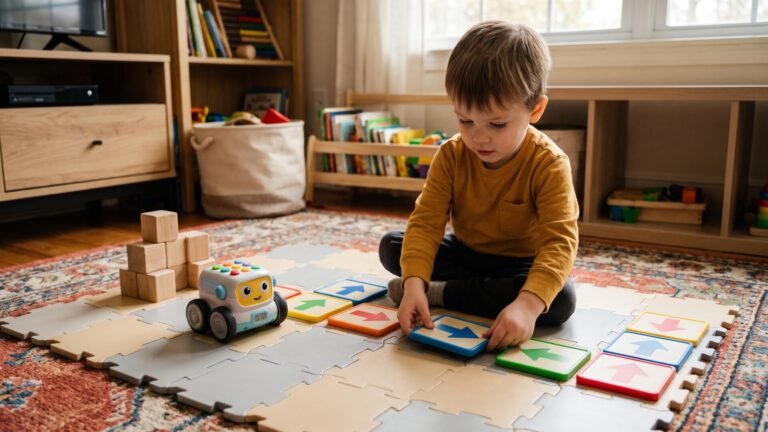
- Ramp and car races (about 10 to 15 minutes). Prop a board or a book cover on some books and roll toy cars down it. Change the ramp height and see how it changes the distance traveled. This is an easy introduction to variables.
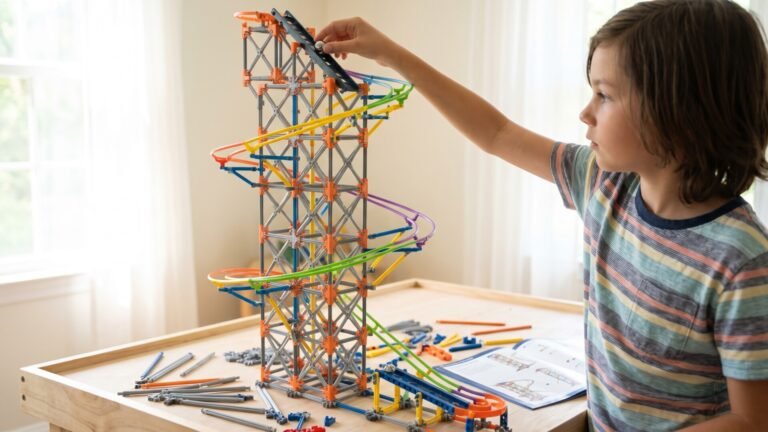
- Straw or cup tower (about 10 minutes). Challenge your child to build the tallest tower they can from paper cups or index cards. Taking turns adds a social element, and a tower that falls is part of the lesson.
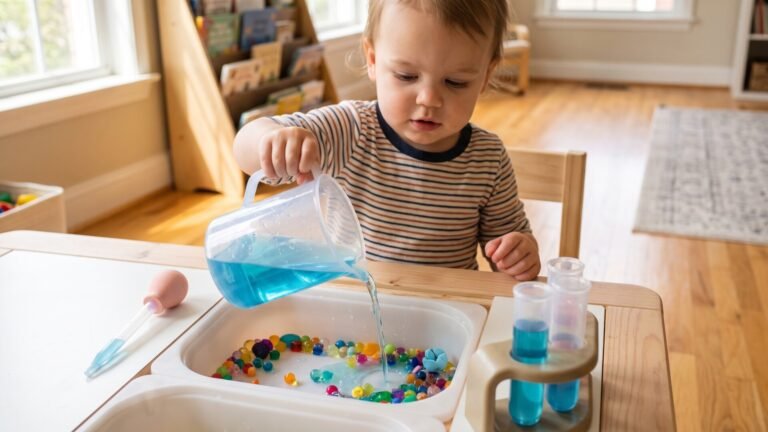
- Rainbow walking water (about 10 minutes setup, longer to watch). Line up cups, fill alternate ones with colored water, and bridge them with folded paper towels. Color travels slowly, so this is a good “check back later” activity for a child who prefers to dip in and out.
- Magnet treasure hunt (about 10 minutes). Give your child a magnet and let them test which household objects it picks up. Keep magnets large and supervised; small or loose magnets are a serious hazard if swallowed.
- Shadow tracing (about 10 minutes). On a sunny day or with a flashlight, trace the shadow of a toy on paper, then trace it again later and compare. It introduces light and the sun’s movement.
- Ice melt race (about 10 minutes). Put ice cubes in different places, such as in the sun, in the shade, or in warm water, and guess which melts first. Sprinkling a little salt on one adds an extra variable.
If your child enjoys these, our guides to fun science experiments to try at home and STEM activities for preschoolers have many more ideas.
How to Make Any Activity Work for a Short Attention Span
- Prepare in advance. Set up the materials before you call your child over.
- Start with the fun part. Do the fizz or the launch first, then talk about why it happened.
- Break it into chunks. Build the tower now and test it after a snack. Leaving a project out on a tray lets your child return when interest comes back.
- Connect it to their interests. Dinosaur fan? Make a fossil dig in a tub of sand. Car fan? Run the ramp race.
- Let them lead the twist. Asking “what should we change?” gives a child a sense of control.
- Use a visible timer. A sand timer or picture timer can make a ten-minute session feel manageable. For sensory-sensitive children, see our guide to quiet STEM activities for sensitive children.
- Stop on a win. End while your child still wants more, and they are more likely to come back.
Key Buying Factors for STEM Kits
Safety. Check the manufacturer’s age grade and warnings. Kits for younger children should be free of small parts, and anything involving chemicals, heat, or electricity needs adult supervision. The age on the box is a safety rating based on the product’s design, not a statement about your child’s ability, so use it as a floor rather than a ceiling for safety and as a starting point for skill.
Durability. Kits that hold up to rough handling are less likely to turn a good session into a frustrating one.
Developmental fit. Your child’s actual skills matter more than the number on the box. A six-year-old may enjoy some kits graded for eight and up with help, while an older child may still love simpler ones.
Setup time. Short attention spans and long setups do not mix. Prefer kits that work almost out of the box.
Real learning. Does the child make decisions, or only follow instructions? The best kits do both.
Storage. A compact kit that can be put away quickly is more likely to be used. Our STEM and educational toys overview helps you compare categories.
Pros and Cons of Short STEM Activities
Pros: Short activities make hands-on learning approachable, encourage curiosity and problem-solving because there is often no single right answer, and many can be done with materials you already own.
Cons: Many require adult involvement, at least at first. Some need supervision for safety. And limited attention spans do lead to unfinished projects. That is normal. A project set aside and revisited a few days later can still count as learning, because children often return to it with fresh eyes.
Kit Recommendations for Short Sessions
Snap Circuits Jr. Electronics Exploration Kit (SC-100)
| Feature | Details |
|---|---|
| Manufacturer age | 8+ |
| Key features | Over 100 projects, snap-together parts, 28 parts, full-color project manual |
| Price range | $ (check current price) |
| Affiliate Program | [Affiliate: Amazon Associates] |
Why it suits short sessions: Parts snap together on a base grid with no soldering or loose wires, and each project has a clear result: a light, a fan, or a sound. Because projects are small and numbered, a child can finish one in a few minutes and stop.
Best for: Curious children who like to see how things work. It introduces circuits, switches, and simple electronics.
Trade-offs: It only covers electronics. The manual is text-heavy, so a younger child may need you to read steps aloud. Batteries are required. Parts are small, so it is not suitable for children under the labeled age.
[Affiliate: Check current pricing on Amazon]
Thames & Kosmos Kids First Chemistry Set
| Feature | Details |
|---|---|
| Manufacturer age | Check the box; designed for young children |
| Key features | 25 experiments, basic lab equipment (test tubes, pipettes, beakers), 48-page color manual |
| Price range | Around $45 at one retailer; check current price |
| Affiliate Program | [Affiliate: Amazon Associates] |
Why it suits short sessions: It replaces the generic “50 experiments” kits that vary widely in quality with a named, documented set. Experiments are short and use kid-friendly equipment, and the manual walks both child and adult through each one.
Best for: Children who love mixing, pouring, and observing, and who enjoy having real lab-style tools.
Trade-offs: Chemistry play is messy and needs supervision. Use a tray or work outdoors, and check which household supplies are not included before you start.
[Affiliate: Check current pricing on Amazon]
Melissa & Doug Wooden Building Blocks Set
| Feature | Details |
|---|---|
| Manufacturer age | See packaging; marketed for toddlers and preschoolers |
| Key features | Classic wooden blocks, open-ended play |
| Price range | $ (check current price) |
| Affiliate Program | [Affiliate: Melissa & Doug] |
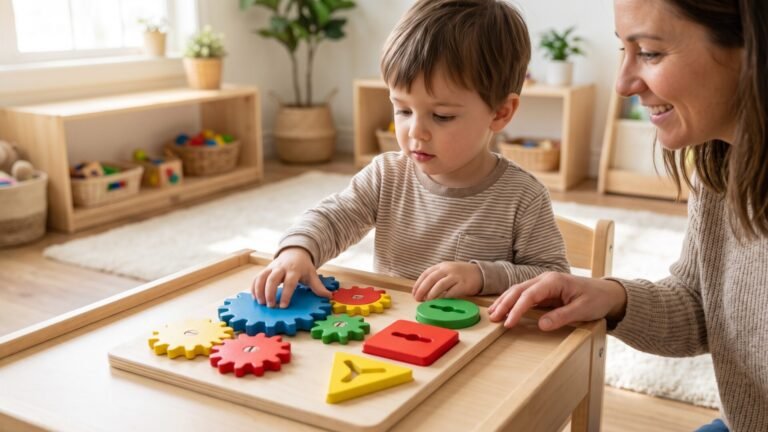
Why it suits short sessions: There is no setup and no wrong way to play. Blocks invite stacking, balancing, and knocking down, which explores gravity and balance. A child can play for two minutes or twenty.
Best for: Younger children who are not ready for kits. Parents who want a simple introduction to engineering ideas can add challenges like “build a bridge for this car.”
Trade-offs: There is no built-in instruction, so the STEM learning depends on the questions you ask. Always follow the manufacturer’s age grade.
[Affiliate: Check current pricing on Amazon]
LEGO Education SPIKE Prime Set
| Feature | Details |
|---|---|
| Manufacturer age | 10+ (grades 6 to 8) |
| Key features | 528 pieces, drag-and-drop coding based on Scratch, optional Python |
| Price range | $$$ (confirm current price) |
| Affiliate Program | [Affiliate: LEGO] |
Correction: an earlier version of this article listed this set as 7+. LEGO Education lists SPIKE Prime for ages 10+. Younger children should look at SPIKE Essential, which is aimed at ages 6+ (see our beginner robotics kits guide).
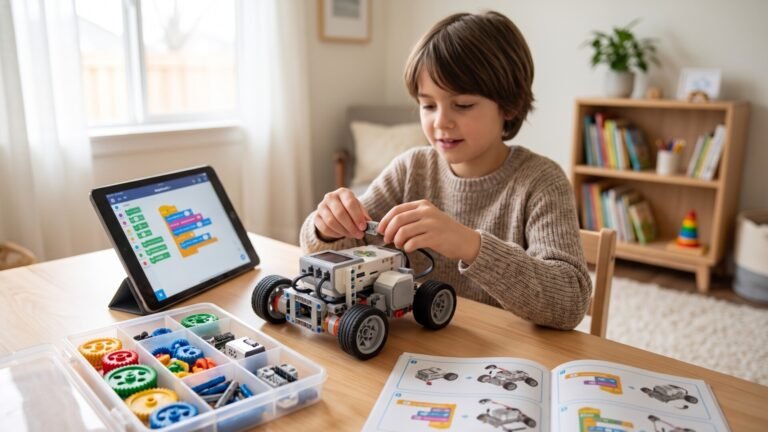
Why it suits some children: It combines LEGO building with block-based coding, so a child can build, program, and test in one session. Immediate feedback, when a robot reacts to the code, suits children who need to see results.
Best for: Older children interested in robotics, ideally working with a friend or parent.
Trade-offs: This is the least “quick” option here. Sorting pieces and charging the hub take time, and it is a larger investment, so it is better for a child who already has patience for building.
[Affiliate: Check current pricing on Amazon]
Kano Computer Kit (check availability)
Kano’s build-a-computer kits teach children to assemble a computer and code with Python, JavaScript, and block-based tools, and one retailer notes children aged 6 to 8 may need supervision while 8 and older tend to be fairly self-sufficient. However, at least one retailer lists the Complete Touch Screen model as retired and replaced, so we cannot confirm which model is currently on sale. Check availability and the current model before you buy. Assembly takes a good while, so it is not a quick activity.
[Affiliate: Check current pricing on Amazon]
Comparison Table
| Product | Manufacturer Age | Setup Time | Typical Session | Best For |
|---|---|---|---|---|
| Snap Circuits Jr. SC-100 | 8+ | Low | 5 to 15 minutes | Electronics learners |
| Kids First Chemistry Set | Check box | Low to medium | 10 to 20 minutes | Hands-on experimenters |
| Melissa & Doug blocks | See packaging | None | Any length | Younger children |
| LEGO SPIKE Prime | 10+ | High | 30+ minutes | Older robotics fans |
| Kano Computer Kit | 6 to 8 with help; 8+ more independent | High | Long build | Tech-curious kids |
How to Choose the Right Option
Best for small spaces: Snap Circuits Jr. fits in a compact box and works on a small table.
Best for toddlers and preschoolers: Wooden blocks. For other toys at this age, see sensory-friendly science kits for toddlers and beginner coding toys for preschoolers.
Best for quick wins: The Kids First Chemistry Set and Snap Circuits Jr., because each activity has a clear start, result, and finish.
Best for collaborative play: SPIKE Prime, since building and programming split naturally between two children.
Best budget starting point: Household activities first, then blocks or Snap Circuits Jr.
If your child has ADHD or other needs: See our guides to simple electronics kits for young learners with ADHD and STEM toys for visual learners with ADHD. A therapist or teacher who knows your child can help you match a kit to their goals.
More Guides to Explore
Continue with STEM toys that build fine motor skills, coding games without a tablet, astronomy and space science kits, and a parent’s roadmap to introducing STEM early.
Conclusion
STEM for children with short attention spans is not about making them sit still. It is about shaping learning into short, satisfying bursts with fast feedback. Start with the free household activities above, see what your child enjoys, and only then buy a kit. For most families, Snap Circuits Jr. is a good first kit for children old enough for it, and a simple chemistry set or a box of blocks covers younger children.
Spilled vinegar, a tower that fell for the fifth time, and a half-wired circuit are all part of the process. A project left unfinished today may be the one your child asks to continue next week.
[Affiliate: Check current pricing and availability on Amazon]
[Affiliate: Browse STEM kits on Target]
Frequently Asked Questions About STEM Activities For Children With Limited Attention Span
What are the best STEM activities for kids with short attention spans?
Quick experiments and builds that take five to fifteen minutes, such as baking soda and vinegar, sink or float, ramp races, and paper airplane tests. Look for activities with immediate feedback, like a light turning on or a reaction fizzing. The faster the payoff, the more likely your child will stay engaged.
How can I keep my child engaged during STEM activities?
Connect the activity to their interests. If your child loves dinosaurs, try a fossil dig in sand. If they love cars, build a ramp. Start with the fun part, keep sessions short, let them choose the twist, and stop while they still want more.
Are there any safety concerns with STEM kits?
Yes. Always check the manufacturer’s age grade and supervise activities involving chemicals, electricity, batteries, magnets, or small parts. Keep small magnets and button batteries away from children who put things in their mouths.
How often should I do STEM activities with my child?
Short, regular sessions tend to work better than rare long ones. Ten to fifteen minutes a few times a week is a reasonable starting point, adjusted to your child’s interest and energy.
Can STEM activities help my child's focus?
Engaging hands-on activities can give children practice at sustaining attention on something they enjoy, but there is no guarantee that they will change attention in other settings. If you are concerned about your child’s attention, speak with your pediatrician or school.
Where can I find affordable STEM activities?
Start with free household experiments using items like baking soda, vinegar, paper, and cups. For kits, look at retailers such as [Affiliate: Amazon] and [Affiliate: Target], and compare the number of activities per kit with the price.