Top 7 Montessori-Style Sound Explorer Toys for Toddlers Under 3
Walk down any toy aisle and you will find plenty of battery-powered toys that play a song when you press a button. A Montessori-style approach to sound toys goes the other way: the toddler makes the sound, hears the result of their own action, and tries it again. This guide walks through what that means in practice, how to keep sound play safe for children under three, and which toys are worth considering, with ages and prices checked against manufacturer and retailer listings.
One note on terminology up front: “Montessori” is not a protected label, so a toy marked “Montessori” is not automatically made to any standard. We use “Montessori-style” to mean simple, well-made, open-ended toys that let a child be the one doing the work. Always judge a toy on its design, materials and safety, not its packaging.
Quick Picks
- Youngest explorers (from birth): Hape Bell Rattle
- Best simple instrument (18 months+): PlanToys Solid Drum
- Best cause-and-effect toy (12 months+): Hape Pound & Tap Bench
- Best mini band (24 months+): Hape Early Mighty Band Melodies
- Save for after the third birthday: Hohner Kids Rhythm Sticks and Melissa & Doug Band in a Box (both labeled 3+)
What Montessori Teaches About Sound
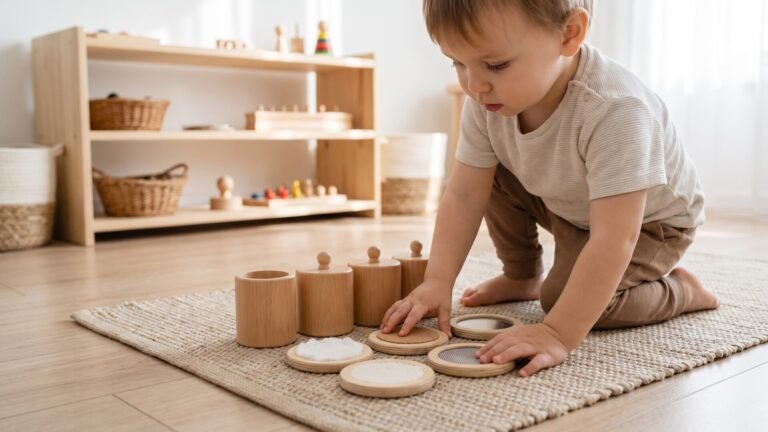
Maria Montessori built her method around the idea that young children learn through their senses and through purposeful activity they choose themselves. In a traditional Montessori classroom, hearing is trained with specific sensorial materials, such as sound boxes (pairs of matching cylinders that rattle at different intensities) and a set of tuned bells that children match by pitch. Those materials are usually introduced in the Children’s House years, around age three, so they are not toddler toys. What toddlers can take from the approach is the underlying set of principles:
- The child is the active one. The toy should stay silent until the child does something. A drum does nothing on its own, which is exactly the point.
- One idea at a time (isolation of quality). A bell rattle is about one sound. A toy that flashes, sings and talks at once makes it hard to notice what any single part does.
- Real, natural materials. Wood, rubber and metal give honest, varied tones and feel good in the hand. See our wooden vs. plastic guide for how to weigh the trade-offs.
- Freedom within limits. A few toys on an open shelf, within reach, and a calm space to use them. Fewer toys, chosen with care, usually get more attention.
- Adults model, then step back. Show how to tap gently once, then let the toddler experiment.
Listening to and making sounds can be a rich part of toddler play, and it fits naturally alongside language-building play and fine motor practice. No toy guarantees a particular outcome, and every child moves at their own pace, so treat the ages below as a guide rather than a deadline. For the bigger picture, see our Montessori and early learning toys hub and the guide to Montessori toys for toddlers (1-3 years old).
Safety First: Sound Toys for Under-3s
Sound toys carry a few risks that other toys do not. Read this section before you buy anything.
Small parts and choking
In the United States, toys intended for children under three must not contain small parts that fit inside a small-parts test cylinder, which is roughly the size of a toddler’s throat. At home, treat anything that fits inside a toilet-paper tube as a hazard. Check often for loose bells, beads, rattle contents, drumstick tips and any ball that comes with a toy. If a part loosens, take the toy away until it is fixed or replaced. Be extra careful with mouthing babies and toddlers: hold the toy, give it a firm tug and shake, and see whether anything rattles that should not.
Button and coin batteries
Button and coin batteries are among the most serious toy hazards. A swallowed battery can lodge in the throat and cause severe internal burns in a short time. Federal rules following Reese’s Law now require secure battery compartments on consumer products that use them, but older products, imports and other household items (remote controls, greeting cards, light-up items) may not comply. Choose battery-free toys when you can, which is one reason every main pick below is a purely acoustic toy. If a toy does take batteries, make sure the compartment closes with a screw, replace batteries yourself out of sight, and store spares out of reach. If you suspect a child has swallowed a battery, go to an emergency department immediately and call the National Battery Ingestion Hotline at 800-498-8666 without waiting for symptoms.
Cords, strings and long handles
Avoid toys with long strings or cords, and never leave a mobile or cord-hung sound toy within reach of a baby or toddler in a crib or play space. Drumsticks and mallets should be short, with a sturdy head, and used while sitting down. Toddlers walk and run while holding things, so supervise stick-like toys.
Volume and hearing
Hearing and speech organizations regularly warn that some toys can be loud enough to be harmful when held close to a child’s ear. Acoustic toys are generally quieter than electronic ones, but not always. Test each toy yourself, at the distance and position your toddler would use it. If it makes you wince, it is too loud for a small ear. Practical tips:
- Play on a rug or mat. Wooden toys on a hard floor are louder than on carpet.
- Pick toys with a soft-tipped stick (like a rubber-headed drumstick).
- Skip any electronic toy without a volume control, or cover the speaker with tape if it is too loud and you cannot return it.
- Keep sessions short and offer quiet breaks. Let the child learn that sound has loud, soft and silent moments.
- Never hold or place a noisy toy right next to an infant’s ear.
Finishes and materials
Children under three mouth almost everything. Look for toys labeled as meeting U.S. toy safety standards (ASTM F963 and CPSC requirements), with non-toxic, water-based finishes, and buy from retailers you trust. Skip old or secondhand toys you cannot identify, and check the CPSC recall list for any brand you are unsure about.
What to Look For When Buying
- A check against the age label. Manufacturer age grades matter. Several toys marketed as “toddler instruments” are labeled 3+ because of small parts, harmonicas or similar features.
- No batteries, no screens. Sound the child produces is more instructive than sound a toy plays at them.
- Pleasant, not piercing, tone. Wood, rubber and good-quality metal tend to sound warmer than thin plastic.
- Simple actions. Shaking, tapping and rolling are plenty at this age.
- Sturdy construction and easy cleaning. Toddlers drop, throw and chew. A wipe-clean surface and solid joins save worry.
- Somewhere to live. A basket or low shelf keeps the toy visible and tidy, which fits the Montessori idea of an ordered environment.
Our Picks: Montessori-Style Sound Toys
Details below come from manufacturer and retailer listings checked at the time of writing. Prices are approximate US ranges and change often, so confirm age grade and price on the product page before you buy. We have not hand-tested every toy, and we say so where it matters.
1. Hape Bell Rattle
| Feature | Details |
|---|---|
| Age Range | From birth (Hape’s listed age grade: 0 months+) |
| Materials | Beechwood and ABS plastic |
| Key Features | Rolls away and loops back like a boomerang, small bell inside, shaped for small hands |
| Approx. Price | $10-$15 |
| Affiliate Program | [Affiliate: Check price on Amazon] |
Why it fits: This is a one-idea toy. The bell inside makes a soft sound when it moves, and the loop shape means that rolling it away brings it back, which is a delightful cause-and-effect moment for a crawler or early walker. It is also a good example of a toy that works at several ages: a baby grasps and shakes it, a toddler rolls and chases it.
Best for: Babies and young toddlers meeting sound for the first time.
Pros: gentle tone, easy to hold, no batteries, suitable from birth. Cons: only one sound; the ABS parts mean it is not an all-wood toy. Check regularly that nothing has worked loose.
2. PlanToys Solid Drum
| Feature | Details |
|---|---|
| Age Range | 18 months and up |
| Materials | Rubberwood and natural rubber, non-toxic water-based dyes |
| Key Features | Compact curved drum, rubber-tipped drumstick that softens the sound |
| Approx. Price | $30-$40 |
| Affiliate Program | [Affiliate: Check price on Amazon] |
Why it fits: A drum and a stick is about as open-ended as sound play gets. The rubber tip takes the harsh edge off the noise, which makes it a calmer choice than many plastic drums. Sit with your toddler, tap slowly, tap fast, tap softly, then let them copy or invent their own pattern. The listing describes the product as chemical-free with no sharp edges.
Best for: Toddlers who love banging and rhythm, from 18 months.
Pros: natural materials, softer sound thanks to the rubber tip, simple to use alone. Cons: pricier than a plastic drum, and the stick is something to supervise. Stock varies by color and retailer.
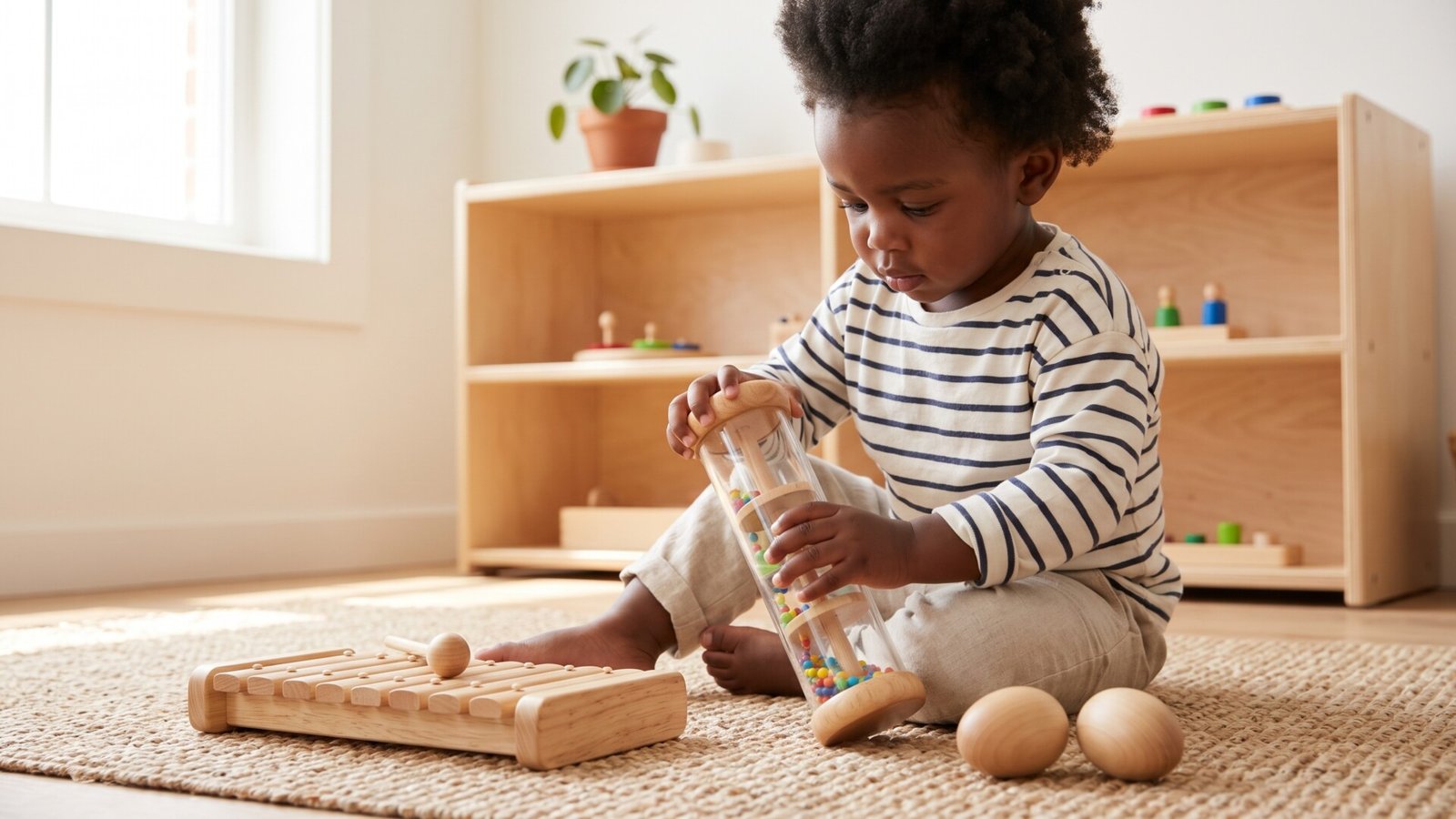
3. Hape Pound & Tap Bench
| Feature | Details |
|---|---|
| Age Range | 12 months and up |
| Materials | Mostly wood, water-based paints, metal xylophone keys |
| Key Features | Pound balls through holes with a hammer; they roll down and ring the xylophone, which slides out for tapping. Six pieces in all. |
| Approx. Price | $30-$45 |
| Affiliate Program | [Affiliate: Check price on Amazon] |
Why it fits: It turns a toddler’s urge to pound into a chain of cause and effect: hit the ball, watch it drop, hear the note. The pull-out xylophone then becomes a second activity. It combines movement, hand-eye coordination and listening in a single, self-contained toy.
Best for: One-year-olds who love pounding and dropping things.
Pros: several kinds of play in one toy, compact. Cons: loose balls get lost, and the xylophone is not tunable, so it is a sound toy rather than a real instrument. Check the balls against a small-parts cylinder or toilet-paper tube before first use and keep an eye on them.
4. Hape Early Mighty Band Melodies
| Feature | Details |
|---|---|
| Age Range | 24 months and up |
| Materials | Wood with child-safe, non-toxic finishes |
| Key Features | Wooden music base with drum, cymbal, guiro, clapper and xylophone, plus two drumsticks |
| Approx. Price | $25-$40 (discounted at some retailers; availability varies) |
| Affiliate Program | [Affiliate: Check price on Amazon] |
Why it fits: Once a toddler is two, comparing different sounds becomes more interesting. A tapped drum, a scraped guiro and a struck xylophone all come from the same object, so your child can compare them side by side. Ask simple questions as they play: “Which one is loud? Which one is scratchy?”
Best for: Two-year-olds ready for more than one sound.
Pros: variety without electronics, stores as one set. Cons: it has more parts and two sticks to supervise, and it is marked 24 months+, so it is not for the youngest toddlers. Because stock changes, check the current listing.
Great Toys to Save for Age Three
Two classics often show up in “toddler music” lists, but their manufacturer age grades are 3 and up, so we do not recommend them for children under three.
Hohner Kids Rhythm Sticks
| Feature | Details |
|---|---|
| Age Range | 3 and up (per retailer listing) |
| Key Features | One pair: a long ridged stick and a short smooth stick for different patterns |
| Approx. Price | $5-$10 per pair |
| Affiliate Program | [Affiliate: Check price on Amazon] |
Rhythm sticks are cheap, durable and endlessly open-ended: tap, scrape the ridged one, keep the beat to a song. Hold them until your child is three and can play seated and without poking.
Melissa & Doug Band in a Box (Clap, Clang, Tap)
| Feature | Details |
|---|---|
| Age Range | 3 and up |
| Key Features | 10-piece wooden percussion set (tambourine, cymbals, maracas, clacker, tone blocks, triangle) with wooden storage crate |
| Approx. Price | $35-$50 |
| Affiliate Program | [Affiliate: Check price on Target] |
A fun group set for a preschooler and siblings or friends. Because of the small parts and the number of pieces, it is best kept for age three and older.
Comparison Table
| Toy | Listed Age | Main Material | Batteries | Approx. Price | Best For |
|---|---|---|---|---|---|
| Hape Bell Rattle | 0 months+ | Beechwood and ABS | No | $10-$15 | First sound toy |
| PlanToys Solid Drum | 18 months+ | Rubberwood, rubber | No | $30-$40 | Rhythm play |
| Hape Pound & Tap Bench | 12 months+ | Wood, metal keys | No | $30-$45 | Cause and effect |
| Hape Early Mighty Band Melodies | 24 months+ | Wood | No | $25-$40 | Comparing sounds |
| Hohner Kids Rhythm Sticks | 3+ | Wood (see listing) | No | $5-$10 | Budget, after age 3 |
| Melissa & Doug Band in a Box | 3+ | Wood | No | $35-$50 | Group play, after age 3 |
Choosing by Age and Situation
Babies and young crawlers (under 12 months)
Start with a single, gentle rattle such as the Hape Bell Rattle, and add the sounds of your own home: your voice, singing, a wooden spoon on a pot while you sit together. Our guide to Montessori toys for newborns covers the earliest months in more detail.
One-year-olds
Around the first birthday, many children love dropping, banging and filling things. The Pound & Tap Bench fits that energy well. See our list of Montessori toys for 1-year-olds for more.
Two-year-olds
Two-year-olds can start to compare and copy rhythms. A drum or the Mighty Band set suits that stage. Our guide to Montessori toys for 2-year-olds goes further.
Small spaces
The Bell Rattle and rhythm sticks take almost no room. A drum fits on a low shelf or in a basket.
Sensitive to noise
Choose the Bell Rattle or a rubber-tipped drum, play on a rug and keep sessions short. Some children are sensitive to sound; if yours covers their ears often, follow their lead and ask your pediatrician if you are concerned.
Sound Play That Costs Nothing
Montessori education values real-life experience, and sound is everywhere at home. Some ideas that need no purchase, always with an adult watching:
- Listening walk. Walk outside and name what you hear: birds, wind, a car, a door.
- Kitchen band. Wooden spoons and pots, an upside-down plastic bowl as a drum, a metal pan for a bright ring.
- Sound baskets. Offer 3-4 safe, large objects that sound different when tapped, such as a wooden block, a metal spoon and a cardboard tube.
- Loud and quiet. Sing a song softly, then louder, then whisper. Toddlers love the surprise.
- Pause and listen. Make a sound, then be quiet together and listen to it fade.
Avoid homemade shakers filled with beans, rice or beads for children under three. If a lid comes off, the contents become a choking hazard. For more at-home ideas, browse our Montessori activities for kids and Montessori sensory toys for 1-3 year olds.
How to Introduce a Sound Toy
- Choose a quiet time, not when your toddler is tired or hungry.
- Sit on the floor and show the toy once, slowly, with very little talking.
- Hand it over and watch. Resist the urge to correct.
- Put it away on a low shelf or in a basket, where your child can find it later.
- Rotate toys every week or two if interest fades. A toy that rests for a while often feels new again.
Where to Buy
These toys are widely sold online and in specialty toy shops. Compare [Amazon](Affiliate: Check current prices on Amazon) and [Target](Affiliate: Check current prices on Target), and check each brand’s own website, which often lists the official age grade and materials. Use the brand’s specifications over a reseller’s listing if they differ. For more brands we like, see our toy brands guide, and to browse by developmental stage, visit toys by age.
Final Thoughts
The best sound toy is rarely the loudest or the most complicated. It is a safe, well-made object that responds only when your child acts, and one you do not mind hearing all afternoon. For most families, a simple rattle for the youngest, a drum or pound-and-tap toy for older toddlers, and plenty of everyday sound play are all you need. Check the age label, test the volume yourself, inspect for loose parts, and keep batteries out of reach. If you are building a wider toy shelf, our first toys for motor skills and building toys for toddlers guides are good next reads, and the Montessori toys hub collects everything in one place.
Frequently Asked Questions About Montessori Sound Explorer Toys
What are Montessori-style sound explorer toys?
They are simple, usually battery-free toys that make sound only when the child acts on them, such as rattles, drums and xylophones. The idea follows Montessori principles of active, hands-on, sensory exploration. ‘Montessori’ is not a protected label, so judge each toy on its design and safety.
Are sound toys safe for toddlers under 3?
They can be, if you choose carefully. Follow the age label, check for small or loose parts, avoid toys with cords, keep button and coin batteries out of reach, and test the volume yourself. Supervise play with sticks and hammers.
At what age can I introduce sound toys?
Babies can use a light rattle designed from birth, like the Hape Bell Rattle. Drums and pounding toys usually suit 12 to 18 months and up, and multi-instrument sets are often labeled 24 months or 3 years and up. Always follow the manufacturer’s age grade.
How loud is too loud for a toddler's toy?
If a toy hurts your ears at the distance your child will hold it, it is too loud for them. Hearing organizations advise caution with noisy toys. Choose softer materials and tips, play on a rug, keep sessions short and never hold a loud toy next to a child’s ear.
Are battery-powered sound toys dangerous?
The main risk is button or coin batteries, which can cause serious internal burns if swallowed. Choose a toy with a screw-secured battery compartment, or go battery-free. If a battery may have been swallowed, seek emergency care immediately and call the National Battery Ingestion Hotline at 800-498-8666.
Do I need to buy Montessori sound materials like sound cylinders?
No. Traditional Montessori sound cylinders and bells are classroom materials usually introduced around age three. For under-threes, a rattle, a drum and everyday sounds at home are plenty.
How do I clean wooden sound toys?
Wipe with a slightly damp cloth and mild soap, then dry right away. Do not soak wooden toys or put them in the dishwasher. Check the manufacturer’s care instructions, particularly for toys with metal keys or bells.