Montessori Language Activities for 2-Year-Olds
The flashcard set arrives on a Tuesday. By Thursday it is a fan. By Saturday it is a pile of thirty cards on the kitchen floor with one chewed corner, and you are standing over it wondering whether the problem is the cards or the child.
It is neither. The problem is the format. A two-year-old does not learn words by looking at pictures of things they have never held. They learn words by handing you a real cup, being told it is a cup, and then handing it to you again forty more times. The best Montessori language activities for 2-year-olds are not a product category. They are matching, naming, listening, conversation, and the slow business of doing ordinary things while somebody talks to you about them.
That is good news for your budget and bad news for your shelf space, because what you actually need is less than you think and more of your own attention than you were hoping to spend. What follows is the honest version: which materials earn their place, which ones look educational and are not, and how to set up a small rotation that survives contact with an actual toddler.
Why Language Activities Look Different at Age Two
A two-year-old is not a small student. They are a person who has recently worked out that everything has a name and is now attempting to collect them all, badly, out loud, all day.
At this age, language work runs on concrete objects, clear images, repetition, turn-taking, and naming the things that are already in their day. A child who is handed a wooden apple and told "apple" gets more out of it than a child who is shown an apple on a laminated card. The object has weight, temperature, and a texture. It exists. The card is a picture of a thing that exists somewhere else.
Montessori-inspired language work at two is not academic drilling. The goal is meaningful communication and a growing vocabulary, not letter memorization. That distinction matters because the toy industry would very much like you to believe otherwise.
Developmental benefits of this kind of activity, in plain terms: listening, attention, expressive vocabulary, understanding of spoken language, categorization, sequencing, and confidence in communicating. Those are the things you are actually building. None of them require a branded kit.
Practical guidance, in order of how often parents get it wrong:
- Follow the child’s interest. If they are obsessed with the washing machine, that is the vocabulary lesson. You do not need to redirect them to a basket of farm animals.
- Keep activities brief. Two to five minutes is a real session. Longer is usually you enjoying yourself.
- Model rather than quiz. Say "that’s a red truck" instead of "what color is this?" The second one is a test, and tests have a failure state.
- Accept imperfect speech. "Tuck" is a truck. Repeating it back correctly is the correction. Asking them to say it again properly is not.
This is not medical treatment and it is not speech therapy. If you have concerns about hearing, understanding, or how your child communicates, that is a conversation for a pediatrician or an early-childhood professional, not a toy list.
The Best Montessori Language Activities for 2-Year-Olds
The activities below are ordered roughly by how early they tend to work and how little they cost. Most of them use things you already own.
Object-to-object matching and naming
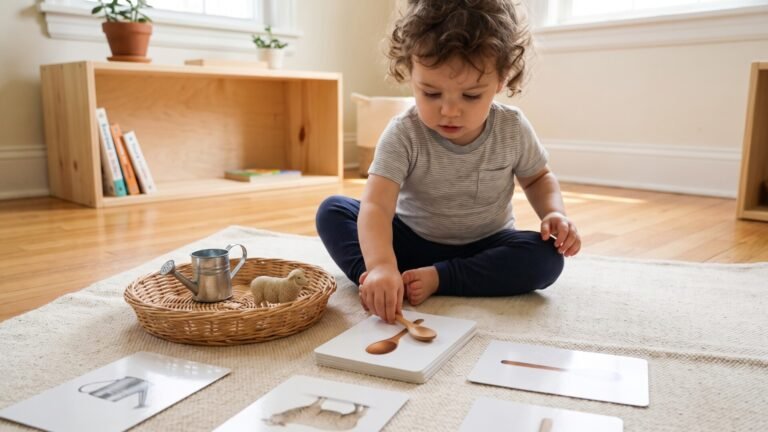
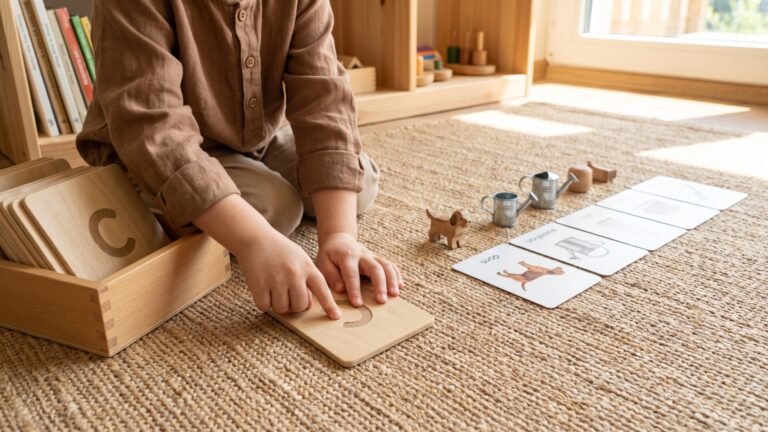
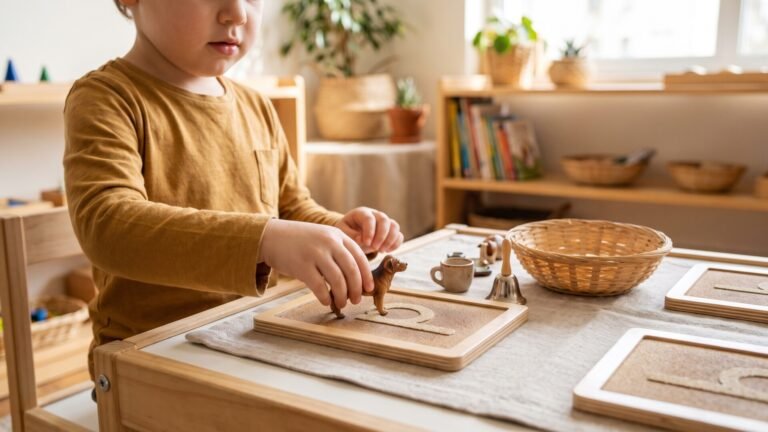
Start with pairs of familiar objects: a spoon, a cup, a sock, a toy animal, a small household item. Put two of each in front of the child, name them clearly, and invite matching.
The presentation matters more than the objects. Introduce one or two at a time. Say the word once, clearly, without adding a paragraph around it. Then let them handle the pieces. When they hand you the matching spoon, name it again on the way back.
Real objects beat themed flashcards at this age for a simple reason: they are tactile and meaningful. A child can put a real sock on their foot. They cannot do anything with a picture of a sock except look at it, and looking is the least interesting thing a two-year-old does.
Safety note: use large objects that cannot become choking hazards. Anything that fits through a toilet paper tube is too small. Supervise anything breakable, and skip small magnets entirely.
Picture matching and vocabulary baskets
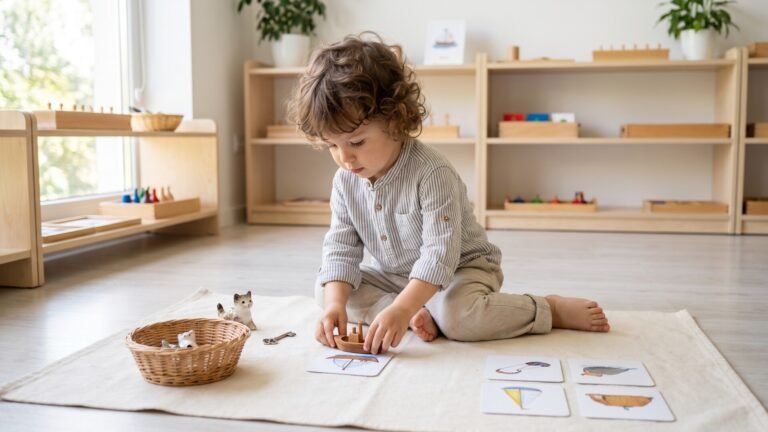
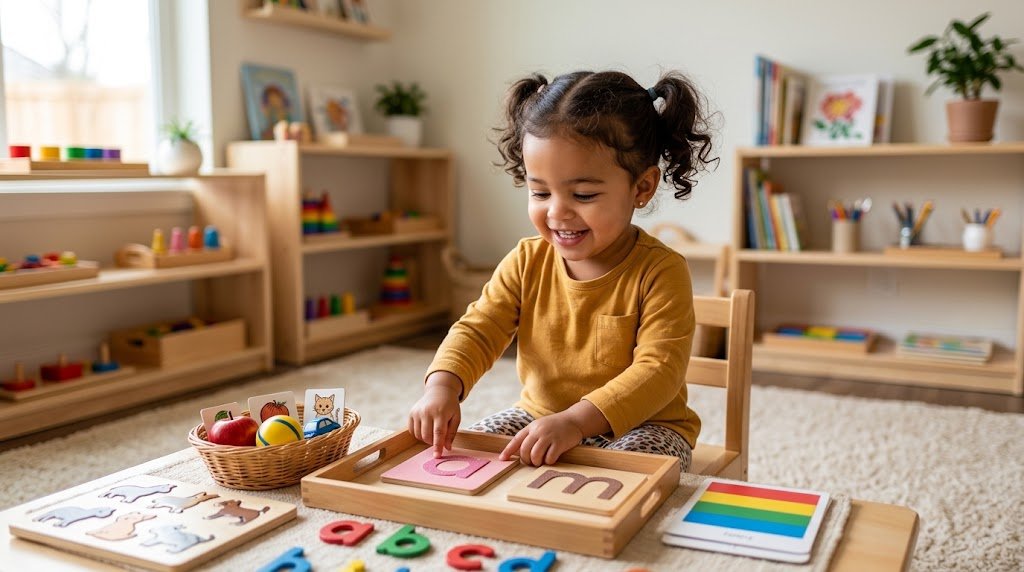
Simple cards or sturdy picture materials work well once a child has some object vocabulary. Choose familiar categories: foods, animals, vehicles, clothing, household items. Realistic images, not cartoons with faces on the apples.
The three-period lesson, translated for people without a Montessori certificate:
- Name it. "This is a cow."
- Ask them to identify it. "Show me the cow."
- Invite them to name it. Point at it and wait. If they say nothing, name it and move on.
That third period is where parents go wrong. It is an invitation, not a demand. If your child is not ready, you stay in period two for another few weeks. That is normal and not a failure.
Vocabulary baskets can be built from household objects, books, and photographs, which means you can skip buying a complete set. A basket with a real wooden spoon, a real sponge, and a real key teaches more than a box of ninety laminated cards, and it costs nothing.
Sound games with environmental noises
Listening games build careful listening and turn-taking without any formal letter-sound instruction. This is the part people skip, and it is arguably the most useful thing on this list.
Try these:
- "Can you find what is making that sound?" while the washing machine runs.
- "The dog says woof. What does the duck say?"
- Animal sounds, vehicle sounds, household sounds, outdoor sounds.
A two-year-old who can identify a sound and name it is doing phonemic awareness work without knowing the word phonemic. That skill shows up later when they start connecting letters to sounds. For a fuller progression, see our guide to [Internal: Montessori Sound Games for Language Development].
Practical-life conversation
This is where the actual language volume lives. Snack preparation, washing hands, sorting laundry, watering plants, setting the table. Every one of these is a running commentary with a participant.
The language opportunities are specific: action words (pour, wipe, open), object names (bowl, cloth, jug), sequence words (first, then, after), descriptive words (wet, heavy, cold), requests ("can I have the spoon"), and polite exchanges.
Narrate the action without turning every moment into a lesson. "I’m pouring the water into the jug. It’s heavy. Now you try." That is a complete language activity. It took eleven seconds and cost nothing, and it will outlast every toy in this article.
The reason ordinary routines beat a toy used once and abandoned is repetition. Your child does snack preparation every day. They will handle a novelty matching set until the novelty ends.
Classification and sorting activities
Sort large, safe objects by category, function, color, texture, or where they belong. Big spoons versus small spoons. Things that go in the kitchen versus things that go in the bathroom.
Classification gives a child a reason to use words like same, different, another, big, soft, food, clothes. Those words are doing real work, which is why they stick.
Start with two contrasting groups. Three is too many. Avoid abstract categories like "things that are useful" because you will not be able to explain the rule yourself.
Keep it flexible. If your child sorts the socks by size instead of color, ask them to show you why. Insisting on one correct answer turns a language activity into a compliance exercise.
Story baskets and object-based book reading
Pair a simple picture book with two or three related objects. A farm book with a toy cow, a toy duck, and a scrap of fake grass. A bedtime book with a small blanket and a cup.
Object-based storytelling supports naming, prediction, sequencing, and recall, because the child has something to hold while the story happens. It also gives you something to do with your hands while you read the same book for the ninth time.
Choose board books with clear pictures, realistic content, repeated phrases, and short text. When your child says "cow gone," you expand it: "Yes, the cow is hiding." You do not correct it. You extend it.
Choosing Materials That a 2-Year-Old Will Actually Use
The buying decision here is not "which is best." It is "which will get used in week six."
Age fit and concrete content. Favor familiar objects, realistic images, large pieces, and activities completable in a few minutes. If it takes longer to set up than to play, it does not get played.
Safety and construction. Check age labeling, choking hazards, splinters, loose pieces, paint or finish, and whether adult supervision is required. Always verify the current manufacturer recommendation rather than trusting a listing description.
Durability and cleanup. Thick cards, solid wood or well-made plastic, wipe-clean surfaces, and storage a toddler can manage themselves. If the child cannot get it out and put it back, you become the storage system, and you will resent it by March.
Language value over decoration. Ask one question: does this create opportunities to name, match, listen, describe, classify, or tell a simple story? If the answer is "it looks nice on a shelf," that is a decoration.
Storage and repetition. A smaller set that is easy to access and repeat beats a large kit with too many pieces. This is the single most common mistake in this category.
Recommended Montessori Language Materials for 2-Year-Olds
Prices below are approximate and move around. Check current listings before you commit.
| Product | Approximate price | Best for | Language value | Space and cleanup |
|---|---|---|---|---|
| Melissa & Doug First Words Flash Cards | $8-$15 | Affordable vocabulary practice | Naming, matching, recall | Small and easy to store |
| Melissa & Doug See-Inside Matching Pairs | $15-$25 | Object and picture matching | Vocabulary, visual discrimination, turn-taking | Compact, but pieces need sorting |
| Montessori-style wooden object matching set | $20-$40 | Concrete matching work | Naming, classification, concentration | Moderate storage |
| Learning Resources Farmer’s Market Sorting Set | $20-$35 | Category and pretend-play vocabulary | Food names, sorting, descriptive language | Larger bin required |
| Hape All Seasons House or similar wooden dollhouse | $80-$150 | Open-ended storytelling | Conversation, sequencing, pretend play | Requires dedicated shelf space |
| Melissa & Doug Take-Along Wooden Barn or similar | $25-$45 | Story baskets and animal vocabulary | Naming, sound imitation, simple narratives | Moderate cleanup |
| High-quality board book collection | $20-$45 for a small set | Shared reading and repeated language | Vocabulary, recall, rhythm, comprehension | Minimal storage |
Melissa & Doug First Words Flash Cards
| Feature | Details |
|---|---|
| Age Range | Typically marketed for toddlers and young children; check the current package |
| Key Features | Picture-based first-word prompts, compact format, easy repetition |
| Price (approx) | $8-$15 |
The verdict: A practical budget choice if you want a simple naming activity without buying a large Montessori kit. Use a few cards at a time and pair them with real objects whenever possible. The cards work as a conversation prompt, not a drilling exercise.
Best for: Families building a basic vocabulary activity collection on a small budget.
Pros: Low cost, easy to store, useful for naming and matching, simple to rotate by topic.
Cons: Less tactile than real objects. Becomes repetitive if you use it as a quiz. Card durability depends entirely on how roughly they are handled.
[Affiliate: Check current pricing on Amazon]
Melissa & Doug See-Inside Matching Pairs
| Feature | Details |
|---|---|
| Age Range | Toddler and preschool range; verify the current manufacturer recommendation |
| Key Features | Chunky matching pieces with a visual matching task |
| Price (approx) | $15-$25 |
The verdict: A strong choice for a matching activity that also encourages naming and turn-taking. The value comes from repeated use: children match independently first, then use the images as prompts for short conversations.
Best for: Toddlers who enjoy puzzles, matching, and simple back-and-forth games.
Pros: Combines visual discrimination with vocabulary. Easy to introduce in short sessions. More engaging than loose flashcards for some children.
Cons: The matching can overshadow the conversation if you let it. Pieces need organized storage. Not every image will be familiar to every child, and unfamiliar images do not generate words.
[Affiliate: Check current pricing on Amazon]
Montessori-Style Wooden Object Matching Set
| Feature | Details |
|---|---|
| Age Range | Usually suitable from around age two when pieces are large and supervised |
| Key Features | Realistic or simple wooden objects for matching, naming, and classification |
| Price (approx) | $20-$40 |
The verdict: Often closer to the spirit of Montessori language work than a large alphabet kit, because it gives the child concrete objects to handle and discuss. Choose a set with large, durable pieces and a limited number of objects rather than paying for variety.
Best for: Montessori homes that prioritize tactile, open-ended materials and controlled presentation.
Pros: Supports naming, matching, and categorization. Reusable in sorting and story activities. Usually fits a minimalist shelf.
Cons: Quality varies widely by seller, and the photographs rarely tell you which one you are getting. Small pieces create real safety concerns. Requires more parent participation than a simple puzzle.
[Affiliate: Check current pricing through our recommended partners]
Learning Resources Farmer’s Market Sorting Set
| Feature | Details |
|---|---|
| Age Range | Commonly marketed for preschool learning; use selectively with a 2-year-old under supervision |
| Key Features | Pretend food pieces, baskets, and sorting or counting opportunities |
| Price (approx) | $20-$35 |
The verdict: Not a pure Montessori material, but useful for language-rich practical play. Food names, colors, quantities, requests, and pretend shopping create more natural conversation than a worksheet, provided you store the pieces safely and adapt the activity to the child’s age.
Best for: Toddlers who enjoy pretend cooking, sorting, and everyday vocabulary.
Pros: Encourages practical-life and pretend-play language. Supports categorization and descriptive words. Offers several ways to play as the child grows.
Cons: Pieces may be too numerous for a young toddler to manage. Requires supervision and a real storage solution. Some of the activities are better suited closer to preschool age.
[Affiliate: Check current pricing on Amazon]
Hape All Seasons House
| Feature | Details |
|---|---|
| Age Range | Check the current manufacturer recommendation and small-part warnings |
| Key Features | Open-ended wooden pretend-play setting with rooms and accessories |
| Price (approx) | $80-$150, depending on configuration |
The verdict: A premium option for families who want one substantial material to support years of conversation and pretend play. It is not necessary for language development. It can earn its space if your child regularly uses it for naming, role-play, sequencing, and storytelling, and it will not earn its space if they do not.
Best for: Families with room for a larger open-ended material and a child who already enjoys pretend play.
Pros: Strong long-term storytelling potential. Supports everyday vocabulary and social scripts. Remains useful well beyond age two.
Cons: Expensive compared with simple language materials. Takes up meaningful floor or shelf space. Accessories are a hidden ongoing cost.
[Affiliate: Check current pricing through our recommended partners]
Melissa & Doug Take-Along Wooden Barn
| Feature | Details |
|---|---|
| Age Range | Check the current product labeling and small-part guidance |
| Key Features | Portable themed setting with animal or farm-play elements |
| Price (approx) | $25-$45 |
The verdict: A useful middle-priced choice for animal names, environmental sounds, pretend routines, and simple stories. It works best when you add language without dominating the play. "The cow is in the barn" is more useful than asking the child to identify every animal in sequence.
Best for: Toddlers drawn to animals, sound imitation, and compact pretend play.
Pros: Portable and easy to introduce. Encourages sound games and storytelling. Familiar theme for many toddlers.
Cons: Themed play will not interest every child. Small accessories require careful storage. Less open-ended than a neutral object set.
[Affiliate: Check current pricing on Amazon]
High-Quality Board Books
| Feature | Details |
|---|---|
| Age Range | Choose sturdy board books labeled for toddlers |
| Key Features | Clear images, repeated language, short stories, familiar subjects |
| Price (approx) | $20-$45 for a small collection |
The verdict: Books are the most consistently useful language purchase you can make. They support shared attention, vocabulary, memory, and conversation while taking up almost no space. Look for a small rotation rather than a large library, and keep the titles your child asks for repeatedly.
Best for: Every family, especially homes with limited space or limited appetite for structured activities.
Pros: High repeat value. Supports both understanding and speaking. Easy to adapt to whatever the child is currently interested in.
Cons: Requires regular adult participation, which is the point and also the catch. Some books are too visually busy or text-heavy to work at this age. Board books can still be destroyed by a determined child.
[Affiliate: Check current pricing through our recommended partners]
Skip This If: Large Alphabet and Worksheet Kits
Formal alphabet workbooks, oversized flashcard bundles, and complex "genius" kits are usually a poor first purchase for a two-year-old, and they are the most heavily marketed thing in this category.
They look educational. What they mostly produce is passive recognition or adult-led drilling, neither of which is meaningful communication. A child who can point at a letter when asked has learned a party trick. A child who can tell you what they want has learned something they will use forty times before lunch.
Spend the budget on books, real objects, and one durable open-ended material instead. Alphabet materials become more appropriate later, depending on the child’s interest and readiness. For the next stage, see [Internal: Montessori Toys for Early Letter Recognition].
What Most Buyers Get Wrong About Montessori Language Activities
They buy materials instead of changing the interaction. A parent who names, listens, expands, and takes turns can create valuable language practice with a wooden spoon and a laundry basket. A parent who does none of those things will get nothing out of a $150 dollhouse.
They introduce too much at once. A full box of cards or objects reduces concentration and makes cleanup a chore for you. A small, rotating selection works better, and it works better for a reason that has nothing to do with Montessori philosophy: toddlers cannot process a pile.
They confuse quiet independent play with language learning. Independent exploration has real value. It is not language practice. Conversation, shared reading, and responsive interaction are where the words come from, and those require a second person.
They push letters before vocabulary. For most two-year-olds, naming familiar objects, following simple directions, describing actions, and enjoying books are more useful starting points than letter drills. The letters will still be there at four.
ToyGuideHub Independent Play Score
This score is an editorial framework, not a lab test. We rate each material from 1 to 5 on four things: how easily a two-year-old can begin using it without help, how many different ways it can be reused, how much adult setup it requires, and how long it is likely to stay useful.
| Material | Independent start | Replay value | Parent setup | Ownership verdict |
|---|---|---|---|---|
| First Words Flash Cards | 3/5 | 3/5 | Low | Best as a short guided activity |
| See-Inside Matching Pairs | 4/5 | 3/5 | Low | Good for matching-focused toddlers |
| Wooden object matching set | 3/5 | 4/5 | Medium | Stronger long-term value with adult modeling |
| Farmer’s Market Sorting Set | 3/5 | 4/5 | Medium | Better for pretend play than isolated lessons |
| Hape All Seasons House | 4/5 | 5/5 | Medium | High potential if the child enjoys pretend play |
| Take-Along Wooden Barn | 4/5 | 4/5 | Low to medium | Good compact themed choice |
| Board books | 2/5 alone, 5/5 with an adult | 5/5 | Low | Best overall language value |
The interesting result is at the bottom. Board books score a 2 for independent use and a 5 for long-term language value, which is the highest spread in the table. That is the whole trade-off in one row.
The highest independent-play score is not automatically the best language purchase. A dollhouse a child can use alone for twenty minutes is a good toy and a mediocre language tool. A book that requires you to sit down and read it is a mediocre toy and the best language tool in the list. If you are buying for language specifically, you are buying for interaction, and interaction is the thing you cannot outsource.
Use the framework to avoid buying materials that look impressive on a shelf and rarely get touched. Then score your own home materials the same way, based on actual use rather than appearance. Most parents find the cheap stuff scores higher than they expected and the expensive stuff scores lower.
How to Build a Simple Weekly Language Shelf
Keep only a few choices available at once: one or two board books, one object or picture activity, and one practical-life or pretend-play material. That is the whole shelf. It should fit on one low unit.
A sample rotation, one thing per day:
- Object naming and matching. Two pairs of familiar objects.
- Snack preparation vocabulary. Pouring, wiping, naming the food.
- Sound game. Listening for the washing machine, the door, the dog.
- Shared story basket. One book, two related objects.
- Free conversation during a household routine. Laundry sorting is the reliable one.
Watch for the signals. If the child repeats the activity, adds words, or returns to it on their own, keep it available. If they avoid it, simplify it or rotate it out. Avoidance is information, not defiance.
Storage advice that actually works: low open shelving the child can reach, labeled baskets for you rather than a complicated sorting system for them, and immediate removal of anything damaged or unsafe. A broken piece is not a project. It is a bin item.
How to Choose the Right Option
Best Overall
A small board-book rotation combined with real-object naming and one open-ended pretend-play material. This gives you the strongest language value without a costly kit, and it adapts as the child’s vocabulary grows.
Best Budget Pick
Melissa & Doug First Words Flash Cards, or a homemade basket of familiar household objects paired with sturdy board books. The homemade version is genuinely competitive here, which is unusual and worth saying plainly.
Best for Small Spaces
Board books, a compact matching set, and a small pouch of large, safe objects. Avoid dollhouses and large sorting kits unless you already have somewhere to put them.
Best for Montessori Homes
A Montessori-style wooden object matching set, realistic picture cards, practical-life routines, and carefully selected board books. For the wider category, see our [Internal: Montessori Language and Literacy Toys: Complete Guide].
Best for Pretend Play and Storytelling
The Melissa & Doug Take-Along Wooden Barn for a lower-cost themed option, or the Hape All Seasons House for a premium, longer-use choice.
Best for Parents Concerned About Screen-Free Learning
A small shelf with books, real objects, and one matching or sorting activity. The quality of the interaction matters more than the number of materials, and this is the category where that is most obviously true.
The Hidden Costs of Choosing the Wrong Material
The obvious cost is the unused kit. A $30 bundle is poor value if the child ignores most of the pieces or you cannot face the setup. That is a $30 lesson, and most parents learn it more than once.
Storage and replacement are the quieter costs. Large pretend-play sets with many accessories need a home, and the accessories go missing in a predictable order. Replacement pieces are frequently priced in a way that makes you consider buying the whole set again, which is the business model.
Time is the cost nobody counts. An activity that requires constant adult correction, sorting, or preparation is not a five-minute activity. It is a fifteen-minute activity with a five-minute payoff, and it will get skipped on the days you are tired. Those are most days.
The long-term value rule: buy the material that can support at least three kinds of play, such as naming, matching, and storytelling, rather than a product limited to one scripted task. A set of wooden animals can be named, sorted, hidden, and turned into a story. A worksheet can be completed once.
The Cheaper Truth
You can spend $300 on this and get roughly the same outcome as spending $40, provided the $40 goes to books and the $300 does not.
The materials that earn their money are the boring ones. A small stack of board books you read until the spine gives out. A matching set that lives on a low shelf and gets pulled down twice a week. A wooden barn that turns into a vet clinic, a parking garage, and a place where the cow has strong opinions. Everything past that is you buying the feeling of having prepared, which is a real feeling and not a useful purchase.
Spend more only in two situations. First, if your child has already shown you they will use a big open-ended material for months, in which case the Hape house is a reasonable place for the money to go. Second, if durability genuinely matters to you because this is the third child and the first two destroyed everything, in which case solid wood over card stock is a defensible upgrade.
For everyone else, the answer is fewer things, used more often, with you sitting on the floor talking about them. Check current pricing and availability through our recommended partners if you want the shortlist, and if you want the next stage of this, our [Internal: Montessori Pre-Reading Activities for Toddlers] and [Internal: Montessori Language Activities for Preschoolers] guides pick it up from here.
Frequently Asked Questions About Montessori Language Activities For 2-Year-Olds
Are Montessori language activities appropriate for every 2-year-old?
They can be adapted for different interests, communication styles, motor abilities, and attention spans. Follow your child’s engagement rather than expecting them to use materials the way a book or a video demonstrates. Some two-year-olds will sit with a matching set for ten minutes. Others will throw it. Both are within normal range.
Should a 2-year-old be learning letters?
Some two-year-olds show genuine interest in letters, and there is no harm in following that. Formal letter work is not required for language development at this age. Vocabulary, conversation, listening, books, and practical experiences are the appropriate foundation, and letters land more easily once that base exists.
How long should a Montessori language activity last?
A few minutes is a real session. The useful measure is engagement, not duration. Stop while the child is still interested, because the ending is what they remember, and repeat the activity on another day. A two-minute activity done four times a week beats a twenty-minute activity done once.
Are flashcards Montessori?
Flashcards are not automatically Montessori or non-Montessori. What matters is realistic content, limited presentation, active conversation, and whether they complement rather than replace real experiences and books. A flashcard used as a conversation prompt is fine. A flashcard used as a quiz is a different product wearing the same clothes.
What should I do if my 2-year-old will not repeat words?
Model words naturally, avoid pressure, offer choices, and respond to all forms of communication, including pointing and gestures. If you have concerns about hearing, understanding, or communication development, discuss them with a qualified pediatric or early-childhood professional. Do not use a toy list, including this one, as a substitute for that conversation.
Are wooden toys better for language development?
Material alone does not create language learning. Wood can be durable and pleasant to handle, and it often survives a sibling better than card stock. But a simple book, a household object, or a pretend-play prop may produce more conversation than an expensive wooden set. Buy wood for durability if you like. Do not buy it for vocabulary.
How many Montessori language toys does a toddler need?
A small rotation is usually enough: a few books, one matching or sorting activity, and accessible real-life or pretend-play materials. More products create clutter without adding useful language opportunities. If you are unsure whether you have enough, count how many are currently in use. That number is your answer.
Do I need to buy anything at all?
No. A basket of safe household objects, a library card, and fifteen minutes of narrating your day will cover most of what this article describes. Buying materials makes the activities easier to repeat and easier to store. It does not make them work.