Montessori Language and Literacy Toys: Complete Guide
It is 4:40 on a Tuesday and you are standing in the toy aisle holding two boxes. One is a wooden alphabet puzzle with a picture of a smiling acorn on the front. The other is a plastic phonics tablet that says forty-two words out loud in a voice you can already hear in your sleep. Both boxes say Montessori. Both cost roughly the same. Your child is two and a half, has just learned to say "no" with real conviction, and currently prefers the box the dishwasher came in.
Here is the thing the packaging will not tell you: the best Montessori language toys are usually the ones with the fewest letters on them. Not the most. A child does not learn to read by being surrounded by alphabet products. They learn by hearing words, saying words, noticing that words are made of sounds, and only then connecting those sounds to symbols they can touch and move. That sequence is the whole game, and it is worth more than any single purchase you will make this year.
This guide walks the progression, names the materials that actually hold up, and tells you which popular options to skip. Age and readiness decide more than piece count.
What Montessori Language Toys Are Designed to Support
Montessori language work follows a sequence that runs from spoken language to written language, not the other way around. Children build vocabulary first, through naming, conversation, and real objects. Then they tune their ears to the sounds inside words. Only after that do they meet letters as symbols, trace them, and eventually arrange them into words they can already say.
A language toy in this tradition invites a child to do something active: hear it, touch it, match it, sort it, name it, or build with it. A toy that merely displays letters and plays a jingle is not doing the same job, even if the box has the word Montessori printed on it twice.
That distinction matters because Montessori labeling in retail is inconsistent at best. There is no universal standard controlling who can use the term on a toy box. Some genuinely thoughtful materials carry it. So do a lot of plastic tablets with a wooden-look sticker. Assess the design and how you would actually use it, not the marketing copy.
One more thing worth saying plainly: no toy teaches language on its own. Materials supplement conversation, stories, songs, and shared reading. A child who gets twenty minutes of alphabet puzzle and no conversation has a worse deal than a child with no alphabet puzzle and a parent who narrates the grocery store. The toys are the garnish, not the meal.
Choosing Toys by Developmental Stage
Toddlers: language, vocabulary, and listening
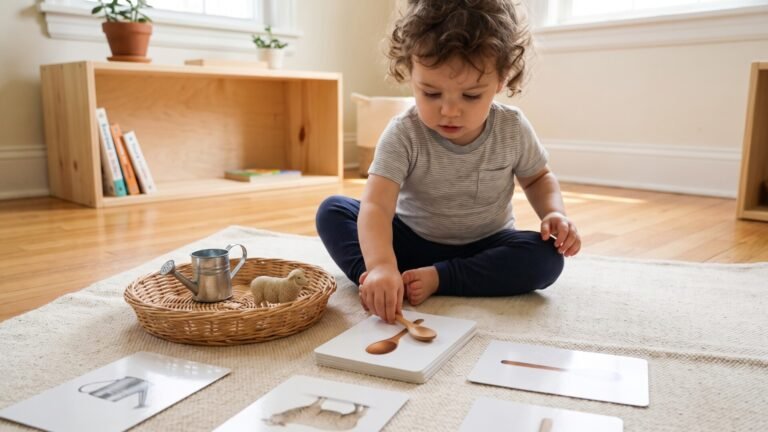
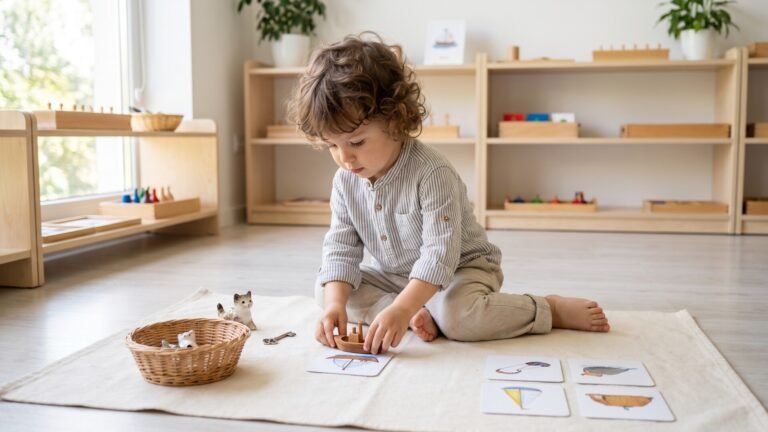
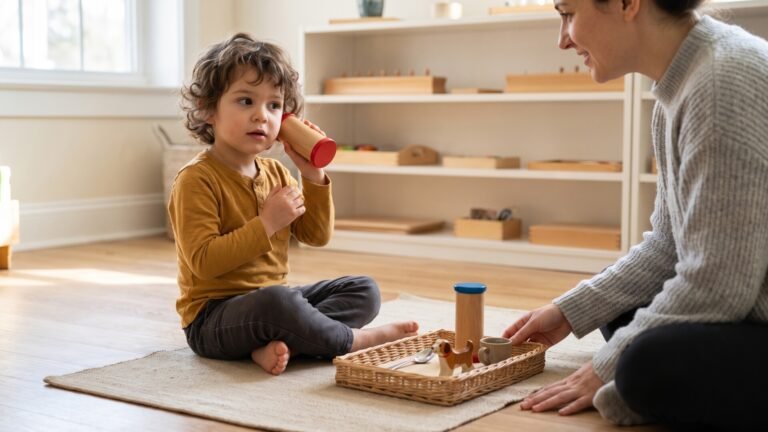
For a two-year-old, the highest-value language materials are not letters at all. They are realistic objects, object-to-picture matching sets, simple picture cards, and anything that gives you a reason to name things out loud. A basket of small farm animals and matching photos will do more for language development than an alphabet poster, because it generates conversation.
Naming familiar objects, describing what you are doing, and expanding what your child says back to you – "yes, a big red truck, it is going fast" – is the actual curriculum at this age. Alphabet memorization is not a goal here, and pushing it usually produces a child who can sing the song and cannot hear that "cat" starts with the same sound as "cup."
If you want a structured place to start, our [Internal: Montessori Language Activities for 2-Year-Olds] covers the practical setup, and [Internal: Montessori Pre-Reading Activities for Toddlers] walks through the sound and listening games that come before any letter work.
Preschoolers: sounds, symbols, and writing readiness
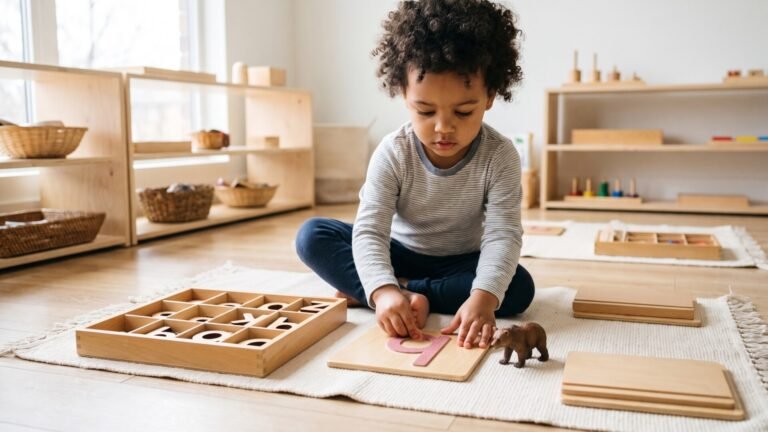
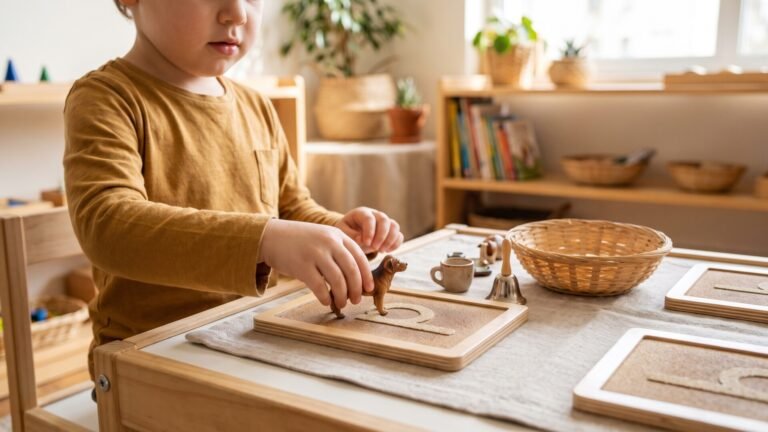
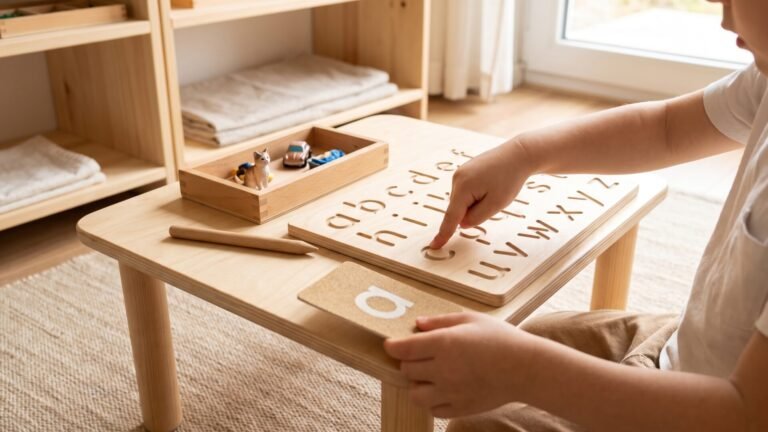
Somewhere between two and a half and four, most children start noticing that letters exist and mean something. This is when beginning-sound games, sandpaper-style letters, tracing materials, and alphabet matching earn their place on the shelf. Movable letters can come in too, once the child handles small pieces safely and shows genuine interest in symbols.
The trap here is assuming that letter recognition means reading readiness. Plenty of three-year-olds can name every letter and cannot blend a single word, because blending is a different skill that comes later. Keep presentations short and playful. Two minutes of sound game at the right moment beats fifteen minutes of table work that ends in tears.
Our [Internal: Montessori Toys for Early Letter Recognition] covers this stage in detail, and [Internal: Montessori Sound Games for Language Development] explains the listening games that make the letters mean something once they arrive.
Older preschoolers and beginning readers
Once a child can hear individual sounds and knows a decent number of letter symbols, the movable alphabet becomes the workhorse. They can build words they cannot yet write, which is the entire point – spelling out "sun" with loose letters is a real literacy act, and it does not require the hand control that handwriting demands.
This is also when phonetic object sets, simple word-building materials, and early readers start pulling weight. The progression runs from hearing sounds, to connecting sounds with symbols, to composing simple words. Writing tools come alongside, not before.
For the full sequence, [Internal: Montessori Language Activities for Preschoolers] maps out what to introduce and roughly when.
Key Buying Factors for Montessori Language and Literacy Toys
Developmental fit
Ask what the material actually builds: vocabulary, listening, sound awareness, symbol recognition, writing control, or word construction. A toy that does none of these clearly is decoration. Buying advanced materials because they look educational is the most common mistake in this category, and it produces a shelf of things your child is not ready for and you feel vaguely guilty about.
Hands-on quality and durability
Compare wood against cardboard against plastic honestly. Wood is not automatically better – a well-made plastic letter set beats a splintering wooden one every time. What matters is whether the pieces survive being dropped, whether the paint stays on, and whether the set has somewhere for its parts to live.
A well-organized set with a tray gets used far longer than a bigger loose-piece kit, because the tray is the difference between "we can do this for five minutes" and "I am not getting all ninety-two of those out right now."
Clarity and sensory design
Look for uncluttered images, readable letter forms, accurate sound associations, and tactile surfaces that stay distinct after a few months of handling. A sandpaper letter whose texture has worn smooth is a wooden board with a letter printed on it. Sets that overload the child with competing prompts – flashing lights, sounds, colors, and letters all at once – tend to get used less, not more.
Parent usability and safety
Ask whether you can introduce the material simply, whether the pieces are choking hazards, and whether the set resets easily at the end of the day. Small letters and cards need supervision and a storage plan. Follow the manufacturer’s age and choking-hazard warnings, inspect wooden parts for damage, and keep small pieces away from children who still mouth objects. If you are unsure about a specific product’s suitability, check the current package guidance rather than a blog post, including this one.
Recommended Montessori Language and Literacy Toys
The shortlist below covers different stages and budgets. No single one of these teaches the whole language progression, and buying all of them at once would be a mistake. Pick the one that matches where your child is now.
Melissa & Doug See-Inside Alphabet Peg Puzzle
| Feature | Details |
|---|---|
| Age Range | Toddlers and preschoolers; check current package guidance |
| Key Features | Wooden alphabet pieces, matching puzzle spaces, large handles |
| Price (approx) | Usually around $15-$25 |
| Loud | No |
| Lost by March | Maybe the Q |
The Verdict
A practical first alphabet material for children who enjoy matching and pulling pieces out. It supports letter exposure and hand-eye coordination, and it is genuinely hard to break. It is not a phonics system and should not be treated as one.
Best For: Toddlers starting to notice alphabet symbols, and parents who want an affordable, low-complexity introduction.
Pros
- Familiar puzzle format with clear visual matching
- Large pieces suit young hands
- Inexpensive and easy to store on a shelf
Cons
- Supports recognition, not sound blending
- Completing the puzzle can become pure visual matching
- Gets outgrown once the alphabet is familiar
[Affiliate: Check current pricing through our recommended partners]
Melissa & Doug Wooden Alphabet Letters
| Feature | Details |
|---|---|
| Age Range | Preschool and early school years; follow current safety guidance |
| Key Features | Loose wooden uppercase letters for sorting, matching, and supervised word play |
| Price (approx) | Usually around $10-$20 |
| Loud | No |
| Storage | You will need a bin |
The Verdict
A flexible budget option for parents who want reusable letters rather than a one-purpose puzzle. Its value depends almost entirely on what you do with it. Sort by shape, match against lowercase letters you write yourself, build a familiar name. Left alone in a bag, it is just a bag of letters.
Best For: Flexible alphabet play on a small budget.
Pros
- Supports several stages of letter play
- Simple format encourages open-ended use
- Cheaper than any specialized literacy set
Cons
- Often uppercase only, with no phonetic organization
- Loose pieces need a storage solution you provide
- Structured learning requires adult guidance
[Affiliate: Check current pricing through our recommended partners]
Montessori Sandpaper Letters
| Feature | Details |
|---|---|
| Age Range | Preschool, when the child is ready for tactile letter work |
| Key Features | Textured letters on wooden boards, tactile tracing, vowel and consonant sets |
| Price (approx) | Approximately $25-$60 depending on construction and set size |
| Loud | No |
| Storage | Boards stack flat |
The Verdict
These are among the most recognizable Montessori language materials because they link letter shape, movement, and sound in one activity. Quality varies enormously. Prioritize clear lettering, durable texture, and a consistent lowercase style across the set. A cheap set with worn texture and confusing letter forms is worse than no set.
Best For: Children ready to connect letter sounds with tactile symbols.
Pros
- Combines visual, tactile, and movement-based learning
- Supports short repeated presentations
- Useful across several months of practice
Cons
- Not suitable for children still mouthing materials
- Inexpensive sets often have weak texture or odd letter forms
- Requires accurate sound presentation from an adult
[Affiliate: Check current pricing through our recommended partners]
Montessori Movable Alphabet
| Feature | Details |
|---|---|
| Age Range | Preschool through early reading, depending on readiness |
| Key Features | Loose lowercase letters, tray or compartments, color or sound grouping in some sets |
| Price (approx) | Approximately $30-$90 |
| Loud | No |
| Lost by March | Several vowels, always |
The Verdict
A stronger long-term purchase than a decorative alphabet set, because it lets a child compose words before handwriting is fluent. It is most useful after the child has real sound awareness and some familiarity with letter symbols. Bought early, it becomes a tray of small objects to scatter.
Best For: Children beginning to build phonetic words, and parents who want a material with extended use.
Pros
- Supports word composition before fluent handwriting
- Grows from simple sound work into early spelling
- Substantial replay value across a year or more
Cons
- Too advanced for many toddlers
- Small letters scatter and vanish
- Needs an organized tray and adult modeling
[Affiliate: Check current pricing through our recommended partners]
Learning Resources Alphabet Island or Similar Letter-Matching Game
| Feature | Details |
|---|---|
| Age Range | Usually preschool; check current product guidance |
| Key Features | Colorful letter pieces, matching or game-based play, recognition practice |
| Price (approx) | Usually around $15-$30 |
| Loud | No, unless you count the children |
| Storage | Box, eventually a bag |
The Verdict
A more playful mainstream choice for children who resist quiet tabletop materials. It often generates quicker engagement than plain wooden letters, though the game structure rewards speed and matching over careful sound work. That is fine as a supplement and insufficient as a phonics plan.
Best For: Families wanting a lively bridge between alphabet recognition and structured play.
Pros
- Engaging format for children who prefer games
- Useful for matching and letter naming
- Easy to introduce without a long lesson
Cons
- Less open-ended than loose letters
- Busier visual design than Montessori-style materials
- Recognition does not automatically become phonics knowledge
[Affiliate: Check current pricing through our recommended partners]
Melissa & Doug Lace and Trace or Preschool Writing Practice Materials
| Feature | Details |
|---|---|
| Age Range | Preschoolers developing hand control; follow current guidance |
| Key Features | Tracing, lacing, line practice, or early writing movements depending on the set |
| Price (approx) | Usually around $15-$30 |
| Loud | No |
| Storage | Flat, which is the point |
The Verdict
Writing readiness is part of literacy, and parents routinely skip it. Letter worksheets get introduced before a child has the control or interest to use them. A tracing and fine-motor material is often the better bridge, especially alongside drawing, practical work, and short letter-writing invitations.
Best For: Preschoolers who need hand preparation before formal handwriting practice.
Pros
- Builds control without demanding full letter formation
- Often supports independent repetition
- More approachable than worksheets
Cons
- Does not teach reading
- Some children prefer drawing or real-life fine-motor work
- Limited use once hand control improves
[Affiliate: Check current pricing through our recommended partners]
A Phonetic Object and Picture Matching Set
| Feature | Details |
|---|---|
| Age Range | Preschool and early reading stages, with adult supervision |
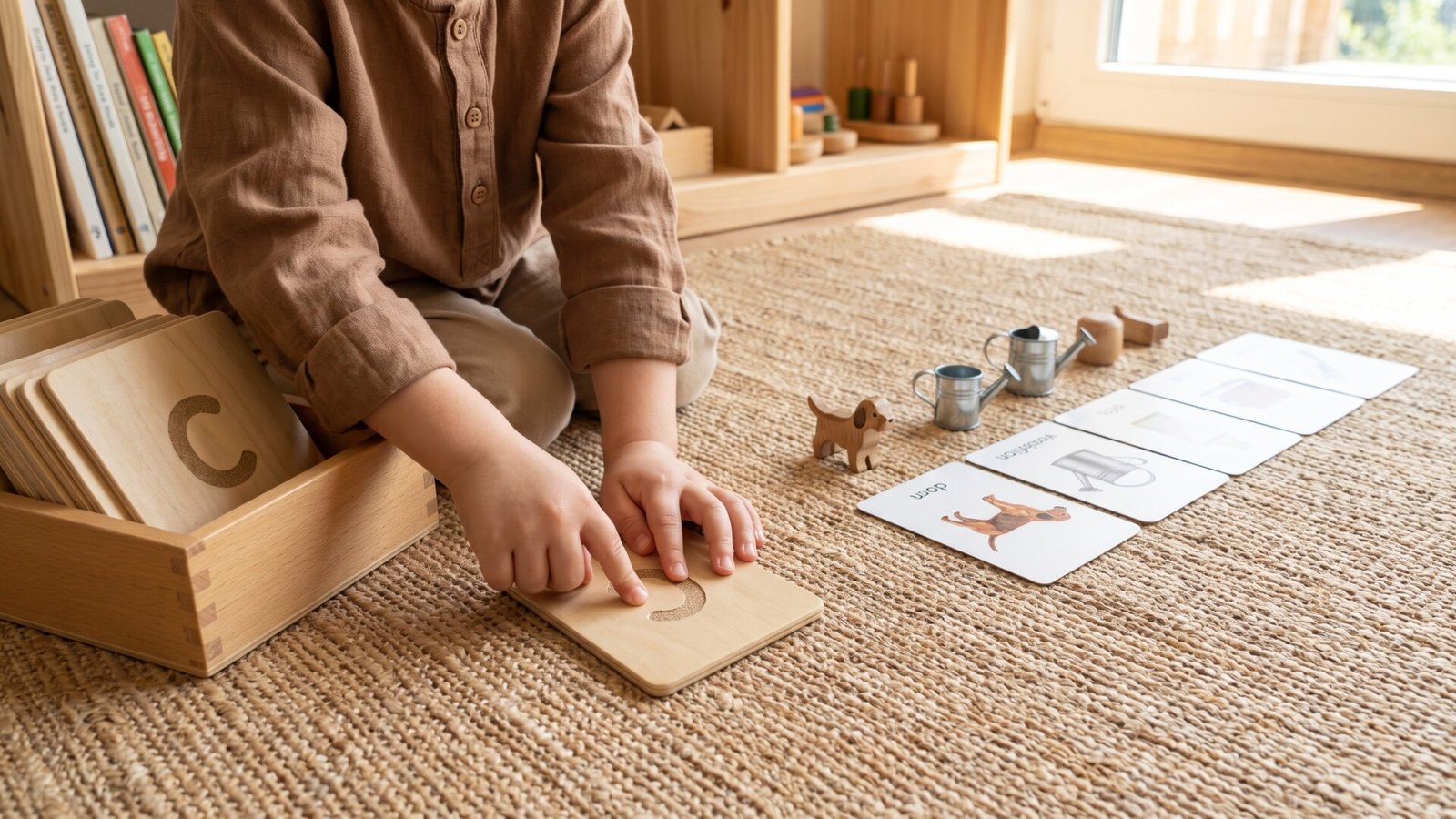
| Key Features | Small objects or clear pictures paired with beginning sounds or movable letters |
| Price (approx) | Approximately $20-$70 depending on contents |
| Loud | No |
| Supervision | Required |
The Verdict
This category delivers more meaningful phonics practice than an alphabet poster, because the child connects a spoken sound to a concrete object and then to a symbol. Choose a set with familiar objects, accurate pictures, and enough pieces to build varied short activities. Quality and sound choices vary substantially between sellers.
Best For: Children moving from letter recognition into beginning-sound and word-building work.
Pros
- Connects sounds with meaningful vocabulary
- Supports sorting, matching, and early word building
- Adaptable across skill levels
Cons
- Specialist sets can be expensive
- Small objects need careful storage and supervision
- Sound choices vary between sellers
[Affiliate: Check current pricing through our recommended partners]
Comparison Table
| Product or Material | Best Stage | Main Skill | Durability and Storage | Price Range | Best For |
|---|---|---|---|---|---|
| Melissa & Doug See-Inside Alphabet Peg Puzzle | Early toddler and preschool | Letter recognition and matching | Good; pieces need a shelf or bin | $15-$25 | First alphabet exposure |
| Melissa & Doug Wooden Alphabet Letters | Toddler through preschool | Open-ended letter play | Moderate; loose pieces need storage | $10-$20 | Budget flexibility |
| Montessori Sandpaper Letters | Preschool | Sound-symbol connection and tracing | Varies; boards store well | $25-$60 | Tactile letter learning |
| Montessori Movable Alphabet | Preschool and beginning reading | Word composition and early spelling | Good if stored in a compartment tray | $30-$90 | High replay value |
| Learning Resources Alphabet Island or similar | Preschool | Recognition and matching | Moderate; pieces need organization | $15-$30 | Playful practice |
| Phonetic object and picture set | Preschool and early reading | Beginning sounds and phonics | Varies; small pieces need supervision | $20-$70 | Sound-to-word work |
What Most Buyers Get Wrong About Montessori Language Toys
The most common mistake is buying the complete alphabet too early. A full set of sandpaper letters, a movable alphabet, and a phonics game bought for a two-year-old produces an impressive shelf and no language work. The materials sit there looking educational while the child plays with the box, and the parent concludes the child is not ready for "learning." The child was ready for vocabulary and sound games. Nobody sold them that.
The second mistake is confusing passive exposure with active work. Alphabet posters, electronic letter sounds, and educational videos all provide exposure. Naming, listening, matching, tracing, and composing are active work. Exposure is not harmful, but it does not build the same thing, and a wall covered in letter charts is not the same as ten minutes of sound games at the kitchen table.
The third is the assumption that Montessori materials must be expensive, handmade, or made entirely from wood. They do not. The learning sequence matters more than the material’s aesthetic. A cheap set of wooden letters used well beats a $90 imported set that never leaves the shelf.
Which brings us to the counterintuitive part. The best first language toy for most families is not an alphabet product at all. It is a basket of realistic objects, a stack of picture books, or a habit of narrating what you are doing. Those cost almost nothing and do more for language than anything in the toy aisle.
Which Toys Still Make Sense After Six Months?
This is the ToyGuideHub Replayability Analysis, scoring each material from 1 to 5 on repeat use, developmental progression, activity flexibility, storage burden, and likelihood of adult reuse. It is not a durability test. It is an attempt to predict what is still in rotation next spring.
| Material | Replayability | What Limits It |
|---|---|---|
| Movable alphabet | 5 | Nothing, if the child has sound awareness. Small letters vanish. |
| Quality sandpaper letters | 4 | Texture wears; child outgrows it once sounds are solid. |
| Phonetic object set | 4 | Depends entirely on readiness; useless if bought early. |
| Wooden alphabet letters | 3 | Needs you to invent activities. |
| Alphabet peg puzzle | 3 | High accessibility, short lifespan. |
| Letter-matching game | 2 | Fun for a season, then the novelty is gone. |
| Tracing and lacing materials | 2 | Retired once hand control improves. |
The pattern is consistent. Materials that let a child do more than one thing score highest. The movable alphabet starts as sound sorting, becomes word building, becomes early spelling, and eventually supports sentence work. That is four jobs from one tray. An alphabet puzzle does one job, does it well, and then it is done.
What tends to limit ownership value is predictable: pieces too small to manage, sets with a single narrow activity, unclear letter forms, and poor storage. The last one is underestimated. A material with no home gets put away in a bag, and a material in a bag gets forgotten.
Here is the rule of thumb worth carrying out of this section. Buy one material for your child’s current stage, and one "next step" item only if you have a clear plan for when and how you will introduce it. Two materials used well beat six materials displayed.
How to Build a Small Montessori Language Shelf
Build in stages, not all at once. Books and conversation materials first. Then one simple matching or sound activity. Then tactile letters. Then movable letters and early writing tools. Each stage earns its place when the previous one is comfortable.
Rotate one or two materials at a time rather than displaying every alphabet product you own. A shelf with three things on it invites use. A shelf with twelve things on it invites nothing, because the child cannot see what to choose.
Presentations should be short. Name the object or sound, demonstrate once, invite the child to try, and stop before frustration sets in. Two minutes that end well beat fifteen that end in a meltdown, and the child will come back tomorrow.
On safety, the practical version: supervise small pieces, inspect wooden parts for cracks and loose paint, keep materials away from children who still mouth objects, and follow the manufacturer’s age and choking-hazard warnings. If a set has small magnets or loose parts, check the current guidance before handing it to a child who puts things in their mouth.
How to Choose the Right Option
Best budget pick
The Melissa & Doug Wooden Alphabet Letters or a simple alphabet peg puzzle, depending on whether your child prefers open-ended play or matching. Both land under $25 and both will survive a sibling.
Best Montessori-style investment
A well-made set of sandpaper letters, bought when the child is ready for tactile sound-symbol work and you are prepared to present the sounds consistently. The material is only as good as the presentation.
Best for long-term replayability
A Montessori movable alphabet for a preschooler who already shows sound awareness and interest in composing words. This is the one purchase on the list that keeps working for a year or more.
Best for beginning phonics
A phonetic object and picture matching set with familiar vocabulary and clear sound associations. Buy it when the child is moving out of pure letter recognition, not before.
Best for small spaces
A compact letter puzzle or a small set of tactile letters, rather than a large boxed curriculum. Storage is a real constraint, and a set with no home gets abandoned.
Best for reluctant learners
A playful matching game, or letters folded into familiar objects, names, signs, and storybooks. Do not insist on formal lessons with a child who is not interested. Come back in six weeks.
The Short Version
If your child is a preschooler who can hear sounds and wants to make words, the movable alphabet is the purchase that earns its shelf space. If they are three and just noticing letters, sandpaper letters introduced properly will do more than anything else on this list. If they are two, buy a basket of small animals and a stack of picture books, and skip the alphabet entirely for now.
Everything else here is a supporting player. The alphabet puzzle is fine. The letter game is fine. The tracing boards are fine. None of them will teach your child to read, and none of them need to, because that is not what they are for.
The thing that actually moves language forward is you, talking, naming, reading the same book for the fortieth time, and letting the child hear the sounds inside words before anyone hands them a symbol. The materials just give that work somewhere to land. [Internal: Montessori Pre-Reading Activities for Toddlers] and [Internal: Montessori Language Activities for Preschoolers] cover the parts you do without buying anything at all.
Check current pricing and availability through our recommended partners.
Frequently Asked Questions About Montessori Language Toys
Are Montessori language toys only for children who attend Montessori schools?
No. The materials work at home, but the presentation and sequence matter more than the setting. You do not need a full classroom setup. You need a calm space, realistic expectations, and activities matched to what your child can actually do this month.
What is the best Montessori language toy for a 2-year-old?
Vocabulary, naming, object matching, books, and listening games are more appropriate than formal reading materials at this age. A basket of realistic objects and matching pictures will do more than any alphabet set. Small pieces require close attention to age guidance and choking risk, so check the manufacturer’s warnings.
When should a child start using sandpaper letters?
There is no universal age, and anyone who gives you one is guessing. Look for interest in symbols, the ability to handle the boards safely, and enough attention to connect a sound with a tracing movement. Some children are ready at three, some at four and a half.
Do Montessori alphabet toys teach children to read?
They support recognition and sound-symbol knowledge, which are components of reading. Reading itself develops through a longer progression that includes spoken language, phonological awareness, word building, and shared reading. No toy on this list replaces any of that.
Are wooden Montessori toys better than plastic literacy toys?
Not automatically. Wood is not more educational, and it is not always more durable. Compare the quality of the design, the clarity of the symbols, safety, cleanability, storage, and whether your child will actually use it. A good plastic set beats a bad wooden one.
Should parents buy uppercase or lowercase Montessori letters?
It depends on the material’s purpose and the child’s stage. Lowercase forms matter for early word building, because that is what most printed text uses. Uppercase letters are often more familiar first, through names, signs, and alphabet puzzles. Having both is useful eventually; starting with lowercase is defensible.
How many Montessori language toys does a child need?
Fewer than you think. A practical home setup can begin with books, one sound or matching activity, one letter material, and a writing-readiness option when appropriate. Rotate rather than display everything at once.
Do I need a movable alphabet if my child already knows their letters?
Knowing letters and being able to build words are different skills. If your child can hear the sounds inside words and shows interest in making words, a movable alphabet gives them a way to do it before handwriting is fluent. If they cannot yet hear the sounds, wait.