Best Montessori Toys for 5-Year-Olds
If you are shopping for a toddler, this is not your article. Most of what gets sold as a Montessori toy for a two- or three-year-old is a shape sorter, a stacking ring, or a knobbed puzzle, and a five-year-old will complete any of those in about forty seconds and never touch them again. The toddler years are over. Buying down a level is the single most common mistake in this category, and it produces a shelf of toys that look educational and get ignored.
The toy that actually works for a five-year-old is the one that offers a real challenge without needing you to sit there and run it. That is a narrower target than it sounds. Toys pitched at this age tend to fall into two failures. Some are too simple and get abandoned by week two. Others are so academic they are worksheets with wooden handles, and the child can smell it.
What follows is a shortlist built around one question: will this still be in rotation by next summer?
What Makes a Montessori Toy Appropriate at Age 5?
“Montessori toy” is a marketing term more often than a description. Nobody certifies it, and plenty of products borrow the word because it photographs well next to a neutral-colored playroom. The useful question is not whether a toy is Montessori. It is whether it behaves like a Montessori material.
The traits that matter are concrete. A good material is manipulated by hand, has a clear purpose the child can see, allows for concentration without interruption, connects to something real in the world, and can be used more than one way. The best ones also let the child notice their own mistakes. A pattern block that does not fit the board is self-correcting. You do not have to tell them. That is the whole point, and it is why these toys hold attention longer than the ones that beep when you get it right.
At five, the developmental shift is real. Children this age can follow a multi-step process without losing the thread, sort and compare by more than one attribute, plan a small project and carry it out, explain their reasoning out loud, and stay with one activity for a genuinely long stretch. That last one is the one parents underestimate. A five-year-old who is interested can work on a puzzle or a build for twenty or thirty minutes. A five-year-old who is bored will last ninety seconds.
This is why age labels are close to useless on their own. Two children with the same birthday can be eighteen months apart in fine-motor control, frustration tolerance, reading readiness, and what they actually find interesting. A child who cannot yet hold a pencil steadily will find a lacing set genuinely hard. A child who reads early will find a letter-matching game insulting. Buy for the child in front of you, not the one on the box.
You will also see Montessori-inspired toys sitting next to toys that are simply well-made learning materials. That distinction is less important than it sounds. A sturdy wooden fraction puzzle and a plastic gear set can both build useful skills. Rigid brand loyalty is not the same as good judgment.
Key Buying Factors for Montessori Toys at Age 5
Challenge without frustration
The target is an activity with an obvious starting point and a reachable next step. Too easy and it is a five-minute toy. Too hard and it becomes a fight you have to referee. The best materials let the child start where they are and add difficulty without buying anything new. Camelot Jr. is a good example: the early challenges are solvable in a minute, and the later ones take real thought. Same box, same pieces, very different demand.
Independent-play potential
Ask yourself one question before buying: can my child understand the task, see their own progress, and fix their own mistakes without me managing every turn? If the answer is no, you are not buying a toy. You are buying a job. That is fine if you want the job, but be honest about it before you spend the money, because a toy that needs a parent to function gets used exactly as often as that parent is available.
Durability and ownership cost
Solid construction matters more at this age than at any other, because five-year-olds are hard on things in a specific way. They are not destructive on purpose. They are just applying real force to small objects. Wood that is properly finished and thick enough not to snap will outlast thin plywood by years. Loose parts are the other half of this. Anything with many small pieces needs a container, and the container needs a home, or you will be finding gears under the sofa until 2031.
Learning value in ordinary play
Prioritize toys that build practical skills, early math, language, spatial reasoning, fine-motor control, creativity, or observation without turning play into a test. The moment a toy starts quizzing the child, it stops being play and becomes homework. A fraction puzzle that invites a conversation about halves is useful. The same puzzle used as a flashcard drill is not.
Safety and supervision
Check the manufacturer’s age guidance and read it properly. “Montessori” is not a safety certification and never has been. Watch for small parts that a younger sibling could mouth, magnets, cords and strings, sharp or splintered edges, and any activity that involves water, tools, or loose powder. Small parts are the obvious hazard at this age, but the one parents forget is the younger sibling in the same room. A five-year-old’s toy is frequently a two-year-old’s choking risk. Supervise accordingly, and when in doubt, follow the packaging and ask the manufacturer.
What Most Buyers Get Wrong About Montessori Toys for 5-Year-Olds
The most expensive wooden toy is not automatically the best one. This is worth saying plainly because the category encourages the opposite belief. A large, beautiful, expensive set photographs well and gets played with less than a twenty-dollar box of pattern blocks, because the expensive set is often one activity dressed up with a lot of material. Price buys finish and packaging. It does not buy replayability.
The second mistake is buying too many related toys at once. It feels efficient. You get the whole shelf in one order and the playroom looks sorted. What actually happens is that the child flits between five activities, finishes none, and never builds the concentration that makes these toys worth owning. Montessori classrooms are deliberately sparse for this reason. One material, presented well, gets deeper play than six materials competing for attention.
Third, quiet play and meaningful play are not the same thing. A toy does not have to be silent or beige to teach something. A gear set is loud and plastic and teaches cause and effect better than most wooden objects on the market. Minimalist appearance is a design preference, not a learning outcome.
Here is a decision rule that cuts through most of it. Buy for the child’s next useful challenge, not for the child you imagine they will become. If they are currently obsessed with building, buy building. If they are currently obsessed with sorting, buy sorting. The child who is “going to get into science soon” does not exist yet, and the kit you buy for them will sit in the cupboard until they do.
Best Montessori Toys for 5-Year-Olds
The shortlist below spans budget, mid-range, and premium options. Each pick is chosen for a distinct use case rather than ranked against the others by price, because a twenty-dollar lacing set and a fifty-dollar brick box are not competing for the same job.
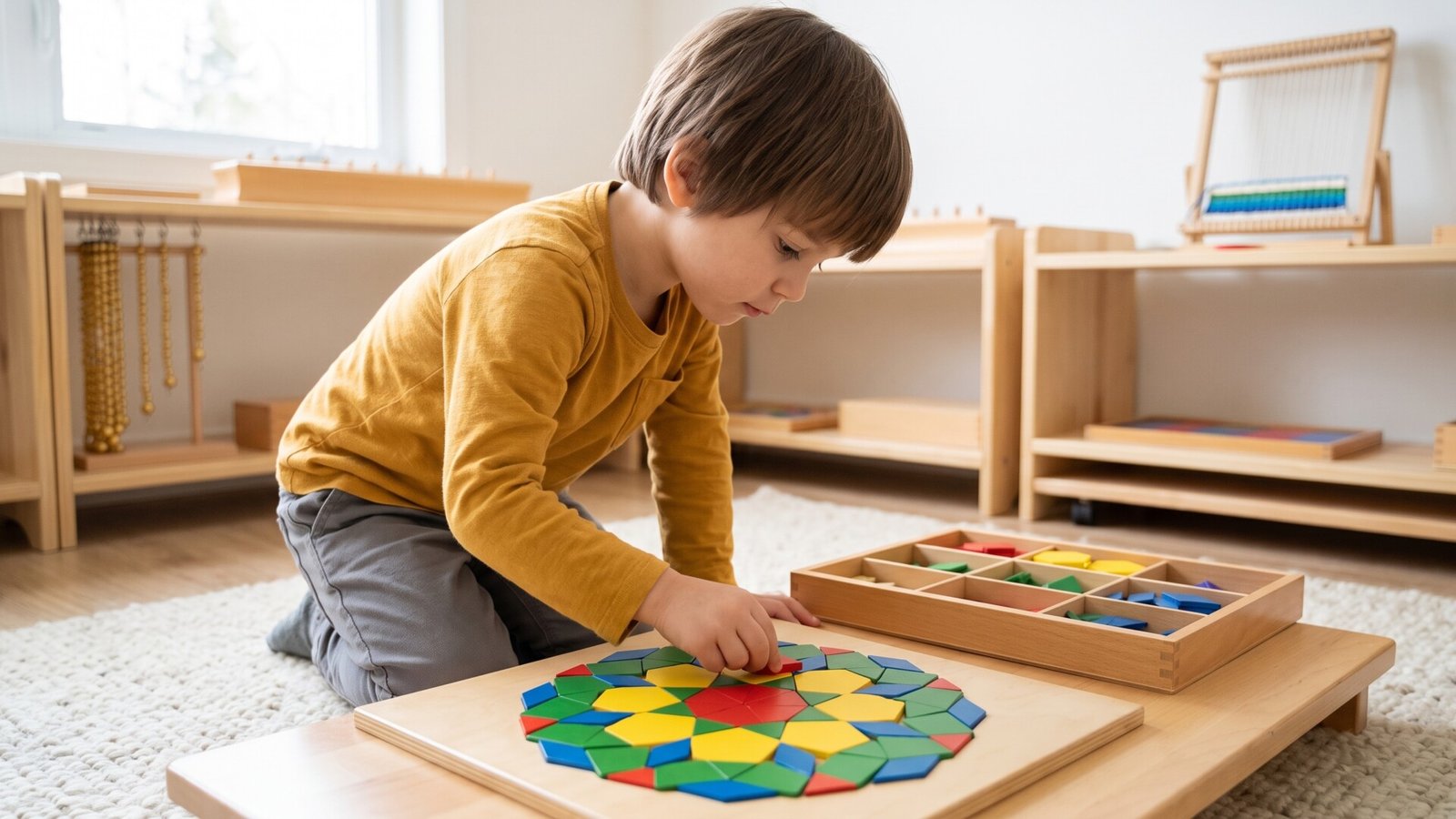
Melissa & Doug Pattern Blocks and Boards
| Feature | Details |
|---|---|
| Age range | Preschool and early elementary; confirm current packaging |
| Key features | Pattern boards, geometric pieces, visual matching, spatial reasoning |
| Price | Approximately $20-$35 |
| Noise level | Silent |
| Lost by March | A few triangles, always |
The Verdict
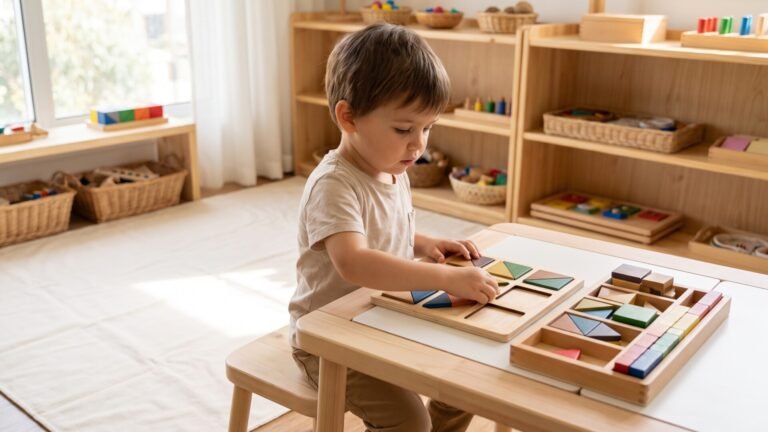
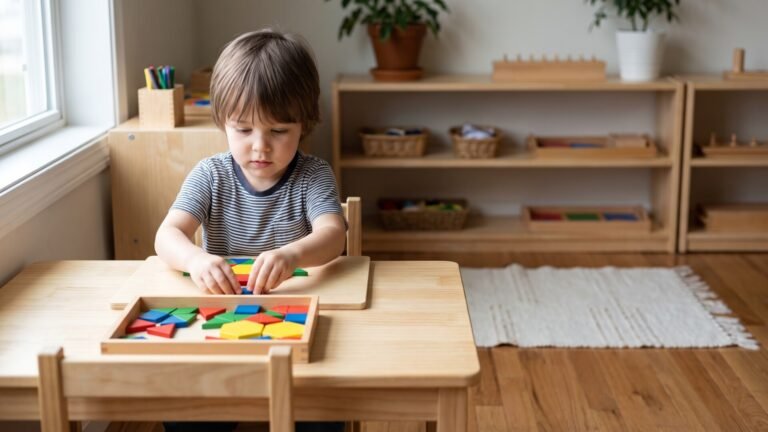
This is the strongest entry point for a child who likes puzzles, patterns, and visual challenges. The boards give a clear task with a visible finish line, which is exactly what a five-year-old needs to start independently. The same pieces then work freeform once the cards lose their novelty, which is what saves it from becoming a one-trick toy.
Best For
Children who need a structured tabletop activity that can loosen up into something more creative over time.
Pros
- Clear progression from copying patterns to designing independently
- Builds spatial reasoning and visual discrimination
- Compact, affordable, and easy to store on a tray
Cons
- Some children outgrow the included cards quickly
- Small pieces need supervision and a dedicated container
- Will not appeal to a child who wants movement or pretend play
[Affiliate: Check the price on Amazon]
Learning Resources Gears! Gears! Gears! Building Set
| Feature | Details |
|---|---|
| Age range | Preschool and early elementary; confirm current packaging |
| Key features | Interlocking gears, construction, cause and effect, problem-solving |
| Price | Approximately $25-$45 |
| Noise level | Quiet, but it does rattle |
| Floor footprint | Grows fast |
The Verdict
A good fit for children who like building systems and watching their own decisions produce movement. The learning here is genuine and it is mechanical: turn one gear, watch the whole chain respond. The strongest play happens when the child experiments with gear placement rather than copying the picture on the box.
Best For
Early engineering play and children who enjoy mechanical cause and effect.
Pros
- Encourages experimentation and revision
- Supports fine-motor and spatial skills
- Works for both guided and open-ended play
Cons
- Pieces spread across the floor with alarming speed
- Less patient children need an initial demonstration
- Novelty fades if adults always build the designs
[Affiliate: Check the price on Amazon]
LEGO Classic Large Creative Brick Box
| Feature | Details |
|---|---|
| Age range | Commonly suitable for ages 4 and up; confirm the current set |
| Key features | Assorted bricks, creative construction, visual planning, open-ended design |
| Price | Approximately $25-$55 |
| Noise level | Loud when the box is tipped out |
| Lost by March | The small specialty pieces, not the bricks |
The Verdict
The most flexible option on this list, and the one that survives the longest. A loose brick collection does not have a single intended outcome, which means it does not have an expiry date. A child who builds a house this month will build a spaceship next month out of the same box. That is why loose construction materials consistently outperform single-use themed sets on long-term value.
Best For
Open-ended building, design confidence, and repeat play.
Pros
- High replayability and strong sibling appeal
- Supports spatial reasoning, planning, and creativity
- Easy to expand over time with more bricks
Cons
- Storage becomes a real problem without a bin and a sorting routine
- Small pieces must be kept away from children who still mouth objects
- Children may need help moving from copying models to designing independently
[Affiliate: Check the price on LEGO]
SmartGames Camelot Jr.
| Feature | Details |
|---|---|
| Age range | Preschool and early elementary; confirm current packaging |
| Key features | Logic challenges, path planning, problem-solving, self-contained pieces |
| Price | Approximately $30-$45 |
| Noise level | Silent |
| Storage | Book-sized |
The Verdict
A strong choice for a five-year-old who enjoys puzzles and can work through increasing challenge levels. The built-in progression is the selling point: you can match the activity to the child’s current ability on any given afternoon, which is rare in this category. It also packs away into almost nothing.
Best For
Logic practice and focused independent problem-solving.
Pros
- Clear progression in difficulty
- Compact and easy to store
- Encourages persistence and planning
Cons
- Far less open-ended than building materials
- Frustration rises fast if the child starts above the right level
- Strictly a tabletop activity
[Affiliate: Check the price on Amazon]
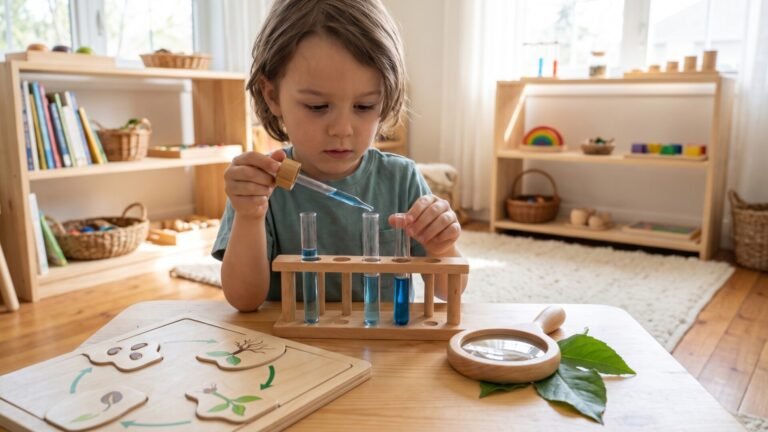
Learning Resources Primary Science Lab Set
| Feature | Details |
|---|---|
| Age range | Preschool and early elementary; confirm current packaging |
| Key features | Child-sized tools, observation, sorting, measuring, simple experiments |
| Price | Approximately $20-$35 |
| Noise level | Silent |
| Cleanup | Depends entirely on you |
The Verdict
Worth it for children who ask how things work and enjoy collecting, comparing, and observing. Be clear about what this is: a tool kit, not a self-running science curriculum. The set gives you the equipment. The worthwhile activities come from short, real investigations with an adult nearby, and that is the honest cost of this one.
Best For
Early science exploration and children who enjoy practical experiments.
Pros
- Encourages observation and scientific language
- Connects play to ordinary household and outdoor discoveries
- Supports fine-motor and early measurement skills
Cons
- Adult guidance is usually needed to create worthwhile activities
- Some pieces get used far less than the main tools
- Water and outdoor play add cleanup
[Affiliate: Check the price on Amazon]
Beginner Wooden Sewing or Lacing Set
| Feature | Details |
|---|---|
| Age range | Often suitable for preschool children with supervision; verify the manufacturer’s guidance |
| Key features | Lacing, threading, hand-eye coordination, sequencing, practical fine-motor work |
| Price | Approximately $15-$35 |
| Noise level | Silent |
| Storage | A small bag |
The Verdict
The budget-friendly fine-motor choice, and the unglamorous one that quietly outlasts more exciting toys. Threading develops patience and hand control through plain repetition, which is exactly the kind of practice a five-year-old needs and rarely gets from anything with a screen or a siren. Choose a specific wooden set after checking its age rating and construction, because quality varies a great deal in this corner of the market.
Best For
Fine-motor practice, quiet concentration, and children who enjoy practical tasks.
Pros
- Usually affordable and compact
- Easy to introduce in short sessions
- Builds coordination and sequencing
Cons
- Some children find repetitive threading boring, and they are allowed to
- Strings and small pieces need proper storage
- Adult help is often needed at the beginning
[Affiliate: Check the price on Amazon]
Wooden Fraction or Geometric Shape Puzzle
| Feature | Details |
|---|---|
| Age range | Preschool and early elementary; confirm current product guidance |
| Key features | Part-to-whole relationships, shape recognition, sorting, early mathematical language |
| Price | Approximately $15-$40 |
| Noise level | Silent |
| Storage | Flat, on a shelf |
The Verdict
A good pick for children ready to explore halves, quarters, symmetry, and classification through physical pieces. The value is in handling and discussing the pieces, not in memorizing fraction names. A child who has physically stacked two quarters to make a half understands something a worksheet cannot deliver, and they will not need the vocabulary for another two years.
Best For
Early math exploration and children who enjoy sorting or completing puzzles.
Pros
- Makes abstract concepts visible and touchable
- Compact and easy to revisit
- Works for independent play and adult conversation
Cons
- Some products are too thin or poorly finished, so check before buying
- The activity can become repetitive once the layout is mastered
- Parents need accurate language without turning it into a quiz
[Affiliate: Check the price on Amazon]
Skip This If: Large Montessori Toy Sets With Many Nearly Identical Pieces
This is a buying warning, not an attack on a brand. Oversized bundles look like better value because the piece count is high and the price per item is low. In practice they create three problems at once. Storage becomes a project. The child is overwhelmed by choice and finishes nothing. And a meaningful share of the activities in the box get used once and never again.
Buy one durable, well-matched material first. Add a second only after the child has shown sustained interest in the first. If they have been building with the same bricks every day for three weeks, you have your evidence. If the pattern blocks are gathering dust, the answer is not more toys. It is a different toy.
Comparison Table
| Product | Approx. Price | Best Skill Area | Independent Play | Space Needed | Best For |
|---|---|---|---|---|---|
| Melissa & Doug Pattern Blocks and Boards | $20-$35 | Patterns and spatial reasoning | High | Low | Structured tabletop play |
| Learning Resources Gears! Gears! Gears! | $25-$45 | Engineering and cause and effect | Medium-High | Medium | Builders and experimenters |
| LEGO Classic Large Creative Brick Box | $25-$55 | Creativity and construction | High | Medium | Long-term open-ended play |
| SmartGames Camelot Jr. | $30-$45 | Logic and planning | High | Low | Puzzle-oriented children |
| Learning Resources Primary Science Lab Set | $20-$35 | Observation and early science | Medium | Low-Medium | Curious investigators |
| Beginner wooden sewing or lacing set | $15-$35 | Fine-motor control | Medium-High | Low | Quiet practical work |
| Wooden fraction or geometric shape puzzle | $15-$40 | Early math and classification | High | Low | Hands-on math learners |
ToyGuideHub Independent Play Score
The Independent Play Score is a planning tool, not a laboratory result. It rates each toy from 1 to 5 on how easily a typical five-year-old can understand the activity, begin without a long explanation, notice their own progress, and come back to it later without a parent restarting the whole thing. It is based on how these materials generally behave in a normal home, not on testing we ran.
Highest scoring: SmartGames Camelot Jr., pattern blocks, LEGO Classic, and a wooden geometric puzzle. All four can be picked up cold, understood in under a minute, and returned to a week later. Camelot Jr. edges ahead because the difficulty ladder means the child rarely hits a wall they cannot climb down from.
Strong but interest-dependent: Gears! Gears! Gears! Children who love mechanisms will play with this independently for long stretches. Children who do not will need you to demonstrate the first build, and if you do that every time, you have bought yourself a hobby.
More adult-supported: The Primary Science Lab Set. The quality of play here depends almost entirely on the questions and materials an adult provides. That is not a flaw. It is just a different kind of purchase, and it should be priced in your head as a toy plus your time.
What the score misses: A lower score does not mean lower educational value. A parent-guided science activity can produce richer conversation and deeper thinking than a puzzle a child completes alone in silence. Independent play is one axis, not the only one.
One practical note that the score cannot capture: independent play is not the same as unattended play. Stay nearby when the materials include small parts, tools, water, or anything a younger sibling could reach. The point of a high score is that the child does not need you to run the activity. It is not that they should be alone with it.
How to Choose the Right Toy for Your Family
Best Overall
The LEGO Classic Large Creative Brick Box wins on the broadest mix of replayability, creativity, construction, and long-term usefulness. It is the one purchase on this list that is still doing work in three years. It is also the wrong choice if you need a contained, low-mess activity, because it is neither of those things.
Best Budget Pick
Take the beginner wooden sewing or lacing set if the child likes fine-motor repetition, or Melissa & Doug Pattern Blocks and Boards if they prefer visual puzzles. A lower price is only useful if the child returns to the activity. A cheap toy that gets ignored is more expensive than a mid-range one that gets used daily.
Best for STEM Learning
Gears! Gears! Gears! for mechanical construction, or the Primary Science Lab Set for observation and experimentation. The difference matters. One teaches a child to build a system and watch it behave. The other teaches them to look closely at the real world and ask what is happening. Both are useful. They are not the same skill.
Best for Montessori Homes
Pattern blocks, a geometric puzzle, or a practical lacing activity. These are hands-on, orderly, screen-free, and easy to present on a shelf so the child can take them down and put them back without help. Do not let minimalist appearance decide it. A beige wooden object that gets played with twice is worse than a bright plastic one that gets used every day.
Best for Small Spaces
Camelot Jr., pattern blocks, or a wooden geometric puzzle. All three store flat or small. Use a tray or shallow basket so the child can carry the activity to the table, use it, and return it to the shelf in one motion. That single habit does more for independent play than any toy on this list.
Best for Children Who Resist Adult-Led Learning
LEGO Classic or pattern blocks. Both let the child start with a concrete task and then change direction the moment they want to. Avoid highly scripted kits that require a parent to read instructions for every step. If the toy cannot start without you reading aloud, it will not start at all on a busy afternoon.
The Hidden Cost of Choosing Wrong
The sticker price is the smallest part of what a toy costs you. The rest shows up later: shelf space that could hold something else, pieces that go missing and make the set unusable, setup time every time it comes out, cleanup time every time it goes away, and the slow realization that nobody has touched it since February.
Run the arithmetic on setup versus play. A toy that takes ten minutes to assemble for five minutes of use is a bad purchase no matter how impressive the educational description sounds. This is the trap with elaborate kits. The photograph shows a finished activity. It does not show the twenty minutes of preparation that preceded it, or the fact that you will be the one doing it.
There is a simple ownership test worth running before you buy. Estimate how often the child will realistically use this in the first month, then ask whether it still has a job once they have mastered the initial skill. Pattern blocks pass because the cards are a starting point and the pieces are not. A single-outcome puzzle fails because once it is solved, it is solved. A brick box passes because it has no final state.
This is also the argument against buying the whole shelf at once. Start with one or two carefully matched materials. Watch what actually happens. The child will tell you what they need next far more accurately than any buying guide, including this one.
If you want to see how these choices change across the preschool years, our Montessori Toys for Preschoolers (3-6 Years Old) hub covers the whole span, and Best Montessori Toys for 4-Year-Olds sets out what works one year earlier. For children who lean toward investigation, Future Scientists: Montessori Biology and Chemistry Toys for Age 5 goes deeper on the science side, and Critical Thinking for Kids: Montessori Logic Toys for 4-Year-Olds covers the logic puzzle category in more detail.
Conclusion
The best overall pick is the LEGO Classic Large Creative Brick Box, because it is the one that keeps working after the novelty has gone and the sibling has arrived. The best budget pick is Melissa & Doug Pattern Blocks and Boards or a beginner wooden lacing set, depending on whether your child prefers visual puzzles or fine-motor repetition. If you want a specialized choice, SmartGames Camelot Jr. covers logic and the Primary Science Lab Set covers investigation. For a long-term investment, a durable open-ended construction setup is where the money holds its value, once you have checked current availability and pricing.
None of that matters as much as one thing. Buy for the challenge your child is actually ready for, not the one the product description implies they should be ready for. The most impressive toy on the shelf is frequently the least used, and the plain wooden thing in the shallow basket is the one that gets carried to the table every afternoon.
If you get it right, the toy is still there in five years, still in the rotation, still doing something useful. If you get it wrong, it goes to the charity shop in the spring with the pieces in a bag, and you buy the right thing anyway. Check current pricing and availability through our recommended partners, and start with one.
Frequently Asked Questions About Montessori Toys For 5 Year Olds
Are Montessori toys good for 5-year-olds who already know their letters and numbers?
Yes, and often better than what they would get otherwise. The strongest options at this age do not repeat basic academic drills. Building, logic, measurement, pattern work, and practical tasks extend learning past recognition and memorization into reasoning and application. A child who knows their numbers still has plenty to learn from a fraction puzzle.
Should Montessori toys for a 5-year-old be made of wood?
No. Wood is common because it is durable and tactile, and those are real advantages. But material alone does not determine educational quality. A well-designed plastic gear set or logic puzzle can support worthwhile play just as effectively, and sometimes more so, because plastic allows shapes and mechanisms wood cannot easily produce.
How many Montessori toys does a 5-year-old need?
Fewer than most families own. A small rotating selection beats a crowded shelf every time. The right number depends on your storage, your space, and whether the child can take materials out and put them back independently. If the shelf is so full that nothing gets finished, you have too many.
Are these toys safe for a 5-year-old to use alone?
It depends on the toy and the child. Check the manufacturer’s age guidance and read it properly. Supervise anything involving small pieces, magnets, cords, tools, water, or materials that could be misused, and remember that a five-year-old’s toy is often a choking risk for a younger sibling in the same room.
What is the best Montessori toy for a child who gets frustrated easily?
Look for activities with visible progress and adjustable difficulty, like pattern blocks or a beginner-level logic puzzle. Start below the child’s maximum ability and increase the challenge gradually. Early success builds the tolerance to handle harder problems later, and starting too high is the fastest way to lose a child’s interest permanently.
Can LEGO count as a Montessori-inspired toy?
Not in the traditional sense, but the fit is better than purists suggest. Open-ended construction and hands-on problem-solving are core Montessori ideas, and LEGO delivers both when the child is free to design rather than only follow instructions. The moment it becomes a step-by-step kit with one correct outcome, it stops being Montessori-inspired and becomes a model to assemble.
Are Montessori toys worth the higher price?
Sometimes. Value depends on replayability, durability, and how much adult involvement the toy demands. A simple, frequently used activity is a better purchase than a premium set that gets abandoned in six weeks. Price buys finish and packaging more reliably than it buys play.
Do I need to buy new, or is secondhand fine?
Secondhand is often the smarter buy, particularly for wooden puzzles, pattern blocks, and brick collections, because these are the toys that hold up. Check for missing pieces, splintered edges, and worn finishes before buying. A complete used set usually beats a new one that is half the size.