Toys for Children Who Prefer Solitary Play
The best toy for a child who prefers solitary play is not the quietest one. It is the one that hands them a starting point, keeps them interested past the first twenty minutes, and does not require you to sit down and run it.
That last part is where most purchases go wrong. Parents buy for the child they think they have – the one who will happily play alone for an hour if only the right toy appears – and then buy something that either does everything for the child or nothing at all. The toy with the most features is usually the worst offender. It talks, it lights up, it has a mode for every mood, and the child is a spectator in their own play.
The distinction that matters is control. A child who plays alone for long stretches is not necessarily shy, and they are not necessarily easy to occupy. They are often particular. They want to set the pace, repeat the same action forty times, stop without negotiating, and come back tomorrow to the same setup. Toys that allow that tend to be simple, physical, and open-ended. Toys that fight it end up in the bin by spring.
What Good Solitary-Play Toys Actually Do
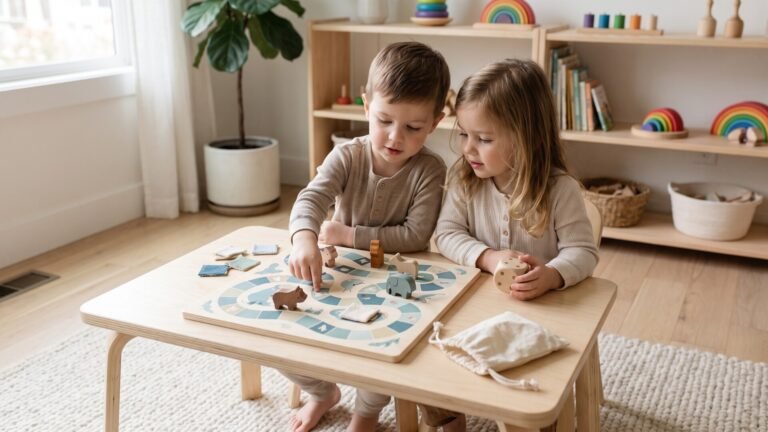
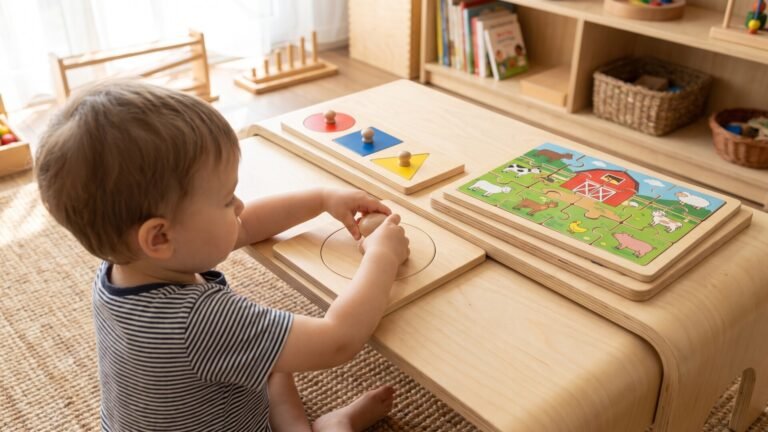
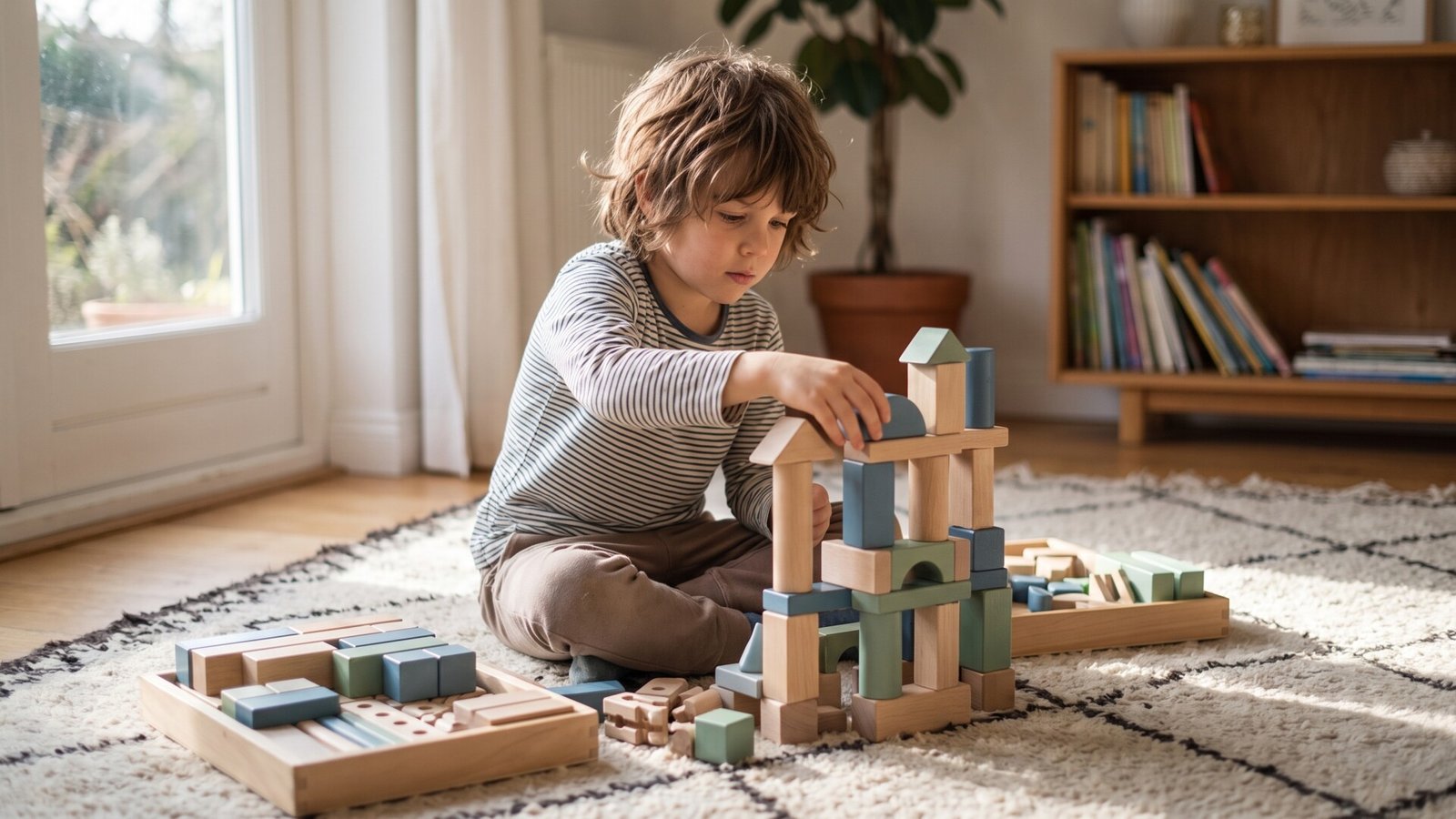
Solitary play is one of the ordinary stages of how children play, alongside independent play, parallel play, and group play. A child building alone on the floor while you cook is not opting out of childhood. They are doing something specific, on purpose, at their own speed.
The confusion is usually between solitary play and forced isolation. They are not the same thing. A child can prefer playing alone and still want you nearby, still want to show you what they made, still want the option of joining a game later. The toy does not need to replace you. It needs to work without you.
Predictable, self-contained activities tend to fit this best, and the reason is mechanical rather than emotional. The child controls the pace. They can repeat an action as many times as they want. They can stop mid-build without a sibling complaining or a game collapsing. They can leave the thing out and pick it up after lunch. None of that is possible with a toy that runs on a timer or expects two players.
The balance that matters most is between structure and openness. A completely blank creative activity – here is a pile of clay, do something – stalls a lot of children, especially younger ones. They need a starting point, not a blank page. But a toy with one correct sequence and nothing else has the opposite problem: once solved, it is done, and the child knows it.
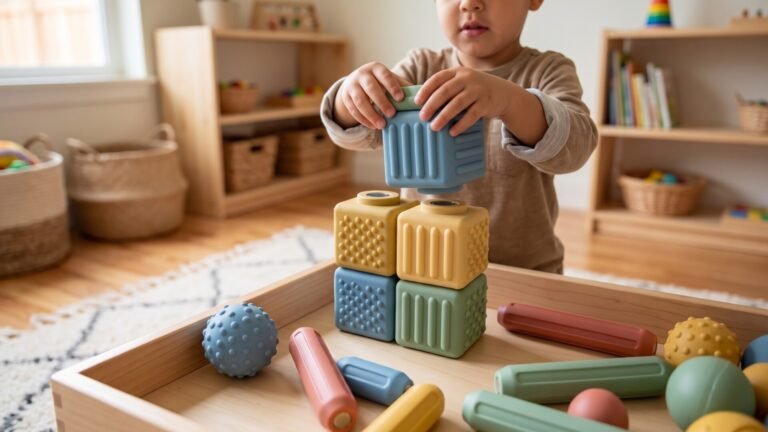
The sweet spot is a toy with an obvious first move and no fixed ending. A brick box. A set of interlocking shapes. A logic puzzle with graded challenges. Each of these gives the child something to do immediately and something to keep doing later.
One boundary worth stating plainly: none of this is treatment. Solitary play preference is not a diagnosis, and toys are not therapy. If you have concerns about your child’s communication, comfort, or daily functioning, that is a conversation for a qualified professional, not a buying decision. What this article covers is fit – whether a toy actually suits how your child plays.
Key Buying Factors for Children Who Prefer Playing Alone
Most buying guides rank toys by features. That is the wrong axis. Rank by how much of the toy’s operation the child owns.
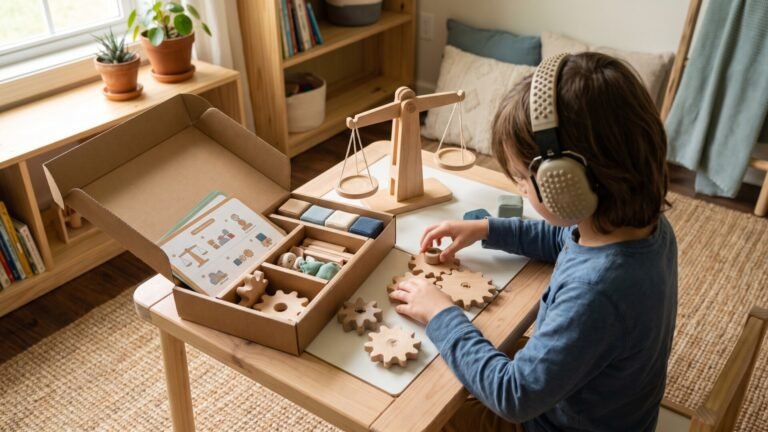
Independent usability is the first filter. Can your child understand what to do and start without you? For a four-year-old, that might mean you demonstrate once and then step back. For a seven-year-old, it should mean opening the box and going. If the toy needs an adult to set it up every time, it is not an independent toy. It is a toy you operate while your child watches.
Interest and sensory fit comes next, and this is where assumptions cause the most damage. Not every child who plays alone wants a quiet toy. Plenty want movement, texture, resistance, or noise they control themselves. A child who loves arranging objects will get more from a sorting or building toy than from a cooperative board game bought in the hope of drawing them out. Watch what your child already does with their hands and buy more of that.
The right level of challenge is a narrow band. Too easy and the toy is abandoned within a week – the child solved it, there is nothing left. Too hard and it requires constant adult help, which defeats the point. Look at the age range on the box, then at the fine motor demands, whether reading is required, and how the toy handles failure. A puzzle that punishes a wrong move with a loud buzz is a different experience from one that simply does not fit.
Household practicality decides whether the toy survives past January. How loud is it? How much floor does it eat? How long does cleanup take? How many pieces will be gone by summer? A toy that is wonderful for the child and unbearable for the household gets quietly retired. That is not a failure of parenting. It is a predictable outcome you can plan around before you buy.
What Most Buyers Get Wrong About Solitary Play
The single most common mistake is buying the most heavily featured electronic toy on the shelf. It seems logical – more modes, more content, more value. In practice, automatic sounds and scripted responses take control away from the child. The toy decides what happens next. The child presses a button and watches. That is entertainment, not play, and the useful life of the toy is usually measured in weeks.
The word “educational” on a box deserves the same skepticism. A toy with forty preprogrammed lessons is not necessarily teaching anything; it is reciting. A puzzle, a construction set, or a tray of clay may hold more genuine engagement because the child is the one doing the thinking. Plenty of toys marketed as educational are just toys, and that is fine. Buy them as toys.
Another quiet error: buying for an imagined future child. The one who will suddenly love cooperative games, or who will finally sit still for chapter books, or who will share nicely with a cousin. Buy for the child in front of you. If they love arranging objects in rows, buy for that. The social stuff can be built separately, on its own timeline, without turning every toy into a nudge.
The principle running through every recommendation below is the same: choose for control, replayability, and manageable setup. Not feature count. Not the size of the box. A toy your child can start, stop, restart, and own is worth three that need you to run them.
Recommended Toys for Children Who Prefer Solitary Play
Six options, spanning roughly $10 to $160, across building, art, logic, tactile, and audio play. Age ranges come from current manufacturer guidance – check the specific listing before buying, and follow the product’s own safety instructions.
LEGO Classic Large Creative Brick Box
| Feature | Details |
|---|---|
| Age Range | Typically 4 years and up; verify the current set listing |
| Key Features | Open-ended construction, varied brick shapes, reusable storage box |
| Price (approx) | Usually around $30-$55 |
The Verdict
The strongest all-rounder here. A child works privately toward a result they chose, and the box refills itself with new possibilities every time. Younger children will need help with basic construction at first, but the learning curve is short.
Best For
Children who design, sort, build, and return to projects across multiple sessions.
Pros
- High replay value with no batteries and no volume switch to find
- Scales from simple stacks to genuinely complex builds
- Pieces stay useful across every future LEGO set
Cons
- Small parts mean real age and supervision decisions
- Storage drifts into chaos without a system
- Some children stall without an idea book or a single starter prompt
[Affiliate: Check current pricing on LEGO Classic sets]
Melissa & Doug Deluxe Wooden Standing Easel
| Feature | Details |
|---|---|
| Age Range | Commonly 3 years and up; verify current guidance |
| Key Features | Reusable art surfaces, drawing and painting space, standing format |
| Price (approx) | Usually around $100-$160 |
The Verdict
A premium pick for the child who creates at their own pace and does not want a finished product dictated by the toy. It takes more room and more setup than a tabletop activity, but it becomes a permanent creative station rather than a one-project kit.
Best For
Children who draw, paint, write, or move between art materials on their own.
Pros
- Open-ended creative work with no correct answer
- Supports longer sessions than most small craft kits
- Reusable, unlike consumable project boxes
Cons
- Needs dedicated floor space, which rules it out for some homes
- Supplies create ongoing replacement costs
- Setup and cleanup lean on an adult
[Affiliate: Check the price on Amazon]
SmartGames IQ Puzzler Pro
| Feature | Details |
|---|---|
| Age Range | Commonly 6 years and up; verify current guidance |
| Key Features | Compact logic challenges, multiple puzzle formats, travel-friendly case |
| Price (approx) | Usually around $15-$25 |
The Verdict
The best small-space option for a child who likes rules, patterns, and a clear goal. It is more structured than building, so it suits children who enjoy solving a defined problem rather than inventing a scene.
Best For
Independent mental challenges in a compact, low-mess format.
Pros
- Fits in a bag and stores in a drawer
- Graded challenges give a progression to work through
- No screen, no batteries, no loose project materials
Cons
- Difficulty can jump and frustrate
- Less imaginative than construction or pretend play
- Lose one piece and the puzzle is compromised
[Affiliate: Check the price on Amazon]
Plus-Plus BIG or Standard Construction Set
| Feature | Details |
|---|---|
| Age Range | BIG sets are commonly aimed at younger children; standard sets generally for older children; verify the listing |
| Key Features | Repeating interlocking shape, flat mosaics and 3D builds, compact storage |
| Price (approx) | Usually around $15-$35 |
The Verdict
A useful middle ground between a puzzle and a traditional building set. The repeated shape cuts down decision overload, while the ability to make pictures or three-dimensional objects keeps the child in charge of the outcome.
Best For
Children who enjoy repetition, pattern-making, and construction without a large brick collection.
Pros
- Compact and highly reusable
- Works for guided patterns and free building alike
- Formats available for different age ranges
Cons
- Small pieces need age-appropriate supervision
- Color sorting becomes its own storage chore
- Less appealing to children who want bigger, chunkier materials
[Affiliate: Check current pricing on Plus-Plus sets]
Play-Doh Modeling Compound Starter Set
| Feature | Details |
|---|---|
| Age Range | Commonly 2 years and up for many sets; check the exact product |
| Key Features | Malleable modeling material, tools, cutters, open-ended shaping |
| Price (approx) | Usually around $10-$25 |
The Verdict
The cheapest way into hands-on, repetitive, outcome-free play. It is also the highest-maintenance option on this list. Drying, crumbs, and storage are part of the deal, not a surprise to discover later.
Best For
Children who seek tactile creative play and can manage simple tools with supervision.
Pros
- Low entry price and easy to replace
- No reading, no instructions, no setup
- Supports squeezing, shaping, and rebuilding indefinitely
Cons
- Mess and dried-out compound are guaranteed
- Some children dislike the smell or texture
- Not for eating, and not for children past the age of putting things in their mouths
[Affiliate: Check the price on Amazon]
Yoto Mini or Yoto Player
| Feature | Details |
|---|---|
| Age Range | Commonly designed for young children and families; verify current guidance and content suitability |
| Key Features | Audio stories and music through physical cards, screen-free listening |
| Price (approx) | Usually around $50-$100, before content-card costs |
The Verdict
An audio player supports independent quiet time for a child who wants company without another person directing the activity. Treat it as a listening tool, not a complete play experience, and budget for the cards.
Best For
Children who enjoy stories, music, and predictable audio routines without a screen.
Pros
- Screen-free format with physical controls
- Buttons are easier than navigating an app
- Genuinely useful during quiet time, travel, and independent routines
Cons
- Content cards add ongoing cost
- Listening is not the same as active play
- Volume and content need adult setting
[Affiliate: Check current pricing on Yoto players and card collections]
Skip This If: High-Feature Electronic Toys With No Clear Off-Ramp
Scripted electronic toys are not automatically bad. Some children love them, and a well-designed one with simple controls can hold attention for a long time.
They are a weak fit, though, when the child becomes passive, cannot control the pace, or loses interest the moment the novelty fades. Toys with dozens of sounds, lights, and buttons are also a poor match for children who prefer predictable, low-stimulation play – the toy is doing the talking and the child is waiting.
Buy an electronic toy only when its controls, content, volume, and replay value clearly match your child. If you cannot picture them using it in month three, that is your answer.
Comparison Table
| Product | Approx. Price | Best For | Independent Use | Ownership Tradeoff |
|---|---|---|---|---|
| LEGO Classic Large Creative Brick Box | $30-$55 | Building and invention | High after initial familiarity | Small parts and storage |
| Melissa & Doug Deluxe Wooden Standing Easel | $100-$160 | Art and longer creative sessions | Moderate to high | Space, supplies, cleanup |
| SmartGames IQ Puzzler Pro | $15-$25 | Logic and compact play | High for puzzle-ready children | Can frustrate at higher levels |
| Plus-Plus Construction Set | $15-$35 | Patterns and construction | High | Small pieces and sorting |
| Play-Doh Starter Set | $10-$25 | Tactile creative play | Moderate | Mess and replacement compound |
| Yoto Mini or Yoto Player | $50-$100 before extra cards | Stories and quiet listening | High for listening routines | Ongoing content costs |
ToyGuideHub Independent Play Score
This is an editorial comparison, not a lab test. Each toy is scored 1 to 5 on five things that decide whether a toy actually gets used alone: whether the child controls the pace, whether it can be put down and resumed, how much adult setup it demands, whether it survives past the novelty period, and how well it fits a shared household.
| Product | Child Control | Restartability | Setup Burden | Replayability | Space and Noise Fit |
|---|---|---|---|---|---|
| LEGO Classic Brick Box | 5 | 5 | 3 | 5 | 3 |
| Melissa & Doug Easel | 5 | 4 | 2 | 4 | 2 |
| SmartGames IQ Puzzler Pro | 4 | 5 | 5 | 4 | 5 |
| Plus-Plus Construction Set | 5 | 5 | 4 | 4 | 4 |
| Play-Doh Starter Set | 4 | 3 | 3 | 4 | 2 |
| Yoto Mini or Player | 4 | 4 | 4 | 4 | 4 |
Setup burden is scored so that higher is better – less work for you.
Read across the rows and the trade-offs show up fast. SmartGames IQ Puzzler Pro is the strongest compact, structured option: it stores in a drawer, restarts instantly, and asks nothing of you. LEGO Classic is the best all-round balance of control and replayability, with storage as its only real weakness. Plus-Plus wins for children who like repeated patterns and want construction without a brick collection the size of a suitcase.
Play-Doh is the best low-cost tactile option and the worst on mess, which is a fair trade if you have a wipe-clean floor and a child who loves the texture. The easel is the strongest creative station here, but only for households with the floor space to leave it up – folded into a closet, it stops being an art station and becomes a chore. Yoto supports quiet time well and is not a substitute for active play.
No toy scores 5 across the board, because no toy can. The score is there to help you compare trade-offs against your own household, not to crown a universal winner.
How to Choose the Right Option for Your Child
Best for Small Spaces and Travel
SmartGames IQ Puzzler Pro is the easiest call here. It lives in a bag, needs no surface beyond a tray table, and cannot spill. For a child who wants construction in a small footprint, Plus-Plus in a lidded container is the next best thing – the pieces are small, but the whole collection fits in a shoebox.
Large easels, sprawling brick collections, and messy materials are the wrong shape for tight spaces. Not because they are bad toys, but because a toy that has to be packed away and set up every single time gets used a fraction as often.
Best for Creative Children
Three different children, three different answers. If your child invents structures, LEGO Classic. If they draw and paint, the Melissa & Doug easel. If they want texture in their hands, Play-Doh.
The distinction worth making is between a child who invents freely and one who needs a visual prompt. The first will take a brick box and run. The second may sit in front of it and stall, and would do better with a pattern card, an idea book, or a single suggested starting point. Keep only a manageable selection available at once – a shelf of twelve options produces more standing and staring than a shelf of three.
Best for Children Who Prefer Predictable Rules
IQ Puzzler Pro and structured Plus-Plus pattern cards are the picks. A clear goal is more comfortable than a blank creative activity for a lot of children, and there is nothing wrong with that. The rule is not “open-ended is better.” It is “match the child.”
Challenge should climb gradually, with help available but not imposed. If your child asks you to sit down, sit down. If they do not, stay in the room and let them work.
Best for Quiet Time and Low-Stimulation Use
A low-volume audio player, a simple puzzle, or a small building set all work here. The key is to check the actual product rather than the marketing – lights, sounds, textures, and visual clutter matter more than the word “educational” on the box.
If your concern is broader than solitary play, our guides to Low-Stimulation Toys and Sensory-Friendly Toys for Different Environments cover the wider picture.
Best Budget Pick and Best Premium Pick
Best budget: SmartGames IQ Puzzler Pro for compact replay value, or Play-Doh if your child is tactile and you can live with the crumbs.
Best premium: the Melissa & Doug easel, for a child who will genuinely use an art station several times a week. Premium only pays off when the household has the space, the supplies, and the interest to support frequent use. Otherwise it is an expensive coat rack.
The Hidden Costs of Ownership
The sticker price is the smallest number in this article. What you actually spend shows up over the following year.
Storage containers, replacement art supplies, lost pieces, batteries or charging cables, audio content cards, and cleanup time all add up. Yoto is the clearest example: the player is the entry fee, and the cards are the subscription you did not know you signed up for. An easel is similar – the frame is a one-time cost, but paper, paint, and brushes are not.
The better measure is cost per useful session. A $20 puzzle used three times a week for two years is a rounding error per session. A $70 electronic toy abandoned after a fortnight is the most expensive thing in the house. Purchase price tells you almost nothing about value.
Adult attention is a resource too, and it is the one buyers forget to budget. A toy that needs constant setup, sorting, or emotional coaching is not genuinely independent, even if the child can technically use it alone. If you are rebuilding the train track every eleven minutes, the toy is not doing its job.
Before you buy, run four questions:
- Where will this live? If you cannot name the shelf, it will live on the floor.
- How will it restart tomorrow? A toy that has to be fully reset is a toy that stays reset.
- What will be lost or used up first? Buy spares of that thing, or accept the loss.
- Does your child already do this activity with something else? If they sort buttons for fun, buy more sorting. Do not buy the thing you wish they liked.
Safety and Parent Guidance
Follow the manufacturer’s age range, warnings, and supervision instructions. That applies to every product here, and especially to small parts, modeling tools, cords, and art materials. Age ratings exist for a reason and are not a suggestion.
Independent play does not mean unsupervised play. Supervision should match your child’s age, abilities, environment, and the specific risks of the product in front of them. A six-year-old alone with a logic puzzle is a different situation from a six-year-old alone with a craft knife.
If your child has known sensitivities, check materials and textures before buying rather than after. Do not assume what they will tolerate – a texture that seems pleasant to you may be the exact thing that ends the activity in ninety seconds.
Introduce one toy at a time. Model the first step without taking over, then let your child abandon or modify the activity as they see fit. Modifying it is usually a good sign.
Stay available and responsive throughout. The aim is supported choice, not isolation, and not a timer. If your child plays alone for eleven minutes and then wants you, that is a successful eleven minutes.
Where This Lands
The best toy for a child who prefers solitary play is the one they can control, put down, and pick back up without asking you for anything. That is the whole test, and it rules out most of what gets marketed as independent play.
If you want a single answer: the LEGO Classic Large Creative Brick Box is the best overall pick, because it hands the child the wheel and keeps handing it back for years. For a compact, structured alternative, SmartGames IQ Puzzler Pro is the budget pick that punches well above its price. The Melissa & Doug easel is the right call for a child who will use a dedicated art space, Plus-Plus suits pattern-makers in small rooms, Play-Doh is the cheapest way into tactile play if you can tolerate the mess, and Yoto handles quiet time as long as you accept the ongoing card costs.
Check current pricing and availability through our recommended partners, and browse our Best Toys for Children With Specific Needs hub for the wider picture. If fine motor demands are part of the decision, Toys for Children With Fine Motor Challenges covers grip, resistance, and tool design in more detail.
Frequently Asked Questions About Toys For Children Who Prefer Solitary Play
Is preferring solitary play a problem?
Not by itself. Plenty of children enjoy independent activity, and a preference for playing alone does not establish a developmental or medical concern. Look at the whole picture – communication, comfort, relationships, daily functioning – and raise anything that worries you with a qualified professional rather than judging it from toy preference alone.
What are the best toys for a child who likes to play alone?
Open-ended construction, puzzles, art materials, modeling toys, and audio storytelling are the strongest starting categories. The final pick should follow your child’s age and interests, not the other way around.
How can I encourage independent play without forcing it?
Make a small selection accessible, demonstrate how to begin, accept short sessions, and stay nearby without directing every move. Do not use solo play as a demand or a punishment – that turns a comfortable activity into a test.
Are electronic toys good for children who prefer solitary play?
Some are, particularly audio players with simple physical controls. Automatic lights, sounds, and scripted play tend to reduce the child’s control and shorten the toy’s useful life. Judge each one by pace, volume, content, and whether it will still be interesting in three months.
What should I do if my child abandons every toy quickly?
Check the basics first: too difficult, too easy, too loud, too messy, too visually crowded, or simply unrelated to what your child actually likes doing. Then offer fewer options at once and watch which actions they repeat on their own. That repetition is the clue to what to buy next.
How much adult help should a child need for independent play?
It varies by age and by toy. You may need to demonstrate setup or explain a safety rule once. After that, a good independent-play toy lets the child take over rather than requiring continuous direction from you.
Are sensory toys appropriate for solitary play?
They can be, when the child genuinely enjoys the specific texture, movement, or resistance involved. They are not treatment, and they should not be presented as such. See our guide to Sensory-Friendly Toys for Different Environments for matching sensory toys to settings, and check supervision and material guidance before buying.
Do I need to buy the premium option?
Only if the household can support frequent use. An easel that stays up and gets used four times a week is good value at $130. The same easel folded behind a door is an expensive mistake. The budget picks on this list are not compromises – they are the right answer for a lot of families.
How many of these should I buy at once?
One. Possibly two if you are covering clearly different modes, like a building toy and an audio player for quiet time. Rotating a small number of toys produces more play than stacking a shelf, and it makes it obvious which one your child actually reaches for.