The Ultimate Guide to Play Food: Hape Wood vs. Learning Resources Plastic
Every family with a play kitchen eventually faces the same question: wooden play food or plastic play food? It may seem like a small decision, but it shapes pretend play in surprisingly different ways. Hape’s wooden sets appeal to parents drawn to natural materials, sensory heft, and open-ended, symbolic play. Learning Resources plastic sets attract those who want realism, easy cleaning, and a more structured learning experience.
This guide compares durability, safety, realism, ease of maintenance, educational approach, and value for each type. I’ll also walk through specific sets from Hape, Learning Resources and Melissa & Doug so you can decide which fits your child’s age, your home, and your budget. By the end, you’ll know what to look for—and whether the best play food for your family is wood, plastic, or a mix of both.
Short answer: choose wooden cutting food (Hape or Melissa & Doug) for children around 3 and up who enjoy the “slicing” action and a calm, natural look; choose Learning Resources New Sprouts for toddlers from 18 months, for easy wipe-clean play, or for sorting and food-group learning. Always check the age label on the exact set, because age grades vary between lines.
Disclosure: This article contains affiliate links. If you purchase through them, I may earn a small commission at no extra cost to you.
Why Play Food Is So Important for Development
Before diving into materials, it’s worth remembering why play food is such a staple. A basket of pretend fruits and vegetables isn’t just cute—it gives children plenty to practise.
Pretend play – When a child pretends to slice a cucumber or cook a stew, they are rehearsing real-world scenarios and using their imagination. Play like this invites flexible thinking and storytelling, skills that support later creative problem-solving.
Language and communication – Naming foods (“this is an avocado!”), describing actions (“I’m stirring the soup”), and narrating stories while cooking all enrich vocabulary and sentence formation. Social play with siblings or friends naturally introduces requests, negotiations, and shared storytelling.
Social skills – Sharing a pizza or taking turns at the stove is a chance to practise turn-taking, cooperation, and empathy. Kids navigate disagreements over who gets the red pepper or why the cake needs more candles—small but useful interpersonal lessons.
Early life skills – Sorting groceries into food groups, counting pieces of fruit, and sequencing the steps of a recipe invite early math, logic, and planning. Play food also gives children a friendly way to talk about meals and kitchen safety before they ever use a real stove.
A note on Montessori: Montessori education tends to favour real, purposeful materials (a child-sized knife and a real banana) over pretend ones, so wooden play food is “Montessori-friendly” mainly because of its natural materials and simplicity, not because Montessori requires it. If that approach appeals, see our guide to Montessori kitchen helpers and learning towers and our list of the best Montessori toys for 2-year-olds.
Hape Wooden Play Food Overview
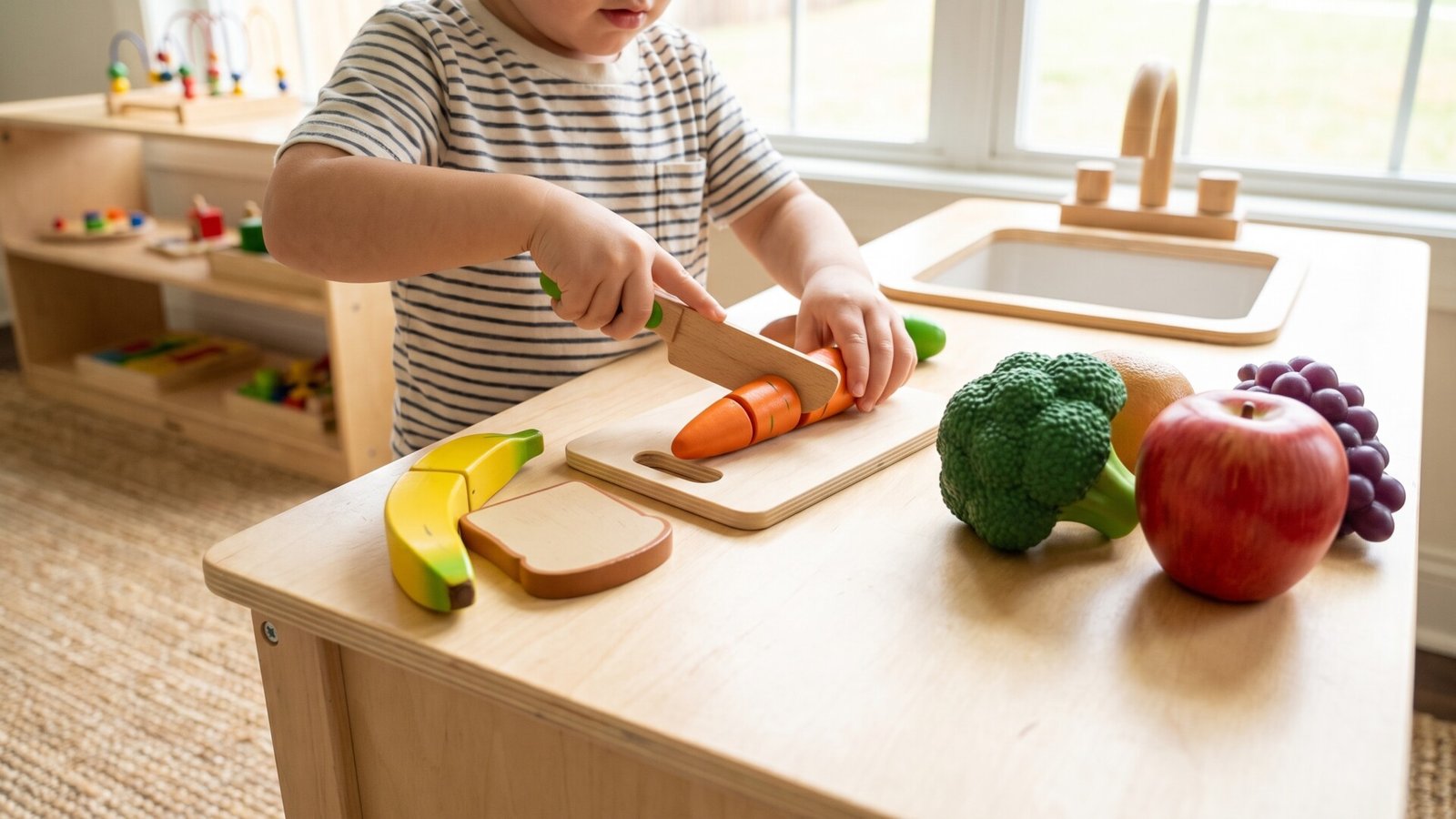
Core concept – Hape’s play food is made from wood (and in some ranges bamboo) with non-toxic, water-based finishes; check each product page for material and certification details. Many cutting sets feature a Velcro “cutting” system: fruits and vegetables are held together by a strip of Velcro, and children use a child-safe wooden knife to slice them apart. This mimics the real action of chopping ingredients—a satisfying sensory experience.
Design style – Hape uses a simplified, natural aesthetic. Foods are painted in realistic colors but lack the hyper-detailed ridges, gloss, and brand labels of plastic counterparts. This abstraction encourages symbolic thinking; a painted green oval becomes a pear, a brownish cylinder becomes a sausage. Pieces are chunky enough for small hands to grasp, yet not cartoonishly oversized.
Common features – Velcro-cut fruits and vegetables, wooden knives, cutting boards, crate-style storage boxes, and occasional felt accents. Sets range from small fruit or vegetable collections to larger meal-themed kits.
Target age – Hape’s cutting food sets are commonly labelled for ages 3 and up (for example, the 7-piece Healthy Fruit Playset is listed by retailers as ages 3+), largely because of the small parts and the knife. Some chunkier non-cutting food is labelled younger, so check the label on the specific set, and supervise closely if you introduce wooden food before age 3.
Learning Resources Plastic Play Food Overview
Core concept – Learning Resources’ play food, especially the New Sprouts line, is designed for realism and structured learning. Sets are molded from durable plastic with realistic shapes and colors, and many are made for classroom use. New Sprouts sets such as the Multicultural Food Set and the Dinner Basket are listed for ages 18 months and up.
Design style – The emphasis is on recognition. Pieces look like the food they represent, which helps young children connect the toy to what is on their plate. That can be a useful hook for language development and for talking about trying new foods, though it is a conversation starter rather than a guaranteed fix for picky eating.
Common features – Themed collections (breakfast, dinner, fruit, veggies, multicultural foods), baskets, and sorting activities. The New Sprouts Pick ‘n’ Sort Food Groups set is built around categorization.
Target age – Many New Sprouts sets are labelled 18 months and up, with some sorting sets aimed at older preschoolers. Check the label of each set.
Key Differences — Wood vs Plastic
Realism vs Imagination
Learning Resources leans toward realism. The detail in textures, shapes, and colors can help toddlers who are still learning to identify real foods. Seeing a toy avocado that looks like the one in the fridge reinforces the link between play and daily life.
Hape leans toward abstract, symbolic play. The painted wood leaves room for the child’s imagination to fill in the gaps. A wooden broccoli floret is recognisable but not photo-realistic. This open-ended approach suits families who prefer toys that suggest rather than dictate reality.
Durability and Longevity
Both materials hold up well, in different ways. Solid wood pieces resist breaking under normal play, though paint can scratch or fade over years of heavy use, and Velcro strips can lose grip as they collect lint. Plastic food tolerates drops, dishwashers and classroom use, though it can scuff or stain. Both can be passed down if cared for.
Sensory Experience
Wood offers a distinctive tactile feel: smooth, cool, and substantial. The satisfying rip of a Velcro “cut” adds sensory richness, and sawing through the seam with a wooden knife gives children practice with hand coordination.
Plastic offers variety: some sets include soft or hollow pieces with differing textures, which some tactile-seeking children enjoy. Most plastic food is not sliceable, which means fewer fine-motor challenges but also less to reassemble.
Cleaning and Maintenance
Plastic is easier to keep hygienic. Most plastic play food can be washed with warm, soapy water; check the manufacturer’s care instructions before using a dishwasher, since not every set is rated dishwasher-safe. This is a real advantage in homes where food toys inevitably end up in mouths or on sticky floors.
Wood requires more care. Never submerge wooden play food in water. Wipe with a damp cloth and mild soap, then dry immediately. Avoid soaking or harsh chemicals. Velcro strips can collect fuzz over time, reducing the “cutting” action; a quick pass with a lint brush or tape usually helps.
Educational Approach
Hape’s design favours natural materials, simplicity, and open-ended play, and the Velcro pieces only fit together one way, which gives children simple feedback as they reassemble them. These toys invite the child to lead.
Learning Resources is built for structured learning. Sets often come with sorting categories and activity ideas, which makes them a favourite in preschools and for parents who want to weave food groups, counting, or language into play.
Pros and Cons of Each System
Hape Wooden Play Food
Pros
- Natural materials – Wood or bamboo with non-toxic finishes.
- Open-ended – Encourages imaginative, symbolic play.
- Cutting action – Velcro design gives fine-motor practice.
- Durable – Solid construction can last for years.
- Attractive – Looks lovely on open shelves.
Cons
- Less realistic – Abstract shapes may not be instantly recognisable to very young toddlers.
- Often labelled 3+ – Cutting sets have small parts and a knife.
- No dishwasher – Cleaning requires more care.
- Higher price per piece – Wooden sets generally cost more than comparable plastic ones.
- Velcro wears – Grip can fade with heavy use.
Learning Resources Plastic Play Food
Pros
- Realistic – Helps toddlers identify real foods.
- Wide variety – Many themed sets (breakfast, dinner, multicultural, food groups).
- Easy to clean – Great for classrooms and busy homes.
- Many sets from 18 months – Suits younger toddlers.
- Educational structure – Sorting-focused sets available.
Cons
- Less open-ended – Can encourage scripted play.
- Environmental concerns – Plastic is not biodegradable.
- Possible initial odor – Some parents note a smell that fades after washing.
- Feels less premium – Plastic may look out of place on a natural shelf.
- No cutting action – Lacks the Velcro slicing challenge.
Best Play Food Sets in 2026
Set contents and age labels below come from retailer and manufacturer listings and can change between versions, so confirm the details on the product page before buying. Prices vary by retailer and season, so use the links to check current pricing.
Best Wooden Set: Hape Healthy Fruit Playset
Age range: 3+ (per retailer listings)
Contents: 7 wooden fruit pieces with a wooden knife.
A good first Hape set. The fruit pieces are held together with Velcro so a child can “cut” and re-join them with the wooden knife, which keeps the activity quiet and repeatable. It is a compact set, so you may want to add a vegetable set later for variety.
Pros
- Natural finish and a calm look on a play shelf.
- Cutting action gives fine-motor practice.
- Small enough to store in a basket.
Cons
- Only a handful of pieces.
- Wipe-clean only; no soaking.
Check current price and availability at Amazon, Hape’s own store, and other major toy retailers.
Wooden Value Option: Melissa & Doug Cutting Food
Age range: 3+ (per retailer listings)
Contents: Varies by set; the Wooden Cutting Food Box is listed as a set of 10, and a separate Cutting Fruit Set is listed at 18 pieces.
Melissa & Doug is Hape’s best-known wooden competitor and is often easier to find in big-box stores. The cutting sets use the same Velcro-and-knife idea, with a simpler look. It is a sensible entry point if you want to see whether your child enjoys wooden cutting food before investing in more.
Pros
- Widely available.
- Several set sizes (fruit, boxed food, pizza and breakfast variants).
- Teaches basic food-preparation play.
Cons
- Velcro grip can fade with heavy use.
- Painted look is more cartoonish than Hape’s in some sets.
Check current price and availability at Amazon, Target and other retailers.
Best Plastic Set for Toddlers: Learning Resources New Sprouts Dinner Basket
Age range: 18 months+ (per retailer listings)
Contents: 18 pieces in a basket.
New Sprouts is Learning Resources’ toddler-friendly line, and this dinner set is a handy way to start. The pieces are sized for small hands and recognisable enough to spark conversations about meals. If you want variety, the Multicultural Food Set (listed at 15 pieces, also 18 months+) adds dishes from different cuisines.
Pros
- Realistic, recognisable pieces.
- Basket included for easy tidy-up.
- Labelled for toddlers from 18 months.
Cons
- No cutting action.
- Some families notice an initial plastic smell.
Check current price and availability at Amazon, Walmart, Target and other retailers.
Best for Sorting and Learning: Learning Resources New Sprouts Pick ‘n’ Sort Food Groups
Age range: Check the label; retailers list it for preschool–kindergarten
Contents: Roughly two dozen food pieces (retailers list between 21 and 26) for sorting into food groups.
This set is designed for structured learning. Children sort the play food into groups, which can be tied to nutrition conversations, counting exercises, or language development. It works well for preschoolers and in small group or classroom settings.
Pros
- Clear learning purpose.
- Encourages classification and conversation.
Cons
- More focused than a free-play set.
- Check pieces for small-parts warnings if younger siblings are around.
Check current price and availability at Amazon, Target and educational retailers.
Mixing Wood and Plastic: A Practical Kitchen Setup
You don’t have to choose one material. Many families pair a wooden or plastic play kitchen with one wooden cutting set for slicing and one plastic set for variety and wipe-clean convenience. Start small, watch what your child actually plays with, and add one set at a time. A wooden kitchen with plastic food works well, and so does the reverse.
Wood vs Plastic Play Food
| Feature | Hape Wooden Sets | Learning Resources Plastic |
|---|---|---|
| Realism | Medium – simplified, symbolic | High – detailed, recognisable |
| Material | Wood (some bamboo), non-toxic paint | Durable plastic (see product page for material details) |
| Cutting Action | Yes – Velcro slicing | No |
| Cleaning | Wipe only; do not submerge | Washable; check care label before using a dishwasher |
| Durability | High (paint and Velcro can wear) | High (survives drops and classroom use) |
| Educational Focus | Open-ended, symbolic play | Recognition, sorting, structured activities |
| Typical Age Label | Cutting sets commonly 3+ | New Sprouts sets commonly 18 months+ |
| Variety of Sets | Moderate | Extensive |
| Best For | Natural-material fans, fine-motor practice, ages 3+ | Toddlers, classrooms, sorting and food-group activities |
Safety Checklist for Play Food
- Follow the age label. Age grades are mostly about safety (small parts, sharp-ish edges), not ability. A Velcro cutting set labelled 3+ is not meant for a child who still mouths objects.
- Small-parts test. Anything that fits through a toilet paper tube is a choking risk for children under 3. Check for loose stems, leaves and Velcro tabs.
- Look for compliance information. Toys sold in the US should meet CPSC children’s product requirements and ASTM F963; the packaging or the manufacturer’s site should say so.
- Inspect regularly. Discard wooden pieces that splinter or have chipped paint, and plastic pieces that crack or come apart.
- Check recalls on the CPSC recall list, especially for secondhand sets.
Play Ideas and Ages: How to Get More From Play Food
18–24 months: Simple putting-in and taking-out play with a basket, naming foods, and “feeding” a doll or stuffed animal. Plastic toddler sets suit this age best.
2–3 years: “Cooking” in a play kitchen, setting a pretend table, and imitating meals. Visit our little chef corner ideas for set-up tips.
3–5 years: Slicing with Velcro food, running a pretend café or grocery store, taking orders, sorting by food group, and counting. Wooden cutting sets and sorting sets shine here.
Which Should You Choose?
Choose Hape or other wooden cutting food if:
- Your child is around 3 or older and past the mouthing stage.
- You prefer open-ended, symbolic play over hyper-realism.
- A natural, calm look on your play shelf matters to you.
- You want a fine-motor activity built in (the cutting action).
- Environmental impact and avoiding plastic are priorities.
Choose Learning Resources plastic if:
- Your child is a young toddler (18–36 months) and the set is labelled for that age.
- You need easy, frequent cleaning (several children, or a classroom setting).
- You want sorting and food-group activities.
- Realism helps connect play with mealtimes at home.
- You want a wide variety of themed sets to keep play fresh.
Best strategy for many families: combine both. Invest in one or two wooden cutting sets for the sensory and fine-motor appeal, and add a plastic breakfast, dinner or multicultural set for realism and variety. For more guidance on materials, see our explainer on wooden toys vs. plastic.
Frequently Asked Questions About Wooden Vs Plastic Play Food
Which is better: wooden or plastic play food?
Neither is universally better. It depends on your child’s age, how you like to play, and how much cleaning you want to do. Wooden cutting sets are usually labelled for ages 3+, while many plastic toddler sets are labelled from 18 months.
Is wooden play food safer than plastic?
Neither material is automatically safer. What matters is the age label, small parts, and whether the maker states compliance with safety standards such as ASTM F963 and CPSC requirements. Buy from reputable brands, follow the age grade, and inspect toys regularly for damage.
Which lasts longer over time?
Both are durable. Wooden food can show scratches or faded paint after years of heavy use, and Velcro can lose grip. Plastic food generally tolerates drops and washing, though it can scuff. Either can be passed down if it is looked after.
Is Learning Resources play food realistic?
Yes. New Sprouts and other lines are designed to look like the foods they represent, which is a major strength of the brand, especially for younger toddlers who are learning to name foods.
Does Hape play food break easily?
Hape’s wooden food is generally sturdy for normal play, but the Velcro can wear and paint can chip with rough use. Stop using any piece that splinters or has chipped paint.
What age is best for play food sets?
Simple plastic sets are often labelled from 18 months, while wooden cutting sets with knives are commonly labelled 3+. Always follow the label on the set you buy, and supervise play with young children.
Can play food help with real eating habits?
It can make talking about food easier and more playful, and some families find that pretend meals make new foods less intimidating. It is not a proven fix for picky eating, so treat it as a fun conversation starter rather than a treatment.
Are these toys good for classrooms?
Both are popular. Learning Resources is common in preschools because it is easy to clean and often comes with sorting or learning activities. Wooden sets suit classrooms that favour natural materials and quieter pretend play.
How many pieces should a good set have?
A starter collection of around 15 to 25 pieces is plenty for most toddlers and preschoolers. Too few and play becomes repetitive; too many can overwhelm a young child. Add sets gradually.
How do I clean wooden and plastic play food?
Wipe wooden food with a damp cloth and mild soap, then dry right away; never soak it. Wash plastic food with warm soapy water, and only use a dishwasher if the manufacturer says the set is dishwasher-safe.
Where can I buy play food?
Hape, Learning Resources and Melissa & Doug sets are sold at major retailers such as Amazon, Target and Walmart. Use the links in this article to check current pricing and availability.
Conclusion
Play food is one of the richest pretend-play toys in early childhood, supporting language, social skills, problem-solving, and conversations about food. The choice between Hape wood and Learning Resources plastic isn’t about which is right and which is wrong. It’s about which style—open-ended, symbolic play, or realistic, structured learning—better suits your child’s age, temperament, and your family’s values.
For parents who want a calm, natural play space and have a child around 3 or older, Hape’s wooden cutting sets are a joy. For those who want realistic, easy-to-clean play food for toddlers, with plenty of variety, Learning Resources is a strong choice. And for many families, the best approach is a blend: wood for cutting and sensory weight, plastic for realism and variety.
Sometimes the best way to teach children about the real world is to let them rehearse it—one wooden slice or plastic fruit at a time.