Montessori Pre-Reading Activities for Toddlers
Most parents start pre-reading with letters because letters are the thing they can see working. You hold up a card, the toddler says "B," everyone feels progress. The problem is that letter naming is the last skill in the chain, not the first. The children who learn to read easily are usually the ones who arrived at letters with a full tank of vocabulary, a trained ear, and a stack of books they already love.
That is the correction this article makes. Montessori pre-reading activities for toddlers are mostly talking, listening, handling books, matching, and sorting, and the majority of them cost nothing. You do not need a shelf of wooden alphabets. You need a few good books, a basket of real objects, and the willingness to name things slowly while your toddler is paying attention.
The materials matter, but only when they solve a specific problem. Below is what to do first, what to buy second, and what to skip entirely.
What Pre-Reading Means in the Montessori Approach
Montessori language work runs on a sequence: spoken language first, then sound awareness, then symbols, then decoding. Toddlers live in the first two stages. That is not a delay; it is the order the method is built on.
Drilling letter names inverts that order. A two-year-old who can recite the alphabet from a song has learned a song. A two-year-old who can tell you the difference between a spoon and a ladle, follow a two-step instruction, and sit through a picture book has built the actual foundation.
The skill areas that matter at this age:
- Listening and auditory discrimination. Noticing that two sounds are different, then the same. This is the root of phonics.
- Vocabulary and expressive language. Knowing the names of things, and having the words to ask for them.
- Book awareness. That pages turn one way, that pictures carry meaning, that stories have a shape.
- Matching, sorting, and visual discrimination. Same and different, big and small, this category and that one.
- Sound awareness. Environmental sounds, speech sounds, rhythm, rhyme.
Toddlers develop these at wildly different rates, and the range of normal is wider than most product marketing implies. Activities should stay brief, playful, and voluntary. The moment an activity becomes a test, you have taught the child that language work is a performance, which is the opposite of what you want.
If you want the broader material picture, our [Internal: Montessori Language and Literacy Toys: Complete Guide] covers the whole sequence from toddler through preschool.
The Best Montessori Pre-Reading Activities for Toddlers
Practical activities that need little or no equipment
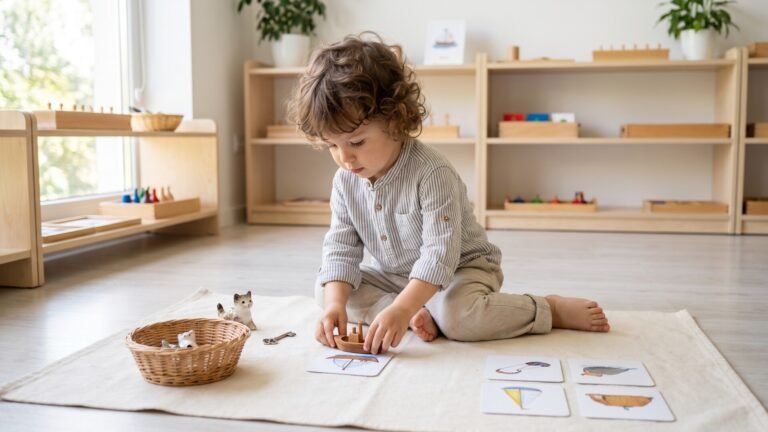
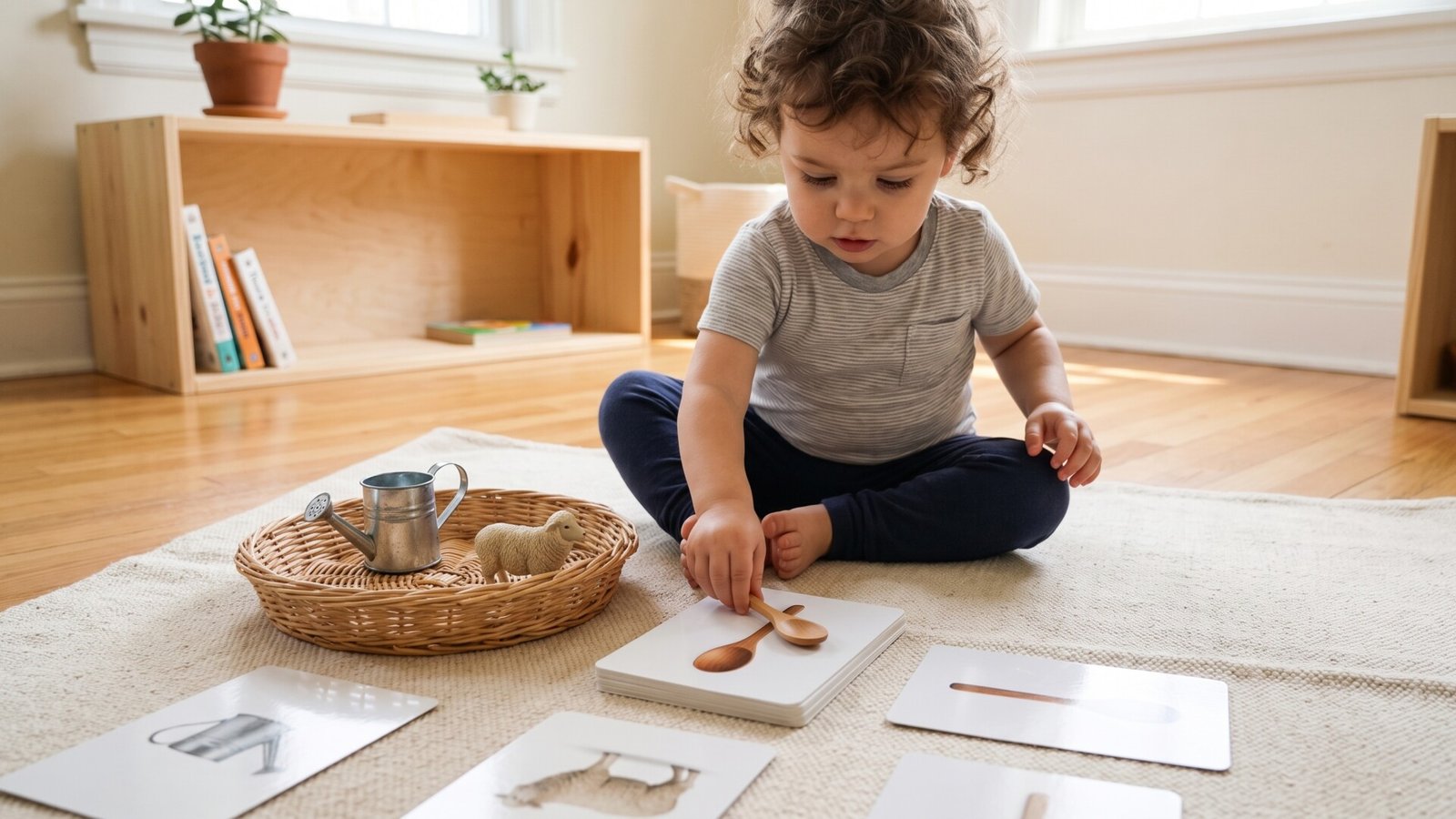
Object naming baskets. Put five or six familiar, realistic objects in a low basket: a wooden spoon, a brush, a key, a small cup, a ball, a sock. Sit with your toddler, take one out at a time, and name it slowly and clearly. Then invite them to find it, hand it to you, or tell you what it is.
The realism matters. A plastic cartoon version of a spoon teaches the cartoon, not the spoon. Rotate the objects every week or two so the basket stays interesting, and keep the count low enough that tidying is a one-minute job.
Sound walks and listening games. On a walk, stop and listen. Birds, a truck, water running, a door, footsteps. At home, pause and name what you hear. This looks like nothing. It is attention training and auditory discrimination, which is exactly what a child needs before they can hear the difference between "b" and "p."
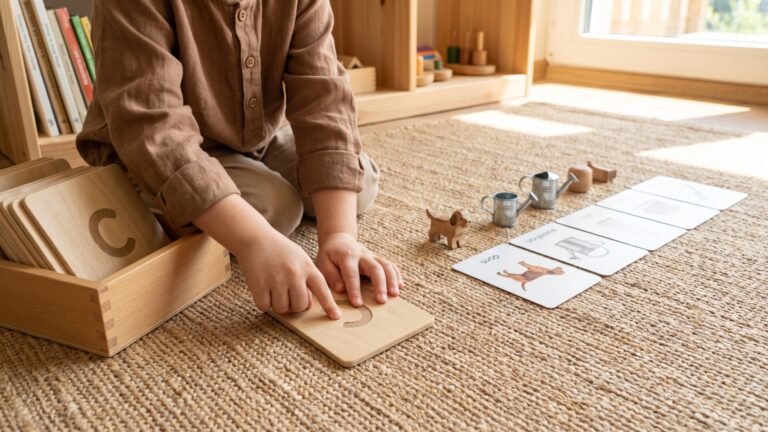
Picture matching and object-to-picture matching. Start with identical pictures: two copies of the same photograph, matched side by side. Then move to matching a real object to its photograph. Then to matching a photograph to an illustration. Each step is harder than it looks, and each one builds visual discrimination.
Story retelling and book handling. Let the toddler choose the book. Let them turn the pages, even if it is out of order. Point at pictures and name them. Retell a scene in your own words and let them correct you. Model left-to-right page turning naturally, without narrating it like a lesson.
The parent guidance here is short: keep materials to a handful of items, follow the child’s interest, and stop before frustration. A five-minute activity that ends well gets repeated tomorrow. A fifteen-minute activity that ends in tears does not.
Sound and listening games
Environmental sound guessing. Put a few large wooden blocks in a sealed container and shake it. Then a container of rice. Then a metal tin with a lid. Let the toddler listen and guess which one it is. Keep the containers sealed and check them regularly, because this activity fails the moment a child can open one.
Voice and rhythm games. Clap a simple rhythm and let them copy it. Bounce a stuffed animal on your knee to a song’s beat. Whisper, then speak normally, then use a silly voice. Rhymes and songs do more for sound awareness than most purchased materials, and they are free.
Animal sound and object sound matching. Pair a sound with a toy animal or a picture. The goal is listening, not a fixed correct answer. If your toddler says the cow says "moo" when you made a duck sound, you have a conversation, not a wrong answer.
These are early sound-awareness activities, not phonics lessons. Do not push a toddler to identify initial sounds before they are ready. If they are not interested, they are not ready, and that is information, not a problem.
Matching, sorting, and visual discrimination
Object sorting by one visible quality. Start with one attribute only: large and small, or smooth and rough, or red and blue. Two categories, a few objects each. Adding a second attribute at the same time is where most toddlers lose the thread.
Picture classification. Sort pictures into broad, familiar groups: foods, animals, clothing, vehicles. Use photographs rather than stylized drawings where you can.
Memory and matching games. Begin with three or four pairs of cards, face up. Move to face down only when the child succeeds easily. Increase the count when they are bored, not when you think they should be ready.
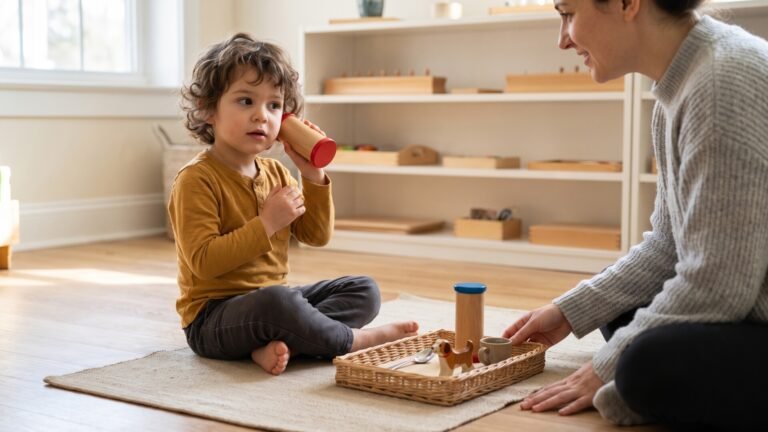
Sound cylinders or simple auditory matching materials. Pairs of sealed containers with different contents, matched by sound. This is the one purchased material in this section that earns its place, and only for children who enjoy quiet, repetitive matching work. Sealed means sealed: inspect regularly, and keep them away from children who still mouth or pry at objects.
Early letter and symbol exposure
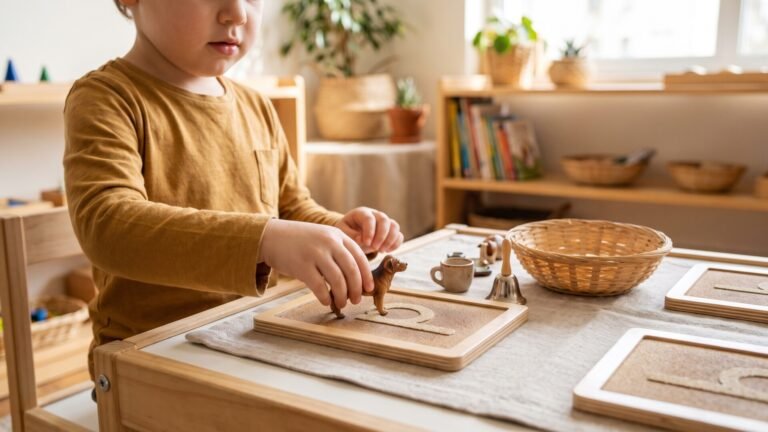
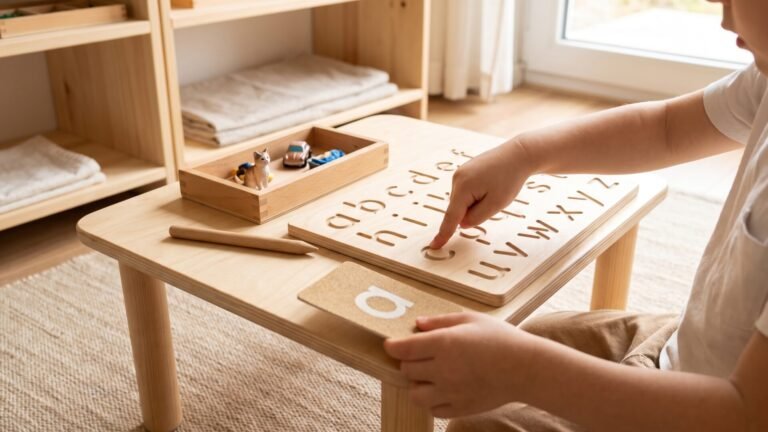
Sandpaper letters. Present one or two letters at a time, using the three-period lesson only when the child shows interest and can engage for a minute or two. Trace the letter, say the sound, let them trace it. Do not run the full lesson if they walk away at step two.
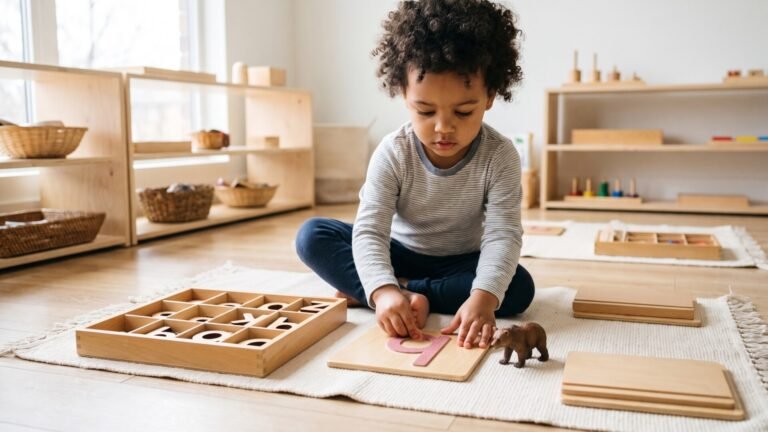
Moveable alphabet preparation. A full moveable alphabet is usually a preschool material, not a toddler one. Toddlers may explore a few selected tactile letters, but this is not a spelling tool at two. If your child is not yet enjoying listening games and naming objects, the moveable alphabet is not the missing piece.
Letter matching in the environment. Notice a familiar letter on a sign, a cereal box, or a name card. Say it once and move on. Turning every outing into a letter quiz is the fastest way to make letters feel like homework.
Letter recognition is one strand of pre-reading. It should not crowd out conversation, books, songs, and sound games, which carry more weight at this age. For more on that specific strand, see [Internal: Montessori Toys for Early Letter Recognition].
How to Choose Montessori Materials for a Toddler
Age appropriateness. Favor large, easy-to-handle pieces and activities that finish in a few minutes. Check the manufacturer’s stated age range, and keep small parts away from children who still mouth objects. This is not a formality; it is the single most common mistake in this category.
Safety and construction. Look for stable materials, smooth edges, securely attached pieces, and sealed containers for anything sound-related. Inspect wooden materials regularly for cracks, loose components, and peeling finishes. If a finish is flaking, the item comes out of rotation.
Language value over visual novelty. Choose materials that invite naming, matching, listening, or storytelling. Be skeptical of anything that flashes letters or plays automated sounds. A toy that says the letter for your child has removed the work your child was supposed to do.
Storage and rotation. One tray or basket out at a time. Everything else stored, not displayed. A shelf with twelve activities on it produces a child who flits between all twelve and finishes none.
Parent involvement. Many Montessori activities need an adult presentation at first. A material is not educational because it is wooden; it is educational when the child can use it meaningfully. If it requires constant correction to work, it is the wrong material for right now.
Recommended Montessori Pre-Reading Materials
Prices below are approximate and move around with sales and bundles.
| Material | Approximate Price | Best For | Main Skill | Space and Supervision |
|---|---|---|---|---|
| Melissa & Doug See and Spell Learning Toy | $20-$35 | Beginning letter and word exposure | Letter matching, visual discrimination | Compact; supervise small pieces |
| Melissa & Doug Wooden Alphabet Puzzle | $15-$25 | Alphabet familiarity | Letter recognition, fine-motor control | Compact; supervise young toddlers |
| Montessori-style object-to-card matching set | $20-$45 | Vocabulary and classification | Oral language, matching | Low storage; adult presentation helpful |
| Montessori sound cylinders | $25-$60 | Listening discrimination | Auditory matching | Small footprint; inspect seals |
| Sandpaper letters | $30-$70 | Tactile letter introduction | Letter-sound and symbol awareness | Needs careful presentation |
| Moveable alphabet | $40-$90 | Older or highly interested toddlers | Early sound-to-symbol work | Many small pieces; not a first purchase |
| Picture books and realistic story cards | $10-$40 | Everyday language development | Vocabulary, comprehension, sequencing | Flexible; easy to rotate |
Melissa & Doug See and Spell Learning Toy
Marketed for preschool-age children, so treat the stated age range as the real one. Younger toddlers may use it only with close supervision and only if they are already past mouthing objects.
It is a bridge from picture recognition to printed letters: picture cards, letter pieces, and simple word matching. Around $20 to $35. The useful version of this activity is an adult naming the picture and the child hunting for the matching letter, not a child being asked to spell correctly.
Best for: families who want one compact, familiar letter-matching activity that stores flat.
The honest downsides: small pieces need supervision, and the design rewards answer-getting over conversation. It is not a complete Montessori language program and should not be treated as one. [Affiliate: Check current pricing on Amazon]
Skip this if your child is still primarily mouthing objects or shows no interest in matching pictures to objects.
Melissa & Doug Wooden Alphabet Puzzle
Commonly intended for toddlers and preschoolers; verify the current package labeling before buying. Chunky wooden letters and a matching board, usually $15 to $25.
Used as a matching and fine-motor activity, it is a reasonable first alphabet material. Used as a memorization test, it is a chore with a wooden finish. It offers far less language depth than object cards or books, so it complements those rather than replacing them.
Best for: budget-conscious families introducing letter shapes casually.
The limits are real: no sound work, no vocabulary work, and puzzle play can become purely mechanical, with the child completing it on muscle memory and learning nothing new. [Affiliate: Check current pricing on Amazon]
Skip this if your child gets frustrated by letter shapes or is more engaged by real objects and pictures. That is not a failure; it is a signal to wait.
Montessori-style object-to-card matching set
Often suitable from around age two with adult presentation, depending on piece size and complexity. Realistic objects paired with photographs or simple picture cards, usually $20 to $45.
This is one of the most useful purchases in the category because it supports vocabulary before formal letter work, which is the correct order. Choose realistic images and durable cards, and objects large enough to be handled safely.
Best for: toddlers who need richer vocabulary and concrete language experiences.
Quality varies enormously between sets, and cheap versions tend to include objects that are too small, cards that bend, or images that are stylized rather than photographic. Adult involvement is usually needed at first. Buy from a specialist Montessori collection or a reputable educational toy collection rather than a novelty set. [Affiliate: Browse object-to-card matching sets]
Montessori sound cylinders
Usually more appropriate from about two and a half to four years, depending on whether your child can handle and match them safely. Pairs of sealed cylinders containing different materials, matched by sound. Around $25 to $60.
This is a focused listening material, and it is genuinely good for children who enjoy quiet, repetitive matching. It is not essential for every toddler. Everyday sound games do much of the same work for nothing, so do those first and buy cylinders only if your child loves the activity.
Best for: children who enjoy auditory matching and careful repetition.
Some sets are overpriced for what is essentially a box of sealed tubes. Pieces must stay securely sealed, and the material offers no vocabulary practice by itself.
Safety note: inspect regularly, and keep away from children who may open or mouth the cylinders. If a seal fails, the contents come out and the material goes in the bin.
Sandpaper letters
Often introduced around age three or later, though readiness varies widely. Tactile letter forms the child traces while hearing the associated sound. Typically $30 to $70.
This is a strong Montessori material introduced deliberately and at the right time. It is not the best first purchase for a young toddler who still needs spoken-language experience, and the adult presentation matters more than which box you bought. A cheap set presented well beats an expensive set presented badly.
Best for: older toddlers showing sustained interest in letters and sound-symbol connections.
The costs: higher price, correct presentation required, and small pieces that may not suit younger children. Check whether the set uses the letter case and sound conventions that match the approach you intend to follow, because sets differ. [Affiliate: Browse sandpaper letter sets]
Moveable alphabet
Generally better for preschoolers who already recognize several sounds and can use small pieces safely. Individual letters for composing words without handwriting. Usually $40 to $90.
It is a valuable later-stage material and a poor impulse purchase for most toddlers. It becomes useful after vocabulary, sound awareness, and some letter familiarity are in place. Before that, it is a box of small pieces with a high tidy-up cost.
Best for: children nearing preschool who are ready to experiment with written language.
Skip this if your child does not yet enjoy listening games, naming objects, or matching activities. That is the whole test.
Picture books and realistic story cards
Suitable throughout toddlerhood, matched to attention span and language level. Roughly $10 to $40 depending on format and set size.
Books are the highest-value literacy purchase you will make, because they support vocabulary, comprehension, attention, sequencing, and enjoyment at the same time. A small rotating library beats a large pile of barely used titles every time. Favor board books, realistic nonfiction, rhyming stories, and simple narratives rather than relying only on alphabet books.
Best for: every toddler, including families buying no specialist Montessori materials at all.
The drawbacks are practical: books get damaged, some toddler titles are visually busy or linguistically thin, and the format requires an adult to actually read them. [Affiliate: Browse picture book collections]
What Most Parents Get Wrong About Montessori Pre-Reading
Starting with letters because they look measurable. Letter naming produces visible progress, so parents chase it. Meanwhile vocabulary and listening sit underdeveloped, and those are the skills that carry the child through decoding later. A toddler who knows twelve letter names but cannot follow a two-step instruction is not ahead.
Buying a complete shelf of materials. A full language shelf looks like commitment. In practice, too many choices reduce concentration, increase cleanup time, and make it harder to see what your child actually enjoys. One tray at a time tells you more about your child than twelve trays ever will.
Confusing independent work with no adult input. Montessori independence comes from a short, precise presentation, not from handing a child a complicated material and leaving. A two-minute demonstration often buys you ten minutes of independent work. Skipping the demonstration buys you a frustrated child and a mess.
Correcting every mistake. Modeling, waiting, and repeating language naturally works better than correction. If your toddler says "tuck" for truck, you say "yes, the truck" and move on. Correction turns a conversation into a test.
The counterintuitive point underneath all of this: the best pre-reading activity is often ordinary conversation during cooking, dressing, errands, and outdoor play. Naming what you are doing, answering questions, and narrating the world is free, unlimited, and more effective than most materials on this list.
The Hidden Cost of Choosing the Wrong Activity
The financial cost is the easy one to see. A moveable alphabet at $70 that sits unused because your child is not ready is $70 badly spent. Multiply that across a shelf of materials bought at the wrong stage and you have funded a small Montessori classroom in your living room.
The space cost is the one parents underestimate. Loose letters, cards, and puzzle pieces do not stay in their boxes. They migrate under the sofa, into the kitchen, into the car. Every piece is a thing you will pick up, count, and eventually replace. A material with ninety pieces is a material with a ninety-piece tidy-up attached to every use.
The pressure cost is the worst of the three. Repeated quizzing makes books and language activities feel like performance tasks. A child who associates reading time with being tested stops choosing books. That is a much harder problem to undo than an unused alphabet puzzle.
The decision framework that avoids all three:
- Buy books and object-based vocabulary materials first. These have the widest age range and the lowest risk.
- Add one matching or listening material if your child enjoys the activity. One. Not a set of four.
- Introduce tactile letters later, when interest and readiness are visibly there.
- Avoid anything that requires frequent correction or has no clear use beyond memorization.
If you want the sound-game side of this in more depth, [Internal: Montessori Sound Games for Language Development] covers it properly.
How to Build a Simple Montessori Pre-Reading Routine
Daily language foundation. Conversation, songs, naming, and shared reading, woven into routines you already have. Meals, bath time, the walk to the car. This is the bulk of the work and it costs nothing.
Short shelf activity. One matching, sorting, or listening activity on a tray, available for the child to choose and repeat independently. One. Rotate it when interest drops.
Readiness-based letter work. Letters only when the toddler shows sustained interest, can handle the materials safely, and enjoys sound or symbol exploration.
Weekly rotation. Keep a small selection out, store the rest, and rotate based on what actually gets used rather than a schedule you invented on a Sunday.
Parent observation checklist. Watch for whether your child listens, repeats words, matches objects, handles books, notices sounds, and returns to an activity voluntarily. Those six behaviors tell you more about readiness than any age chart. For age-specific guidance, [Internal: Montessori Language Activities for 2-Year-Olds] walks through what this looks like in practice.
Best Choices for Different Families
Best for a tight budget. Library books, household object baskets, homemade picture matching cards, songs, and outdoor sound walks. If you buy one thing, make it a durable picture book collection or an object-to-card matching set rather than a large letter kit.
Best for small spaces. Board books, one wooden alphabet puzzle, and a compact matching set. Avoid a full Montessori language shelf until your child has demonstrated interest in specific activities. In a small apartment, the storage burden is the deciding factor, not the price.
Best for vocabulary development. Realistic object-to-card matching materials, picture books, and naming baskets. Vocabulary breadth supports later comprehension more directly than early letter memorization, and it is the area where a modest purchase does the most work.
Best for early letter interest. A wooden alphabet puzzle first, then sandpaper letters when the child is ready for tactile sound-symbol work. Do not rush to a moveable alphabet for a young toddler, however keen they seem this month.
Best for long-term value. Quality books, durable matching materials, and sandpaper letters only when developmentally appropriate. Judge value by repeated use, sibling potential, storage burden, and whether the material supports more than one skill. [Affiliate: Browse the Melissa & Doug collection]
The Long View
Here is what this looks like in three years. The families who bought a shelf of materials at age two are usually selling them at a loss, because the child either outgrew the stage before using them or never took to them. The families who read aloud daily, named everything in sight, and added one matching tray at a time are the ones whose four-year-old is asking what the signs say.
The materials on this list have a long life if you buy them in the right order. A good picture book collection gets read for years and handed down. An object-to-card matching set works at two, three, and four, just with different expectations. Sandpaper letters, bought at the right moment, will serve a younger sibling later. A moveable alphabet bought too early serves nobody.
So the ordering is the whole decision. Books and vocabulary first. One matching or listening activity when your child shows you they enjoy it. Tactile letters when the interest is genuinely there. If you get that sequence right, the specific brands matter far less than the order you bought them in. Check current pricing and availability through our recommended partners, and start with the books.
Frequently Asked Questions About Montessori Pre-Reading Activities For Toddlers
What are the best Montessori pre-reading activities for toddlers?
Shared reading, object naming, songs, sound walks, matching, sorting, picture sequencing, and book handling. Letter activities get added when the child shows interest and readiness, not on a schedule.
Should a 2-year-old be learning letters?
Some two-year-olds enjoy letters and will pick them up from puzzles and signs. Formal letter instruction is not necessary at this age. Prioritize spoken vocabulary, listening, books, and matching, and follow your child’s interest without pressure.
Are Montessori sandpaper letters appropriate for toddlers?
They suit some older or highly interested toddlers, but many children are better served by language-rich activities first. Check piece size and safety, and be honest about whether your child is ready for sound-symbol work.
How can I teach phonics without pushing my toddler?
Emphasize natural speech sounds, rhymes, songs, and playful sound matching. Avoid demanding that a toddler identify or produce sounds on command. If they are not interested, they are not ready, and that is fine.
Do Montessori toddlers use alphabet puzzles?
They can, for matching and fine-motor practice. An alphabet puzzle is not automatically a Montessori activity, and it should not replace books, conversation, or object-based language work.
How long should a Montessori pre-reading activity last?
A few minutes is normal and can still be valuable. Stop while the child is engaged, then offer the activity again another day. Length is not the measure; voluntary return is.
Are flashcards useful for toddler pre-reading?
Not essential. Real objects, photographs, books, songs, and conversation offer richer language opportunities and connect more easily to the child’s actual world.
What if my toddler ignores every activity I set up?
That usually means the activity is too hard, too abstract, or too long. Drop back to naming objects and reading together, and try a matching activity again in a few weeks.
Do I need a full set of Montessori language materials?
No. Most families do better with books, a vocabulary material, and one listening or matching activity. Add tactile letters when your child is ready. A complete set bought at once is a storage problem with a learning curve attached.