Montessori Practical Life Activities for Preschoolers
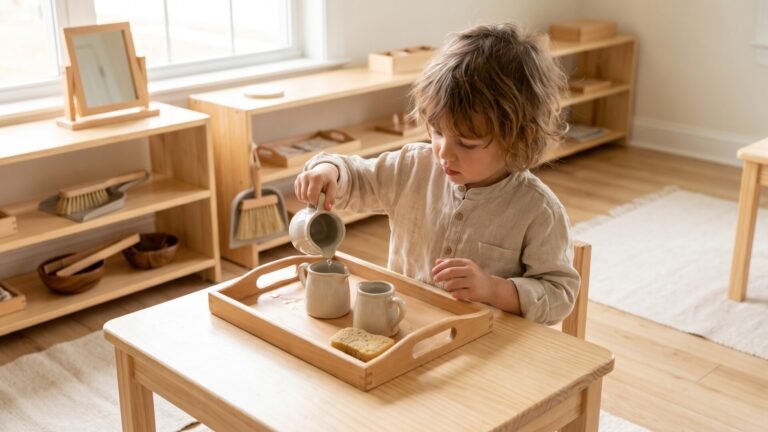
I bought a small wooden tray, two ceramic pitchers, and a set of miniature tongs for my four-year-old. Total cost, somewhere near forty dollars. She used it twice, then asked if she could help unload the dishwasher. That was the whole lesson, and it cost me forty dollars to learn.
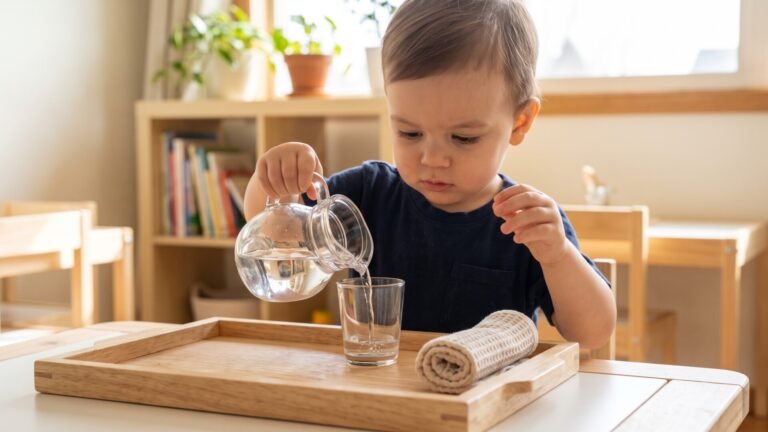
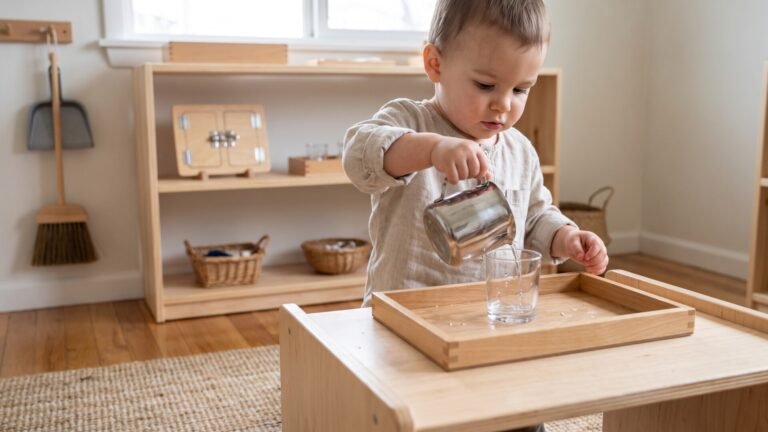
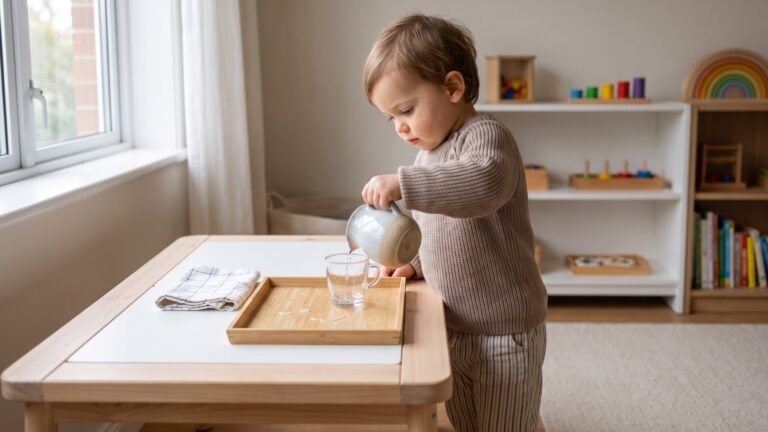
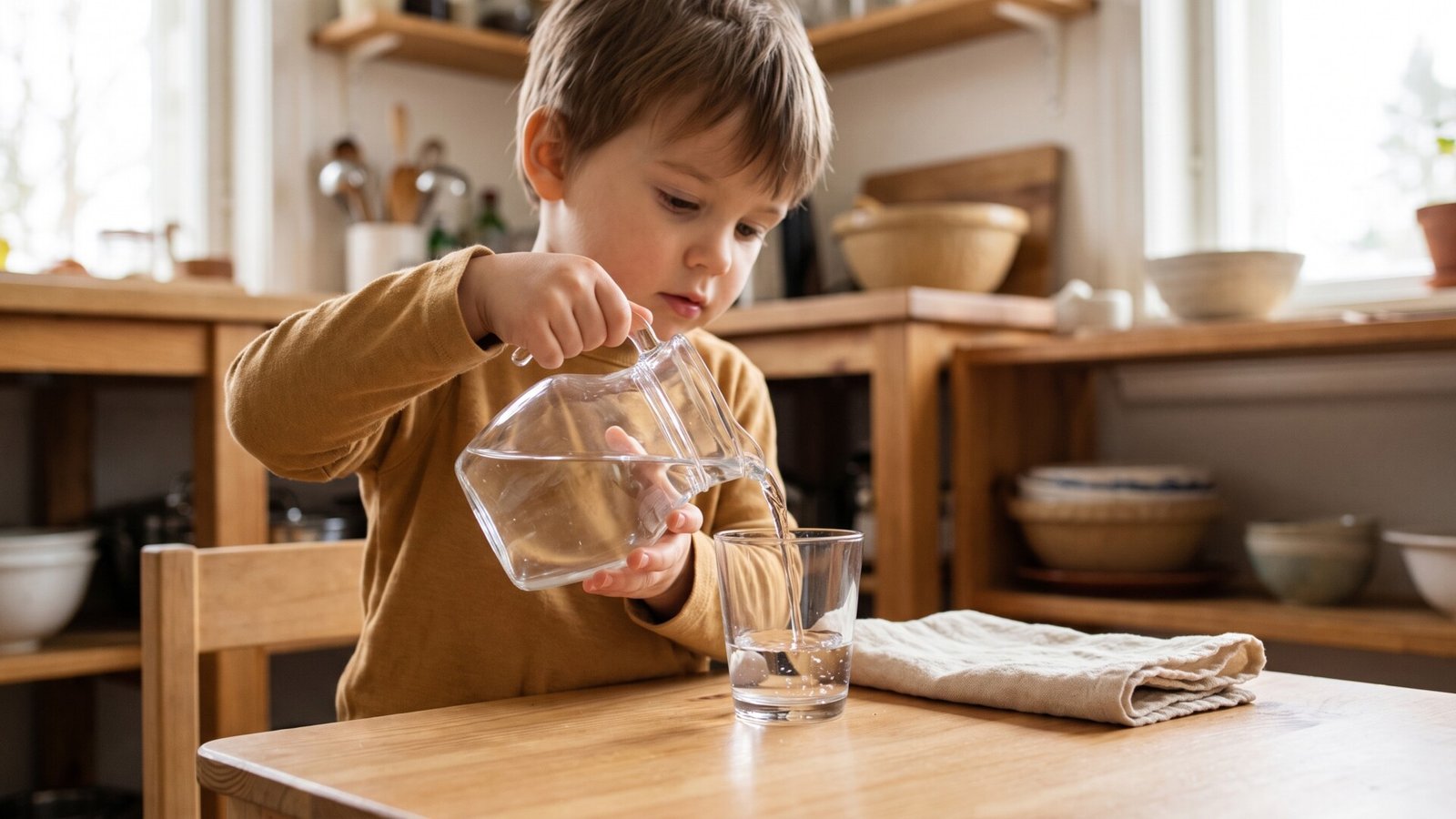
The most effective practical life activities for preschoolers are not activity trays. They are ordinary tasks a four-year-old can repeat: pouring water at the table, washing an apple, sweeping crumbs, hanging a coat on a hook they can actually reach. The work is real, the result is visible, and nobody has to set it up in advance.
That changes what you buy. You are not shopping for a curriculum. You are shopping for child-sized versions of tools you already use, so your kid can take part in the routines your family already runs. Practical life activities for preschoolers work best when they attach to something that was going to happen anyway.
As children move into the preschool years, practical life activities can become more complex, giving them greater responsibility and opportunities to refine coordination, concentration, and independence. For a broader selection of Montessori practical life materials and ideas across different skills and ages, see our Montessori Practical Life Toys: Complete Guide.
Why Practical Life Activities Matter at Preschool Age
Preschoolers are in an odd position. They are capable of far more than most of us let them do, and they are still genuinely bad at most of it. Both things are true at once, and the gap between them is where the frustration lives.
Practical life work gives a child a full sequence to own. Get the materials. Do the thing. Clean up. Put it back. That arc, repeated, is the point. A three-year-old can pour water into a glass if the pitcher is small enough and the glass is stable. Nobody is claiming this builds executive function in a measurable, documented way. It builds a habit of doing a thing from start to finish, which is useful in itself.
The honest framing: this is practice, not performance. Your child will sweep crumbs into a slightly different pile. The table will be wetter after they wipe it. If you are measuring the output, you will quit in a week, because a preschooler is slower and worse at housework than you are. That is not a reason to stop. It is the entire reason to start.
Then there is the preschool reality. You have twenty minutes before dinner and a child who wants to help and a kitchen that is already chaotic. Adding a child to that is more work, not less, for the first several months. Most parents try this once, find it exhausting, and quietly go back to doing everything themselves.
The way through is to pick one thing and protect it. Not five activities on a shelf. One job, done the same way, at the same time, every day. You can read more about how the approach fits together in our Montessori Practical Life Toys & Activities hub, but the short version is that repetition beats variety here.
The Practical Life Activities Preschoolers Are Ready For
Group activities by the kind of independence they practice. A four-year-old who can pour water is not automatically ready to peel a carrot, and a child who dresses themselves in the morning may still need help with a zipper at bedtime.
Food Preparation and Kitchen Work
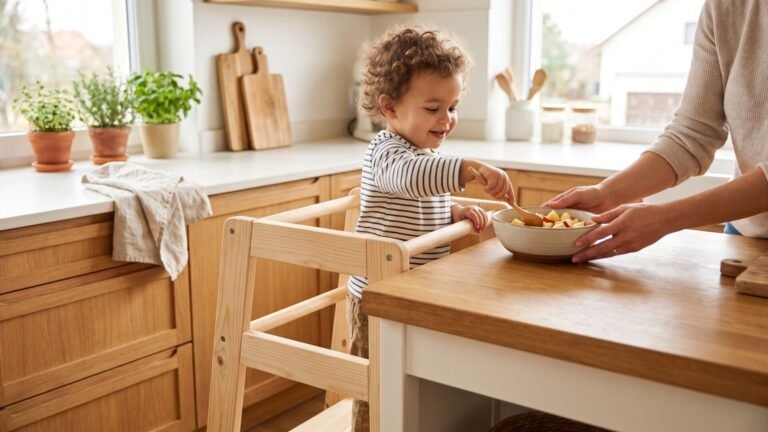
Washing produce, spreading soft cheese or butter, peeling a banana, pouring water, transferring dry ingredients between bowls, stirring, and setting their own place at the table. These are the ones with the most replay value, because your child sees a result they can eat.
Supervision is not optional. Knives, hot surfaces, raw meat, choking hazards, glass, and appliances all need active adult judgment, and the specific rules depend on your child and your kitchen. A four-year-old can use a butter knife on a banana. A four-year-old should not be near a stove, full stop.
The reason food work beats pretend food work is simple. A pretend kitchen task has no consequence. A real one does, and children notice the difference. When your kid spreads their own peanut butter, they eat the sandwich with a certain amount of ownership that a plastic tomato will never produce.
Dressing and Personal Care
Choosing between two outfits you have already approved. Putting on pants with an elastic waist. Fastening large buttons, working a chunky zipper, folding a shirt, brushing hair, washing hands, and getting shoes on the right feet.
Here is the part parents skip: simplify the environment before you expect independence. A four-year-old cannot hang up a coat on a hook at adult height, and they will not learn to do it by being reminded. Move the hook. Put the socks in a low drawer. Buy the pants with the elastic waist and save the buttons for when they are five.
If you want the longer version of this, Montessori Dressing and Self-Care Activities covers the setup properly. The principle is the same as everywhere else in this article: change the room, not the child.
Care of the Environment
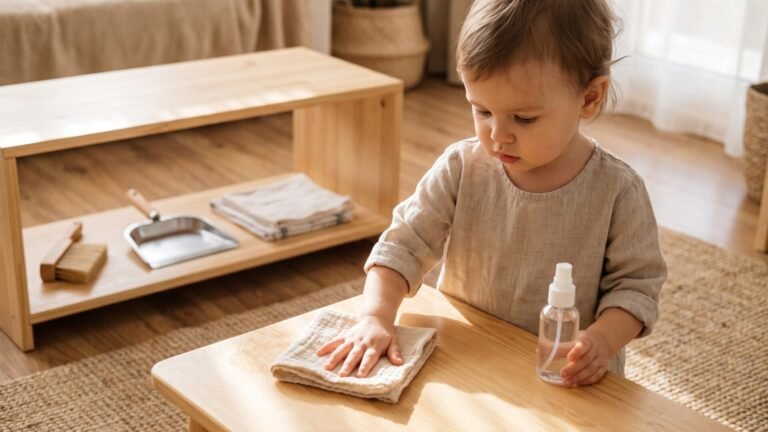
Sweeping, dusting, wiping a table, watering a plant, sorting laundry into two piles, putting toys away, carrying light items, cleaning a small spill with a cloth. This is where preschoolers can genuinely contribute, and where the tools matter most.
Give each task a clear beginning and end. Get the cloth. Wipe the table. Rinse the cloth. Hang it back on the hook. A task with no defined finish becomes a vague instruction, and vague instructions get ignored by everyone, including adults.
One useful responsibility is the target, not a chore chart. A four-year-old who waters the two plants every morning has a real role. A four-year-old with eight daily chores has a job, and they will quit it.
Grace, Courtesy, and Everyday Social Skills
Greeting someone at the door, waiting for a turn, carrying a chair carefully instead of dragging it, asking for help instead of whining, serving food to someone else before themselves, caring for a shared space.
These are not taught through a lesson. They are taught through what you do, repeatedly, in front of them. If you say hello to the person at the door, your child eventually says hello to the person at the door. If you carry your chair carefully, so will they, mostly, until they forget.
The failure mode here is forcing a performance. A child who is made to recite a greeting on command learns to perform greetings, not to mean them. Model it, give them the chance, and let the awkward silence sit there. It usually resolves itself by age five.
How to Set Up Practical Life Activities Without Creating More Work
The setup that works is smaller than you think. A low shelf or basket with three complete activities, each one returning to the same spot. If the shelf has twelve things on it, your child will use none of them and you will spend your evenings rebuilding it.
Adapt what you already own before you buy anything. A small pitcher, a child-sized dustpan and brush, low hooks, a couple of sturdy cloths, a tray, a washable apron, an unbreakable bowl. That list costs almost nothing and covers most of what a preschooler can actually do.
Your job as the adult is narrower than it feels. Demonstrate the whole thing slowly, once, with very few words. Then step back. Let them repeat it badly. Intervene for safety, not for quality. The wet table is not a problem to solve.
Run this test before you commit to a station. Can your child reach the materials without help? Do they understand the first step? Can they finish? Can they clean up and put it back without you rebuilding it afterward? If the answer to any of those is no, the setup is wrong, not the child.
Key Buying Factors for Montessori Practical Life Materials
Five things decide whether a purchase is worth it. Price is not one of them.
Functionality and safety. Does the tool do a real job? Secure handles, stable bases, appropriate size, no unnecessary sharp edges or parts that come off. Follow the manufacturer’s age guidance and supervise water, food, tools, and cleaning products. This is the one area where you do not get to improvise.
Age and skill fit. Preschoolers span a wide range. A just-turned-three and a nearly-five are different people. Start with materials that need one or two manageable steps, then add complexity as your child gains control. Buying for the child you have beats buying for the child the product page describes.
Durability and cleanability. Washable fabric, sturdy wood, food-safe materials, replaceable parts. A watering can that cracks in month two is not cheap, it is expensive in a way that does not show up on the receipt.
Storage and parent effort. Can this stay ready to use? Does it create more cleanup than it prevents? Does it use something you already have? A tool that requires ten minutes of setup will be used twice.
Value beyond novelty. Will it be used weekly? Does it transfer to a real routine? Will it still be useful after your child masters the first version? A dressing frame that teaches buttons is done once the buttons are learned. A broom is not.
Recommended Montessori Practical Life Toys and Tools
These are supporting tools, not a substitute for genuine household participation. A child who only ever uses a toy broom has learned to play at cleaning. A child who uses a real broom on real crumbs has learned to clean.
I have mixed inexpensive household items with dedicated products, because that is the honest answer. Some of the best things here cost under twenty dollars and are not marketed as Montessori at all.
Melissa & Doug Deluxe Wooden Cleaning Set
| Feature | Details |
|---|---|
| Age Range | Marketed for young children; check current manufacturer guidance |
| Key Features | Child-sized cleaning tools, organized storage, role-play format |
| Price (approx) | Usually around $25-$40 |
The Verdict
A useful bridge for a child who wants to copy you while you clean. It works best when the tools get used on real, low-risk messes – sweeping crumbs, wiping a low table – rather than staying in the corner as props. Some pieces are more toy than tool, which is fine for motivation and less useful for actual work.
Best For
Children who are motivated by copying household work, and families who want the whole set in one box.
Pros
- Familiar household roles encourage participation
- Several coordinated tools in one purchase
- Easier to store than loose equipment
Cons
- Some pieces are more toy-like than functional
- Does not replace supervision around real cleaning products
- Better for motivation than for advanced practical work
[Affiliate: Check current pricing and availability through our recommended partners]
Child-Sized Kitchen Utensil Set
| Feature | Details |
|---|---|
| Age Range | Preschool age; verify the specific product listing |
| Key Features | Child-sized utensils and role-play accessories |
| Price (approx) | Usually around $15-$35 |
The Verdict
A cheap way to build a kitchen participation station for stirring, serving, and transferring. Pick a set with durable, washable pieces and then actually use it with real ingredients. A plastic whisk that only ever stirs imaginary soup is a toy. The same whisk in a real bowl of batter is a job.
Best For
Families starting food preparation on a modest budget.
Pros
- Affordable entry point
- Supports stirring, transferring, serving, and sequencing
- Combines easily with equipment you already own
Cons
- Some sets are primarily pretend-play items
- Quality varies a lot between sets
- You still have to supply the real tasks
[Affiliate: Check the price on Amazon]
Child-Sized Broom and Dustpan Set
| Feature | Details |
|---|---|
| Age Range | Preschoolers who can follow simple safety directions |
| Key Features | Lightweight handle, stable dustpan, usable sweeping head |
| Price (approx) | Usually around $15-$35 |
| Best Use | Sweeping crumbs and dry, low-risk messes |
The Verdict
This is the single highest-value purchase in the category, and it is not close. It does a real job, it gets used several times a week if you leave it somewhere reachable, and it costs less than a takeaway dinner. A functional broom beats a large activity kit for almost every family.
Best For
Anyone who wants one tool that earns its place.
Pros
- Performs a genuine household task
- Builds coordination and a sense of responsibility
- Inexpensive
Cons
- Will not collect debris as well as your adult broom
- Needs an appropriate, low-risk mess to be useful
- Becomes clutter if it has no assigned storage spot
[Affiliate: Check the price on Amazon]
Small Watering Can and Plant Care Tools
| Feature | Details |
|---|---|
| Age Range | Preschoolers with supervised water access |
| Key Features | Lightweight design, manageable capacity, easy-grip handle |
| Price (approx) | Usually around $10-$30 |
| Best Use | Watering indoor plants or a small outdoor patch |
The Verdict
Plant care gives you a clear sequence and a visible result, which is exactly what a preschooler needs. The trick is buying the small can, not the big one. A full two-liter can is heavy, spills constantly, and gets abandoned by week two. A small capacity means your child can actually carry it and finish the job.
Best For
Households with a couple of plants and a child who likes a daily routine.
Pros
- Simple and repeatable
- Builds care for a living thing
- Scales up easily as your child grows
Cons
- Spills are guaranteed at first
- Not every home has suitable plants or safe water access
- Needs limits, or the plants will drown
[Affiliate: Check current pricing and availability through our recommended partners]
Montessori-Style Dressing Frames
| Feature | Details |
|---|---|
| Age Range | Preschoolers practicing one specific fastening skill |
| Key Features | A single fastening type, presented in isolation |
| Price (approx) | Usually around $20-$60 |
| Best Use | Focused practice before applying it to real clothing |
The Verdict
Worth it in exactly one situation: your child is stuck on buttons or zippers and the frustration of a whole outfit is getting in the way. Then a frame that isolates that one fastening can help. If your child is not stuck, skip it. A frame does not feel like clothing, and most children lose interest once the skill clicks.
Best For
A child working on one specific fastening, with a parent who will follow it up with real dressing practice.
Pros
- Focuses attention on a single fastening
- Useful when real clothing practice is frustrating
- Compact compared with a full dressing station
Cons
- Gets repetitive fast
- Does not reproduce the feel of real clothing
- Expensive for what it teaches
[Affiliate: Check current pricing and availability through our recommended partners]
Wooden Transfer, Pouring, or Sorting Tray
| Feature | Details |
|---|---|
| Age Range | Preschoolers who can follow material-specific safety rules |
| Key Features | Contained setup, transfer tools, repeatable sequence |
| Price (approx) | Usually around $15-$45 assembled |
| Best Use | Coordination, sequencing, and controlled movement |
The Verdict
A tray earns its place by containing the mess and making the activity easy to start and put away. It loses its place the moment you fill it with tiny pieces that create more sorting and supervision than useful practice. Keep the materials large, dry, and few.
Best For
Families who want a contained activity that lives on a shelf.
Pros
- Flexible and easy to customize
- Supports pouring, transferring, and sequencing
- Can be built from inexpensive household items
Cons
- Small parts create real safety concerns
- Requires adult preparation every time
- Interest fades when the task has no connection to real life
[Affiliate: Check the price on Amazon]
Low Shelf, Hooks, and Storage
| Feature | Details |
|---|---|
| Age Range | Preschoolers using accessible household routines |
| Key Features | Low access, defined storage, visible materials |
| Price (approx) | Usually around $40-$150 depending on construction |
| Best Use | Making independent access possible |
The Verdict
Storage is the least exciting purchase and the one that decides whether any of this happens. A low shelf or a row of hooks at your child’s height creates more independence than another tray, because it makes the whole routine visible and repeatable without you. Anchor anything that could tip.
Best For
Anyone who has bought the tools and watched them sit unused.
Pros
- Removes your child’s dependence on you for setup
- Helps them return materials without a reminder
- Serves several activities over the years
Cons
- Takes floor or wall space
- Needs safe installation
- A large unit invites you to overload it
[Affiliate: Check current pricing and availability through our recommended partners]
Skip This If: Large Practical Life Activity Bundles
Skip the big bundles with forty miniature tools in a wooden box. They look comprehensive in the listing photo and become a storage problem in your hallway by February. Every piece needs a home, most pieces have no real function, and you are the one who ends up sorting them back into the right compartments.
Buy one functional tool tied to a routine you already have. If your child takes to it, add a second. Pretend cleaning and kitchen sets still have a place in role-play, and there is nothing wrong with that, but do not mistake them for an independence curriculum.
Comparison Table: Which Materials Are Worth Adding First?
| Product or Tool | Approx. Price | Real Household Use | Parent Hassle | Best For |
|---|---|---|---|---|
| Child-sized broom and dustpan | $15-$35 | High | Low | Cleaning practice |
| Small watering can | $10-$30 | High | Low to medium | Plant care |
| Kitchen utensil set | $15-$35 | Medium to high | Medium | Food preparation |
| Cleaning set | $25-$40 | Medium | Low | Household role-play |
| Dressing frame | $20-$60 | Medium | Low | Fastening practice |
| Low shelf or storage | $40-$150 | Very high | Low after setup | Consistent access |
ToyGuideHub Parent Hassle Score and Real-World Ownership Verdict
The Parent Hassle Score is a 1-to-5 rating, where 1 means the tool mostly runs itself and 5 means it creates more work than it removes. It is an editorial framework based on setup time, supervision needs, cleanup, storage, and how easily the activity slots into a routine you already have. It is not the result of any testing, and it is not a safety rating.
Here is how the categories land.
Household tools score lowest for hassle, around 1 to 2. A broom, a watering can, a cloth, a low hook. They live where the work happens, they need no setup, and cleanup is the activity itself. You buy them once and they stay useful.
Trays land in the middle, around 3. The tray contains the mess, which is genuinely helpful, but somebody has to fill it, and somebody has to notice when the pieces are gone. If your child uses it daily, the hassle is worth it. If it sits on the shelf, you have bought a container for your own guilt.
Large multi-piece kits score highest, 4 to 5, unless you have dedicated storage and a child who reliably returns things. Every piece is a future missing piece. Every activity needs rebuilding. The kit looks like a complete system and behaves like a second job.
The counterintuitive finding, and the one worth carrying out of this article: the most Montessori-looking product is not the most independence-building one. A beautiful wooden transfer tray with matching tongs photographs better than a broom. The broom is what your child can use alone, repeatedly, to produce a result you both care about. Independence comes from access and repetition, not from aesthetics.
Six months out, here is what survives. The broom is still by the door. The watering can is still by the sink. The low hooks are still holding a coat. The dressing frame was mastered and moved on from. The forty-piece bundle was sorted into a bin and quietly donated. Prioritize tools that still work after the novelty disappears, that a younger sibling can inherit, and that do not need you to rebuild them every Sunday.
The purchase order that follows from this is short. Start with one cleaning tool or one kitchen tool tied to a real routine. Add accessible storage so your child can reach it without asking. Then, and only then, buy a specialized dressing frame or tray if a specific skill or interest justifies it. Most families never need to go past step two.
How to Choose Activities for Different Preschoolers
Best for Children Who Want to Help
Give them real, visible work. Setting the table, watering plants, carrying napkins, wiping a low surface. Keep them close to whatever the family is already doing rather than assigning an isolated activity in another room. The motivation is the company, not the task.
Best for Children Who Prefer Short Tasks
Use activities with a clear finish. Pour three cups. Wipe one table. Put away five items. Water two plants. Small quantities, same task, repeated before you increase complexity. A task with a visible end gets done. A task with an unclear end gets abandoned.
Best for Small Spaces
Go foldable or wall-mounted. One compact tray, a cloth, a small tool that does a real job, and a hook or two at your child’s height. Skip anything that needs permanent floor space, because in a small apartment that space is already spoken for.
Best for Montessori Homes on a Budget
Start with what you own. A small pitcher, a cloth, a bowl, a child-sized brush, a low hook, an accessible basket. Spend on fit and access before you spend on matching wooden accessories. The accessories are the least important part of this entire article.
Best for Preschoolers Building Dressing Independence
Simplify the clothing first. Reachable storage, elastic waists, two approved options instead of a full closet. Add a dressing frame only when one specific fastening is genuinely blocking progress. Montessori Dressing and Self-Care Activities has the full setup.
What Most Parents Get Wrong About Practical Life Work
The first mistake is expecting adult results. If you correct the sweeping, your child stops sweeping. The pile of crumbs does not matter. The habit of picking up the broom does.
The second is assuming every activity needs a prepared tray. Most of the strongest practical life work happens during meals, laundry, tidying, and time outside, with no tray in sight. You do not need to build a station to teach a child to hang up a coat.
The third is over-purchasing. Too many choices make materials harder to find, harder to use, and harder to return. A shelf with three things gets used. A shelf with twelve things gets ignored, and then you feel bad about the money.
The fourth is the big one. Practical life is not unpaid labor. Your child is not responsible for maintaining the household, and they are not your cleaning staff. You remain responsible for safety, for standards, and for the actual work. What you are offering is participation, which is a very different thing, and children can tell the difference.
Safety and Supervision Guidance
Preschoolers need active adult judgment around water, food preparation, choking hazards, breakable items, cleaning products, tools, cords, heat, and outdoor equipment. That list is not a reason to avoid practical life work. It is the reason you stay in the room.
Choose non-toxic, washable materials where you can, and follow current product labels, manufacturer age guidance, and local safety advice. If you are unsure whether something is appropriate for your child, treat that as a no until you have checked.
Introduce one risk at a time. Model carrying the pitcher before you introduce pouring. Model pouring before you introduce cleanup. Presenting three unfamiliar hazards at once is how accidents happen, and it is also how children get scared off a task they were enjoying.
Set a stop rule and actually use it. If your child repeatedly mouths materials, throws tools, reaches for unsafe substances, or cannot hold the basic boundary, remove the activity and try again in a few weeks. That is not failure. That is the setup telling you the timing is wrong.
Conclusion
The best practical life setup is not the largest Montessori collection. It is a small number of safe, reachable tools used consistently inside routines your family already has.
If you buy one thing, buy the child-sized broom and dustpan. It is the best overall pick because it is inexpensive, functional, and repeatable, and because it does a job that genuinely needs doing. Best budget is a small pitcher, a cloth, a bowl, and an accessible basket assembled from what you already own. Best for food preparation is a durable child-sized utensil and pouring setup. Best specialized option is a dressing frame, but only for a child working on one specific fastening. Best long-term investment is the storage, the hooks, the low shelf, because access is what makes everything else possible.
Run the six-month test before you spend. Buy fewer materials. Put them where your child can reach them without asking. Choose activities that stay useful after the novelty wears off, because the novelty always wears off, and what is left is either a real tool or a bin of parts.
If you want to go deeper on any of this, Montessori Practical Life Toys & Activities covers the philosophy and materials, Montessori Cleaning Activities for Young Children handles the cleaning side properly, and Best Montessori Toys for Teaching Independence covers the broader category. Check current pricing and availability through our recommended partners when you are ready to buy.
If you have a child who wants to help with everything and a kitchen that cannot absorb the chaos, buy the broom and the small pitcher, put them where they can be reached, and let the table be wet. If you have a child who would rather not, buy nothing yet. Practical life work is not a purchase you can make on their behalf, and a shelf of unused trays will not change that.
Frequently Asked Questions About Practical Life Activities For Preschoolers
What are the best practical life activities for preschoolers?
The strongest starting activities are simple and repeatable: pouring water, washing produce, setting a table, sweeping crumbs, watering plants, dressing, and putting belongings away. Pick the ones that attach to a routine your family already runs, because those are the ones that survive past week three.
Do practical life activities need to be Montessori-branded?
No. Functional household items usually provide better value than branded materials, as long as they are appropriately sized, safe, accessible, and connected to something real. A supermarket dustpan that your child can actually use beats an expensive wooden set that stays on a shelf.
How long should a preschool practical life activity last?
A few minutes at first, and that is fine. Repetition and a clear finish matter far more than keeping your child occupied for a set period. A four-year-old who wipes one table every day for two minutes is getting more out of this than one who spends twenty minutes on a tray once a week.
Are practical life activities safe for preschoolers?
Many are appropriate with active supervision, but it depends entirely on the material, the child, the environment, and the task. Food, water, small parts, cleaning products, sharp tools, and heat all need adult judgment. Check the manufacturer’s age guidance and stay in the room.
What should I buy first for Montessori practical life activities?
A child-sized broom and dustpan, a small pitcher or watering can, accessible storage, and one kitchen or self-care tool tied to a real routine. That is roughly fifty dollars and covers more ground than most kits. Add specialized materials only when a specific skill needs them.
How do I encourage independence without making my child frustrated?
Break the task into smaller steps, demonstrate slowly, offer limited choices, and help only where help is actually needed. When something goes wrong, adjust the setup rather than criticizing the result. Most frustration in this area is an environment problem wearing a child-sized coat.
Are practical life trays better than real household chores?
Trays can isolate a skill and make practice manageable, which is genuinely useful for something like pouring or transferring. Real household participation usually offers stronger long-term value because it has a real purpose and repeats on its own. Use trays for a specific skill, not as a replacement for helping.
How many practical life activities should be available at once?
Three is a good number for most preschoolers. Enough to offer a choice, few enough that everything gets used and returned. If you notice yourself rebuilding the shelf every evening, you have too many, and your child probably agrees.