The Ultimate Guide to Heavy-Duty Trampolines: Why Enclosure Netting Matters
A trampoline can be a wonderful part of a backyard, and it also deserves a clear-eyed look before you buy. The American Academy of Pediatrics (AAP) recommends against trampolines at home, and the US Consumer Product Safety Commission (CPSC) says only one person should jump at a time. Many families still choose one, so this guide is for them: how to pick a sturdy trampoline, why the enclosure netting matters so much, and how to set it up and use it as safely as possible.
“Heavy-duty” is a marketing phrase, not a regulated term, so we will look at what actually makes a trampoline hold up: frame, springs, mat, anchoring and, above all, the enclosure. We checked the specs of five well-known models against manufacturer pages (details below). If you are still comparing options, our roundup of the best backyard trampolines covers more models, and the wider outdoor and seasonal toys hub has other ways to get kids moving outside.
First, What Pediatricians and the CPSC Say
It helps to start with the official guidance, because no trampoline or net removes the risk entirely.
- AAP position: the AAP recommends that children not use trampolines except in settings with trained coaches and specialized equipment. If you do own one, it advises placing and maintaining it carefully. The AAP reports that roughly 110,000 US emergency room visits each year are linked to trampoline accidents.
- One jumper at a time: both the AAP and the CPSC say only one person should be on the trampoline at once. Most injuries happen when several people jump together.
- Age: the AAP says children under 6 should never jump on a trampoline, and the CPSC says children under 6 should not use a full-size trampoline.
- Adult supervision: an adult should be watching whenever anyone is jumping.
- No somersaults or flips: these cause the most serious head, neck and back injuries, according to the AAP.
- Enclosure and padding: the CPSC says an enclosure can help prevent injuries from falls. The AAP advises keeping the net zipped while kids jump, checking spring, hook and frame padding before each session, and replacing nets with tears, holes or separated seams.
- Ladder: lower or remove the ladder when no one is jumping so little ones cannot climb up alone.
None of this is meant to scare you off. It is meant to help you set rules that keep bouncing fun and low-drama. We link the sources at the end of the article.
What Makes a Trampoline “Heavy-Duty”?
Because the term is unregulated, look past the label to the specifications. Here is what to compare.
Frame. Look for galvanized, powder-coated steel with reinforced joints, and check whether the maker publishes tube thickness. Brands that are proud of their frames usually say so (the models below range from “up to 1.5 mm” poles to a 2.5 mm frame). Longer frame warranties, such as 10 years on the JumpFlex Hero, Springfree and ACON models, are a good sign of confidence.
Springs, or a springless design. Longer galvanized springs give a smoother bounce and typically last longer than short, cheap ones. Springless designs such as Springfree use flexible composite rods and have no exposed springs on the jumping surface, which removes one common source of pinches and bumps.
Weight limit. Read this carefully, because manufacturers state it in different ways. Some give a limit per jumper, others a total rating, and some also quote a “static” figure from lab tests. Springfree, for instance, lists a tested static capacity of 1,500 lb but a single-jumper limit of 220 lb. Always follow the per-jumper figure, and remember that the one-jumper-at-a-time rule applies no matter how high the number is.
Mat and stitching. Look for a UV-resistant polypropylene mat with strong, reinforced stitching along the edge.
Anchoring. Trampolines are light for their size, and wind can move or flip one, even with children off it. Use an anchor kit (wind stakes or auger-style anchors) and follow the manual. The CPSC also advises not using a trampoline in high wind, since it can shift or blow away.
Why Enclosure Netting Matters So Much
Falls to the ground and impacts with the frame and springs are the injuries an enclosure is designed to reduce. It is not a guarantee, and it never replaces supervision, but it is the most important accessory you can have.
Look for ASTM F2225
ASTM F2225 is the US safety specification for consumer trampoline enclosures. It covers components, assembly, use, labeling and performance requirements for enclosures sold with or for trampolines of a certain size. ASTM itself notes that an enclosure alone will not necessarily prevent all injuries. Check the product page or manual for an ASTM F2225 statement, and ask the seller if it is missing. Springfree lists both ASTM F2225 and F381 on its product page, and Zupapa lists ASTM certification for its trampolines.
Net-inside-the-frame designs
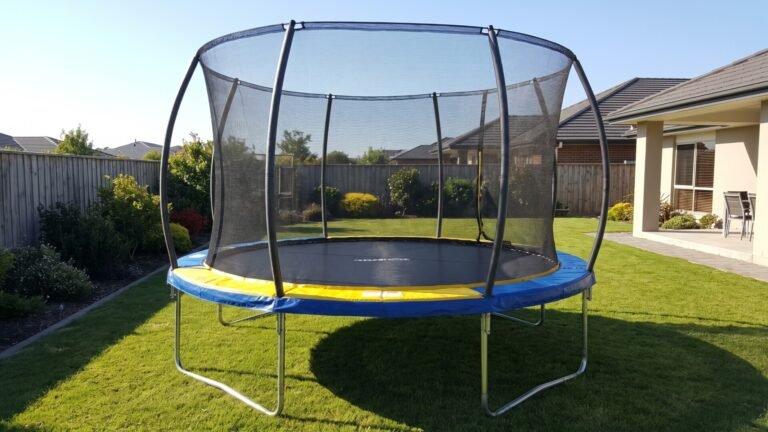
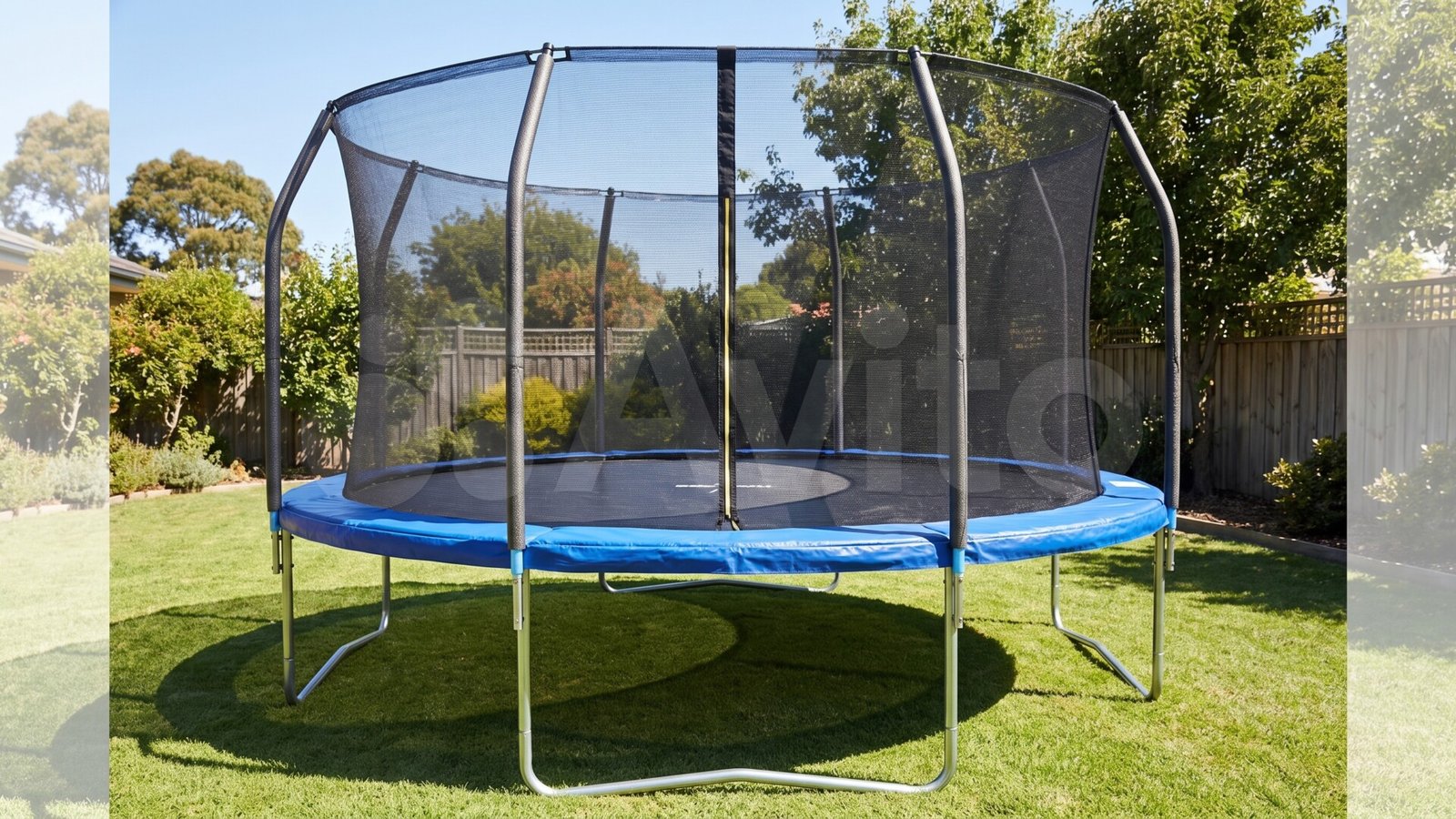
Many modern enclosures put the net and poles inside the frame, between the jumping mat and the springs and frame. This is why you will see terms like “no-gap” design. It keeps a child who bounces into the net away from the springs and from the gap at the edge. Older “outside” designs left the springs and frame within reach of the jumper. When comparing models, favor one where the net attaches to the mat side of the frame and there is no gap to fall through.
Details that separate a good net from a flimsy one
- Tight mesh: small openings help prevent fingers and feet from catching. ACON, for example, advertises a “no finger access” mesh.
- A secure entry: a zipper plus a buckle or latch that small children cannot easily open. ACON uses a zipper-free double-layer entry.
- Padded poles: poles should reach the ground or be firmly attached to the frame, with thick foam. Zupapa, for instance, wraps its long poles in 10 mm foam.
- Spring cover that stays put: a thick pad that fully covers springs, hooks and frame, with no gaps.
- Replaceable parts: nets are a wear item. Before you buy, confirm the brand sells replacement nets, pads and springs. Warranties on nets are usually short (ACON lists 1 year), so plan to inspect and replace.
What to Check Before You Buy
Size and yard space. Measure the trampoline plus the safety zone around it. Manufacturers often publish the yard space needed: Springfree, for example, lists 18 ft x 23 ft for its 8 x 13 ft oval. Keep it well away from trees, fences, walls and buildings, and make sure there are no overhead wires or branches. The AAP also suggests putting the bouncing surface as close to the ground as possible.
Shape. Round trampolines are the most common and are what most families buy. Rectangular models give a more predictable bounce but invite the sort of tricks that the AAP advises against, so they are better suited to older, experienced jumpers under supervision. Whatever the shape, ASTM-style enclosure protection and one-at-a-time rules matter more than geometry.
Ground and anchoring. Choose a flat, level spot with a soft landing surface around it such as grass (not concrete, asphalt or hard-packed dirt). Install the manufacturer’s anchors, and re-check them after storms.
Ladder. A ladder is handy but lets young siblings climb up on their own. Remove it or lay it down when you are not supervising.
Assembly. Plan on a few hours and two adults, and read the manual in full. Loose bolts or a mis-seated net are safety problems, not cosmetic ones.
Warranty and parts. Compare frame, spring, mat, pad and net coverage. The best warranties are on frames and springs; nets and pads tend to be covered for only a year or two.
Homeowner’s insurance. Some insurers restrict or exclude trampolines. A quick call before you buy is worth it.
Heavy-Duty Trampolines Worth Considering
The specs below come from the manufacturers’ own product pages (or, where noted, a major retailer listing) when we checked. Prices move constantly with sales, so treat the ranges as a guide and confirm the weight limit on the current listing before you buy. As always, the rule is one jumper at a time, regardless of the number on the box.
Best Overall for Families: JumpFlex Hero 15ft Trampoline
Best for: Families with older kids who want a robust frame and a long warranty at a mid-range price.
The JumpFlex Hero uses a “DualRing” frame of high-tensile galvanized, powder-coated steel (1.7-inch tubing on the upper ring and 1.5-inch on the lower), assembled without welds or bolts on the frame. JumpFlex lists 96 springs, each 7.1 inches long, a 10-year frame warranty in the USA, and a total weight rating of 550 lb with a maximum of 350 lb per jumper. It comes with a net enclosure and ladder, and JumpFlex describes it as suited to jumpers from 40 to 220 lb.
Pros: long frame warranty; sturdy-feeling design; generous per-jumper limit. Cons: 15 ft needs a large yard; a 12 ft Hero is also sold if space is tight. We could not confirm a 14 ft size from the manufacturer, so this guide lists the 15 ft.
Price range: roughly $900 to $1,300 USD (list $1,299, often discounted). Check on Amazon
Best Premium Pick: Springfree Large Oval Trampoline
Best for: Families who want a springless design with a flexible-net enclosure and a long warranty, and are happy to pay for it.
The Large Oval (model O92) has an 8 ft x 13 ft jumping mat, stands about 9 ft tall and needs roughly 18 ft x 23 ft of yard space. There are no springs on the jumping surface, and the FlexiNet enclosure is designed to cushion contact and help prevent falls. Springfree lists ASTM F2225 and F381 compliance and a 10-year warranty on all parts.
Important weight note: Springfree lists a tested static capacity of 1,500 lb, but the single-jumper limit is 220 lb. It is not a two-adult trampoline, despite what you may read elsewhere.
Pros: no exposed springs on the jumping surface; strong warranty; clear safety documentation. Cons: expensive; longer, more involved assembly; it still needs supervision and one jumper at a time.
Price range: roughly $1,500 to $1,850 USD. Shop at Friendly Toy Box
Best Budget Option: Skywalker 12ft Round Trampoline with Enclosure
Best for: Families who want an enclosed trampoline at an entry-level price for school-age kids.
According to a major retailer’s listing for this model, it has a 12 ft diameter, 72 steel springs, a galvanized steel frame with reinforced T-sockets, a polypropylene mat, a polyethylene net and a UV-resistant PVC spring pad, with a 3-year frame warranty and 1-year coverage on other parts. The listed weight limit is 200 lb and the recommended age is 6 and up. We could not load Skywalker’s own site, so check the box or manual for the limit that applies to the version you buy.
Pros: low cost; widely sold; a compact 12 ft footprint. Cons: lower weight limit than premium options; shorter warranty; budget models need closer attention to net and pad condition.
Price range: roughly $270 to $300 USD at the time we checked. Available at Ryder Toys
Best for Older, Experienced Jumpers: ACON Air 16 Sport HD
Best for: Teens and adults with real jumping experience (and gymnastics-style training) in a supervised setting.
This is a large rectangular trampoline: the mat is about 171 x 86 inches, with a 2.5 mm frame (60 mm tube), 140 galvanized springs and a 10-year frame warranty. ACON lists a certified limit of 150 kg (about 330 lb) per jumper on its European page and notes that only one jumper should be on the mat at a time. Its US page describes the model as having no single-user limit and a static load of 1,650 lb. Those two descriptions do not match, so confirm the limit with ACON before buying. Its enclosure has a “no finger access” mesh and a zipper-free, double-layer entry.
Pros: premium build and long warranty; very large jumping area. Cons: expensive, huge footprint, and its performance orientation invites the tricks that pediatric guidance advises against. It is not the right choice for younger children.
Price range: roughly $2,500 to $2,800 USD. Check on Amazon
Best for Smaller Yards: Zupapa 10ft No-Gap Trampoline
Best for: Smaller yards where a 10 ft footprint is all that fits.
Zupapa’s 10 ft model lists a 375 lb weight limit (higher for its larger sizes), steel poles up to 1.5 mm thick, long net poles that reach the ground wrapped in 10 mm foam, and ASTM and TUV certification. Zupapa does not state spring length on that page.
Pros: compact; no-gap enclosure design; solid weight rating for its size. Cons: small for bigger kids; we could not verify warranty terms from the manufacturer page; the product was listed as sold out when we checked.
Price range: about $460 USD at the time we checked (sale price). via eBay Partner Network
Quick Comparison
| Model | Size | Stated weight limit | Frame warranty | Approx. price (USD) |
|---|---|---|---|---|
| JumpFlex Hero | 15 ft round | 550 lb total, 350 lb per jumper | 10 years | $900-$1,300 |
| Springfree Large Oval | 8 x 13 ft oval | 220 lb single jumper (1,500 lb static) | 10 years | $1,500-$1,850 |
| Skywalker 12ft | 12 ft round | 200 lb (retailer listing) | 3 years (retailer listing) | $270-$300 |
| ACON Air 16 Sport HD | Rectangular, about 14 x 7 ft mat | 150 kg per jumper (EU page); confirm | 10 years | $2,500-$2,800 |
| Zupapa 10ft | 10 ft round | 375 lb | Not verified | about $460 |
Setting Up and Using It Safely
Even the sturdiest trampoline is only as safe as the rules around it. A simple routine helps everyone relax.
- Post the rules: one jumper at a time, no flips or somersaults, zip the net every time, no shoes or sharp objects, no climbing on the net.
- Supervise: an adult should be watching every session. Phones down.
- Keep under-6s off: the AAP and CPSC both advise against full-size trampolines for this age group. A toddler-appropriate alternative like a wooden balance board builds balance without the height.
- Stay off when wet, windy or icy: wet mats are slippery, and the CPSC advises against use in high wind.
- Remove the ladder when no one is jumping.
Maintenance Tips
A short check each month, and a longer one each spring, catches most problems early.
Inspect the net. Look for tears, loose stitching, stretched mesh and zippers that stick. Replace a damaged net rather than patching it, since the AAP specifically advises replacing nets with tears, holes or separated seams.
Check the spring pad. If foam is torn, waterlogged or shifting, replace it before anyone jumps.
Re-tighten hardware. Go over every bolt and joint in spring, and look for bent legs or poles.
Check anchors after storms and inspect the frame if the trampoline has shifted or tipped.
Protect from sun and snow. UV breaks down mats and nets over time. A cover helps in the off-season, and heavy snow should be cleared from the mat. Follow your manufacturer’s advice on whether to take the net down for winter.
Budget for wear items. Nets, pads and springs eventually need replacing. Look up the replacement prices from the manufacturer before you buy, so there are no surprises.
Conclusion
If a trampoline is going to be part of your backyard, choose one with a sturdy frame, an enclosure that meets ASTM F2225, and replacement parts you can actually buy. Then do the unglamorous things that matter most: anchor it, check it, supervise it, and keep to one jumper at a time.
- Best overall for families: JumpFlex Hero 15ft, for its frame and 10-year warranty.
- Best premium pick: Springfree Large Oval, with no springs on the jumping surface.
- Best budget option: Skywalker 12ft, with a lower weight limit.
- Best for experienced jumpers: ACON Air 16 Sport HD, supervised.
- Best for small yards: Zupapa 10ft.
Looking for more ways to get kids outside? Browse our outdoor and seasonal toys guide, compare wooden vs. metal swing sets, explore plastic-free backyard play, or try a mud kitchen for calmer, messier fun.
Check current pricing and availability:
- JumpFlex Hero on Amazon
- Springfree Large Oval via Friendly Toy Box
- Skywalker 12ft at Ryder Toys
- ACON Air 16 on Amazon
- Zupapa 10ft via eBay Partner Network
Sources: AAP (HealthyChildren.org, “Trampolines: What You Need to Know”); CPSC Neighborhood Safety Network trampoline tip sheet; ASTM F2225; manufacturer product pages for JumpFlex, Springfree, ACON and Zupapa; retailer listing for Skywalker. Specs and prices were checked in November 2026 and can change.