Top 5 Wooden Balance Boards for Toddlers
Promoting balance, coordination, and fun at home
Toddlers are bundles of energy. They love to run, climb, jump, and explore, and this is a stage when children are practising balance and coordination every day. One simple tool that invites that practice is a wooden balance board.
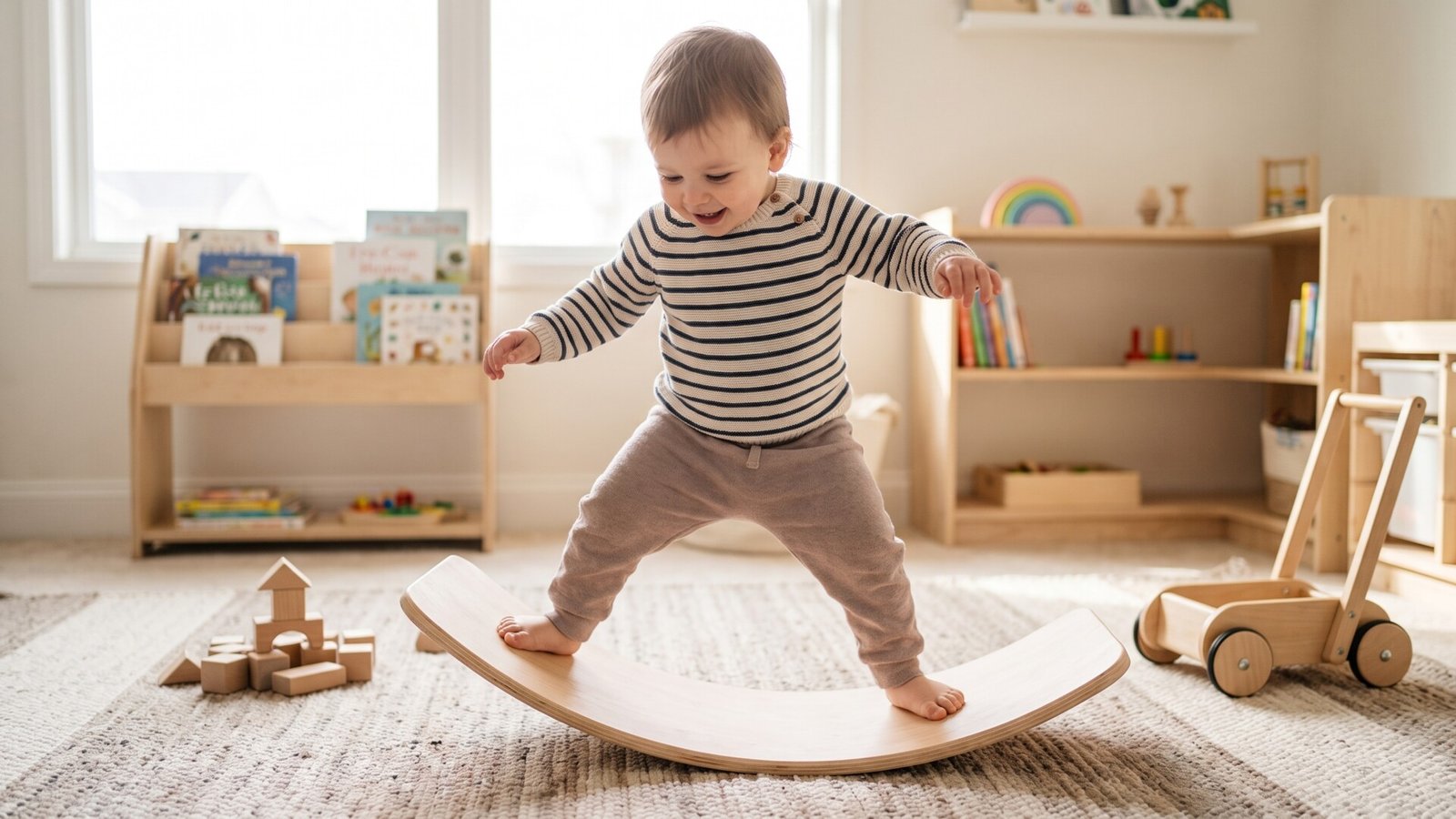
Balance boards are simple yet versatile: a curved wooden plank that rocks back and forth, giving toddlers a chance to practise core strength, motor skills, and body awareness. They work for indoor movement play, obstacle courses, and creative open-ended play.
In this guide, we review five wooden and wood-based balance boards for toddlers based on manufacturer and retailer information (we have not tested them ourselves), explain safety features and play ideas, and give tips for choosing the right board for your child. This guide is part of our outdoor and active play toys collection.
Quick Comparison: Our 5 Picks
| Board | Material | Age per maker/retailer | Weight capacity | Approx. price (USD) | Best for |
|---|---|---|---|---|---|
| Wobbel Original | Layered European beech, lacquered; optional wool felt base | 0+ with adult supervision | 200 kg (about 440 lb), one person at a time | About $115 new (US retail cited by a resale listing); check current listing | One board that lasts from toddler to adult |
| Wobbel Starter | Layered beech | 0+ with adult supervision | Listing conflicts (100 kg vs 200 kg); check before buying | Lower than the Original; check current US listing | Smaller budget; the youngest children |
| Kinderfeets Kinderboard | European beech plywood, water-based paints | 18 months+ | 220 kg (485 lb) | About $110–$135 | Colorful, toddler-sized, widely sold |
| Hape Light-Up Balance Board | Solid wood body with non-slip base | 24 months+ (one page also says 12 months+) | Not listed | About $230 | Children who like games and lights |
| Battat Rock & Balance Wooden Board | Wood and polyester | 3+ | 220 lb (one listing) | About $60–$100 (Battat lists $99.99) | Lower-cost entry; preschoolers |
Specifications come from manufacturer and retailer pages and can change; some listings were out of stock when we checked. Always confirm age, size, and weight limits on the product page you are buying from.
Why Wooden Balance Boards Are Great for Toddlers
Before diving into specific products, it’s important to understand why these boards appeal to parents:
1. Physical Development
Balance boards give toddlers practice with:
- Core strength: Rocking engages abdominal and back muscles.
- Leg strength: Standing and shifting weight uses leg muscles.
- Coordination: Keeping balance uses proprioception, the body’s sense of where it is in space.
- Motor planning: Children try to predict movements and adjust their body accordingly.
2. Cognitive Benefits
- Problem-solving skills: Learning how to balance and tilt the board requires experimentation.
- Concentration: Staying on the board takes focus.
- Spatial awareness: Children explore how their body moves in relation to the environment.
3. Open-Ended Play
- Wooden balance boards are versatile. Toddlers can use them as:
- Rockers and seesaws
- Slides for small toys
- Stepping stones for obstacle courses
- Pretend play props: Bridges, ramps, or tunnels
This open-ended quality is why balance boards often appear in Montessori-inspired playrooms. If that interests you, our Montessori and early learning toys guide explains the thinking behind choosing simple, open-ended materials. Keep in mind that “Montessori” is a description of an approach, not a certification, so a board labeled that way is not automatically better.
When Is a Toddler Ready for a Balance Board?
Manufacturers list very different ages. Wobbel lists its boards as suitable from birth with adult supervision, mostly as a surface for sitting, rocking, and tummy time on, while Kinderfeets recommends its Kinderboard from 18 months and Battat lists its board for 3 and up. Our rule of thumb: let your child’s own skills guide you. Many toddlers are ready to stand on a board once they walk confidently, usually somewhere between about 18 months and 2.5 years, but children vary a lot. Before then, use the board as a rocker, a tunnel, or a ramp for toys, with you right beside them.
What to Look for in a Toddler Balance Board
When choosing a board, keep these criteria in mind:
- Size and Weight Capacity
- A toddler board should be lightweight and low to the ground for safety. For comparison, a Wobbel board is about 90 × 30 cm (roughly 35 × 12 inches) and weighs about 4.5 kg (10 lb), while the Kinderboard is about 32 × 12 inches.
- Check weight limits if older siblings might want to join play, and note that some makers specify one person at a time.
- Material Quality
- Layered (plywood-style) wood, as in most of the boards here, is durable and resists warping better than a single plank.
- Look for smooth edges and non-toxic, water-based finishes with low-emission glue.
- Surface Texture
- Non-slip surfaces or grip tape help prevent slipping, and a felt or non-slip underside protects hard floors and keeps the board from sliding.
- Stability vs Challenge
- Beginners need a board that rocks gently.
- More advanced boards can offer a greater tilt to increase the challenge.
- Safety Standards
- Look for boards from brands that state their safety testing, with rounded edges and smooth surfaces. In the US, children’s products are expected to meet CPSC requirements; check the maker’s product page for compliance details.
Top 5 Wooden Balance Boards for Toddlers
Here’s a detailed look at the options we think are worth considering, based on the information on manufacturer and retailer pages:
1. Wobbel Original Balance Board
Overview:
Wobbel is a Dutch premium brand known for its durable wooden boards and smooth rocking motion. New boards have retailed at around $115 in the US; prices vary by finish (lacquered, felt-backed, colored), and secondhand boards are common because they last so long.
Features:
- Made from layers of FSC-certified European beech, pressed together and finished with water-based lacquer.
- About 90 cm long and 30 cm wide.
- Available with or without a wool felt base; the felt protects floors and keeps play quieter.
- Listed weight capacity: 200 kg (about 440 lb), one person at a time.
Pros
- Very sturdy, and the same board can serve a child for years.
- Versatile for open-ended play.
- Water-based, non-toxic finishes.
Cons
- Higher price point than most competitors.
- At roughly 35 inches long it can feel large for a very small toddler, and some retailers show it out of stock.
Play Ideas:
- Use as a rocker or slide for toys.
- Create obstacle courses by combining with cushions.
- Encourage balance challenges as your child gains confidence.
2. Wobbel Starter Balance Board
Overview:
The Starter is described by retailers as the smallest Wobbel board and “designed for the youngest children,” using the same rocking principle as the Original.
Features:
- Made from layered FSC-certified beech with water-based paints and lacquer.
- Listed at about 90 × 30 cm by one European retailer; felt is optional.
- Retailer lists age as 0+ with adult supervision. That retailer’s weight information is inconsistent (100 kg in one place, 200 kg in another), so check the maker’s current specification.
Pros
- Wobbel build quality at a lower price than the Original.
- Suited to young children who are just starting to rock and climb.
Cons
- Less availability in US stores than some other brands, and some retailers list it as out of stock.
- Children may outgrow the simpler version sooner than they outgrow the Original.
Play Ideas:
- Gentle rocking while seated, with an adult close by.
- Use as a pretend boat, bridge, or ramp.
- Practice stepping on and off in small spaces.
3. Kinderfeets Kinderboard
Overview:
Kinderfeets makes the Kinderboard, a widely sold balance board sized for children, available in natural wood and many colors.
Features:
- Made from European beech plywood with non-toxic, water-based paints and lacquers and non-formaldehyde glue. Some retailers also sell bamboo-finish versions.
- About 32 × 12 × 7 inches (81 × 30 × 18 cm).
- Recommended age on the maker’s site: 18 months and older.
- Weight limit: 485 lb (220 kg), so it also works for older siblings and adults one at a time.
Pros
- High weight capacity, so it lasts well past the toddler years.
- Lots of colors and easy to find.
- Made with non-toxic finishes.
Cons
- Not budget-priced: roughly $110–$135 depending on seller and color (the maker lists about $120 in USD), and some colors sell out.
- No felt underside on the standard board, so use it on a rug or mat to protect floors.
Play Ideas:
- Indoor rocking or gentle stepping exercises.
- Use as a pretend boat, bridge, or ramp.
- Great for gross motor practice in small spaces.
4. Hape Light-Up Balance Board
Overview:
Hape is a well-known children’s brand, and this board adds lights and games to the rocking motion. Note that it is an electronic board, not a plain wooden one.
Features:
- Solid wood body with a non-slip fabric underside.
- About 31.5 × 7.1 × 11.8 inches and 7.2 lb.
- Three built-in games (Practice, Challenge, and Bumper Ball) with lights that respond to the child’s movement.
- Requires 4 AA batteries (included).
- Age on Hape’s page: suitable for 24 months and above in the features list (the page’s summary says 12 months and above, so the two conflict; we suggest following the 24-month figure).
Pros
- Games and lights give feedback that motivates some children to keep trying.
- Designed with a limited tilt angle (a 35° safety angle is listed).
Cons
- At about $230, it is the most expensive board here, and the electronics are an extra thing that can fail.
- It is less open-ended than a plain board, and lights and sounds may over-stimulate some children.
- Batteries need to be kept secure and out of reach.
Play Ideas:
- Try the “Practice” mode first, then move to the harder games.
- Take turns with a sibling to build patience.
- Turn the lights off sometimes and use it as a plain board.
5. Battat Rock & Balance Wooden Board
Overview:
Battat’s Rock & Balance Wooden Board is a lower-priced option that comes with a foam semi-circle, so the board can be used on a flatter, more stable base or flipped for more wobble. Battat’s own product page lists it for ages 3 and up at $99.99 and notes that the foam cushion’s cover is removable and machine-washable; the weight limit below comes from a retailer listing, so please confirm on the product page.
Features:
- Made from wood and polyester.
- Recommended for children 3 years and over.
- Maximum load listed at 220 lb; board weighs about 7 lb.
Pros
- Often cheaper than the premium beech boards: Battat lists it at $99.99, and third-party listings have been lower.
- The two-part design lets you change the challenge level.
- The foam cushion cover is removable and machine-washable.
Cons
- Listed for age 3+, so it is better for older toddlers and preschoolers than for 18-month-olds.
- Stock varies; some listings have shown it as out of stock.
Play Ideas:
- Practise balancing while catching a soft ball.
- Use the foam piece to make a mini seesaw.
- Add to an indoor obstacle course.
Also Worth Considering: Kinderfeets Kinderboard Lite
If the full-size boards above feel too big for a young toddler, Kinderfeets also makes the Kinderboard Lite, a smaller, lighter version of the original in the same European beech plywood. Retailers list it for 12 months and older, weighing about 4 lb, at around $88 in the US. A lighter board is easier for a small child to flip into a tunnel or ramp, though children may outgrow it sooner than the standard Kinderboard. The weight limit was not listed on the page we checked, so confirm it before letting older siblings use it.
Balance Board or Something Else?
A balance board is not the only way to give a toddler balance practice, and it is worth checking it suits your child and your space:
- Balance board: best for rocking, open-ended pretend play and small spaces. Stores flat or against a wall.
- Stepping stones and balance beams: stable pieces that sit flat on the floor, good for younger or more cautious toddlers who are not ready for a rocking surface.
- Climbing triangles and low climbers: more about climbing and pulling up than balancing; see our review of durable climbing toys for toddlers.
- Balance bikes: the next step for many children around 2 to 3, practising balance while moving; our guide to balance bikes vs. training wheels covers sizes and ages.
Many families end up with a board indoors and a bike or climber outside; they complement rather than replace each other.
Buying a Balance Board Secondhand
Because good wooden boards last for years, secondhand Wobbel and Kinderfeets boards are easy to find, often at around half the new price. Before buying, check the board for cracks along the layers, splinters, lifting veneer and wobble from side to side (a warped board rocks unevenly). Felt bases can be replaced, but a cracked laminate should not be used. Manufacturer warranties usually do not transfer to secondhand items, and it is worth checking cpsc.gov for any recalls on the model before buying.
Tips for Safe Use of Wooden Balance Boards
Even the best balance boards require parental guidance for safety:
- Use on a flat, stable surface: Avoid slippery floors, stairs, and hard edges nearby.
- Supervise toddlers: Stay within arm’s reach, especially at first, and guide their steps.
- One child at a time: Most makers specify one person per board.
- Start slowly: Begin with gentle rocking while seated or holding your hands before attempting standing play.
- Use socks with grip or bare feet: Slippery socks can cause slips.
- Add padding: Place the board on a play mat or carpet for extra cushioning.
- Watch for finger and toe pinch points: Keep little hands and toes clear of the underside as the board rocks.
- Rotate activities: Encourage balancing, stepping, rocking, and imaginative play.
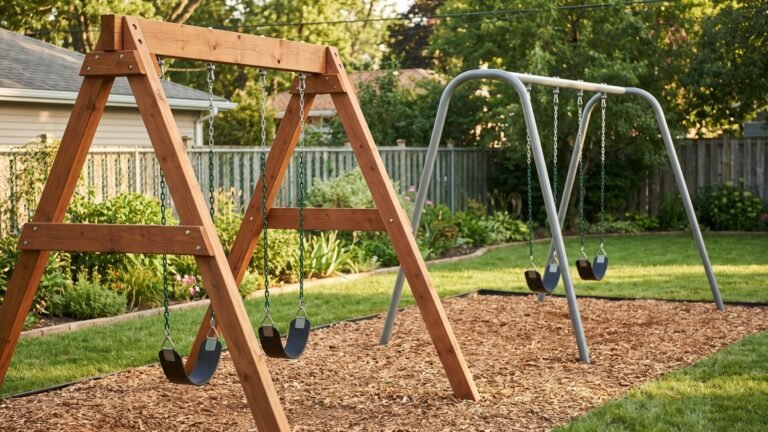
Balance boards are for the playroom, not the driveway. If you are looking for bigger active equipment, our guides to wooden vs. metal swing sets and backyard trampolines cover the more serious safety considerations for outdoor equipment, and why trampoline enclosure netting matters explains one of the biggest backyard safety decisions. A balance board can still go outside on dry grass in good weather, but bring it in afterwards, since damp can warp layered wood.
Creative Ways to Play with Balance Boards
- Rocking Chair – Toddlers can sit and rock gently.
- Bridge or Ramp – Stack pillows or other toys to create obstacle courses.
- Boat or Ship – Encourage pretend play adventures.
- Step Challenge – Practice stepping on and off to build coordination.
- Balance Games – Challenge toddlers to hold poses, reach for toys, or balance a soft toy.
- Tunnel – Flip the board upside down and prop it on couch cushions for a crawl-through tunnel.
- Toy Slide – Lean one end on a sturdy cushion to make a ramp for cars and balls.
These activities extend playtime, build skills, and keep children engaged. For more outdoor-friendly open-ended play, see backyard play without plastic and outdoor mud kitchens; a balance board also makes a good “boat” or “bridge” prop inside a backyard playhouse. If interest fades, put the board away for a few weeks; our guide to toy rotation for outdoor toys explains why that works.
Choosing the Right Board for Your Family
When deciding among the options:
- Consider age and size: Younger toddlers need smaller boards with gentle rocking.
- Look at material and durability: Layered wood lasts longer and withstands rough play.
- Think about versatility: Boards that double as props for open-ended play give more value.
- Set a budget: Premium boards like Wobbel and Kinderfeets are priced as long-term purchases, the Battat board is sometimes cheaper on sale and adds an adjustable foam base, and the Hape Light-Up board is a specialty item. The gap between them is smaller than you might expect, so durability and age fit usually matter more than a $20 price difference.
Think about price per year of use. A board that fits a toddler, a school-age sibling, and a parent doing stretches can be good value, while a single-purpose electronic board may be outgrown sooner.
Maintaining and Caring for Wooden Balance Boards
- Regular cleaning: Wipe with a damp cloth, avoid harsh chemicals.
- Check for cracks or splinters: Smooth rough edges promptly, and stop using the board if it develops structural cracks.
- Store properly: Keep away from moisture to prevent warping.
- Protect your floors: Use a felt base or rug under boards without one.
Conclusion
Wooden balance boards give toddlers a fun way to practise balance, coordination, and core strength, while encouraging creative, open-ended play.
The boards reviewed here—Wobbel Original, Wobbel Starter, Kinderfeets Kinderboard, Hape Light-Up, and Battat Rock & Balance—offer a range of sizes, materials, and price points.
- For durability and versatility, Wobbel and Kinderfeets are the long-term options.
- For a smaller, simpler first board, consider the Wobbel Starter.
- For game-style play, the Hape Light-Up board offers lights and challenges; for a lower-cost try, look at Battat.
By supervising play, encouraging creativity, and maintaining the boards, you can help your toddler practise new skills, have fun, and stay safe. For more ideas, return to our outdoor and seasonal toys guide, or see our review of durable climbing toys for toddlers.
Frequently Asked Questions About Toddler Balance Boards
What age can a toddler start using a balance board?
Makers list very different ages: some say 0+ with supervision (mainly for sitting and rocking), Kinderfeets lists 18 months and older, and Battat lists 3 and up. Most children are ready to stand on a board once they walk confidently, but every child is different. Always stay within arm’s reach.
Are wooden balance boards safe for toddlers?
They can be safe with supervision, on a flat, non-slip surface, with one child at a time. Choose boards from makers who list safety testing, with smooth edges and non-toxic finishes, and stop using a board that cracks.
What is the difference between Wobbel and Kinderfeets?
Both are layered beech boards of similar size. Wobbel offers felt-backed versions and a smaller Starter model, while Kinderfeets offers a wide range of colors and lists a recommended age of 18 months and up. Prices vary by seller, so check current USD listings.
Do balance boards help with motor development?
They give toddlers practice with balance, core strength, and coordination, along with open-ended play. They are a toy, not a therapy, so if you have concerns about your child’s movement or development, speak with your pediatrician.
Can balance boards go on carpet or hard floors?
Both. Boards without a felt base can scratch hard floors or slide, so use a rug or mat. On thick carpet, the rocking may be less smooth.
Is the Hape Light-Up Balance Board a good first board?
It suits children who enjoy games and feedback, but it is battery-powered, more expensive, and less open-ended than plain boards. For a first board, many parents prefer a simple wooden one.
How much does a good toddler balance board cost?
In the US, the boards in this guide range from roughly $60 to $135 for plain wooden boards (Kinderfeets Kinderboard about $110 to $135, Wobbel Original around $115 new, Battat Rock and Balance listed at $99.99 by the maker), with the electronic Hape Light-Up board at about $230. Secondhand boards are often around half price.
Which balance board is best for a 1-year-old?
At this age a board is mostly for sitting, rocking and crawling over with an adult right beside them. A smaller, lighter board such as the Kinderfeets Kinderboard Lite (listed for 12 months and up) is easier to handle. Boards graded 3+ are better left until later.
Can a balance board be used outside?
Occasionally, on dry, level grass or a mat. Layered wood can warp or delaminate if it gets wet, so bring it inside after play and never leave it out overnight.