Top 7 Outdoor Mud Kitchens for Messy, Creative Play
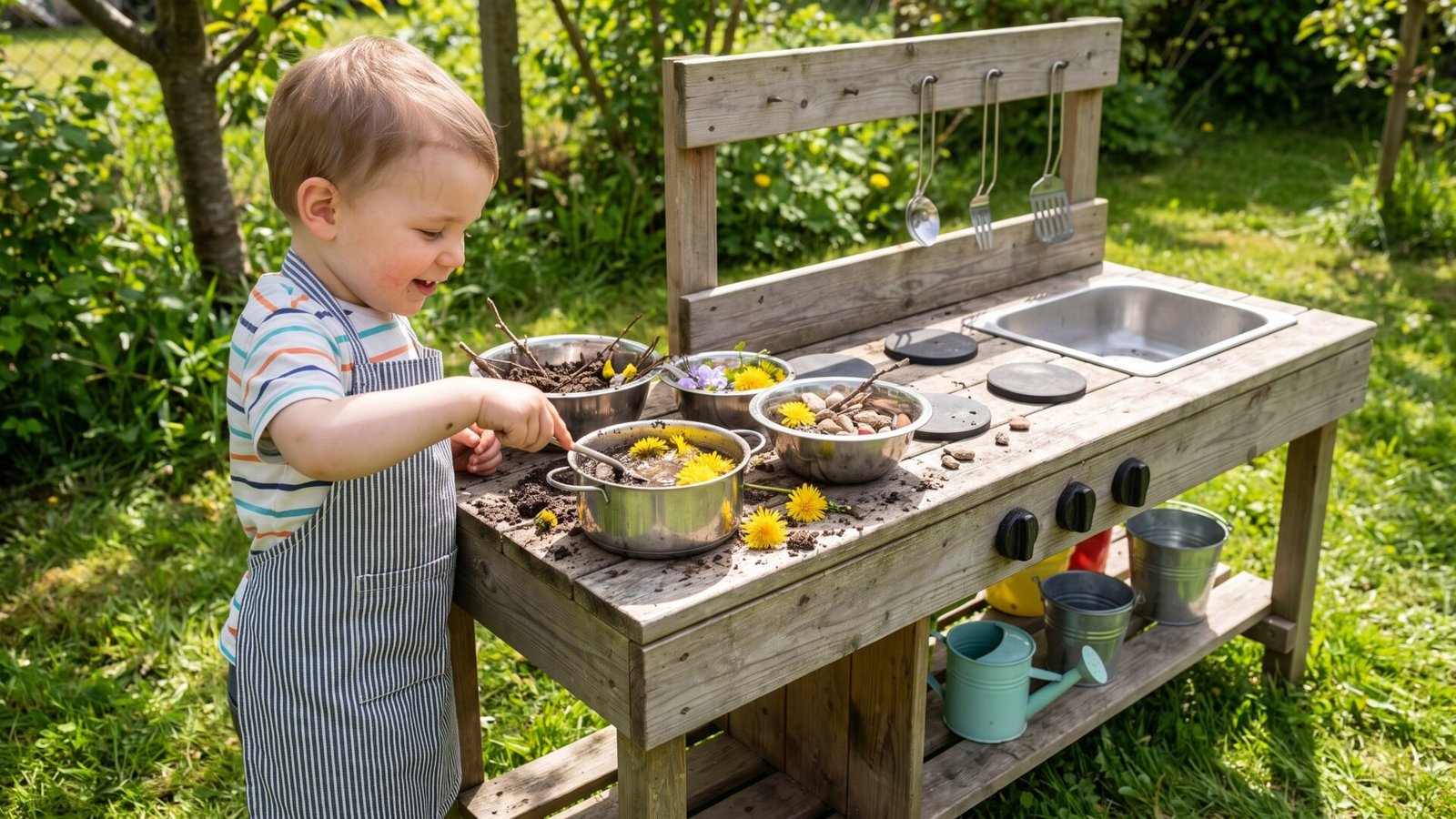
There is a special kind of joy in watching a child stir mud, water and leaves into a “soup” and serve it to you with a dandelion garnish. It is messy, it is noisy, and it is a lovely way to fill an afternoon outdoors. A mud kitchen gives that mess a home: a counter, a basin, somewhere to hang the spoons.
Here is the honest part. A true “mud kitchen” is often a simple wooden or DIY set-up, and the US toy market has far fewer branded ones than you might expect. So this guide covers four products I could confirm on manufacturer or major-retailer pages, from a wooden mud kitchen to plastic play kitchens that cope well with outdoor use, plus a budget DIY route that works just as well. I have not hands-on tested any of them, so everything below comes from published specifications. It sits alongside our wider outdoor and seasonal toys guide.
Quick picks: the Plum Discovery Mud Pie Kitchen if you want a real wooden mud kitchen; the Step2 All Around Playtime Patio with Canopy if you want sand and water play with shade; the Step2 Fun with Friends or Little Tikes Cook ’n Play Outdoor BBQ if you want a plastic kitchen that wipes clean.
What to Look for in a Mud Kitchen
Think about where it will live, how many children will use it, and how much mess you are happy to host.
Material and weather. Wood looks natural and can be sealed or stained, but needs upkeep and should be kept out of standing water. Plastic is rust-proof, wipes clean and moves easily, though it can look less at home in a garden and may fade in strong sun.
Size. Compact kitchens suit a small patio or a single toddler. Wider ones (roughly 4 feet or more) let two or three children cook side by side. Measure your space, then add a little room for the grown-up who is supervising.
A basin that really holds water. Mud play lives and dies on the sink. Check whether it is a removable bowl (easy to empty and scrub) or a molded-in sink (convenient, but water can pool).
Storage and hooks. Somewhere to hang pots and stash spoons keeps pieces from disappearing into the garden.
Age grade. Manufacturers typically rate the products below 2+ or 3+. Always follow the age grade and the assembly warnings on the box, and note that small accessories are a choking risk for under-3s.
The Kitchens Worth Considering
Specs and prices are taken from manufacturer or major-retailer listings at the time of writing and can change, so check the current listing before you buy.
1. Plum Discovery Mud Pie Kitchen (best true mud kitchen)
Plum is a UK outdoor-play brand, and the Discovery Mud Pie Kitchen is the closest thing here to a classic mud kitchen. It is made from sustainably sourced wood and has an outdoor sink bowl for mixing, a painting screen that wipes clean, and a built-in planter. Listings describe it as made for children aged 3 and up, and it comes with pans, utensils and paintbrush pens. It needs self-assembly.
Material and size: Wood; roughly 1.45 m wide, 1.16 m high and 0.7 m deep (about 57 x 46 x 28 inches) per the retailer listing.
Pros: Genuinely built for mud, sand and rainwater; room for more than one child; the planter lets you grow herbs for the “restaurant”.
Cons: A larger footprint; wood needs care to last outdoors; assembly takes time.
Best for: A garden with room and children aged 3 and up. I could not confirm a current US price, so check the listing.
2. Step2 All Around Playtime Patio with Canopy (best for water and sand play)
This is not strictly a mud kitchen, but it is the nearest Step2 equivalent: a sturdy play patio with a sand station (with lid), a water area, a toy grill, a snack station and a built-in canopy for shade. Step2’s page lists a 16-piece accessory set and an age grade of 2+. Pretend food is sold separately.
Size and price: About 56.4 in tall, 47.7 in wide and 55.2 in deep once built; listed at $229.99 on Step2’s site.
Pros: Shade built in; space for several children; separate sand and water zones.
Cons: Reviewers describe assembly as difficult and say it can take two adults, sometimes with power tools; it takes a lot of space.
Best for: A family with several young children who want a one-stop outdoor play spot.
3. Step2 Fun with Friends Kitchen (plastic kitchen for the patio)
Step2 sells this as a kids’ kitchen for ages 2 and up, and retailer listings describe it as suitable for indoor or outdoor play. It has a molded-in sink with faucet, a pretend coffee station, an electronic stove burner that lights up and makes cooking sounds, two pass-through windows, storage bins and shelving, and a set of dishes, utensils and cookware (Step2’s page lists 23 or 24 pieces; retail listings say 25). It comes in tan or pink.
Size and price: Roughly 40.9 in tall, 35.8 in wide and 12.5 in deep; listed at $139.99 on Step2’s site.
Pros: Wipes clean, lots of storage, a good fit for a covered patio.
Cons: Not designed for dirt; the electronic burner and its sounds are best kept dry and out of heavy rain, and some reviewers mention unclear instructions or missing parts.
Best for: Toddlers and preschoolers who like pretend cooking and mostly clean water play.
Target | Check Step2 Fun with Friends on Amazon →
4. Little Tikes Cook ’n Play Outdoor BBQ (compact and budget-friendly)
Little Tikes makes this one for the outdoors. The manufacturer page lists a dual-level grill with lid, a molded-in sink, cook top and oven, counter space, pegs for hanging utensils and a pan, clicking knobs, and 10 play food accessories. No batteries are needed. It is rated 2+ and made in the USA. The page does not say the sink connects to a hose, so treat any water play as bucket-and-jug.
Size and price: About 29.25 in long, 12 in deep and 35.25 in tall, around 18 lb; listed at $74.99 (the page showed it as out of stock when I checked, so availability may vary).
Pros: Light enough to move, small footprint, fewer parts to lose.
Cons: Limited storage, and it is a pretend BBQ rather than a mud kitchen.
Best for: Small patios and first-time buyers.
Ryder Toys | Shop Little Tikes Cook ’n Play at Ryder Toys →
At a Glance
| Kitchen | Material | Approx. size (H x W x D) | Age grade | Listed price (USD) |
|---|---|---|---|---|
| Plum Discovery Mud Pie Kitchen | Wood | 46 x 57 x 28 in | 3+ | Check listing |
| Step2 All Around Playtime Patio with Canopy | Plastic (per reviewers) | 56.4 x 47.7 x 55.2 in | 2+ | About $230 |
| Step2 Fun with Friends Kitchen | Plastic | 40.9 x 35.8 x 12.5 in | 2+ | About $140 |
| Little Tikes Cook ’n Play Outdoor BBQ | Not stated | 35.3 x 29.3 x 12 in | 2+ | About $75 |
The Budget Route: Build Your Own Mud Kitchen
Plenty of families skip the box entirely, and children are happy with a very humble set-up. A sturdy old table, a low shelf or a bench works. Add a plastic wash-up bowl for a sink, a few hooks, and secondhand pots, whisks and ladles from a charity shop.
- Pallets: Sand them thoroughly, remove every nail and staple, and check for splinters before use. Avoid chemically treated wood.
- Height: The counter should reach about your child’s waist so they can work without stretching.
- Stability: Make sure the frame cannot rock; fix it to a base board or stake it down on soft ground.
- Pots: Use plastic, wood or enamel. Skip glass and anything with a sharp lip or rim.
What to Put in a Mud Kitchen
The best accessories are usually the cheapest. Muffin tins, sieves, funnels, jugs, wooden spoons, old measuring cups, watering cans and a few small bowls. Natural “ingredients” like leaves, petals, pinecones, stones and sand add variety. Rotating a few items each week keeps the kitchen feeling fresh, and you can lean on natural, low-plastic materials if you prefer.
What Mud Kitchens Encourage
Mud play invites children to pour, scoop, stir and sort, which keeps small hands busy and encourages fine motor practice. Making up recipes and serving customers encourages storytelling and role play, and sharing the sink and the spoons gives siblings and friends plenty of chances to cooperate. Measuring and mixing wet and dry materials is a gentle first taste of STEM-style exploring. Many children also simply enjoy the sensory side: cool mud, the smell of wet earth, the sound of splashing. If your child is cautious about mess, let them start with water and sand, and add mud when they are ready.
Safety Notes for Outdoor Mud Play
A mud kitchen is meant to be messy, but a few habits keep it safe. None of this replaces the manufacturer’s instructions for your specific product.
Supervise water and mud play. Young children can drown in very little water, so stay within arm’s reach, and empty basins, buckets and sinks after every session. Watch for mud and small objects heading toward mouths.
Anchor and stabilize. Place the kitchen on firm, level ground. Tall or top-heavy units can tip if a child pulls on or climbs on them, so follow the anchoring or staking guidance in the manual, and do not let children climb on counters or canopies. Lightweight plastic units can also slide, so a rubber mat underneath can help.
Check for sharp edges and splinters. Run your hand over wood surfaces each season, sand rough spots, and tighten screws. Look for cracks and broken edges on plastic after winter, and stop using anything with exposed fasteners. Keep pointed tools such as trowels and forks for grown-up-supervised use.
Mind soil and hygiene. Use clean topsoil or play sand rather than soil from areas pets use, compost heaps or old paint-and-fuel storage spots. Cover cuts with a waterproof plaster, keep food and drinks away from the play zone, and wash hands thoroughly with soap and water afterwards. Rinse the kitchen and tools so mud does not harden and breed mildew, and wash fabric aprons separately.
Mind the electronics. If your kitchen has an electronic burner or sound features (like the Step2 Fun with Friends), keep it dry and bring it inside during wet weather unless the manufacturer says otherwise.
Contain the mess. A tarp, an old shower curtain or a patch of bark chips under the kitchen makes clean-up easier. A bucket of clean water and a towel by the back door saves your floors.
Caring for Your Mud Kitchen Through the Seasons
For wooden kitchens, brush off dirt, let it dry fully, and re-seal each spring with a non-toxic outdoor finish; stand legs off wet ground if you can. Plastic kitchens clean up with mild soap and a hose, and last longer if stored under cover in harsh winters since very cold temperatures can make plastic brittle. You will find more ideas for year-round outdoor gear in our outdoor and seasonal toys hub, and if you are planning a bigger backyard, take a look at our guide to backyard playhouses or compare wooden and metal swing sets.
Frequently Asked Questions About Outdoor Mud Kitchens
Which mud kitchen is best for toddlers?
For toddlers aged 2 and up, a compact, stable plastic kitchen like the Little Tikes Cook ‘n Play Outdoor BBQ (rated 2+) is an easy starting point. Choose a height your child can reach comfortably, check for small parts, and supervise all water and mud play.
Can mud kitchens stay outdoors all year?
Check the manufacturer’s guidance. Plastic kitchens generally cope with weather but can fade or become brittle in extreme cold, so covered storage helps. Wooden kitchens last longer if you seal them yearly, keep them off wet ground and cover or store them over winter.
Do mud kitchens need assembly?
Most do. Some listings describe straightforward assembly, while others, such as the Step2 All Around Playtime Patio, get reviews mentioning two adults and power tools. Allow time and follow the instructions carefully.
Are accessories included?
It varies. The Step2 Fun with Friends includes a set of dishes, utensils and cookware, the Little Tikes Cook ‘n Play includes 10 play food pieces, and the Plum Mud Pie Kitchen comes with pans, utensils and paintbrush pens. Pretend food is sold separately for the Step2 Patio.
Is a mud kitchen safe for young children?
With the right set-up, yes. Stay within arm’s reach during water play, empty all basins afterwards, anchor or stabilize taller units, check for splinters and sharp edges, use clean soil or sand, and wash hands after play.
What ages are mud kitchens suitable for?
The products in this guide are rated 2+ or 3+ by their manufacturers. Many older children keep enjoying them for imaginative play, especially with extras like a water jug, sieves and a planter.
Can I make my own mud kitchen?
Yes. A sturdy table or sanded pallet frame, a plastic wash-up bowl and hooks for utensils is all you need. Remove nails, sand rough edges and make sure the frame cannot wobble.
How do I clean a mud kitchen?
Hose down plastic and wipe with mild soap. For wood, scrub with a stiff brush and water without soaking, then let it dry fully in the sun. Wash fabric accessories separately.
Final Thoughts
You do not need an elaborate set-up to enjoy mud play. If you have a garden and want the real thing, the Plum Discovery Mud Pie Kitchen is the strongest fit. If you have limited space or a younger child, a plastic kitchen like the Little Tikes Cook ’n Play or Step2 Fun with Friends is easier to move and clean. And if you want sand, water and shade in one, the Step2 Patio covers it. Whichever you choose, the real magic is the handful of wet dirt, a sprinkle of petals and a generous serving of imagination. Prices and availability change, so check the current listing before buying.