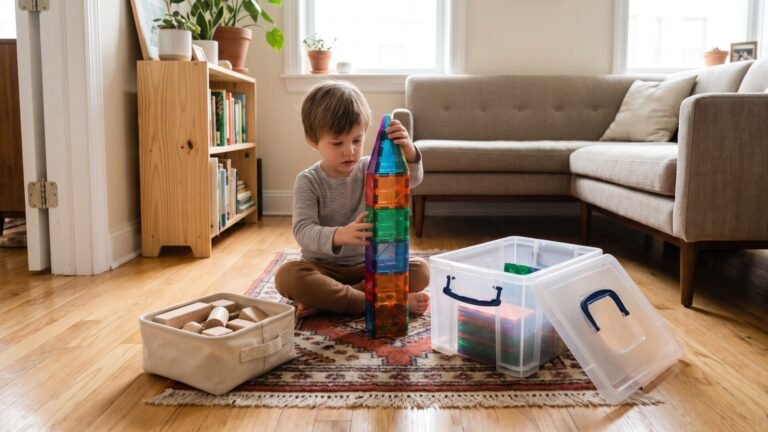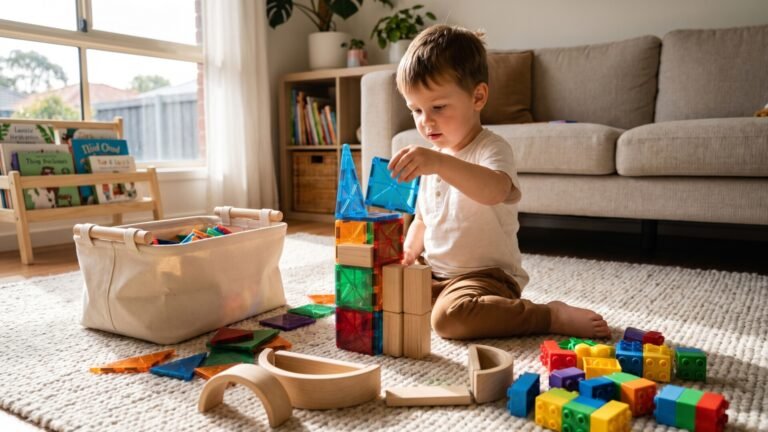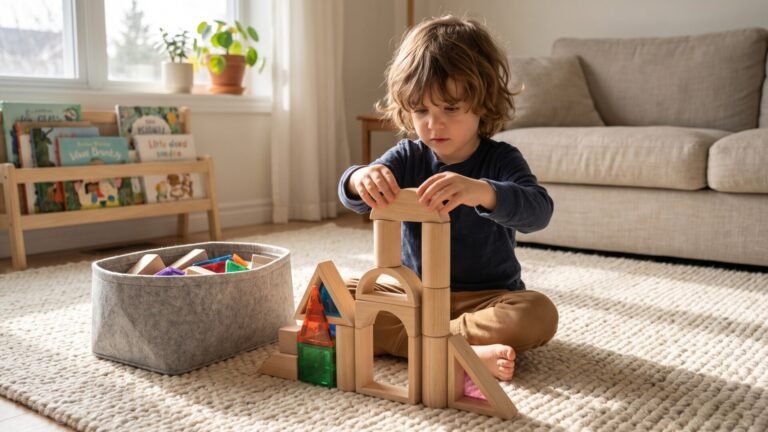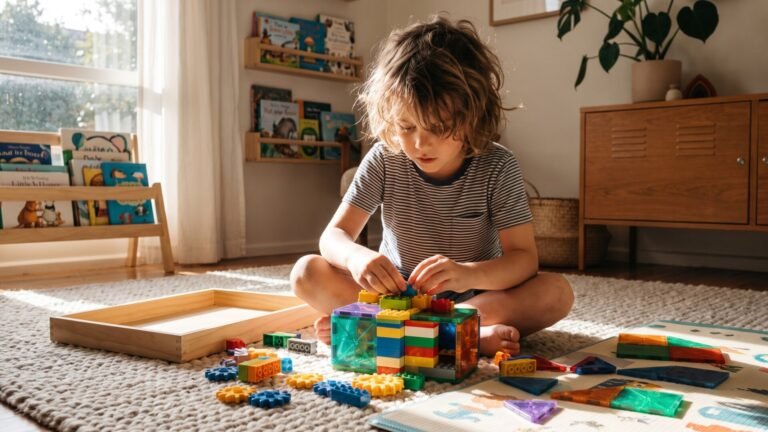
Wooden Blocks vs. Plastic Building Sets: What Should Parents Choose?
Eight months from now, one of these two purchases will be in a bin at the bottom of a closet, and the other will still be on the floor. Which is which depends far less on wood versus plastic than on one question: does your child want to build freely, or do they want the thing to stay together?
That is the whole tradeoff. Wooden blocks are the better first building toy for most young children because they ask nothing of the child except imagination and a steady hand. Plastic building sets become the better buy the moment a child gets frustrated that their tower keeps falling down, or wants wheels, hinges, characters, and a model that survives being picked up.
This is not a natural-versus-synthetic argument. It is a question about age, patience, floor space, and how much sorting you are willing to do on a Sunday evening.
What Each Type of Building Toy Actually Offers
Both categories get called “blocks,” which is where most of the confusion starts. They are not the same play system, and they do not fail in the same ways.
Wooden blocks
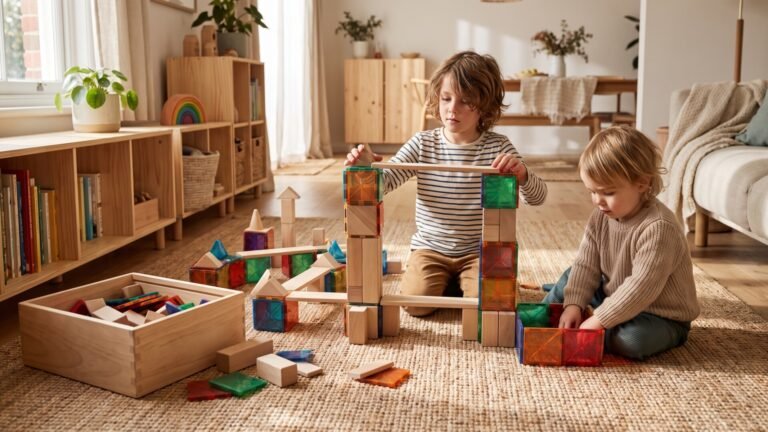
A wooden block set is a pile of shapes: cubes, planks, arches, cylinders, ramps, sometimes triangles. Nothing connects to anything. Everything stays up because of gravity and balance, which means the child is the only engineer in the room.
That is the entire appeal and the entire difficulty. A four-year-old who wants a bridge has to figure out that a long plank needs support at both ends and that a rounded arch will not hold a heavy cube on top. They learn it by watching it fall.
Basic wooden building blocks for kids stay useful across a surprisingly wide age range, but only if the set has enough variety and quantity. Twelve blocks is a toy. A hundred blocks of eight different shapes is a construction system, and it will still be getting used when the child is seven and building ramps for toy cars.
Plastic building sets
Plastic construction systems connect. Bricks click, rods slot into connectors, gears mesh. The build holds its shape, which means a child can pick it up, drive it around, and put it on a shelf without it collapsing.
The category splits in two, and the split matters more than the material.
- Open-ended plastic systems – LEGO Classic, LEGO DUPLO, K’NEX-style rod-and-connector sets. You get a pile of parts and a child invents the model.
- Instruction-led and licensed sets – themed kits, movie tie-ins, anything where the box shows one finished model and the manual walks you to it. The pieces are often specialized, and the build is a one-time event unless the child starts modifying.
Both are plastic. They behave completely differently after week three.
The key difference for parents
Wooden blocks offer fewer built-in answers. That encourages invention but can leave a younger child staring at a pile with no idea where to start, which is why adult modeling matters in the first few weeks.
Plastic systems give more predictable results, which is exactly what a child who hates failure needs. The trade-off is that some children will follow the instructions, admire the model, and never build anything of their own.
Open-ended play depends on the design of the set, not the material it is made from. A themed kit with forty unique pieces is less open-ended than a box of identical bricks, and both are plastic.
Key Buying Factors: What Matters More Than the Material
Material is the least useful way to choose. These five things decide whether the toy gets played with.
Age appropriateness and frustration level
Toddlers do best with large, easy-to-grasp pieces – either chunky wooden blocks or a large-piece plastic system such as LEGO DUPLO. Small standard bricks are a choking risk at this age and a fine-motor mismatch besides.
Preschoolers can handle both, and the deciding factor is temperament. A child who enjoys balancing and knocking things down will get more from wooden blocks. A child who wants a house that looks like a house and stays a house will get more from interlocking pieces.
Older children tend to outgrow a basic wooden block set unless it is combined with figures, ramps, vehicles, and loose parts. A plain tower stops being interesting around six. A block city with toy animals living in it does not.
Durability, safety, and maintenance
Solid wood survives drops, chews, and being stood on. It can chip and splinter at the corners over years of hard use, so check edges periodically and retire anything that has gone rough.
Plastic resists impact and wipes clean, which matters more than parents expect. It also cracks, and a cracked brick no longer connects properly, which is how a set quietly dies one piece at a time.
For both: check for smooth edges, splinters, cracked plastic, loose small parts, and damaged magnets. Small plastic bricks and accessories are not suitable for children who still mouth toys. Follow the manufacturer’s age guidance on the specific set rather than assuming all blocks in a category are interchangeable – a large-piece toddler system and a standard brick box carry very different warnings.
Storage, noise, and household space
Wooden blocks are bulky. A decent set eats a shelf or a deep bin, and the shapes do not nest, so the volume never shrinks. They are quiet to stack and genuinely loud when the tower comes down or the whole bin gets tipped out.
Plastic bricks store more compactly by volume but multiply into small pieces that migrate. You will find them in the carpet, the couch, and eventually the vacuum.
If floor space is tight, a smaller wooden set, a compact LEGO Classic box, or a curated magnetic tile collection beats a giant tub every time. See our guide to the best building toys for small spaces for storage setups that actually work.
Educational value and independent play
Neither material teaches anything by itself. A toy marketed as educational is often just a toy, and that is fine – but it is worth being clear about what each format actually asks of a child.
Wooden blocks develop balance, spatial reasoning, and the physical intuition that heavy things need support. Plastic systems develop planning, sequencing, fine-motor precision, and the patience to follow a build to the end.
The quality of the challenge and the child’s freedom to experiment matter far more than the material. A plastic set the child returns to weekly beats a beautiful wooden set that sits untouched, and it is not close.
Wooden Blocks vs. Plastic Building Sets: Head-to-Head Comparison
| Category | Wooden Blocks | Plastic Building Sets | Better Choice |
|---|---|---|---|
| Best starting age | Large blocks for toddlers and preschoolers | Large-piece systems for toddlers; smaller bricks for older children | Depends on piece size |
| Open-ended play | Excellent | Ranges from excellent to limited | Wooden blocks for pure openness |
| Ease of successful builds | Moderate; balance is required | Usually easier once pieces connect | Plastic |
| Fine-motor practice | Stacking, grasping, alignment | Connecting, separating, manipulating small parts | Plastic for precision |
| Imaginative play | Strong when paired with figures or loose parts | Strong in open systems; weaker in rigid kits | Depends on the set |
| Storage | Bulky but simple to sort | Compact pieces but more sorting burden | Depends on space |
| Longevity | Strong for young children; may need add-ons later | Often grows through larger sets and compatible expansions | Plastic for age range |
| Best value | Basic sets with many versatile pieces | Compatible systems used across multiple years | Depends on use |
Read that table as a set of trade-offs rather than a scoreboard. Wooden blocks win on openness and lose on storage. Plastic wins on precision and repeatability and loses on sorting burden. The row that usually decides it is “ease of successful builds” – not because easier is better, but because a child who cannot get anything to stand up will stop trying.
Product Shortlist: Strong Choices in Both Categories
These are examples of the two play philosophies, not a ranking. Prices vary by retailer and set size, so treat the figures as approximate.
Melissa & Doug Wooden Building Blocks
| Feature | Details |
|---|---|
| Age Range | Typically suited to toddlers and preschoolers, depending on piece size and set |
| Key Features | Solid wooden shapes, stacking and balancing play, simple open-ended construction |
| Price (approx.) | $15-$35 |
The verdict: a practical first block set for families who want a low-tech, open-ended toy with no instructions and no batteries. Its value depends entirely on having enough pieces and shapes to move past simple towers.
Best for: toddlers and preschoolers beginning to explore stacking, balance, and pretend construction.
Pros
- Simple to introduce, nothing to set up
- Encourages open-ended building
- Straightforward to store and share
Cons
- Pieces do not connect
- Can feel repetitive without figures or loose parts
- Larger sets take up real shelf space
[Affiliate: Check current pricing on Melissa & Doug blocks through our recommended partners]
PlanToys Unit-Style Wooden Blocks
| Feature | Details |
|---|---|
| Age Range | Preschool and early elementary use, subject to the specific set |
| Key Features | Varied geometric shapes, balancing, bridges, towers, architectural designs |
| Price (approx.) | $30-$70 |
The verdict: the stronger premium choice when you want wooden blocks to stay interesting past basic stacking. The extra shape variety creates more building problems – arches that need supports, planks that need ramps – but the price only makes sense if the child returns to open-ended construction regularly.
Best for: children who enjoy designing buildings, towers, roads, and balanced structures without instructions.
Pros
- More varied construction possibilities
- Supports spatial reasoning and balance
- Attractive enough to leave out in a shared room
Cons
- More expensive than basic sets
- Still needs imaginative input from the child
- Bulky to store
[Affiliate: Check current pricing on PlanToys block sets through our recommended partners]
LEGO DUPLO Classic Brick Box
| Feature | Details |
|---|---|
| Age Range | Generally designed for toddlers and preschoolers; confirm the current set rating |
| Key Features | Large interlocking bricks, simple accessories, compatible DUPLO pieces |
| Price (approx.) | $25-$60 |
The verdict: the most direct plastic alternative to wooden blocks for younger children. DUPLO gives you the satisfaction of pieces that stay connected, in a format small hands can manage.
Best for: toddlers and preschoolers who get frustrated when towers collapse, or who prefer building recognizable objects.
Pros
- Easy-to-connect large pieces
- Strong compatibility across DUPLO sets
- Supports construction and pretend play together
Cons
- More expensive than basic wooden blocks
- Poor for large-scale structures
- Accessories add sorting and storage work
[Affiliate: Check current pricing on LEGO DUPLO through our recommended partners]
LEGO Classic Creative Brick Box
| Feature | Details |
|---|---|
| Age Range | Generally suited to preschoolers and school-age children, depending on brick size and maturity |
| Key Features | Assorted standard bricks, multiple colors, open-ended building |
| Price (approx.) | $30-$60 |
The verdict: a reliable open-ended plastic system for children ready for smaller bricks. It offers more repeatability than wooden blocks, but buy a box large enough that it does not feel limiting after three builds.
Best for: children who invent vehicles, buildings, animals, and objects from a shared collection of compatible bricks.
Pros
- Broad creative potential
- Compatible with the wider LEGO range
- Works for solo and collaborative play
Cons
- Small pieces need age-appropriate supervision
- Sorting often becomes a parent job
- Basic boxes lack specialty pieces for complex builds
[Affiliate: Check current pricing on LEGO Classic through our recommended partners]
LEGO Creator 3-in-1 Set
| Feature | Details |
|---|---|
| Age Range | Usually aimed at school-age children; verify the specific set |
| Key Features | Instruction-led builds with multiple model options, reusable bricks |
| Price (approx.) | $10-$50, depending on the set |
| Best For | Children who enjoy instructions but will also rebuild with the same pieces |
The verdict: a genuine bridge between structured and open-ended play. The value arrives after the child has built the suggested models and starts modifying them or folding the bricks into an existing collection.
Pros
- Multiple guided builds in one box
- Reusable parts extend the set’s life
- Affordable entry into more complex construction
Cons
- Smaller sets finish quickly
- Instructions dominate play at first
- Poor fit for children who dislike step-by-step building
[Affiliate: Check current pricing on LEGO Creator 3-in-1 through our recommended partners]
K’NEX Building Sets
| Feature | Details |
|---|---|
| Age Range | Varies significantly by set; many are intended for school-age children |
| Key Features | Rod-and-connector construction, moving structures, mechanical designs |
| Price (approx.) | $20-$60 |
The verdict: a specialist system for children who have moved past simple brick stacking and want flexible frames, machines, and moving builds. It is not a first building toy. It is a good fourth one.
Best for: older children interested in engineering, mechanisms, and structural problem-solving.
Pros
- Encourages mechanical and structural thinking
- Supports moving, articulated builds
- Adds real variety to a house already full of bricks
Cons
- Requires planning and patience
- Small connectors need careful age matching
- Less immediately satisfying for younger builders
[Affiliate: Check current pricing on K’NEX sets through our recommended partners]
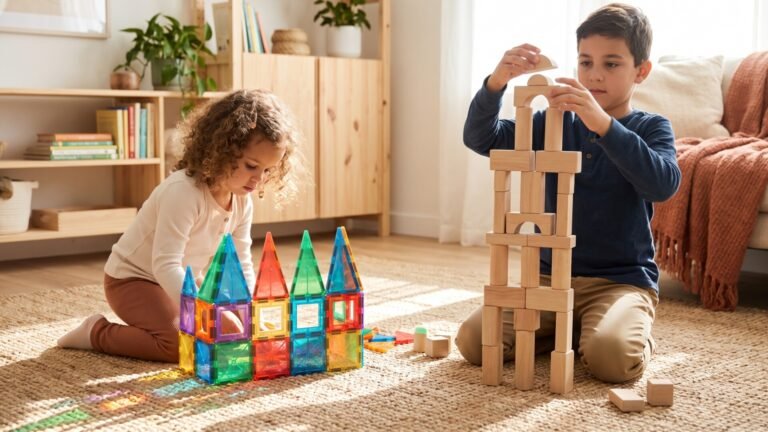
Magnetic tile alternative: Magna-Tiles or Connetix
| Feature | Details |
|---|---|
| Age Range | Varies by product and piece size; follow the manufacturer’s guidance |
| Key Features | Magnetic connections, flat geometric panels, fast 2D and 3D construction |
| Price (approx.) | $40-$150, depending on set size |
The verdict: not a direct substitute for either category, but an important middle option. Magnetic tiles give faster success than balancing blocks and larger visual structures than standard bricks.
Best for: children who want big structures quickly, especially in preschool and early elementary years.
Pros
- Fast, visually rewarding construction
- Large pieces are easier to manage than small bricks
- Encourages shape, symmetry, and spatial play
Cons
- Premium sets get expensive
- Big structures need substantial storage
- Magnetic products need regular inspection for damage and loose components
See our Magna-Tiles guides] and Connetix vs Magna-Tiles for the full comparison, and Magnetic Tiles vs. Building Blocks: Which Is Better for Different Ages? if you are weighing tiles against blocks directly.
What Most Buyers Get Wrong
Three assumptions drive most of the bad purchases in this category, and all three are worth dismantling before you spend anything.
The “natural is always better” assumption
Wooden blocks are not automatically more educational than plastic sets. The variables that matter are piece variety, the level of challenge, whether the child is interested, and how often the thing comes off the shelf.
A plastic set a child returns to every week delivers more developmental value than a beautiful wooden set that sits untouched on a shelf looking tasteful. Parents buy wooden blocks partly because they photograph well and partly because they signal something about the household. That is a real motivation, and it is fine – just do not confuse it with an educational advantage.
The “more pieces means better value” assumption
More pieces increase creative possibility only if the child can manage the collection. A giant unsorted tub actively works against independent play, because finding the piece you need in a hundred-liter bin is a job, and most children quit before finishing it.
For younger children, a smaller set with large, usable pieces beats a huge set every time. Buy the smaller box, see whether it gets used, then expand. That is the opposite of the bulk-buy instinct, and it is the right call.
The belief that instructions ruin creativity
Guided builds teach planning, sequencing, visual-spatial reasoning, and persistence. Those are real skills, and a child who follows a manual to the end has done something harder than free-stacking.
The problem is not instructions. The problem is a set with no meaningful use after the model is finished – a licensed kit full of pieces that only make one thing. Favor systems with reusable parts, alternate builds, and compatibility with what you already own.
The belief that wooden blocks are automatically quieter
Stacking is quieter than snapping bricks, yes. But a wooden tower coming down at 7am is a genuinely loud event, and a toddler tipping a full bin of hardwood blocks onto a wood floor is louder still.
If quiet independent play is the goal, evaluate the shape, the quantity, and the play surface rather than the material. A felt mat and fewer pieces will do more for your mornings than switching materials. See our guide to quiet building toys for indoor and independent play.
Which Option Still Makes Sense After Six Months?
This is a ToyGuideHub Replayability Analysis. The scores below are editorial judgments based on likely repeat use, compatibility across ages, storage burden, and expansion potential – not the results of hands-on testing. Each category is scored 1 to 5.
| Option | Repeat Use | Age Flexibility | Expansion Value | Storage Practicality | Overall Ownership Outlook |
|---|---|---|---|---|---|
| Basic wooden blocks | 4/5 | 4/5 for younger children | 3/5 | 3/5 | Strong first toy if used with loose parts |
| Premium wooden unit blocks | 4/5 | 4/5 | 3/5 | 2/5 | Excellent for committed open-ended builders |
| LEGO DUPLO | 4/5 | 4/5 across toddler years | 5/5 | 3/5 | High value when children enjoy pretend construction |
| LEGO Classic | 5/5 | 5/5 for preschool through school age | 5/5 | 3/5 | Best long-term system for many families |
| LEGO Creator 3-in-1 | 4/5 | 4/5 | 4/5 | 4/5 | Strong for instruction-loving builders |
| K’NEX | 4/5 | 3/5 | 4/5 | 3/5 | Specialized value for engineering-minded children |
| Magnetic tiles | 4/5 | 4/5 | 4/5 | 2/5 | High replay value but larger space and budget demands |
Three things fall out of that table.
The cheapest option is not the lowest cost per use if the child loses interest in six weeks. A $20 block set that gets played with twice costs more per hour than a $60 brick box that comes out every rainy Saturday for three years. Cost per use is the only price that means anything, and you cannot know it in advance – which is an argument for starting smaller than you think you need to.
Plastic systems usually win the long-term value argument because later sets stay compatible with earlier ones. That advantage evaporates entirely if the child dislikes small-piece assembly. Compatibility is worth nothing to a child who will not sit still for it.
Wooden blocks stay useful for years when you combine them with toy animals, cars, dolls, ramps, and loose parts. The blocks themselves are the infrastructure. The play comes from what you put on top of them, and that is a cheap thing to add over time.
How to Choose the Right Option for Your Family
Find the line that describes your child, not your aspirations.
Best choice for toddlers
Large wooden blocks or LEGO DUPLO, depending on whether the child prefers stacking or connecting. Avoid small plastic bricks and loose accessories entirely while mouthing is still a concern. See our guide to the best building toys for toddlers.
Best choice for preschoolers
Wooden blocks for open-ended building, balance, and imaginative scenes. LEGO DUPLO or large magnetic tiles if the child wants faster construction and recognizable builds. See our guide to the best building toys for preschoolers.
Best choice for school-age children
LEGO Classic as the versatile general-purpose system. LEGO Creator 3-in-1 for children who like instructions and rebuilding. K’NEX for engineering and mechanisms. See our guides to the best building toys for kids ages 6-8 and ages 9-12.
Best choice for Montessori-style or low-tech play
A high-quality wooden block set with varied shapes, then add open-ended accessories gradually. Montessori-compatible play depends on simplicity, independence, and real exploration rather than a brand label. See Open-Ended Building Toys That Grow With Your Child.
Best choice for small homes or shared living spaces
A smaller wooden set, a compact LEGO Classic box, or a curated magnetic tile collection rather than a giant tub. Shallow sorting trays and a defined building mat do more for a small apartment than any storage system you can buy. See our guide to the best building toys for small spaces.
Best choice for STEM and problem-solving
Wooden blocks for balance and structural experimentation. K’NEX or advanced LEGO systems for mechanisms, constraints, and iterative design. See our guide to the best construction toys for developing problem-solving skills and our STEM building set coverage.
Skip This If: When a Popular Choice Is Not Worth It
Skip an expensive themed or licensed plastic set if your child mainly wants to free-build. Those kits carry a premium for characters and packaging, and they often include so many specialized pieces that the box does not combine well with anything else you own.
Recognizable characters increase excitement on day one and reduce construction value by month two. Once the model is built and admired, a kit with forty unique parts has very little left to offer a child who wants to invent something.
If you are unsure how committed your child is, start with a basic wooden block set, a LEGO Classic box, or a compatible open-ended starter system before paying a premium for a large theme collection. You can always add the licensed set later, once you know the child actually builds.
This is not a knock on any brand. It is a mismatch between a product format and a play style, and it is the most common way parents spend $80 on something that gets built once.
The verdict, and the one thing worth remembering
If you take one thing into a shop, take this: buy the format your child will actually use, not the one that looks best on a shelf.
For most families, that means wooden blocks first – they are the better first building toy, they ask nothing of the child but imagination, and they stay useful for years when combined with figures, cars, and loose parts. [Affiliate: Check current pricing on wooden block sets through our recommended partners].
If your child gets frustrated when things fall down, or wants models that survive being carried around, skip straight to plastic. LEGO Classic is the best overall pick for families who want one adaptable system with long-term compatibility, LEGO DUPLO is the right call for toddlers, LEGO Creator 3-in-1 suits children who like instructions and rebuilding, and K’NEX is the specialist choice for the engineering-minded. Magnetic tiles from Magna-Tiles or Connetix are the strong alternative when you want big structures fast.
The bin at the bottom of the closet is not decided by wood or plastic. It is decided by whether the toy matched the child in front of you.
Frequently Asked Questions About Wooden Blocks Vs. Plastic Building Sets
Are wooden blocks better than plastic building sets for toddlers?
Neither is better in the abstract. Large wooden blocks suit a toddler who stacks and balances; a large-piece plastic system such as LEGO DUPLO suits one who wants pieces to stay together. Safety decides it more than preference does – if your child still mouths toys, choose the largest pieces available and follow the manufacturer’s age guidance.
Do plastic building sets provide better educational value than wooden blocks?
They develop slightly different skills. Plastic systems lean on fine-motor precision, planning, and sequencing. Wooden blocks lean on balance, spatial reasoning, and free experimentation. Neither is more educational by default, and the set a child actually uses will always beat the one that sits on the shelf.
Are wooden blocks safer than plastic bricks?
Safety depends on piece size, condition, finish, edges, magnets where applicable, and the manufacturer’s age rating – not on the material. Wood can splinter as it ages; plastic can crack and leave sharp edges or loose small parts. Check both regularly and retire anything damaged.
Which type of building toy lasts longer?
Wooden blocks last longer physically. Plastic systems often last longer in useful life, because new sets stay compatible with old ones and the collection can grow with the child. Physical durability and useful lifespan are different things, and the second one matters more.
Are wooden blocks worth the higher price?
Premium wooden sets are worth it when the shapes are varied enough to create real building problems and the child returns to open-ended construction regularly. If the child mostly wants to build vehicles and buildings that stay together, a basic wooden set plus a plastic system is the better use of the same money.
Which building toys are best for independent play?
Basic blocks have the lowest setup cost – tip them out and go. Interlocking bricks give a higher rate of successful builds, which matters for children who get discouraged. Piece accessibility decides more than either: if the child cannot find what they need without help, they will not play alone.
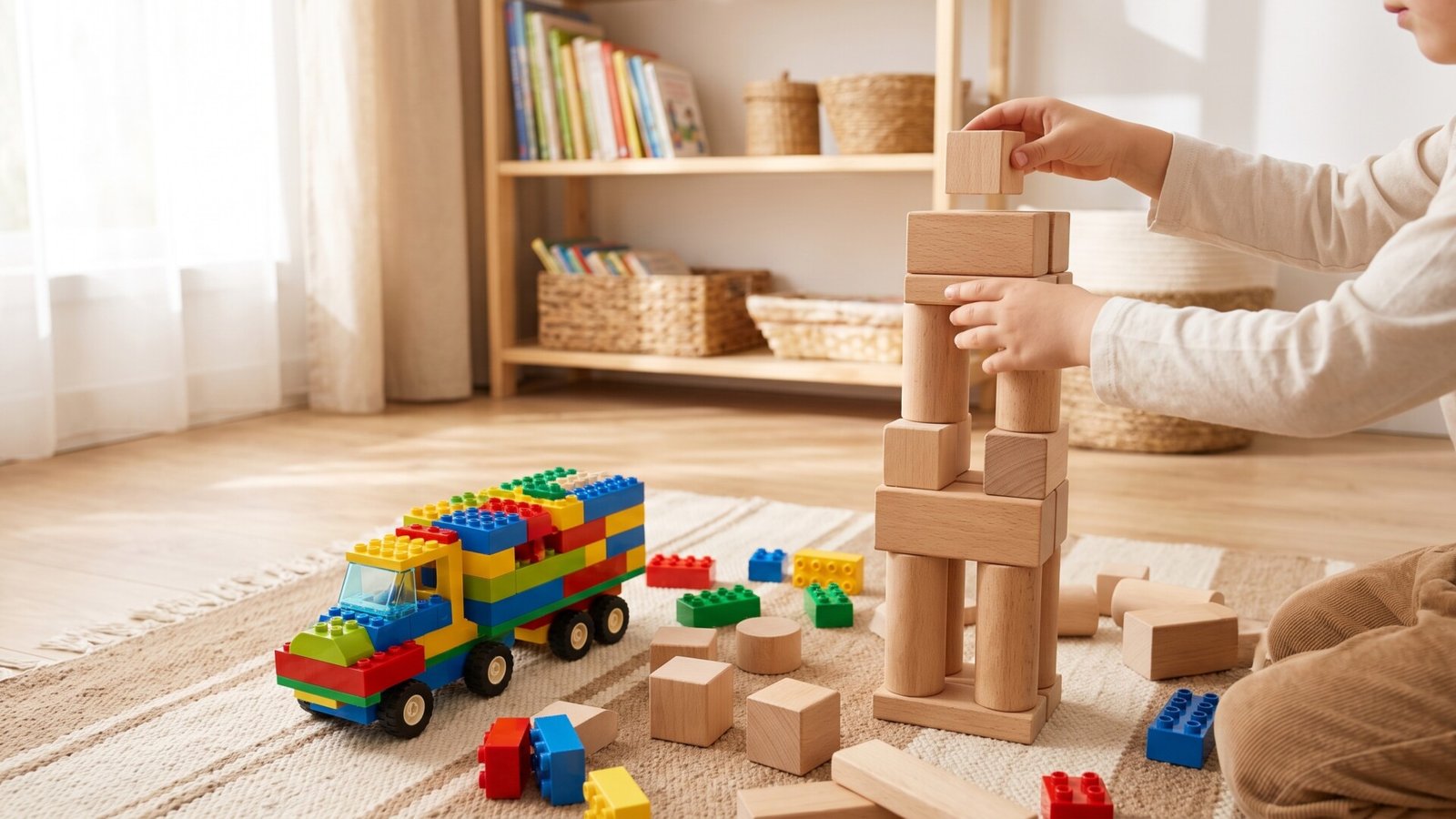
Can children use wooden blocks and plastic building sets together?
Yes, and it is often the best setup in the house. The pieces will not physically connect, but blocks, bricks, toy vehicles, figures, ramps, and loose parts combine into richer scenes than either system alone. A wooden block city with plastic vehicles driving through it is exactly the kind of play both categories are for.