Magnetic Tiles vs. Building Blocks: Which Is Better for Different Ages?
You are shopping for a building toy and you have narrowed it to two boxes. One shows a kid holding up a translucent castle that looks like it took four minutes. The other shows a wooden tower that looks like it took forty. You want to know which one your child will actually use, and the honest answer is that magnetic tiles win for most preschoolers and building blocks win for most children past six – but the reasons are not the ones the packaging gives you.
The real question underneath “magnetic tiles vs. building blocks” is not which toy teaches more. It is which toy your specific child will still be reaching for in eight months, after the novelty has worn off and the box has been shoved under a bed. That depends on how much frustration your child tolerates, how much floor you can spare, and whether they build to display something or build to knock it down and start again. Those three variables decide this purchase far more than age does.
What Makes Magnetic Tiles and Building Blocks Different?
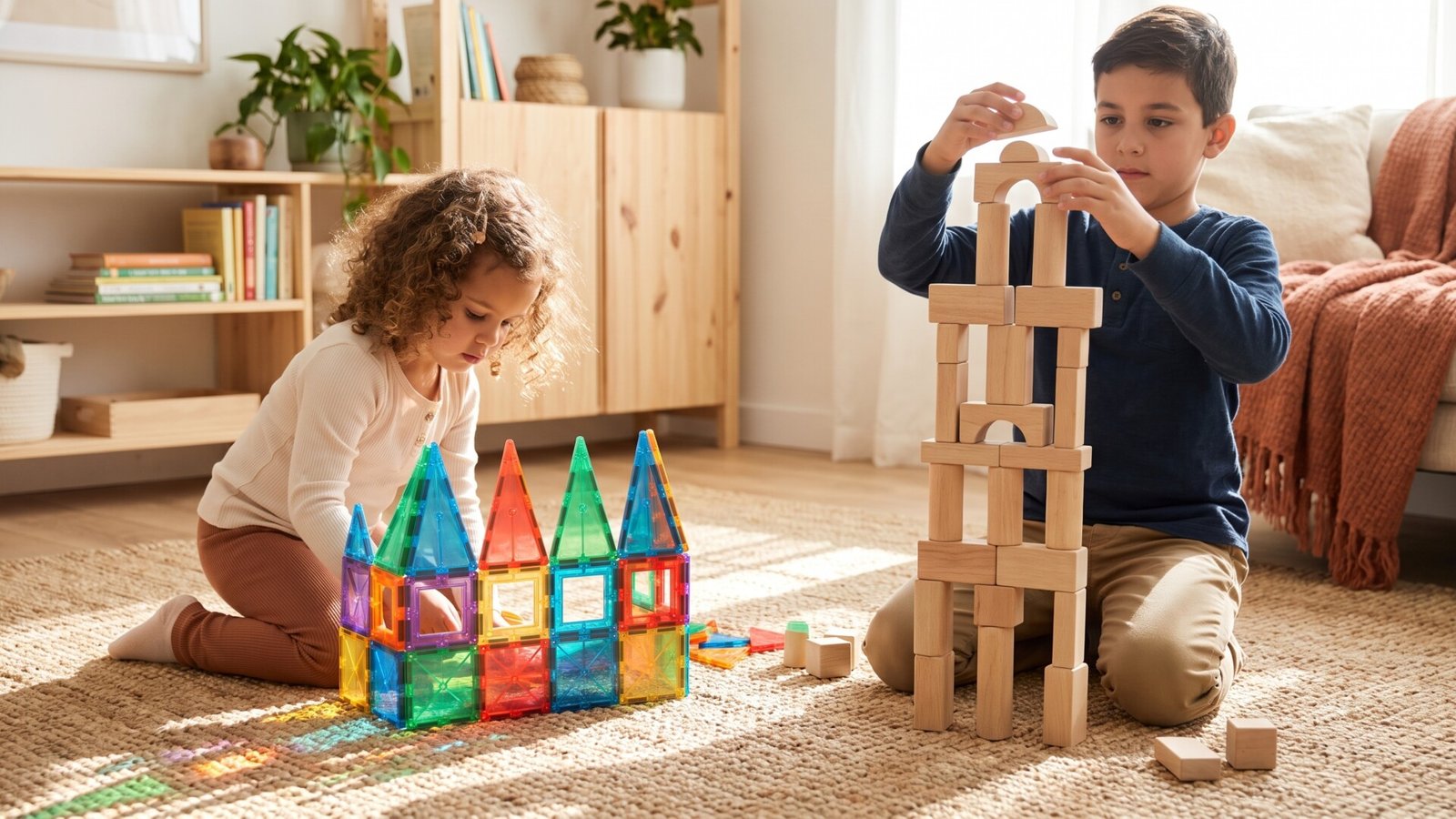
Magnetic tiles are flat geometric panels with magnets set into the edges. They snap together along any side, which means a three-year-old can produce a cube, a pyramid, or a house on the first attempt. The connection does most of the work, so the child spends their attention on shape and structure rather than on holding two pieces in exactly the right position.
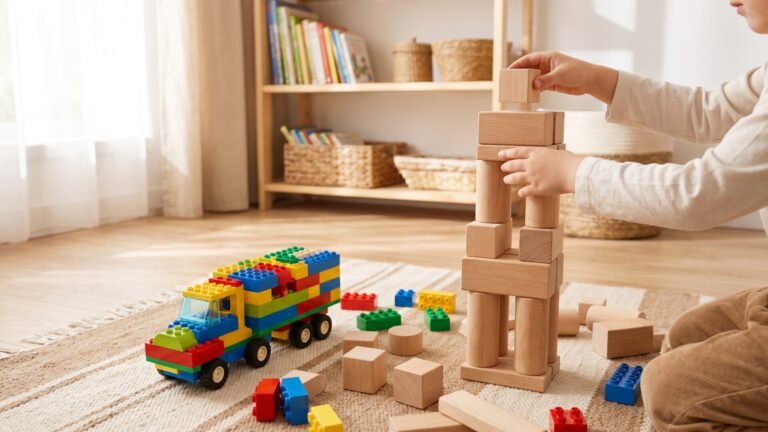
Building blocks are the opposite arrangement. Wooden unit blocks, chunky toddler blocks, interlocking bricks, and larger plastic construction pieces all require the child to solve the stability problem themselves. Balance, alignment, and sequencing are the actual activity. That is harder, and it is the point.
The distinction that matters for your decision is where the difficulty lives. Magnetic tiles remove the mechanical difficulty of joining pieces and leave the design difficulty. Blocks keep both. A child who gets frustrated easily will build more with tiles. A child who likes a problem will build more with blocks.
“Building blocks” is a wide label, and it covers things that behave nothing alike. A set of smooth hardwood unit blocks, a box of chunky toddler cubes, a LEGO brick assortment, and a tub of large interlocking bricks are all “blocks” and none of them play the same way. This comparison sticks to open-ended blocks and general construction sets rather than tiny specialty kits, because those are what parents are actually choosing between at the shelf.
Quality varies enormously inside both categories, and the category name tells you almost nothing. Magnet strength, how the magnet is enclosed, connector design, piece size, and shape variety all change the experience. Two magnetic tile sets at the same price can be a good toy and a disappointing one. Compatibility between brands is not guaranteed either, so mixing systems is a decision to make deliberately rather than by accident.
Which Skills Does Each Toy Build?
Magnetic tiles support visual-spatial reasoning, shape recognition, symmetry, and early geometry. Because pieces connect immediately, children tend to iterate fast – build, look, adjust, rebuild – rather than planning carefully and then discovering the plan failed. That quick loop is where the value sits. It is not that tiles teach geometry by existing; it is that they let a child test a shape idea in seconds.
Building blocks build hand strength, balance, precision, sequencing, and persistence. A tower that falls is not a failed toy. It is the toy working. Children who build with blocks learn where the center of gravity sits, how a wider base changes what is possible, and how to rebuild something that took ten minutes. That is real structural reasoning, and it does not arrive from a toy that holds itself together.
Social play splits along the same line. Magnetic tiles suit group building because several children can add pieces to the same structure at once without knocking it over. Blocks tend to produce turn-taking, negotiation, and more deliberate shared planning, because one careless hand ends the project.
If skill development is your main criterion, the deciding factor is not the category but the child’s tolerance for failure. A toy that a child can enter independently produces more experimentation and longer sessions than a more sophisticated toy they abandon. If you want to go deeper on that idea, Best Construction Toys for Developing Problem-Solving Skills covers which systems actually stretch a child’s thinking, and Open-Ended Building Toys That Grow With Your Child looks at which sets survive multiple developmental stages.
What Most Parents Get Wrong About Magnetic Tiles and Blocks
More complex construction does not automatically mean better learning. A toy a child can pick up and use alone will usually generate more experimentation than one that requires an adult to get started. Parents sometimes buy the harder toy because it looks more educational, then watch it sit in the box while the “easy” toy gets used daily.
The flip side catches people just as often. Easy early success does not mean magnetic tiles stay challenging. By five or six, plenty of children are building the same flat house over and over because nothing in the set pushes them further. Tiles stay interesting when the collection includes ramps, wheels, connectors, or enough triangles to attempt something new. A basic square-and-triangle set has a ceiling, and children reach it faster than parents expect.
Judging value by piece count is the most common mistake in this category. A 200-piece box of duplicate squares is not twice the toy of a 100-piece set with varied shapes. The useful question is how many pieces introduce a new building possibility. Twenty squares and two triangles is a worse set than twelve squares and eight triangles, even though the first has more pieces.
Age labels are a starting point, not an answer. Two four-year-olds can have completely different motor skills, frustration tolerance, and access to floor space. Whether an adult builds alongside the child changes the picture again. A block set that fails with a child building alone can be the best toy in the house when a parent sits down for twenty minutes.
Magnetic Tiles vs. Building Blocks by Age
Age is the single biggest variable, and the answer genuinely flips as children get older. Here is how the comparison lands at each stage.
Toddlers and Young Preschoolers
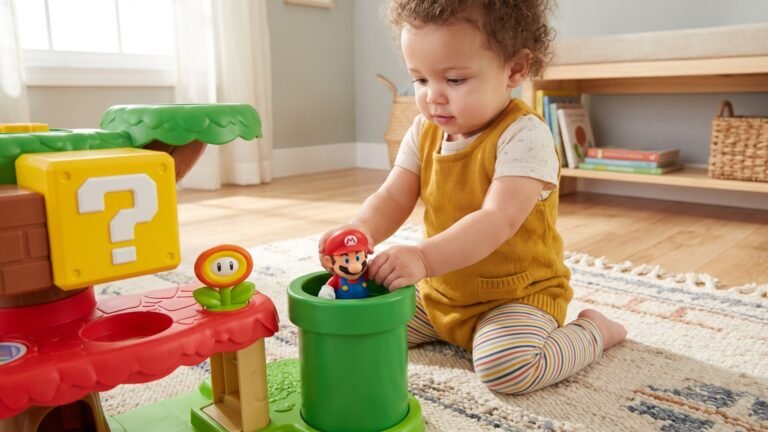
Chunky wooden blocks, large toddler construction pieces, and carefully selected magnetic tiles all have a place here, and the trade-off is worth understanding. Blocks give simple grasping and stacking practice with no mechanism to figure out. Magnetic tiles give more stable connections, which means a toddler can produce something recognizable, but many sets include components that are not appropriate for the youngest children.
Safety matters more at this age than at any other. Supervise closely, inspect pieces regularly for cracks or loose parts, keep magnets away from mouths, and follow the product’s stated age range exactly. Magnetic toys are not suitable for every toddler, and a set marketed for three and up is not automatically right for a two-year-old who still mouths everything. Best Building Toys for Toddlers: Blocks, Bricks & Simple Construction Sets goes through the specific options worth considering.
Preschoolers
This is where magnetic tiles earn their reputation. A four-year-old who wants to build a house, a garage, or a colorful tower gets a result in minutes, and that immediate payoff keeps them coming back. Tiles are the stronger choice for children who are visually motivated and want to see something standing.
Wooden blocks suit a different preschooler – one who enjoys towers, roads, balancing, and pretend play that unfolds slowly. That child will spend twenty minutes arranging a town and another twenty populating it with figures. Neither child is better served by the other toy.
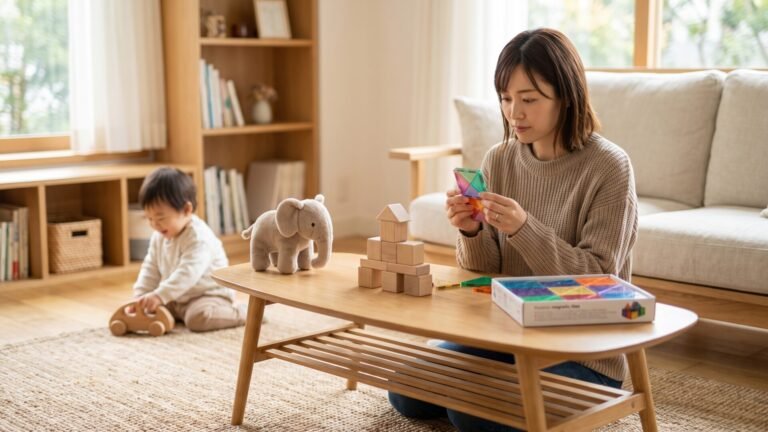
A mixed collection works unusually well at this age. Tiles become walls and roofs; blocks become foundations, roads, figures, and scenery. The two do not physically connect, but they combine in play constantly. If you are working with limited floor, Best Building Toys for Preschoolers and Best Building Toys for Small Spaces cover how to get the most out of a smaller collection.
Ages 6-8
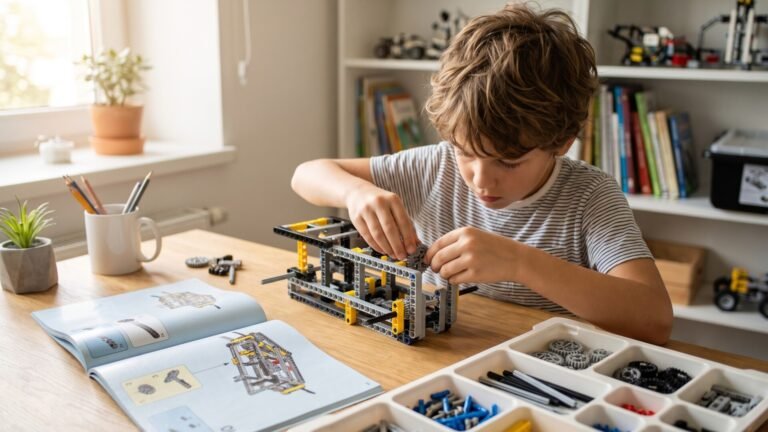
Interlocking bricks and more detailed construction systems start to win here, especially for children who enjoy following instructions or building recognizable models. Precision stops being a barrier and starts being part of the appeal. A child who wants a spaceship with moving parts is not going to get there with flat tiles.
Magnetic tiles remain useful for large-scale building, geometry, marble runs, and collaborative play, but they often need expansion accessories or more advanced shapes to stay challenging. Without them, the builds get repetitive.
The frustration patterns diverge cleanly. Bricks demand precision and punish carelessness. Tiles stay forgiving but feel limiting to a child who wants mechanisms and detail. Match the toy to which of those frustrations your child handles better. Best Building Toys for Kids Ages 6-8 has the specific sets.
Ages 9-12
Traditional building systems offer far more room for detailed structures, engineering challenges, mechanisms, and themed projects at this age. This is where a brick collection becomes a genuine hobby rather than a toy, and where the expansion ecosystem starts to matter more than the starter set.
Magnetic tiles still make sense in specific situations: large architectural builds, group play, a younger sibling in the house, classroom-style activities, or a child who prefers open-ended design to instructions. Some older children return to tiles for scale – a tower that reaches the ceiling is a different project at eleven than it was at four.
Do not buy a large tile expansion just because your child has aged into it. More pieces do not add complexity unless the set introduces new building possibilities. Best Building Toys for Kids Ages 9-12 covers what actually holds attention at this stage.
Product Shortlist: Strong Choices in Both Categories
These six are examples of different ownership priorities rather than a ranking. Prices are approximate and move around, so check current listings before deciding.
Magna-Tiles Classic 100-Piece Set
| Feature | Details |
|---|---|
| Age Range | Typically 3 years and up; verify current manufacturer guidance |
| Key Features | Magnetic geometric tiles, multiple shapes, open-ended construction |
| Price (approx.) | $100-$130 |
The Verdict
The default premium magnetic tile set, and the one most families end up with after trying something cheaper first. Connections are dependable, the shapes are the ones children actually use, and 100 pieces is enough for two children to build something substantial together. The weakness is expansion cost – specialty shapes and additional sets add up quickly, and a single 100-piece box runs out of triangles before it runs out of ambition.
Best For: Preschoolers and early elementary children who want fast, colorful construction.
Pros
- Strong open-ended play potential
- Works well for collaborative building
- Supports early geometry and spatial planning
Cons
- High initial price
- Flat structures get repetitive without new challenges
- Requires regular inspection for damaged pieces
[Affiliate: Check current pricing and availability through our recommended partners]
PicassoTiles 60-Piece Magnetic Tiles Set
| Feature | Details |
|---|---|
| Age Range | Commonly marketed for ages 3 and up; verify current product guidance |
| Key Features | Magnetic geometric tiles, varied shapes, lower-cost entry point |
| Price (approx.) | $30-$50 |
The Verdict
A sensible way to test whether magnetic construction suits your child before committing to a premium system. Sixty pieces is enough for basic structures and enough to find out whether the play style sticks. Quality varies by specific set and seller, so check current reviews and inspect the magnet enclosure when it arrives. Compatibility with other brands is not guaranteed, which matters if you plan to expand later.
Best For: Families testing magnetic tiles at a lower cost.
Pros
- Much lower entry price
- Enough variety for basic builds
- Good way to gauge interest before investing more
Cons
- Quality varies by set and seller
- Small sets feel limiting with siblings
- Check compatibility before mixing brands
[Affiliate: Check the price on Amazon]
Melissa & Doug Wooden Building Blocks
| Feature | Details |
|---|---|
| Age Range | Varies by set; many intended for toddlers or preschoolers |
| Key Features | Solid wooden shapes, stacking, balancing, open-ended pretend play |
| Price (approx.) | $20-$40 |
The Verdict
The unglamorous option that quietly outlasts almost everything else in the toy cupboard. Wooden blocks will not produce an instant castle, but they become roads, houses, ramps, garages, and scenery depending on the day. They are also the cheapest way into construction play, and the easiest to hand down. Expect towers to fall constantly in the first months – that is the toy doing its job.
Best For: Toddlers and preschoolers developing stacking, balance, and pretend play.
Pros
- Simple enough for the youngest builders
- Supports many kinds of pretend play
- Easy to store and pass on
Cons
- Towers collapse easily
- Less immediately rewarding for some children
- Loud on hard floors
[Affiliate: Check the price on Amazon]
LEGO DUPLO Classic Brick Box
| Feature | Details |
|---|---|
| Age Range | Commonly intended for young children; verify current set guidance |
| Key Features | Large interlocking bricks, simple builds, storage container |
| Price (approx.) | $25-$60 depending on set size |
The Verdict
The middle ground between loose blocks and detailed construction bricks. DUPLO gives children the satisfaction of a connection that holds while staying accessible to small hands. The brand ecosystem is the real argument – a DUPLO collection grows with the child and hands off to standard LEGO later. It costs more than plain wooden blocks and suits a child who wants to connect things rather than balance them.
Best For: Toddlers and preschoolers ready for interlocking construction.
Pros
- Pieces connect securely
- Strong expansion ecosystem
- Works for guided and open-ended building
Cons
- More expensive than basic wooden blocks
- Less suited to children who prefer loose parts
- Themed sets can narrow play if used only as instructed
[Affiliate: Check the price on Amazon]
LEGO Classic Large Creative Brick Box
| Feature | Details |
|---|---|
| Age Range | Usually suited to children approximately 4 years and up; verify current guidance |
| Key Features | Assorted standard bricks, multiple colors and shapes, storage box |
| Price (approx.) | $35-$60 |
The Verdict
The better long-term buy than magnetic tiles for a child who enjoys detailed models and rebuilding. It demands more precise hand control and will frustrate a child who is not ready for small pieces. For the child who is ready, replayability is very high and the collection compounds with every future set. Cleanup is the hidden cost – allow ten minutes and a flat surface.
Best For: Preschoolers through elementary-age builders who enjoy detail.
Pros
- High replayability
- Combines with future sets
- Supports increasingly complex projects
Cons
- Small pieces require age-appropriate use
- Cleanup takes real time
- Precision needed to build successfully
[Affiliate: Check the price on Amazon]
Wooden Unit Block Set
| Feature | Details |
|---|---|
| Age Range | Often suited to preschool and elementary play; verify specific product guidance |
| Key Features | Standardized wooden shapes, architectural construction, roads and structures |
| Price (approx.) | $80-$200 or more depending on size and brand |
The Verdict
The premium open-ended option, and the one that turns construction into a permanent play environment rather than an activity. Unit blocks are standardized, which means they stack into real architecture and combine with figures, cars, and fabric for years. The barriers are space and cost – this is not a small-apartment toy, and a full set is heavy.
Best For: Families with floor space and children who build at scale.
Pros
- Excellent open-ended versatility
- Durable across multiple ages
- Integrates naturally with pretend play
Cons
- Needs substantial storage
- High upfront cost
- Heavy pieces are loud and can hurt if dropped
[Affiliate: Check current pricing and availability through our recommended partners]
What to Skip
Be wary of very large magnetic tile bundles sold mainly on piece count. Duplicate squares add volume without adding building possibilities, and a smaller set with useful triangles, windows, ramps, or connectors is often the better buy. A 200-piece box of mostly squares is not twice the toy.
Skip unverified magnetic products where the construction quality, age guidance, or magnet containment is unclear. This is the one category where cutting corners on quality has a safety dimension rather than just a durability one.
Comparison Table
| Option | Best Age Range | Main Strength | Main Limitation | Approx. Price | Best For |
|---|---|---|---|---|---|
| Magna-Tiles Classic 100-Piece | 3 years and up | Fast, stable open-ended building | Expensive to expand | $100-$130 | Premium magnetic construction |
| PicassoTiles 60-Piece | 3 years and up | Lower-cost magnetic entry | Quality and compatibility vary | $30-$50 | Testing magnetic play |
| Melissa & Doug Wooden Blocks | Toddler to preschool | Stacking and pretend play | Structures collapse easily | $20-$40 | Simple tactile building |
| LEGO DUPLO Classic Brick Box | Young children | Secure connections, accessible | Costs more than loose blocks | $25-$60 | First interlocking system |
| LEGO Classic Large Creative Box | Preschool and elementary | Detailed, repeatable construction | Small pieces, more precision | $35-$60 | Long-term building growth |
| Wooden Unit Block Set | Preschool and up | Large-scale open-ended play | Space and cost | $80-$200+ | Architectural and pretend play |
ToyGuideHub Real-World Ownership Verdict
The first month tells you very little. Almost any new building toy gets used hard for three weeks, which is why online reviews written at week two are close to useless. The question worth answering is what happens in month four, when the box has lost its novelty and the child has to want to get it out on their own.
Magnetic tiles usually win that first month convincingly. A four-year-old can produce a recognizable structure without help, and that early success buys a lot of goodwill. The catch is that loose blocks often need an adult to model what is possible. A child handed a basket of wooden blocks and no demonstration may stack six of them, knock them down, and walk away. A child whose parent built a road and drove a car along it understands the toy differently. Blocks have a higher entry cost in adult time, and that cost is real.
By month six, the most-used system is almost always the one that matches the child’s preferred scale and play style. Children who build houses, castles, and geometric shapes tend to return to tiles again and again. Children who create roads, ramps, figures, and changing pretend-play scenes usually get more out of blocks, because blocks do more jobs. A block is a wall, a car, a sandwich, and a bridge. A magnetic tile is a wall, a roof, and a floor, and children notice the difference.
The hidden costs run in different directions. Magnetic tiles pull you toward expansion – the base set runs out of triangles, so you buy a shape pack, then a wheel set, then a marble run attachment. Bricks pull you toward sorting and cleanup, which is a time cost rather than a money one, but it is a cost. Wooden blocks demand the most storage space and the least in accessories. A unit block collection needs a shelf or a deep basket, and it will not fit in a drawer.
Here is the verdict by age, stated plainly. For most preschoolers who want a result they can see, magnetic tiles are the better first construction system and the one that will get used most in year one. For toddlers and for children who play pretend, chunky wooden blocks are the better foundation and the better long-term value. For children past six who want detail, mechanisms, and models, an interlocking brick system beats both. If your budget only covers one purchase, buy magnetic tiles for a visually motivated preschooler, chunky blocks for a toddler or a pretend-play child, and bricks for an older child who likes precision. In a mixed-age house, one magnetic system plus one small durable block collection beats two enormous sets of either.
How to Choose the Right Option for Your Family
Best for Toddlers
Large wooden blocks or age-appropriate chunky interlocking pieces come first. Magnetic tiles are worth considering only when the specific set is clearly suitable for the child’s age and an adult is supervising. Best Building Toys for Toddlers: Blocks, Bricks & Simple Construction Sets has the specifics.
Best for Preschoolers
Magnetic tiles for the child who wants quick visual results. Wooden blocks or DUPLO for the child who enjoys stacking, pretend play, and hands-on connecting. Most preschoolers do well with one of each in modest quantities rather than a large set of either.
Best for Developing Problem-Solving Skills
Wooden blocks for balance and structural experimentation, standard LEGO for precision and planning, magnetic tiles for geometry and rapid iteration. Each builds a different kind of thinking, and Best Construction Toys for Developing Problem-Solving Skills breaks down which system stretches which skill.
Best for Quiet or Independent Play
Magnetic tiles and wooden blocks both work here as long as nothing has a speaker. Blocks are quieter on a rug or mat; a wooden tower hitting a hard floor is one of the loudest sounds in a house. Quiet Building Toys for Indoor and Independent Play covers the full list.
Best for Small Spaces
A smaller magnetic tile set or a compact brick box beats a large unit block collection every time in a small apartment. Think vertical storage, shallow bins, and one system that packs away in under a minute. Best Building Toys for Small Spaces goes through the options that actually fit.
Best Long-Term Value
Pick a system with compatible expansion pieces and more than one play mode. Longevity depends far more on how easily the toy combines with pretend play, figures, roads, and other materials than on how many pieces came in the box. Wooden Blocks vs. Plastic Building Sets: What Should Parents Choose? is the natural next comparison if you are still weighing materials.
Safety and Parent Guidance
Check the age label and take it seriously. Small parts are a choking hazard for children under three, and magnetic sets frequently contain components that are not appropriate for the youngest children even when the box shows a toddler on the front.
Loose magnets are a serious hazard if swallowed and require urgent medical attention. This is not a minor caution. Inspect magnetic pieces regularly for cracks, separation at the seams, or any sign the magnet enclosure is failing, and remove damaged pieces from the collection immediately. Follow the manufacturer’s safety guidance and keep compromised pieces away from children entirely.
Supervise toddlers closely, especially in a mixed collection where an older sibling’s smaller pieces are in the same room. Storage by broad category helps here more than perfect sorting – magnetic shapes in a shallow bin, blocks in an open basket, small interlocking pieces in a lidded container kept out of reach when necessary. That system takes thirty seconds to maintain, which is the only kind of system that survives contact with a real week.
The Long View
Two years from now, the box will be gone and the pieces will be in a bin, and what you will be judging is whether that bin gets opened without prompting. Magnetic tiles tend to hold their place for the preschool years and then split – some children keep them for scale and group play, others drift toward bricks and never come back. Wooden blocks do the opposite: they start slowly, need an adult to unlock them, and then quietly stay in rotation for a decade because a block can be anything.
That difference should shape what you buy first. If you want the toy that pays off fastest for a four-year-old, buy magnetic tiles and accept that you may be adding shape packs in a year. If you want the toy that is still being used when that child is nine and a younger sibling is three, buy blocks, and plan to sit on the floor with them for the first few weeks. Ten years out, a good wooden block set gets handed to a cousin or sold for most of what you paid. Most of the rest gets donated, and one or two things end up in a bin in the attic that nobody can quite throw away.
Frequently Asked Questions About Magnetic Tiles Vs. Building Blocks
Are magnetic tiles better than blocks for toddlers?
Large wooden or chunky blocks are usually the simpler starting point, because there is no magnet enclosure to worry about and nothing to fit together. Magnetic tiles can work for some older toddlers or preschoolers when the specific product is age-appropriate and an adult is supervising. Check the stated age range rather than assuming.
Do magnetic tiles help with STEM learning?
They can support early geometry, spatial reasoning, symmetry, and design iteration. That said, the learning comes from how the child uses them, not from the magnets. A child building the same square house every day is not learning much geometry, whatever the box claims.
Do children outgrow magnetic tiles?
Some do, around six or seven, when they start wanting mechanisms and detail. Others keep using them for large-scale structures, marble runs, and collaborative play well past that. The ones who stay interested usually have expansion pieces that open up new builds.
Are wooden blocks more durable than magnetic tiles?
Solid wooden blocks handle drops and rough use almost indefinitely. Magnetic tiles can last just as long as long as the plastic casing stays intact. The difference is what happens when they fail – a scuffed block is fine, a damaged magnetic piece has to come out of the collection.
Can magnetic tiles and building blocks be used together?
They usually do not connect physically, but they combine in play constantly. Blocks become foundations, roads, walls, furniture, and scenery around a magnetic tile structure. Children figure this out on their own faster than most adults expect.
Which is better for independent play?
Magnetic tiles generally offer faster independent entry, because a child can build something recognizable without help. Blocks can support longer imaginative play once the child has learned what they can do. The child’s preferred play style matters more than the category.
Is a large piece count worth paying more for?
Only when the extra pieces add useful shapes, allow multiple children to build at once, or support larger projects. A high count of repetitive basic pieces often delivers less value than a smaller, better-designed set. Count shapes, not pieces.
How many pieces do you actually need?
For one child, around 60 to 100 magnetic tiles or a mid-size brick box is enough to build something satisfying without overwhelming storage. Two children building together want closer to 100 to 150 tiles, or a brick collection that has accumulated over a couple of birthdays.