5 Sensory-Friendly Science Kits That Toddlers Will Love
A common mistake with toddler science kits is buying one designed for older children: test tubes, mysterious powders, and instructions written for a reader rather than a two-year-old. Those kits tend to end up on a closet shelf.
Disclosure: Toy Guide Hub may earn a commission from qualifying purchases made through affiliate links on this site, at no extra cost to you. The products below are described from manufacturer and retailer information, not hands-on testing by this site; confirm age grades, contents and prices on the current listing before you buy.
Quick picks: the closest thing to a toddler science set is the Learning Resources Primary Science Sensory Tubes (listed for ages 2+). The cheapest option is a supervised homemade sensory bin. Melissa & Doug Primary Lacing Beads (3+) are a fine-motor toy, the VTech Smart Shots Sports Center is an active electronic toy, and the Scientific Explorer kit is graded for older children, so it is a grow-into pick.
The lesson: toddlers need science kits designed for toddlers. Not watered-down versions of older kids’ kits, but thoughtfully crafted sensory experiences that meet them exactly where they are developmentally. The best sensory-friendly science kits understand that for a toddler, science isn’t about memorizing facts—it’s about squishing, pouring, stacking, and wondering.
A kit that works for a toddler contains the mess, uses materials safe enough that you aren’t hovering constantly, and holds attention for a few minutes at a time. That is a perfectly good result.
Below are five sensory-friendly options, compared on safety, age fit and play value. Some are true science sets and some are broader sensory toys, and we say which is which.
First, why sensory play matters and what to look for; then the five options.
The Science Behind Sensory Play
Sensory play can sound like a fancy term for making a mess, but a toddler running their fingers through a bin of rice is doing real exploratory work: noticing texture, weight and sound.
Early childhood educators widely treat hands-on sensory exploration as a core way toddlers learn about the world (our guide to understanding sensory play covers the basics). When toddlers engage several senses at once—touch, sight, sound, even smell—they get practice that supports language, coordination and early problem-solving, though no single toy is required for any of it.
Worth knowing: traditional science kits often work against this natural developmental process. They come with small parts that pose choking hazards, instructions that require reading comprehension a toddler simply doesn’t have, and materials that are either too complex to understand or too boring to hold attention.
Sensory-friendly science kits flip this script entirely. Instead of asking a toddler to understand abstract concepts, they invite the child to experience scientific principles through their body. The texture of slime teaches viscosity. The weight of sand teaches density. The sound of water pouring teaches cause and effect.
In general, the kits that hold up are the ones that embrace mess, prioritize safety, and accept that a toddler’s attention span is measured in minutes, not hours.
Prices, contents and availability change often, so confirm the details on the retailer listing before you buy.
But here’s the catch: not all sensory-friendly science kits are created equal. Some are genuinely wonderful. Others are overpriced collections of items you could buy at the dollar store. Here is how to tell the difference.
What Makes a Science Kit Sensory-Friendly?
Before we dive into specific recommendations, let me define what I mean by “sensory-friendly science kit.” This isn’t a regulated term, so manufacturers use it loosely. Here is what separates the good from the great.
A truly sensory-friendly science kit prioritizes tactile engagement over intellectual challenge. It doesn’t require a toddler to understand why something happens—it simply invites them to experience what happens. The best kits include materials with varied textures: smooth, rough, squishy, crumbly, wet, dry. They engage multiple senses at once, not just sight.
These kits also work differently than traditional science kits. Traditional kits often follow a linear path: read step one, do step one, observe result, move to step two. Sensory-friendly kits are more like invitations. They provide materials and loose guidance, then let the child explore at their own pace. This open-ended approach suits how many young children learn: through play and repetition.
Key terminology matters here. “Sensory play” refers to any activity that stimulates a child’s senses. “Science exploration” for toddlers means hands-on investigation of cause and effect, properties of materials, and simple physical phenomena. “Educational value” in this context doesn’t mean teaching facts—it means building cognitive skills through experience.
The most important distinction between sensory-friendly kits and traditional science kits comes down to three factors: safety design, instruction approach, and material quality. Sensory-friendly kits use larger parts, non-toxic materials, and instructions written for parents rather than children. They assume the adult will facilitate rather than the child will read.
Now, let’s talk about what you should actually look for when shopping.
What to Look For Before You Buy
Common mistakes with toddler science kits include buying ones that are too advanced, too boring, too messy, or too expensive for what they contain. These are the factors worth checking before any purchase.
Safety is non-negotiable. Look for kits that explicitly state they use non-toxic, food-grade materials when appropriate. Check for small parts that could become choking hazards—if a piece fits inside a toilet paper tube, it’s too small for a toddler who still puts things in their mouth. The best kits clearly label age recommendations and safety warnings.
Durability matters more than you might think. Toddlers are not gentle. They drop things, throw things, and occasionally try to eat things. Kits with flimsy plastic components or paper-based materials rarely survive more than a few play sessions. Thick plastic, sturdy cardboard, or natural materials withstand enthusiastic handling best.
Age appropriateness is where most parents get tripped up. The age grade on the box is primarily a safety label (it reflects hazards such as small parts), not a promise about skill, so never give a toddler a kit graded for older children. Beyond the grade, look at the specific activities included and ask: can my child physically manipulate these materials? Can they understand the basic concept without frustration?
Educational value in sensory-friendly kits isn’t about teaching facts. It’s about building foundational skills: fine motor control, cause and effect understanding, vocabulary development through descriptive language, and early math concepts like sorting and classifying. The best kits integrate these naturally rather than forcing academic content.
Ease of use determines whether a kit actually gets used or sits on a shelf. Instructions should be simple enough to read in under two minutes. Setup should require minimal preparation. Cleanup should be straightforward. A kit that needs thirty minutes of setup for ten minutes of play is rarely worth it.
Storage requirements are the hidden factor nobody talks about. Some kits come in compact boxes that fit neatly on a shelf. Others include multiple containers, loose materials, and components that never seem to fit back in the original packaging. If you live in a small space, this matters enormously.
The Upside and Downside of Sensory Science Kits
Let me be honest about what these kits do well and where they fall short.
The good stuff: Sensory-friendly science kits are genuinely engaging for most toddlers. They tap into the natural curiosity that drives all early learning. When a child is allowed to explore freely, they practise focus and concentration. Many toddlers will stay absorbed in a single sensory bin activity for a good while, though attention spans vary a lot from child to child.
These kits also encourage creativity in ways that structured toys don’t. There’s no “right” way to play with a sensory bin. A toddler might pour, scoop, bury, sort, or simply run their hands through the materials. Each approach builds different skills and satisfies different curiosities.
For children with sensory processing differences, these kits can be particularly valuable. They provide controlled exposure to different textures and sensations in a safe, predictable context. Some occupational therapists use this type of play with children who have sensory processing differences. If that applies to your child, check with their therapist before introducing new textures, since some children find certain sensations overwhelming.
The not-so-good stuff: Let’s be real—many of these kits are messy. If mess stresses you out, some activities will test your patience. The best kits include containment strategies (lidded bins, mats, aprons), but toddlers have an impressive ability to spread materials far beyond the intended play area.
Some kits also require more parental involvement than you might expect. While the child does the exploring, an adult usually needs to set up the activity, supervise for safety, and facilitate cleanup. This isn’t a “set it and forget it” type of toy.
Finally, some kits have limited replay value. Once a toddler has explored all the materials, they may lose interest. The best kits include instructions for multiple activities or allow for open-ended reuse, but not all manufacturers design with longevity in mind.
Our Top Five Sensory-Friendly Science Kits
Here are five options, with notes on age fit and how much actual science each contains. Two are better described as sensory or fine-motor toys than science kits, and we say so.
Scientific Explorer My First Mind Blowing Science Kit (a Grow-Into Pick)
| Feature | Details |
|---|---|
| Age Range | 6+ years per retailer listings (verify on the current listing) |
| Key Features | Beginner experiments for older children; adult-led for any younger child |
| Affiliate Program | Amazon Associates |
| Price | Varies by retailer; check the current price |
Why We Like It: Young children don’t need to understand why something happens to be fascinated by that it happens, and experiments with quick, visible results are what hold their interest. The catch is age: this kit is graded for older children, so with a toddler or preschooler any use would be adult-led and closely supervised.
Retailer listings grade this kit for ages 6 and up, so it is not a toddler kit: treat it as something to grow into, and do not give it to a child under 3. Check the exact contents and warnings on the product listing first, as experiment kits can include materials that are unsuitable for young children.
Best For: Families with an older child (6+) who want a first science kit. For toddlers, choose one of the other options below instead.
Pros
- Simple experiments that spark genuine curiosity
- Beginner-level experiments
- Suits a child who can follow simple instructions
- Multiple experiments in one kit
Cons
- Graded 6+, so not suitable for toddlers
- Some materials are single-use
- Requires adult setup and supervision
Learning Resources Primary Science Sensory Tubes
| Feature | Details |
|---|---|
| Age Range | 2+ years (manufacturer grade) |
| Key Features | Set of 4 sensory tubes for hands-on exploration |
| Affiliate Program | Target Affiliate Program |
| Price | Varies by retailer; check the current price |
Why We Like It: This is the closest match on the list to a toddler science set: Learning Resources lists a set of four science sensory tubes for ages 2 and up. Check the listing for exactly what each tube contains and how it is sealed.
Tube-style sensory toys generally let a child shake, tilt and watch without loose materials spilling, which suits a first science experience. As with any toy, inspect it regularly for cracks or loose caps and supervise play.
Best For: Toddlers (2+) who like to shake, roll and watch, and parents who want low-mess sensory play.
Pros
- Hands-on sensory exploration
- Set of four gives variety
- Manufacturer age grade of 2+
- Little or no setup
Cons
- Check contents and construction on the listing before buying
- Some children may lose interest after initial exploration
- Limited “science” content compared to other kits
Melissa & Doug Primary Lacing Beads
| Feature | Details |
|---|---|
| Age Range | 3+ years (small beads and long laces: not for under 3) |
| Key Features | Wooden beads and laces for lacing and sorting (about 30 beads and 2 laces per listing) |
| Affiliate Program | Melissa & Doug Affiliate Program |
| Price | Varies by retailer; check the current price |
Why We Like It: To be clear, this is a fine-motor activity rather than a science kit. It does invite early science-adjacent skills: sorting by color and shape is a first step toward classification, lacing gives hands practice with control, and threading beads in order introduces sequencing.
The set is wooden beads with laces, graded 3+. Because the beads are small and the laces are long, it is not suitable for children under 3, and a child should use it with an adult nearby (cords and strings are a strangulation concern for young children).
Best For: Children ready for 3+ toys who enjoy quiet, hands-on activities, and parents who want a low-mess option. Keep the laces under supervision.
Pros
- Durable wood construction
- Low mess
- Develops fine motor skills
- Compact and portable
Cons
- Limited scientific exploration
- Some toddlers may find lacing frustrating
- Less sensory variety than other options
VTech Smart Shots Sports Center
| Feature | Details |
|---|---|
| Age Range | Roughly 1-3 years (confirm the age grade on the current listing) |
| Key Features | Interactive play, sounds, and lights |
| Affiliate Program | VTech Partner Program |
| Price | Varies by retailer; check the current price |
Why We Like It: This is a toy rather than a science kit, but it gives toddlers a repeatable cause-and-effect loop: do something, then see lights and hear sounds. Active play is also something most sensory kits leave out.
It is a battery-powered electronic toy, so check the listing for the battery type and how the compartment is secured (button and coin batteries are a serious swallowing hazard, and a screw-closed compartment is what to look for). Also confirm the age grade, and check for any small balls or loose parts that may not suit a child who still mouths objects.
Best For: Active toddlers who struggle to sit still for traditional sensory play. Lights and sounds can be overwhelming for some children, particularly those sensitive to noise.
Pros
- Encourages physical activity
- Immediate cause-and-effect feedback
- Lights and sounds respond to play
- Multiple ways to play
Cons
- Less focus on traditional science concepts
- Electronic components may eventually fail
- Requires floor space for setup
- Batteries need replacement
Homemade Sensory Bin (Budget Pick)
| Feature | Details |
|---|---|
| Age Range | 2+ years, once past the mouthing stage and with an adult beside them |
| Key Features | Large, safe household items in a lidded bin |
| Affiliate Program | None (household items) |
| Price | Low; most items are already in the kitchen |
Why We Like It: A lidded bin filled with a base such as dry oats or large pasta, plus scoops, cups and a few large smooth items, gives a toddler a wide range of textures for very little money. Our guide to DIY sensory bin recipes has more ideas.
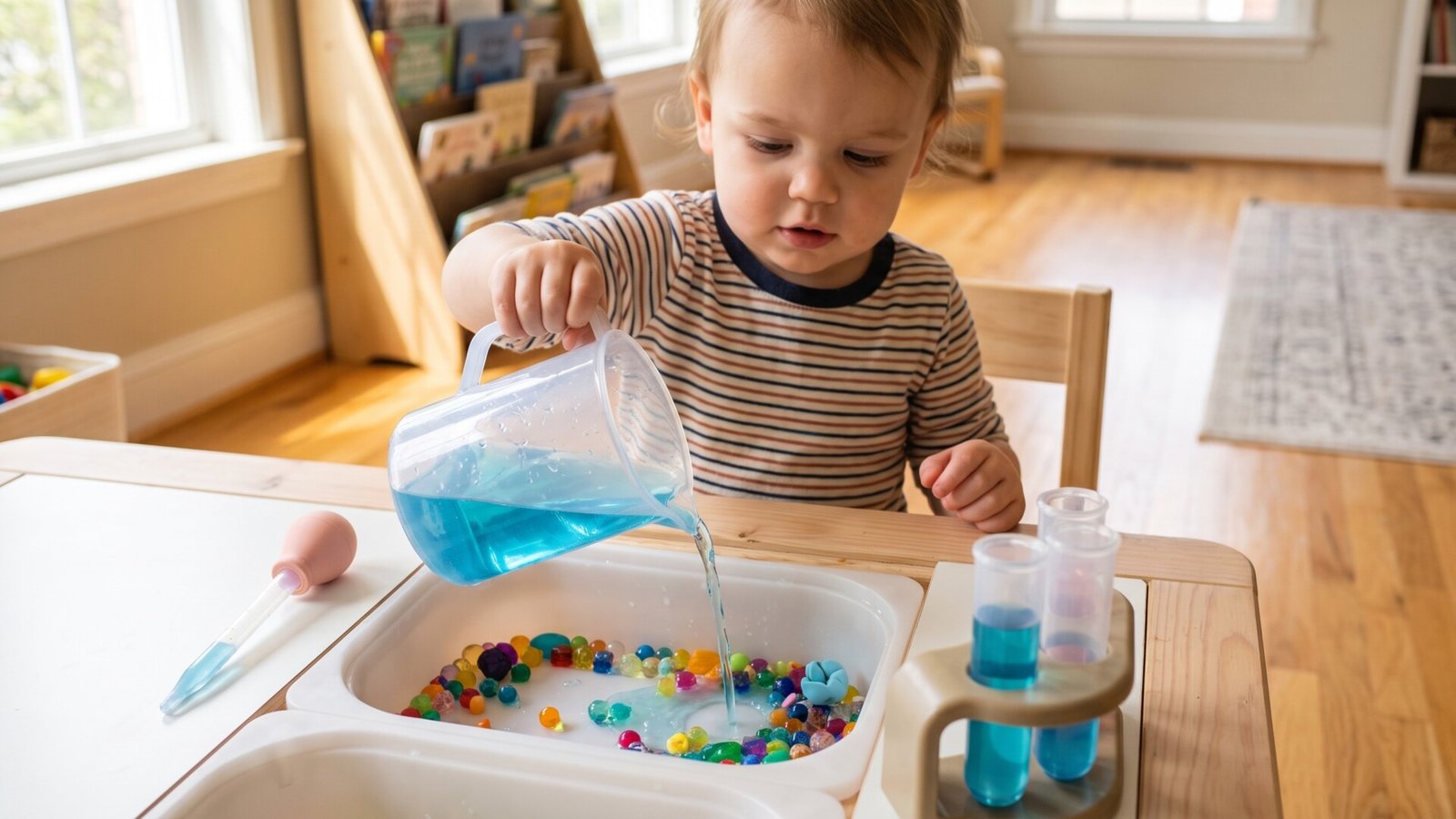
Choose items larger than a toilet paper tube opening so nothing is a choking hazard, and keep water beads, button batteries and magnets out of the bin entirely. Pieces can be sorted, scooped, buried or simply felt, and a lid makes storage easy.
Best For: Families on a budget and toddlers who like scooping and pouring. Introduce textures gradually for children who are sensitive to them.
Pros
- Rich sensory experience with diverse materials
- Versatile for different activities
- Very low cost
- Easy to store in a lidded container
Cons
- Needs adult supervision and careful choice of items
- Dry fillers can scatter
- Less structured than other kits
Quick Comparison Table
| Product | Age Grade | Type | Science Content | Price | Best For |
|---|---|---|---|---|---|
| Scientific Explorer My First Mind Blowing Science Kit | 6+ (verify) | Science kit | High | Varies | Older siblings |
| Learning Resources Primary Science Sensory Tubes | 2+ | Sensory set | Low to medium | Varies | Hands-on, low-mess play |
| Melissa & Doug Primary Lacing Beads | 3+ | Fine-motor toy | Low | Varies | Quiet fine-motor play |
| VTech Smart Shots Sports Center | Verify on listing | Electronic active toy | Low | Varies | Active toddlers |
| Homemade Sensory Bin | 2+ with supervision | DIY | Medium | Low | Budget-minded families |
How to Choose the Right Kit for Your Family
Every family’s situation is different. Here’s how to narrow down your options.
Best for Small Spaces: If you’re working with limited square footage, the Melissa & Doug Primary Lacing Beads (for ages 3+) pack into a compact box and can be used on a small table. The Learning Resources sensory tubes are also compact, and a lidded homemade bin can slide under a bed or shelf.
Best for Toddlers: For children under 2, check each product’s age grade carefully; the VTech Smart Shots Sports Center is the only option here that may be graded that young, so confirm the grade and any small parts on the current listing. The Learning Resources sensory tubes (2+) and a supervised homemade bin suit two-year-olds who are past the mouthing stage.
Best for Outdoor Play: A homemade sensory bin works well on a porch, patio or in the grass, and dry fillers are easy to sweep up. If you add water, stay within arm’s reach: toddlers can drown in very little water.
Best for Sensory Exploration: If your primary goal is rich sensory input, a homemade bin offers the most variety for the least money, and the Learning Resources sensory tubes are the lower-mess alternative.
Best Budget Pick: A homemade sensory bin is the cheapest route. If your child is 3 or older, the Melissa & Doug Primary Lacing Beads are a low-cost fine-motor option; compare current prices at the retailer.
Best Premium Pick: The VTech Smart Shots Sports Center is the most feature-heavy option, with electronics, lights and sound. Compare current prices and weigh them against the noise level and battery upkeep.
Our Final Thoughts
The best sensory-friendly science kit is the one that actually gets used. A perfect kit that sits on a shelf provides zero value, while an imperfect one that your toddler reaches for again and again is worth the money.
For most toddlers, start with the Learning Resources sensory tubes or a supervised homemade bin. If mess is a concern and your child is 3 or older, the Melissa & Doug Primary Lacing Beads are a clean fine-motor alternative. For active toddlers, the VTech Smart Shots Sports Center may suit, once you’ve confirmed its age grade and battery safety. Save the Scientific Explorer kit for when your child is older.
The specific kit matters less than the experience you create around it. Sit with your child. Describe what they’re feeling and seeing. Ask open-ended questions. Let them lead the exploration. The connection you build during these moments is more valuable than any toy.
Age Grades, Small Parts and Safety for Toddlers
A toy’s age grade is a safety label set by the manufacturer. In the US, toys intended for children under 3 must comply with the Consumer Product Safety Commission (CPSC) small parts rules, and toy makers commonly test to the ASTM F963 toy safety standard. As a practical rule, anything that fits inside a toilet paper tube is a choking hazard for a child who still mouths objects.
Button and coin batteries deserve special care. If swallowed they can cause serious internal injury within hours, so look for battery compartments that close with a screw, and seek emergency medical help right away if you suspect a child has swallowed one. Keep magnets, water beads, balloons and long cords or laces away from toddlers as well, and stay within arm’s reach during any water play.
We have not checked each product here against recall databases. Before buying, search the CPSC recall list at cpsc.gov for the exact product name and model.
Keep Exploring
For more ideas, browse our STEM toys hub, read understanding sensory play, try some DIY sensory bin recipes, or see how to support fine motor development at home.
Frequently Asked Questions About Sensory-friendly Science Kits For Toddlers
Are sensory-friendly science kits safe for toddlers?
Safety depends on the specific product and your child’s age, not on the label sensory-friendly, which is not a regulated term. Check the manufacturer’s age grade, avoid small parts and button batteries for children under 3, and supervise all play, especially with liquids, strings or small pieces.
What age range are these kits designed for?
Options in this guide are graded from about 2 and up, but individual products vary, and the Scientific Explorer kit is graded 6+ on retailer listings. Treat the age grade as a safety limit, then consider your child’s stage and whether they still put objects in their mouth.
How messy are these science kits?
Some are messier than others. A homemade bin can scatter dry fillers if it spills. The Melissa & Doug lacing beads are virtually mess-free. Experiment kits generally involve some cleanup. Using any of these on a washable surface or outdoors helps.
Can these kits be used outdoors?
Some can be used outdoors. A homemade sensory bin suits a porch or patio. The VTech toy is electronic, so check the manufacturer’s guidance before using it outside. The Melissa & Doug beads are portable, but should be used with an adult nearby.
Do sensory kits offer educational value?
Yes, though it looks different from a classroom science lesson. These toys invite children to practise cause and effect, sorting, hand control, descriptive language and sustained attention. No single kit is necessary, and open-ended play with everyday objects offers many of the same chances.
How do I choose the right sensory-friendly science kit for my toddler?
Start by considering your child’s age and developmental stage. Next, think about your tolerance for mess and your available space. Finally, consider what type of play your child naturally gravitates toward—active movement, quiet exploration, creative crafting, or tactile sensation. Match the kit to their natural preferences for the best engagement.
Are these kits safe for children under 2?
Do not assume so. Check the manufacturer’s age grade on the current listing. Toys for children under 3 must follow small parts rules, so avoid loose small pieces, button batteries, magnets and long cords, and supervise closely.
What should I avoid putting in a toddler sensory bin?
Avoid anything small enough to fit inside a toilet paper tube, as well as water beads, button batteries, magnets, balloons and long strings. Dry fillers such as oats or large pasta are common choices, but check for food allergies and supervise all play, including any water play.
Is a homemade sensory bin as good as a kit?
For many toddlers, yes. A lidded bin with a safe filler and a few scoops and cups offers similar texture exploration for far less money. A purchased kit mainly saves planning time and may include guidance for adults.
Do sensory kits help children with sensory processing differences?
They can offer a gentle, predictable way to explore textures, but responses vary and some children find certain sensations upsetting. This guide makes no therapeutic claims. If your child has sensory processing differences, ask their occupational therapist which materials suit them.