Best Building Toys for Small Spaces
The best building toy for a small space is the one you can reset in under two minutes, not the one with the smallest box.
That is the whole tradeoff, and almost nobody selling building toys wants to frame it that way. A 600-piece tube takes up less shelf space than a wooden block set and can still turn your living room floor into a minefield by Tuesday. A big LEGO box with a lid is easier to live with than a smaller bag of loose specialty parts, because the lid does half the work. Storage footprint and play footprint are two different numbers, and only one of them shows up on the product page.
So the shortlist, before the reasoning: compact LEGO sets with a reusable box, magnetic construction sets with a dedicated container, and modular wooden blocks are usually the strongest choices for apartments, shared rooms, and anything under 900 square feet. Which one wins depends on your child’s age, how they play, and how much cleanup you are genuinely willing to do on a weeknight.
What Makes a Building Toy Work in a Small Space?
Storage footprint is what the toy occupies when it is put away. Play footprint is what it occupies when it is actually being used. These are rarely the same, and the gap between them is where most small-space purchases go wrong.
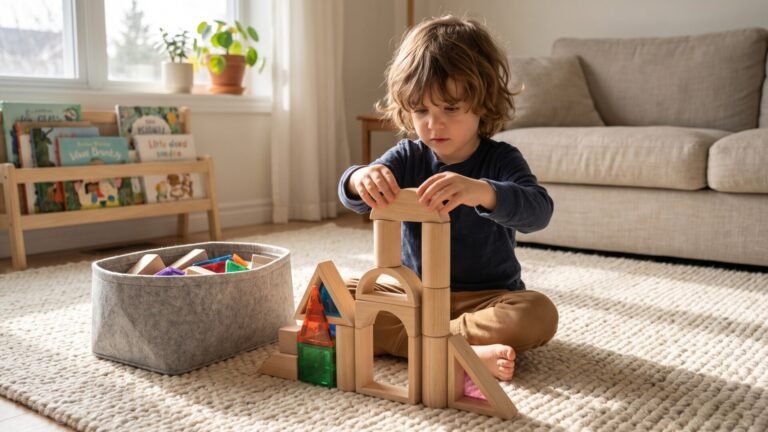
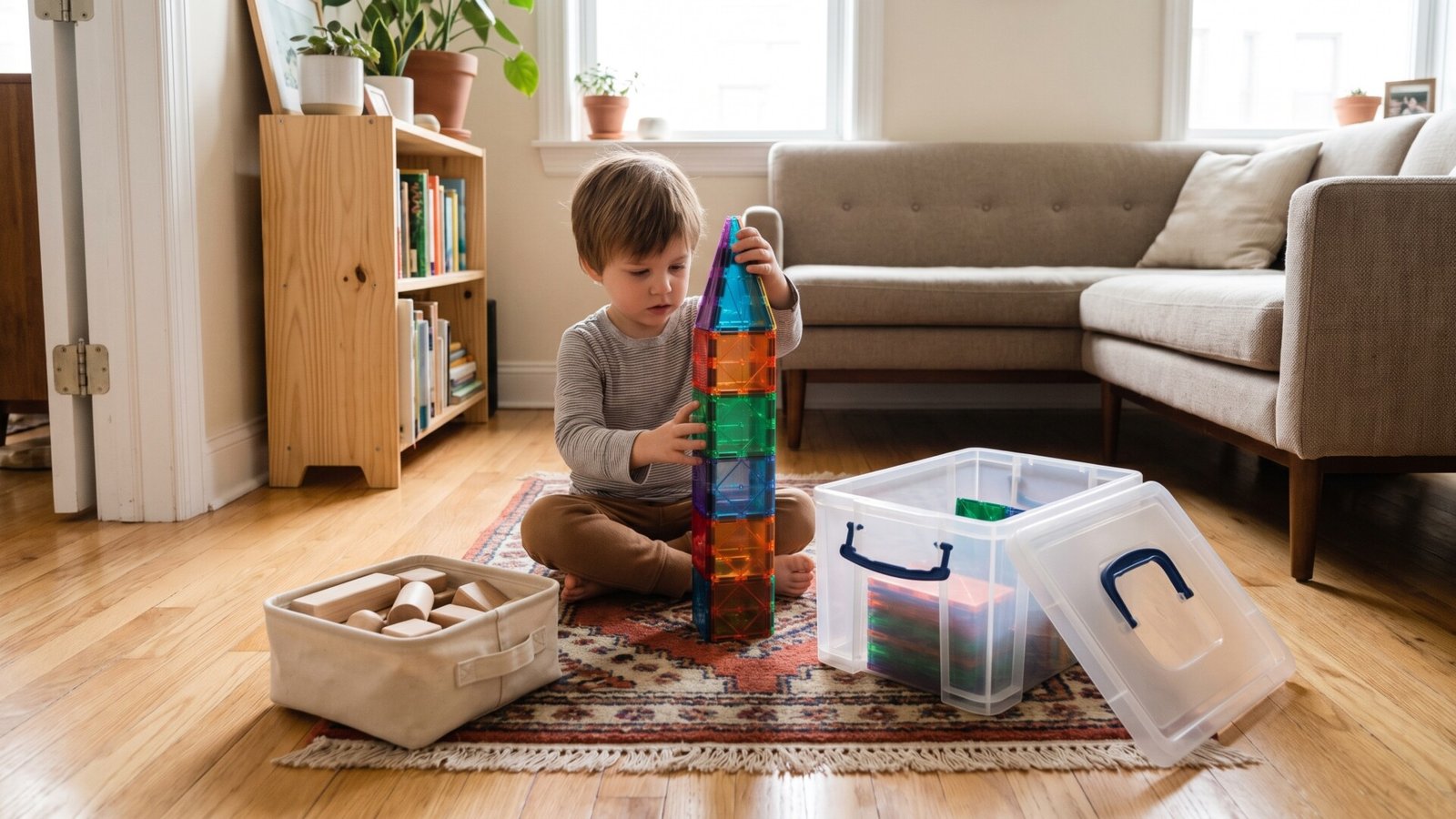
A magnetic tile set is the clearest example. Thirty-two flat squares stack into something the size of a hardback book. Build a castle with them and you need a coffee table, a rug, or a stretch of floor roughly the size of a small dog. The storage is excellent. The play area is not small – it is just temporary.
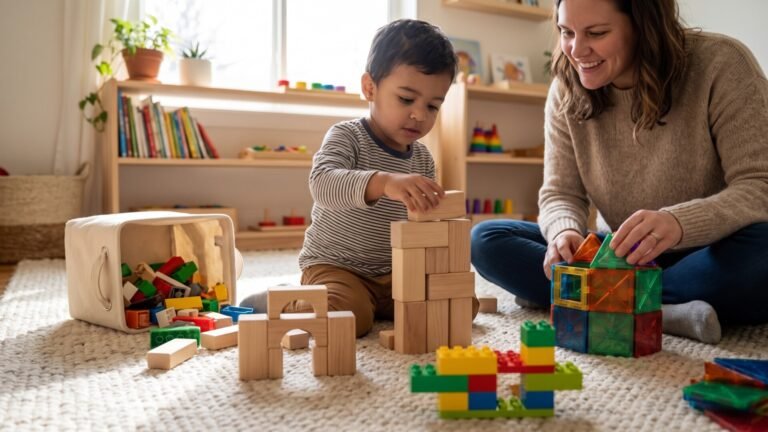
The reverse also happens. A wooden block set in a deep bin looks bulky on a shelf, but the blocks themselves are large, easy to see, and easy to sweep back into the bin in one motion. Bulky storage, low friction.
The criteria that actually matter
Six things decide whether a building toy survives in a small home:
- Container quality. Does the box have a lid that stays on, a handle, and a shape that stacks? A good container is worth more than a hundred extra pieces.
- Piece count and piece size. More pieces means more sorting, more scatter, and more time on your hands and knees.
- Build scale. Does a typical finished model fit on a tray, or does it need the whole floor?
- Noise. Hard plastic on hardwood is loud. Dropped wooden blocks are louder. This matters more than you think in a flat with neighbours below.
- Lost-piece risk. Small, uniform, cheap-to-replace pieces are forgiving. Small, unique, discontinued pieces are not.
- Cleanup time. Be honest about this one. If tidying takes fifteen minutes, the toy will stop coming out.
The Small-Space Building Score
To compare options fairly, we rate each toy out of 25 across five factors, five points each: storage efficiency, play-area efficiency, cleanup ease, independent-play potential, and long-term value. These are editorial estimates based on the criteria above and how each toy behaves in a normal home. They are not the results of laboratory testing, and a lower score does not mean a bad toy – it means a worse fit for a small room.
A set can score well on storage and badly on cleanup. That combination is the most common trap in this category, and it is why the highest score does not automatically belong to the smallest product.
Key Buying Factors for Apartments and Small Rooms
Storage and reset
Look for stackable containers, divided cases, reusable boxes, or a set that can be sorted without buying an organizer. The best storage is the storage that came in the box, because you will not maintain a system you had to build yourself.
Reset speed is the real metric. A toy that takes ninety seconds to put away gets used on a school night. A toy that takes ten minutes gets used on weekends, then stops.
Noise and floor impact
Hard plastic bricks, magnetic tiles, and wooden blocks all make noise when they land. On carpet this is a non-issue. On tile or hardwood in a shared building, it is the thing your downstairs neighbour notices first.
Construction vehicles with motors are the worst offenders in this category, and they are also the least space-efficient – they need roads, ramps, and floor space to be worth owning. If you live above someone, favour tabletop systems and put a mat or rug under the play area.
Age and supervision
Small parts are a choking hazard, and the manufacturer’s age guidance on the box is the number that matters. Follow it. Do not size up because your child seems advanced, and do not size down because the older set is on sale.
Magnets deserve their own caution. Damaged or cracked magnetic pieces should be removed from the collection immediately, and swallowed magnets are a genuine medical emergency rather than a wait-and-see situation. Check magnetic tiles and magnetic rod sets regularly for cracks, and follow the manufacturer’s guidance on inspection and replacement. If you are unsure about a specific product, check the manufacturer’s safety information directly rather than relying on a retailer listing.
Value beyond piece count
Piece count is the least useful number on the box. A 60-piece wooden block set supports more distinct play patterns than a 400-piece themed set with twelve unique parts and a single intended model.
What you are actually buying is compatibility and rebuildability. A set that connects to a system you already own doubles its own value. A set that builds one thing and then sits on a shelf does not.
Recommended Building Toys for Small Spaces
| Product | Approximate Price | Small-Space Strength | Best For | Score |
|---|---|---|---|---|
| LEGO Classic Medium Creative Brick Box | $35-$55 | Built-in storage, open-ended play | One versatile set | 23/25 |
| LEGO Classic Creative Bricks | $25-$60 | Compact storage, tabletop builds | Many build types | 22/25 |
| Plus-Plus BIG or 600-Piece Tube | $15-$35 | Very small storage footprint | Quiet, focused building | 24/25 |
| Magna-Tiles Clear Colors 32-Piece Set | $50-$60 | Flat storage, quick setup | Preschoolers | 21/25 |
| Melissa & Doug Wooden Building Blocks 60-Piece | $20-$35 | Stackable shapes, manageable box | Younger children | 20/25 |
| SmartMax Basic Build or Stunt Set | $40-$80 | Large pieces, contained builds | Preschool STEM play | 20/25 |
| KAPLA 100 Plank Box | $45-$70 | Slim, stackable storage | Older, careful builders | 19/25 |
Scores are editorial estimates across the five small-space factors, not laboratory results. For the full range of options across every age group, see our Building & Construction Toys hub.
LEGO Classic Medium Creative Brick Box
| Feature | Details |
|---|---|
| Age Range | Typically 4+; check the current package |
| Key Features | Open-ended bricks, reusable storage box, wide color and shape assortment |
| Price (approx) | $35-$55 |
This is the best overall choice for a small home, and the reason is the box. A reusable storage container included in the purchase removes an entire decision – you do not have to find a bin, measure a shelf, or buy an organizer that your child will ignore.
The bigger argument is against themed sets. A large licensed set builds one model, which then lives on a shelf as a display object. A box of general bricks builds animals, vehicles, houses, patterns, and nonsense, and then goes back in the box. In a small flat, one container supporting fifty builds beats five containers supporting five.
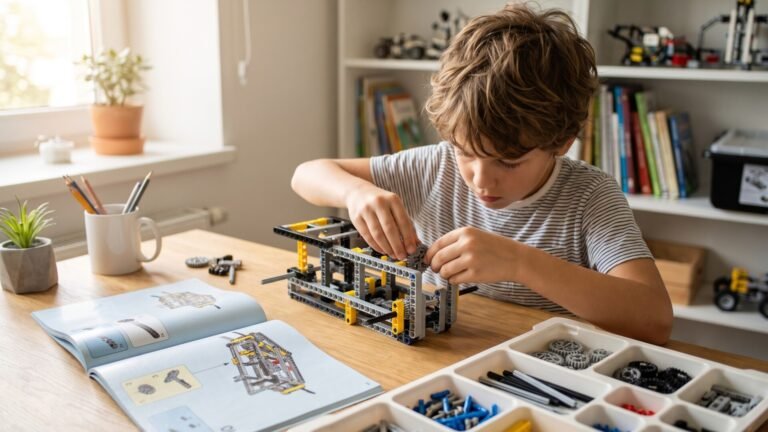
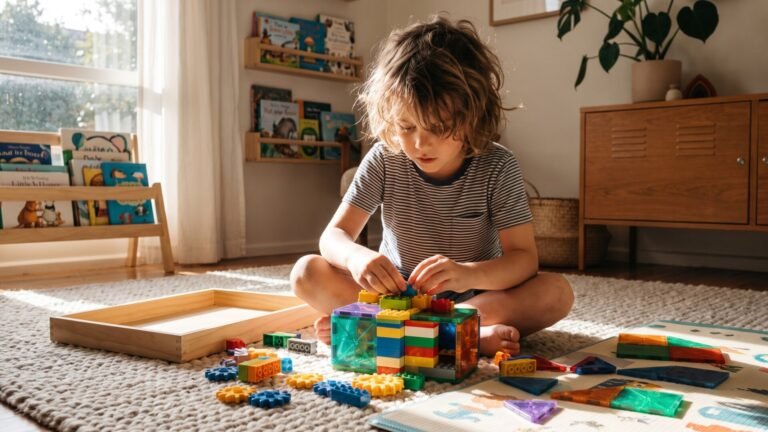
The tradeoff is real: many small pieces, meaningful sorting work, and a genuine choking hazard for children who still mouth objects. It works best when you limit the active collection. Put out a few hundred bricks, keep the rest in a cupboard, and rotate. Nobody needs every brick available at once, and children do not build better with more.
Best for: Families wanting one compact construction system with strong long-term compatibility.
Pros
- High replayability and broad creative range
- Easy to add to over time
- Strong tabletop play potential
Cons
- Small pieces scatter and disappear
- Sorting gets harder as the collection grows
- Not suitable for very young children
[Affiliate: Check current pricing and availability through our recommended partners]
LEGO Classic Creative Bricks
| Feature | Details |
|---|---|
| Age Range | Typically 4+; check the current package |
| Key Features | Assorted bricks, multiple build possibilities, compatibility with other LEGO sets |
| Price (approx) | $25-$60 |
If you already own a container, or you want to start smaller, this is the same idea in a plainer package. It is the most flexible all-purpose option for children who can manage small pieces, and it does not commit you to a theme.
The small-space case is straightforward. One modest container supports an enormous range of builds, and every brick you add later is compatible. That means you never accumulate a second, incompatible storage problem – which is exactly what happens when you buy into three different construction systems across four birthdays.
The tradeoff is the same as above, only more so, because there is no lid doing the work for you. Budget for a shallow tray and a lidded bin, and treat those as part of the purchase price.
Best for: Families who already have storage and want maximum flexibility per dollar.
Pros
- Strong compatibility with existing LEGO
- Wide range of possible builds
- Tabletop scale
Cons
- No integrated storage
- Small pieces are easy to lose
- Sorting demands grow with the collection
[Affiliate: Check current pricing and availability through our recommended partners]
Plus-Plus BIG or Plus-Plus 600-Piece Tube
| Feature | Details |
|---|---|
| Age Range | BIG is designed for younger children; standard Plus-Plus is generally for older children; check the current label |
| Key Features | Interlocking uniform pieces, tube or compact container, quiet construction play |
| Price (approx) | $15-$35 |
This is the best ultra-compact choice, and it wins on a counterintuitive point: uniform pieces. There are no bulky specialty parts, no wheels, no baseplates, no single-use elements. Every piece does the same job, which means storage is predictable and sorting is nearly unnecessary.
Six hundred pieces fit in a tube you can hold in one hand. That is genuinely remarkable storage density for the amount of play it supports, and it makes Plus-Plus the easiest recommendation for households where shelf space is the binding constraint.
Two caveats. Standard Plus-Plus pieces are small and fine-motor demanding, so they frustrate children who want big, fast results. And the finished builds are small – if your child wants to build a castle they can sit inside, this is the wrong product. Plus-Plus BIG is the direction to look for younger builders, within the appropriate age range and with the usual small-parts caution.
Best for: Quiet tabletop play, travel, and households with almost no storage.
Pros
- Excellent storage efficiency
- Quieter than hard bricks
- Supports patterns, mosaics, and small 3D builds
Cons
- Standard pieces are easy to lose
- High fine-motor demand
- Small finished builds
[Affiliate: Check current pricing and availability through our recommended partners]
Magna-Tiles Clear Colors 32-Piece Set
| Feature | Details |
|---|---|
| Age Range | Typically 3+; check current manufacturer guidance |
| Key Features | Magnetic geometric tiles, flat pieces, fast construction, compatibility with other sets |
| Price (approx) | $50-$60 |
For preschoolers, this is the strongest compact option. The pieces are large enough to be manageable, they store flat, and setup takes seconds – which matters enormously when a four-year-old’s attention span is measured in minutes.
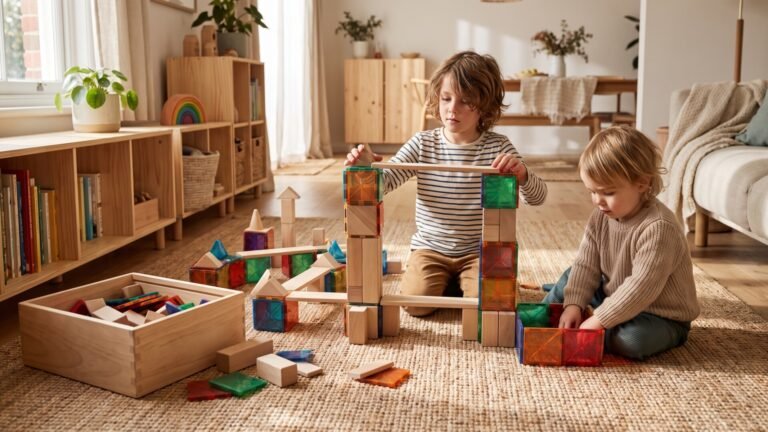
Flat storage is the headline. Thirty-two tiles take up less space than a single shoebox. But be clear about the play footprint: a finished tower, castle, or garage can spread across a table or a good stretch of floor. The storage is small; the building is not.
Check the tiles regularly for cracks, and remove damaged pieces from the collection immediately. Follow the manufacturer’s magnet safety guidance, and if you are comparing systems before buying, our Magnetic Tiles vs. Building Blocks piece covers how they behave at different ages. Our Connetix vs. Magna-Tiles comparison is worth reading if you are choosing a brand rather than a format.
Best for: Preschoolers and families who want fast building with fewer loose parts.
Pros
- Fast setup and pack-away
- Flat, efficient storage
- Encourages shape and spatial play
Cons
- High cost per piece
- 32 pieces limits larger builds
- Damaged magnetic pieces must be removed promptly
[Affiliate: Check current pricing and availability through our recommended partners]
Melissa & Doug Wooden Building Blocks 60-Piece Set
| Feature | Details |
|---|---|
| Age Range | Commonly 3+; check the current product label |
| Key Features | Cubes, arches, cylinders, and rectangular blocks in basic shapes |
| Price (approx) | $20-$35 |
The unglamorous one that outlasts almost everything else. Wooden blocks offer more open-ended play than the modest piece count suggests, they have no instructions to lose, no batteries, and no compatibility problem, because a block is a block.
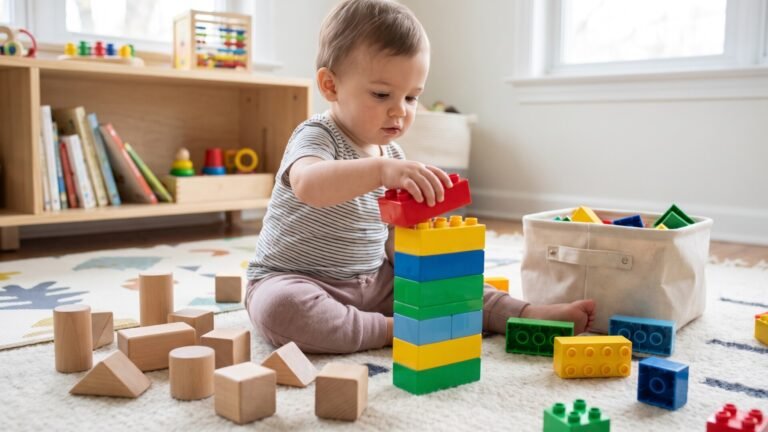
They are also the best option for the youngest builders in this article. Large, simple, durable, and impossible to assemble incorrectly. If you want one building toy that a two-year-old and a six-year-old can both use, this is it.
The costs are physical. Wooden blocks are heavier, they are loud when they hit hardwood, and they need more play surface than flat tile systems. They also need a bin – the box they arrive in is rarely up to daily use. Store them in one open bin rather than a divided organizer, and use a defined mat or tray so the building area has an edge.
Best for: Toddlers and preschoolers who benefit from large, simple pieces.
Pros
- Durable and straightforward
- Supports stacking, balance, and spatial reasoning
- No instructions or specialty parts
Cons
- Heavy and loud when dropped
- Needs more play surface than Plus-Plus
- Storage bin usually bought separately
[Affiliate: Check current pricing and availability through our recommended partners]
SmartMax Basic Build Set or Basic Stunt Set
| Feature | Details |
|---|---|
| Age Range | Varies by set; commonly preschool and early elementary |
| Key Features | Magnetic rods and metal balls, larger components, construction and STEM exploration |
| Price (approx) | $40-$80 |
SmartMax sits in a useful middle ground: pieces big enough for small hands, but a building mechanic that feels more like engineering than stacking. The magnetic rods and balls click together in ways that make children test balance and structure rather than just pile things up.
Cleanup is genuinely easier than with small-piece systems, because large components are visible from standing height. You can spot a stray rod from across the room, which is not true of a single Plus-Plus piece on a dark rug.
The catch is that builds can spread wider than expected. A frame structure needs room to stand, and it will not fit on a small tray. A mat or a defined building zone helps. Some children also find magnetic construction repetitive once they have mastered the basic connections – it rewards a child who likes to experiment, and bores one who wants a finished model.
Best for: Young builders experimenting with connections, balance, and simple structures.
Pros
- Large pieces are easy to handle and find
- Encourages early engineering exploration
- Manageable storage with a dedicated container
Cons
- More expensive than basic blocks
- Can become repetitive
- Larger builds need table space
[Affiliate: Check current pricing and availability through our recommended partners]
KAPLA 100 Plank Box
| Feature | Details |
|---|---|
| Age Range | Generally older preschoolers and school-age children; check current guidance |
| Key Features | Uniform wooden planks, balance-based construction, compact rectangular storage box |
| Price (approx) | $45-$70 |
KAPLA is for the child who will spend forty minutes on a single tower and enjoy it. Uniform planks, no connectors, no instructions, no noise beyond the clatter of a collapse.
The storage is genuinely excellent – one slim box, planks stacked flat, no sorting possible because every piece is identical. That is the same advantage Plus-Plus has, in a different material.
Be honest about who this suits. KAPLA demands a stable surface, patience, and tolerance for failure, because gravity does most of the work and it is unforgiving. Younger or impulsive builders will knock it over and lose interest. The small-space advantage here is controlled storage, not small finished structures – a serious KAPLA build can occupy a whole table.
For a quieter, more focused construction option, it pairs well with our Quiet Building Toys for Indoor and Independent Play roundup.
Best for: Older children who want a calm, focused building challenge.
Pros
- Slim, orderly storage
- Strong replayability
- No batteries, no screens, no instructions
Cons
- Builds need a large stable surface
- Unforgiving for younger builders
- Not interchangeable with other systems
[Affiliate: Check current pricing and availability through our recommended partners]
What Most Buyers Get Wrong About Small-Space Building Toys
The smallest box is not always the best option. A narrow container holding hundreds of tiny pieces can create more household friction than a larger set with fewer, chunkier parts. You are not optimizing for shelf space. You are optimizing for the total daily cost of owning the thing, and packaging is a small part of that.
Piece count is a poor measure of value. Compare a 60-piece wooden block set, a 32-piece magnetic tile set, and a 600-piece Plus-Plus tube. The Plus-Plus tube has ten times the pieces and costs less than the tiles. But the tile set builds a house a preschooler can put a toy inside, the blocks build a tower a toddler can knock down, and the tube builds a small mosaic. Three completely different products, and the number on the box tells you nothing about which one your child will use.
Flat storage does not mean small play. Magnetic tiles and planks pack beautifully and then demand floor space. If your flat has no floor space to give, that matters more than how the toy looks on a shelf.
Open-ended systems usually beat themed sets in small homes. A reusable core collection reduces duplicate storage and supports more play per cubic inch. Themed sets multiply – one box becomes four, each with its own container, each with pieces that only work with themselves. If you have read our Open-Ended Building Toys That Grow With Your Child piece, this is the same argument applied to floor space.
ToyGuideHub Parent Hassle Score
The Parent Hassle Score estimates the daily work a toy creates after you have bought it. Each category is rated 1 to 5 for cleanup, sorting, noise, supervision, and storage, where a lower number means less work. It is an editorial estimate, not a measurement.
| Toy Category | Cleanup | Sorting | Noise | Supervision | Storage | Overall |
|---|---|---|---|---|---|---|
| Plus-Plus | 2 | 3 | 1 | 3 | 1 | Low to moderate |
| LEGO Classic | 3 | 4 | 3 | 3 | 2 | Moderate |
| Magna-Tiles | 2 | 1 | 2 | 2 | 2 | Low to moderate |
| Wooden blocks | 2 | 1 | 4 | 2 | 3 | Moderate |
| SmartMax | 2 | 2 | 2 | 2 | 2 | Low to moderate |
| KAPLA | 2 | 1 | 2 | 2 | 2 | Low to moderate |
Notice what the table actually rewards: systems that are easy to reset. LEGO scores worst on sorting not because it is a bad toy but because mixed bricks are genuinely tedious to organize, and the temptation to sort properly is strong. Plus-Plus scores worst on supervision and fine motor because the pieces are small, but best on storage because there is nothing to organize.
The practical setup that makes all of this work:
- One shallow tray holds the pieces currently in play.
- One lidded container holds the full collection, on a shelf the child can reach.
- Unfinished builds must fit on a designated mat or shelf. If it does not fit, it comes apart.
That third rule does more for small-space peace than any storage product. It caps the play footprint without capping the play.
And buy fewer pieces than you think you need. Add compatible expansions only after your child demonstrates they will use and reset what they already have. Most collections grow faster than the child’s ability to manage them, and the excess becomes your problem.
Which Option Still Makes Sense in Three Years?
Age progression decides most of this. Wooden blocks and magnetic tiles serve early construction well and then get outgrown by roughly age six, though both often survive as a younger sibling’s toy. LEGO and Plus-Plus stay useful through primary school and beyond. KAPLA becomes more rewarding as patience and planning develop, which means it is often a better purchase at eight than at four.
The novelty curve is where instruction-led sets fall apart. A set that builds one model gets built once, admired, and then either displayed or dismantled. A compatible open-ended system stays active if the child keeps getting new challenges – a book of build ideas, a sibling, a friend, or a parent who suggests something specific. The toy does not generate the ideas. It just does not block them.
First failure points, by category:
- LEGO and Plus-Plus: lost pieces, gradually, forever. Nothing breaks. The collection just thins.
- Magnetic tiles: cracked or damaged pieces, which need to be removed promptly for safety reasons.
- Wooden blocks: chipped edges and the occasional split block after years of hard use.
- KAPLA: frustration, not breakage. The planks last; the interest depends on the child.
- SmartMax: lost metal balls, which are the single most likely component to disappear.
The expansion rule is simple. Replace damaged safety-critical parts immediately – magnetic pieces especially. Do not expand a system just because your child has not used the existing collection creatively. More pieces rarely fix an interest problem, and they always make the storage problem worse.
If you are choosing for a specific age band rather than a specific room, our age guides cover this in more detail: Best Building Toys for Toddlers, Best Building Toys for Preschoolers, Best Building Toys for Kids Ages 6-8, and Best Building Toys for Kids Ages 9-12.
How to Choose by Room, Age, and Play Style
Best for the Smallest Storage Footprint
Plus-Plus for older children who can manage small pieces. Magna-Tiles for younger children who need larger, flat components. Both store in less space than a cereal box.
Best for Toddlers and Preschoolers
Melissa & Doug wooden blocks for simple stacking and open-ended play. Move to Magna-Tiles or SmartMax when the child is ready for magnetic construction and meets the manufacturer’s age guidance.
Best for Shared Living Spaces
Plus-Plus or KAPLA for quieter tabletop play. Use a tray or mat to keep pieces out of walkways, and put a rug under the play area if you have neighbours below.
Best for Independent Play
LEGO Classic for children who can follow simple instructions or invent their own builds. Plus-Plus for focused pattern and small-scale construction. Both let a child work alone at a table without an adult narrating.
Best Budget Pick
Melissa & Doug wooden blocks for a durable basic collection, or a smaller LEGO Classic set when compatibility and future expansion matter more than large pieces. Both sit comfortably under $40.
Best Overall
The LEGO Classic Medium Creative Brick Box, for the combination of flexibility, integrated storage, compatibility, and long-term value. It is not the smallest, the quietest, or the cheapest. It is the one that does the most jobs.
Skip This If: Popular Options That Create More Problems Than They Solve
Skip the giant sets. Very large LEGO sets and oversized magnetic tile collections sell on piece count, and piece count is the wrong reason to buy. A thousand bricks will not fit in your storage, will take twenty minutes to sort, and will not produce better play than three hundred. The cleanup burden scales with the collection. The play quality does not.
Skip themed sets with lots of tiny specialty accessories if your child mainly free-builds. A licensed set with forty unique parts and one intended model is a display object with a storage problem attached. A smaller open-ended core set delivers more play per cubic inch, every time.
Skip construction vehicles with motors in a small flat. They are loud, they need floor space to be worth owning, and they are the least space-efficient thing in this category.
Skip the discount set that is not compatible with what you already own. A cheap set from a different system does not extend your collection. It starts a second one, with its own storage, its own sorting, and its own lost pieces. Check compatibility before you check the price.
Skip anything with damaged magnetic components. If you already own magnetic tiles and some are cracked, remove them now rather than later. Follow the manufacturer’s guidance on replacement.
The Verdict
The LEGO Classic Medium Creative Brick Box is the best building toy for most small spaces, because it is the only option on this list that solves storage, flexibility, and long-term compatibility in one purchase. It wins for families with a child past the mouthing stage who wants one system that does many jobs.
The rest of the field splits cleanly. If shelf space is your tightest constraint, Plus-Plus wins outright – nothing else packs that much play into a tube. If you have a preschooler who needs larger pieces and instant setup, Magna-Tiles is the right call. If you want the cheapest durable option that a toddler and a six-year-old can both use, wooden blocks. If you want a calm, focused challenge for an older child, KAPLA. And if early engineering is the goal, SmartMax.
What ties them together is the thing worth carrying into the shop: judge a building toy by how fast you can reset it and how much floor it claims, not by how small the box is. Check current pricing and availability through our recommended partners, and start with fewer pieces than you think you need.
Frequently Asked Questions About Building Toys For Small Spaces
What is the best building toy for a small apartment?
It depends on which constraint is tightest. LEGO Classic Medium Creative Brick Box is the best all-rounder because the storage comes with it. Plus-Plus is best if shelf space is the real problem. Magna-Tiles is best for younger children who need larger pieces and fast setup. If you want the widest view of what is available, start with our Building & Construction Toys hub.
Are magnetic tiles good for small spaces?
They store flat and set up in seconds, which makes them excellent on the storage side. But finished towers and structures still need real floor or table space. Check the pieces regularly for cracks, remove damaged ones immediately, and follow the manufacturer’s magnet safety guidance.
Which building toys are easiest to clean up?
Flat magnetic tiles and uniform pieces like Plus-Plus are the fastest to sweep up, because there is no sorting decision to make. Wooden blocks are also quick if you store them in one open bin. In practice, a dedicated shallow tray matters as much as the toy’s original packaging – the tray is what stops pieces migrating under furniture.
Are LEGO sets too messy for small rooms?
They work fine if the collection is limited, stored in one container, and used on a defined surface. The problem is almost never the bricks. It is uncontrolled collection growth – three sets become nine, and suddenly you are managing a sorting project rather than a toy.
What building toys are quiet enough for apartments?
Plus-Plus and KAPLA are the quietest in normal use, because the pieces are small and light. All hard pieces make noise when dropped on tile or hardwood, so a rug or mat under the play area does more for your neighbours than choosing a different toy would.
How should building toys be stored in a small home?
One shallow tray for active pieces, one lidded container for the full collection, and a low shelf the child can reach independently. Avoid elaborate sorting systems unless your child will actually maintain them – a system you have to run is not storage, it is another chore.
Are small building toys safe for toddlers?
Follow the age guidance on the package. Small parts are a choking hazard, and magnets need particular care – damaged magnetic pieces should be removed immediately, and swallowed magnets are a medical emergency. For toddlers, choose large blocks or products specifically labeled for that age rather than standard small-piece systems. Check the manufacturer’s safety information for anything you are unsure about.
Do I need to buy a storage container separately?
Sometimes. Sets with an integrated box – the LEGO Classic Medium Creative Brick Box is the clearest example – save you the purchase. Loose sets usually need a lidded bin and a shallow tray. Budget $10-$20 for both, and treat it as part of the toy’s cost, because a building toy without storage is a building toy that stops getting used.
How many pieces should I start with?
Fewer than you think. Around 200-400 bricks is plenty for a first LEGO collection, and a single Plus-Plus tube is enough to establish whether the format works. Add compatible pieces only after your child consistently uses and resets what they have. Collections grow faster than children learn to manage them.