Best Construction Toys for Developing Problem-Solving Skills
Most construction toys marketed as problem-solving tools are not problem-solving tools. They are instruction-following tools with a STEM sticker on the box. The child reads a step, places a piece, repeats forty times, and ends up with the picture on the front. That is a fine way to spend an afternoon. It is not the same thing as planning, testing, failing, adjusting, and trying again.
The toys that actually build problem-solving skills are the ones that let a child set the goal, hit a wall, and decide what to change. That usually means open-ended systems and well-designed engineering sets, not kits that produce one predetermined model and then sit on a shelf. Which one is right for your house depends on the child’s age and, honestly, how much frustration they can tolerate before the whole thing ends in tears.
This is a shortlist of construction toys that earn their place, sorted by what they actually teach and who they actually suit.
What Makes a Construction Toy Good for Problem-Solving?
Following instructions and solving a construction problem are different activities, and both have value at different ages. A seven-year-old working through a Technic build is learning sequencing, patience, and how to read a diagram – real skills. But they are not deciding what to build or how to make it stand up. That thinking is already done for them.
The outcomes worth chasing are spatial reasoning, sequencing, prediction, fine-motor control, persistence, cause-and-effect thinking, and flexible problem-solving. A toy supports those when the child has to make a call, watch what happens, and revise. If nothing can go wrong, nothing is being solved.
We score each recommendation on a Problem-Solving Value Score, rated 1 to 5. It weighs open-endedness, whether the challenge is meaningful rather than busywork, how clearly the toy tells the child something went wrong, replayability, age fit, and how much setup a parent has to do. These are editorial evaluations based on how the toys behave in ordinary family use, not laboratory test results.
Adult involvement changes the outcome more than the toy does. The useful move is a prompt – “What could make the base stronger?” – not a rescue. If you take the pieces and fix it, you have turned an engineering problem into a demonstration, and the child learns that the answer arrives from an adult.
Key Buying Factors for Skill-Building Construction Toys
Challenge and age fit
A construction toy should be hard enough to require thought and easy enough that the child succeeds often enough to keep going. Repeated failure teaches nothing except that this toy is not for them. Match the set to the stage: large blocks and tiles for toddlers, magnetic tiles and gears for preschoolers, brick systems and simple frameworks for ages 6 to 8, and mechanisms and engineering challenges for ages 9 to 12.
Open-ended versus guided play
Magnetic tiles and wooden blocks let the child invent the goal. Model-based LEGO sets and engineering kits supply the goal and ask the child to reach it. Instructions are genuinely useful when a child is learning a new technique or a mechanism they have never seen – they are a tutorial. They become a limit when they are the only thing the set can do.
Feedback, durability, and safety
Good construction toys give honest feedback. A tower falls over. A gear jams. A bridge sags in the middle. That feedback is the teaching. Look for pieces that connect securely, edges that are rounded, and magnets that are sealed inside the plastic rather than glued in where a determined child can worry them loose. Check small-part warnings, follow the manufacturer’s age guidance, and treat it as the starting point rather than a suggestion – it reflects choking hazards and, for magnetic toys, ingestion risk that is serious enough that regulators treat it separately.
Real-world practicality
The questions that decide whether a toy survives in your house are dull ones. Where does it live? How long does cleanup take? How loud is it? How many pieces will be gone by spring? Can two children use it at once without a referee? Does it still have a job once the first build is finished? A set that fails those tests gets played with twice regardless of how good it is in theory.
Recommended Construction Toys
This list mixes open-ended systems, guided builds, budget options, and specialist engineering sets. Prices are approximate and move around with sales. Scores are our editorial judgment, not lab results.
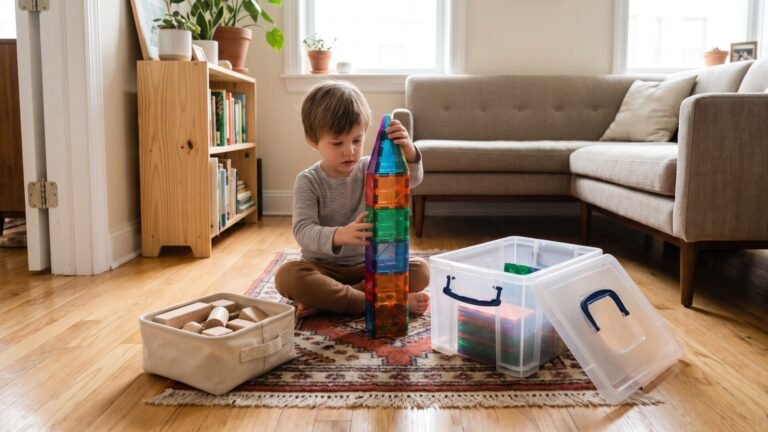
Magna-Tiles Classic 32-Piece Set
| Feature | Details |
|---|---|
| Age Range | Typically 3 years and up; verify the current manufacturer guidance |
| Key Features | Magnetic geometric tiles, transparent pieces, open-ended construction |
| Price (approx.) | $50-$60 |
Problem-Solving Value Score: 4.5/5.
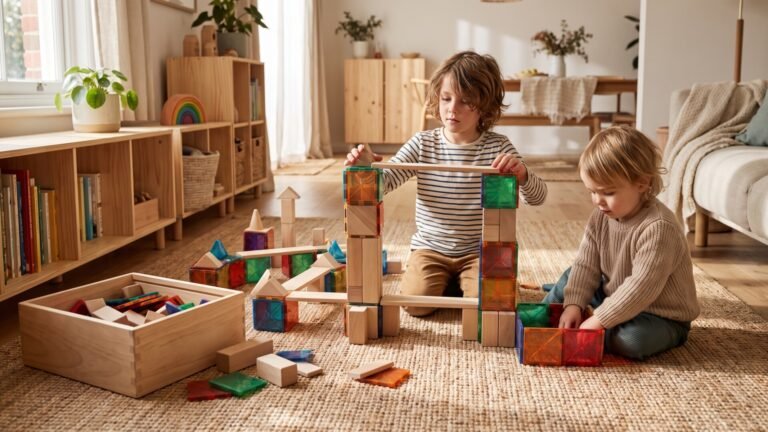
The Verdict: A strong first serious construction system. Children learn balance, shape, symmetry, enclosure, and structural stability because the tiles tell them immediately when a wall will not hold. It supports independent and cooperative play, though advanced builders will outgrow a small starter set quickly.
Best For: Preschoolers and early elementary children who learn by experimenting.
Pros:
- Fast connections make trial and error rewarding rather than punishing.
- Strong open-ended replay value.
- Easy for siblings or adults to join.
Cons:
- Starter sets feel limited once a child starts building big.
- Requires careful storage to keep pieces together.
- No mechanical challenge – no gears, axles, or moving parts.
If you want the full picture on how these compare with the alternatives, our magnetic tile alternatives guide covers where they are worth it and where they are not.
LEGO Classic Large Creative Brick Box
| Feature | Details |
|---|---|
| Age Range | Typically 4 years and up; verify the current manufacturer guidance |
| Key Features | Assorted bricks, wheels, eyes, windows, doors, and creative pieces |
| Price (approx.) | $35-$60 |
Problem-Solving Value Score: 4.5/5.
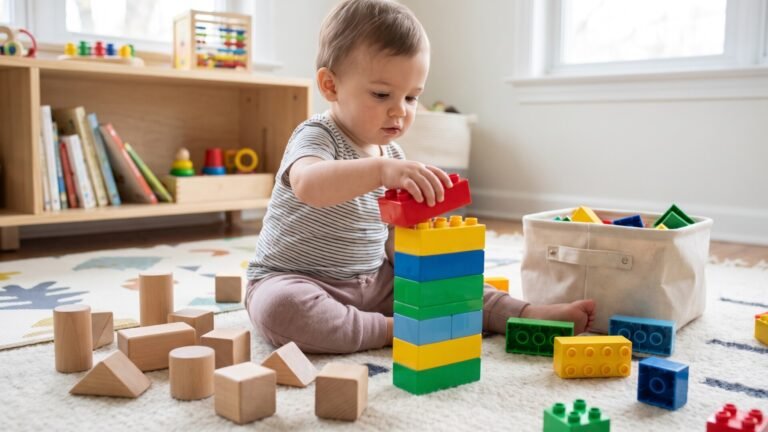
The Verdict: The best all-purpose choice for a child who would rather invent something than complete a themed model. The range of brick shapes forces planning and revision, because the piece a child wants is rarely the piece they have. Younger children may need help sorting and translating an idea into something that stands up.
Best For: Families who want one versatile system that grows with the child.
Pros:
- Excellent long-term compatibility with other LEGO sets.
- Supports both guided and open-ended construction.
- Strong resale and hand-me-down value.
Cons:
- Small pieces create a real cleanup burden.
- Less immediately satisfying for children who need quick results.
- A big loose-brick pile can overwhelm a beginner.
Our LEGO coverage goes deeper on which sets are worth the money and which are packaging.
K’NEX 100 Model Building Set
| Feature | Details |
|---|---|
| Age Range | Often recommended for ages 7 and up; verify the current manufacturer guidance |
| Key Features | Rods, connectors, wheels, and instructions for multiple models |
| Price (approx.) | $35-$60 |
Problem-Solving Value Score: 4/5.
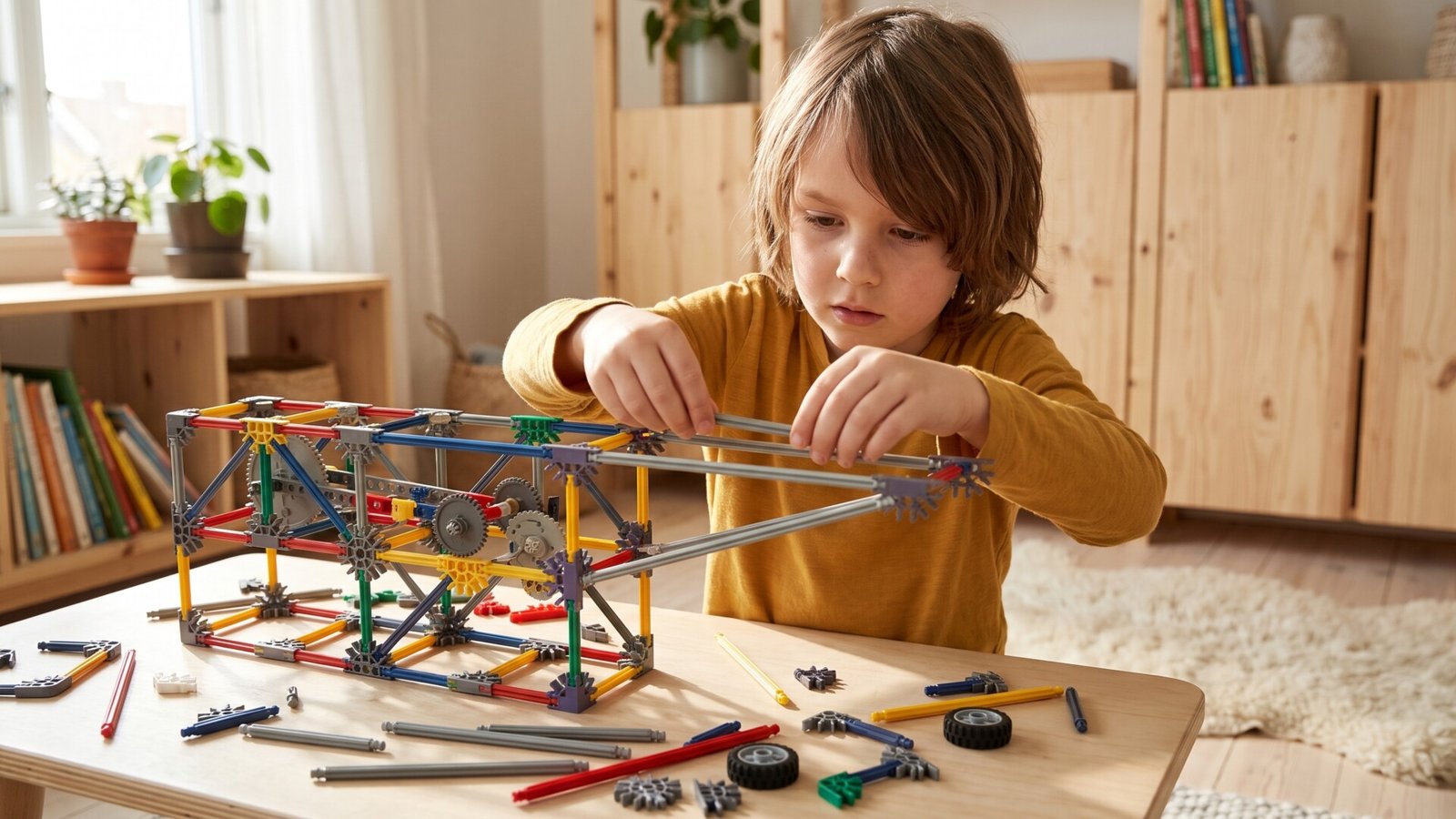
The Verdict: K’NEX introduces structural thinking that bricks cannot match, because rods and connectors make tension, triangulation, and balance visible. It is a good bridge between simple building and deliberate engineering, and a child who builds a K’NEX bridge learns why it holds.
Best For: Children ages 7 to 10 who enjoy testing structures and mechanisms.
Pros:
- Encourages thinking about framework strength.
- Supports both instructions and original designs.
- Offers meaningful mechanical challenge.
Cons:
- Connections frustrate younger builders.
- Builds look less polished than brick models.
- Sorting rods and connectors takes real time.
LEGO Technic Mack LR Electric Garbage Truck
| Feature | Details |
|---|---|
| Age Range | Typically 8 years and up; verify the current manufacturer guidance |
| Key Features | Technic components, steering, moving functions, detailed vehicle build |
| Price (approx.) | $35-$60 |
Problem-Solving Value Score: 4/5.
The Verdict: A good choice for a child who wants a clear project and enjoys discovering how mechanical functions work. It asks for more sequencing and precision than a standard brick set, but the finished model is prescribed and there is not much to do with it afterward.
Best For: Vehicle-focused builders ready for longer, instruction-led projects.
Pros:
- Builds patience and sequential reasoning.
- Introduces functional mechanisms through construction.
- Compact finished model relative to the building experience.
Cons:
- Limited open-ended play once it is built.
- Mistakes can require substantial disassembly.
- Only suits children who enjoy following detailed instructions.
Learning Resources Gears! Gears! Gears! Deluxe Building Set
| Feature | Details |
|---|---|
| Age Range | Typically 3 years and up; verify the current manufacturer guidance |
| Key Features | Interlocking gears, bases, connectors, decorative pieces |
| Price (approx.) | $30-$45 |
Problem-Solving Value Score: 4/5.
The Verdict: This set makes cause and effect visible. One gear turns another, and a gear in the wrong place stops the whole system. That is a more focused challenge than blocks or tiles and a genuinely useful one for a child who wants to know why something moves.
Best For: Preschool and early elementary children interested in motion and systems.
Pros:
- Clear visual feedback when a design works.
- Accessible introduction to mechanical thinking.
- Supports cooperative construction.
Cons:
- Less useful for children who only want representational building.
- Some builds need a stable, flat surface.
- Decorative pieces can distract from the engineering part.
Thames & Kosmos Engineering and Structural Building Set
| Feature | Details |
|---|---|
| Age Range | Varies by specific set; many target older elementary children |
| Key Features | Structural challenges, connectors, beams, experiment-based projects |
| Price (approx.) | $35-$80 |
Problem-Solving Value Score: 4.5/5.
The Verdict: A strong specialist option for a child who enjoys a question like how to make a bridge stronger or how to spread a load. It makes testing and revision central rather than optional. It needs more adult guidance than the open-ended systems here and offers less free-form play.
Best For: Children who enjoy challenge cards, experiments, and explaining why a structure works.
Pros:
- Makes testing and revision the point of the activity.
- Teaches structural ideas through practical tasks.
- Good fit for older elementary learners.
Cons:
- Less appealing to children who want imaginative role play.
- Instructions and challenge formats vary by set.
- Can feel like a school project rather than a toy.
Our Engineering & Building section has more on how these sets fit alongside general construction play.
Plus-Plus BIG or Plus-Plus Open-Ended Building Set
| Feature | Details |
|---|---|
| Age Range | BIG pieces target younger children; standard pieces suit older children; verify current guidance |
| Key Features | Uniform interlocking pieces for flat patterns and 3D builds |
| Price (approx.) | $15-$40 |
Problem-Solving Value Score: 4/5.
The Verdict: A space-efficient option that rewards pattern recognition, planning, and persistence without demanding a storage bin the size of a dog. The uniform pieces make it less versatile than LEGO, but that constraint pushes children to think about how repeated forms create larger structures.
Best For: Small spaces, travel, quiet independent building, and children who like patterns.
Pros:
- Compact and easy to store.
- Supports both flat mosaics and 3D construction.
- Affordable entry point.
Cons:
- Uniform pieces limit some imaginative builds.
- Small standard pieces need age-appropriate supervision.
- Finished structures can be fragile during active play.
Skip This If: Themed Sets That Only Produce One Display Model
You know the category. The big licensed box, the film tie-in, the set that builds one recognizable thing and then becomes a display piece on a shelf. There is nothing wrong with them as objects, and a committed fan will get real persistence practice out of a long, complex model. But if the goal is repeatable problem-solving, they are a poor buy. Once the model is built, the thinking is finished. The child is left with a thing to look at rather than a system to use.
The issue is fit, not quality. A child who loves the subject will push through a hard build and learn something about patience. A child who does not will lose interest at step forty and never touch it again.
Comparison Table
| Product | Typical Age | Problem-Solving Value | Best For | Approx. Price |
|---|---|---|---|---|
| Magna-Tiles Classic 32-Piece Set | 3+ | 4.5/5 | Spatial reasoning and fast experimentation | $50-$60 |
| LEGO Classic Large Creative Brick Box | 4+ | 4.5/5 | Open-ended building that grows with the child | $35-$60 |
| K’NEX 100 Model Building Set | 7+ | 4/5 | Structural frameworks and mechanisms | $35-$60 |
| LEGO Technic Mack LR Electric Garbage Truck | 8+ | 4/5 | Guided mechanical projects | $35-$60 |
| Learning Resources Gears! Gears! Gears! Deluxe Set | 3+ | 4/5 | Cause and effect and moving systems | $30-$45 |
| Thames & Kosmos Engineering Set | Varies | 4.5/5 | Explicit engineering challenges | $35-$80 |
| Plus-Plus Building Set | Varies | 4/5 | Compact, quiet, pattern-based building | $15-$40 |
What Most Buyers Get Wrong About Problem-Solving Toys
The most expensive set is not the best one, and the most advanced set is often the worst purchase you can make. Challenge has to match the child’s current skill and their tolerance for frustration. A set pitched two years above a child does not stretch them. It defeats them, and then it sits in the cupboard.
Piece count is the other trap. A thousand pieces sounds like a thousand opportunities, but in practice it means a lot of sorting and a lot of instruction-following. Volume is not the same as thinking. A child can spend three hours assembling a huge model and make almost no independent decisions along the way.
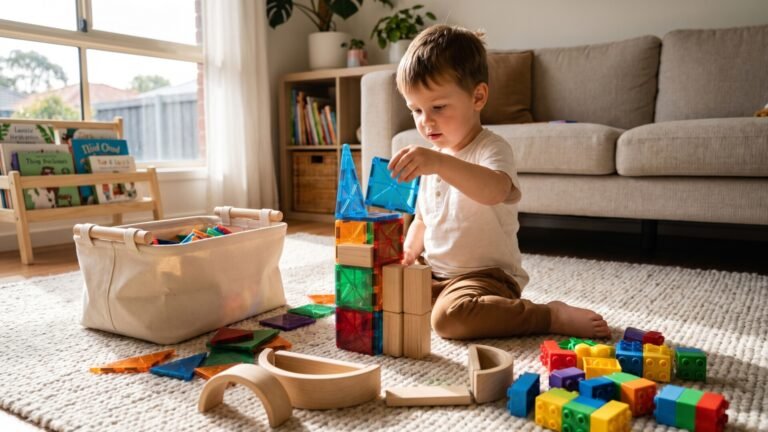
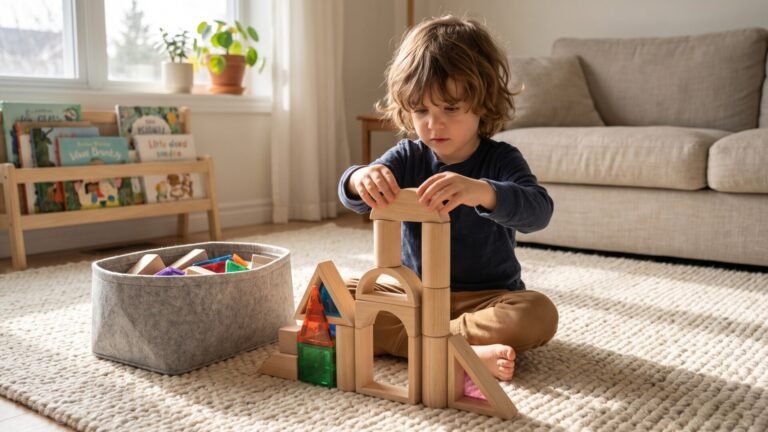
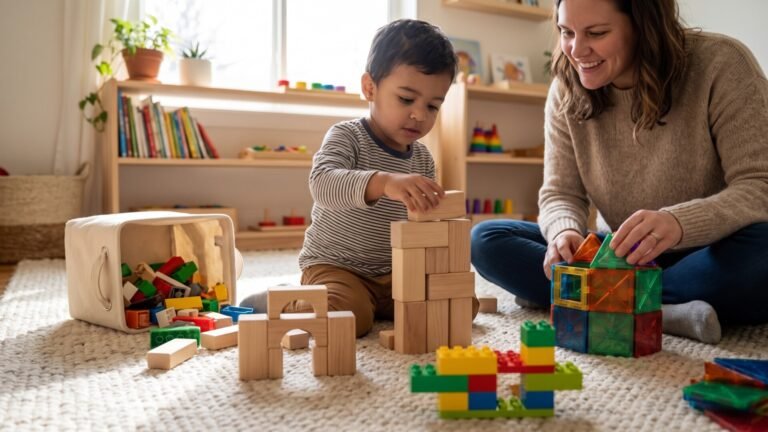
Here is the counterintuitive part. A plain set of wooden blocks or a modest pile of magnetic tiles will often produce more problem-solving than a sophisticated kit, because the child sets the goal. They decide to build a tower taller than the dog. They discover the base is too narrow. They fix it. Nobody handed them a diagram, and nobody told them the answer. That loop – goal, attempt, failure, revision – is the whole mechanism, and it does not require a curriculum or a battery.
Adult behavior decides how much of that loop actually happens. If you take the pieces and build it correctly, you have skipped the only part that mattered. If you sit on your hands and ask what they think went wrong, you have done more for their problem-solving than any toy on this list.
ToyGuideHub Independent Play and Replayability Analysis
Which of these will your child actually use without you standing over them? Magna-Tiles and the Gears set are the quickest to start. The pieces are large, the connections are obvious, and a four-year-old can begin without help. LEGO Classic sits in the middle – a child can start alone, but a beginner may need a hand sorting and getting the first structure stable. Thames & Kosmos and the Technic truck need the most support, at least at first. They are closer to a project you do together than a toy that runs itself.
Six months is where the picture separates. LEGO Classic and magnetic tiles gain value over time because they combine with whatever else the child already has. A new set does not replace the old one, it extends it. Themed one-build sets go the other way. Once the model is finished, the set’s job is done, and it converts from a toy into an ornament.
The hidden costs are the ones nobody puts on the box. Storage bins, because loose pieces migrate across the house. Replacement parts, because the one piece a child needs is always the one that went under the fridge. Expansion packs, because a starter set that felt generous in December feels cramped by spring. Batteries, where a set has lights or sound. And a stable building surface, which matters more than you would think – a wobbly table turns a good build into a frustrating one and a frustrated child into one who walks away.
Practical ownership verdict:
- Best long-term system: LEGO Classic. It compounds.
- Best early experimentation: Magna-Tiles. Fast feedback, low frustration.
- Best mechanical thinking: Learning Resources Gears for younger children, K’NEX for older ones.
- Best structured challenge: Thames & Kosmos.
- Best small-space option: Plus-Plus.
How to Choose the Right Construction Toy
Best for Preschoolers
Magna-Tiles for spatial experimentation, Learning Resources Gears for cause and effect. At this age, simple connections, visible feedback, and short build cycles matter far more than piece count. A preschooler does not need a big set. They need one that lets them try something, see the result, and try again inside a five-minute attention span.
For a fuller picture of what works at this stage, see our Best Building Toys for Preschoolers.
Best for Ages 6–8
LEGO Classic, K’NEX, or an engineering set, depending on whether the child prefers imaginative, structural, or challenge-based play. You do not need to buy a bigger set to raise the difficulty. Introduce a design prompt, add a weight test, or set a timed rebuild. The same box does more work.
More options for this age are in our Best Building Toys for Kids Ages 6-8.
Best for Ages 9–12
K’NEX, LEGO Technic, and Thames & Kosmos suit children ready for mechanisms, constraints, and longer projects. The best set at this age offers room to modify the model rather than only rewarding accurate completion. If the instructions are the only supported outcome, the set has a short life.
Our Best Building Toys for Kids Ages 9-12 guide covers the wider field.
Best for Open-Ended Play
LEGO Classic is the strongest all-round choice, with Magna-Tiles better for fast construction and visual spatial reasoning. Open-ended does not mean structureless – it means the child supplies the goal. Both of these let that happen.
See Open-Ended Building Toys That Grow With Your Child for how these systems hold up over several years.
Best Budget Pick
Plus-Plus or Learning Resources Gears, depending on the child’s age and the type of challenge they enjoy. A low purchase price is not the same as low cost per use. A $20 set played with twice a week for two years beats a $70 set that gets built once. Judge the price against the hours, not the box.
Best for Small Spaces and Independent Play
Plus-Plus for compact storage and quiet use. Magnetic tiles are easier to start alone but take up more shelf space once you have enough of them to build anything interesting.
Our Quiet Building Toys for Indoor and Independent Play and Best Building Toys for Small Spaces guides go into more detail.
The Bottom Line
If you want one box that does the most work for the longest time, the LEGO Classic Large Creative Brick Box is the pick. It is open-ended, it compounds with every set you add later, and it holds value in a way that themed sets do not. For a preschooler, the Magna-Tiles Classic 32-Piece Set is the better starting point, because the feedback is instant and the frustration stays low. Plus-Plus covers tight spaces and quiet afternoons, K’NEX and Learning Resources Gears handle mechanical thinking at different ages, and Thames & Kosmos is the specialist option for a child who likes a defined engineering problem.
[Affiliate: Check current pricing and availability through our recommended partners]
Whichever you choose, the toy is only half of it. The other half is what you do when the tower falls over – and the useful answer is usually nothing at all. For the full range of options across every age and budget, start with our Building & Construction Toys hub, then move to the age-specific guide that matches your child.
Frequently Asked Questions About Construction Toys For Developing Problem-Solving Skills
Are construction toys genuinely good for problem-solving?
The ones that work build planning, spatial reasoning, testing, and revision – but only if the child is making decisions. Passive assembly and repeated instruction-following do not do much beyond teaching a child to read a diagram. The value comes from the loop: set a goal, attempt it, watch it fail, change something, try again. If the toy does not allow that loop, it is entertainment rather than practice.
What age is best for starting construction toys?
Large blocks and simple magnetic tiles work from around age three with supervision. Preschoolers do well with tiles and gears. Ages 6 to 8 are ready for brick systems and simple frameworks. Ages 9 to 12 can handle mechanisms, longer projects, and engineering challenges. The right age is the one where the child succeeds often enough to keep going.
Are magnetic tiles or LEGO better for problem-solving?
They teach different things. Magnetic tiles give immediate feedback and build spatial reasoning fast, which suits younger children and quick experimentation. LEGO demands precision, sequencing, and planning, and its long-term compatibility makes it a better investment over years. Our Magnetic Tiles vs. Building Blocks comparison breaks down the trade-offs by age.
How can parents encourage problem-solving without taking over?
Ask the child to predict what will happen before they build. Let the tower fall. Ask what they think went wrong and what they might change. Compare two versions and ask which is stronger and why. The rule is simple: do not put your hands on the pieces. The moment you build it, they stop thinking.
Are engineering kits better than open-ended building toys?
Neither is better across the board. Engineering kits give clear constraints and explicit challenges, which suits a child who wants a defined problem and a way to test it. Open-ended systems offer more replayability and let the child set the goal, which tends to extend the toy’s life. Many families end up with one of each for different moods.
What should I do if my child gets frustrated and quits?
Reduce the challenge rather than completing it. Make the goal smaller, demonstrate one technique, or change the task entirely and come back later. Finishing the build for them solves the immediate problem and teaches the child that frustration is answered by an adult’s hands. That is the opposite of what you want.
How do I choose a construction toy for siblings of different ages?
Pick a shared system where the pieces work at more than one level – magnetic tiles and LEGO both do this well. Supervise around small parts for younger siblings. Set separate challenge levels so the older child is not simply doing the younger one’s building, and favor pieces that support cooperative construction over competitive scoring.