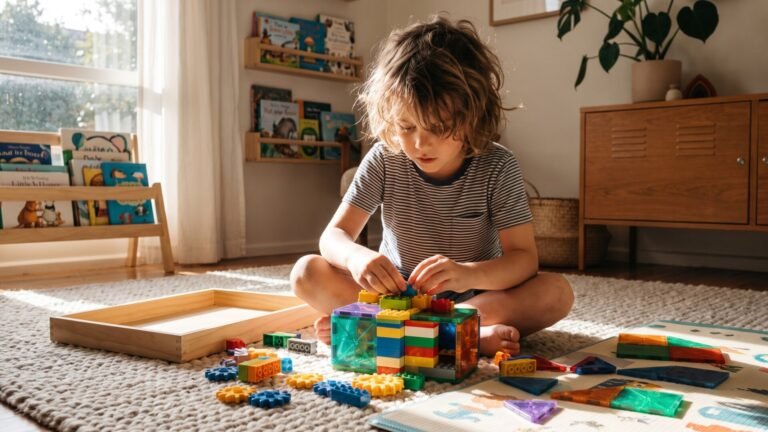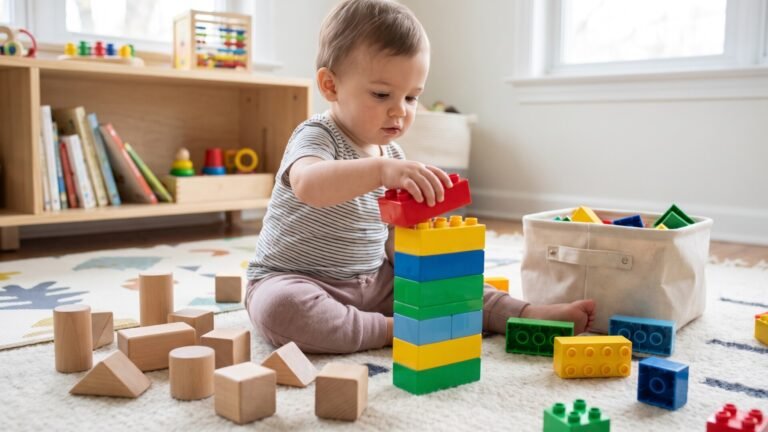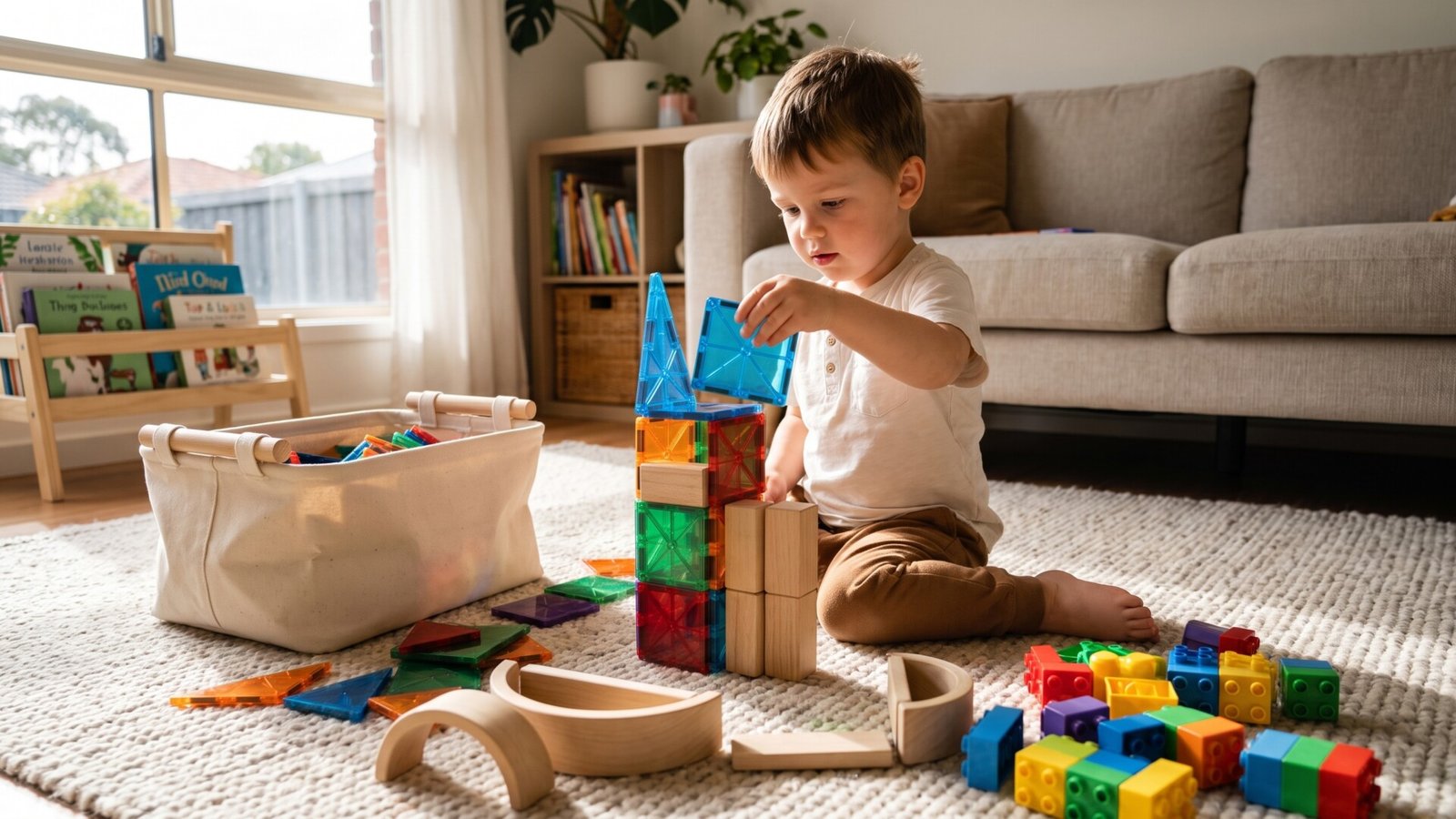
Best Building Toys for Preschoolers
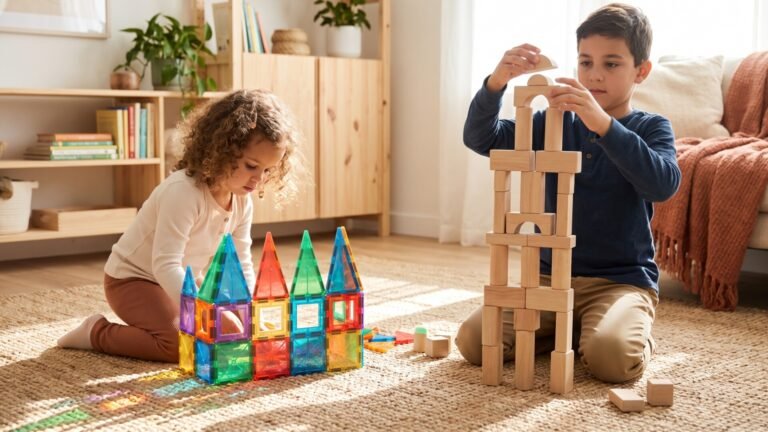
I spent $68 on a magnetic tile set for my three-year-old, and for the first two weeks it was the best money I had ever spent. She built a “castle.” She built a “parking garage.” She built a structure that was, as far as I could tell, a wall. Then she discovered that if you stand on a magnetic tile, it cracks, and if you crack a magnetic tile, you have to take it away, and if you take one away, the whole bin becomes a crime scene. We lost four tiles in a month. The set still works. It is just smaller, and now it is also a lesson about how you treat things.
That is the honest version of buying building toys for preschoolers. The good ones get used hard, and the hard use is the point.
What Preschoolers Actually Need From a Building Toy
Building play is doing real work at this age. It supports spatial reasoning, hand-eye coordination, and the fine-motor control that eventually gets your child to hold a pencil without a fight. It asks them to plan, fail, and replan – which is the whole skill, really. It gives them something to talk about, which builds language. None of that is guaranteed by a box. It is guaranteed by a child who keeps coming back to the thing.
That distinction matters, because it separates two categories of toy that get marketed identically.
Open-ended toys let the child invent the structure. Wooden blocks, magnetic tiles, and a plain brick box all fall here. There is no correct answer, so there is no way to fail, so a three-year-old can succeed on the first try and a five-year-old can still find something new to do with it in March.
Guided sets give a clearer first project. Gears, themed kits, and anything with a step-by-step build. These are not worse. They are just different, and they tend to have a shorter useful life unless the pieces work outside the original model.
The variable that decides whether either one gets played with is frustration. At three, four, and five, a toy that is slightly too hard does not become a challenge. It becomes a thing you ask a parent to do. Pieces that are too small, connections that need real force, instructions with more than about four steps – all of these turn independent building into adult-led building, and adult-led building is a chore with extra steps.
A word on safety, plainly. Follow the manufacturer’s age rating, which is about the toy’s design and materials, not your child’s intelligence. Supervise younger preschoolers around small parts. Inspect magnetic pieces and connectors regularly, and take any cracked or damaged piece out of rotation immediately – a compromised magnet enclosure is not something to keep using. Keep small components away from children who still mouth objects. When in doubt, check the manufacturer’s guidance rather than a review.
What Separates a Toy That Gets Used From One That Sits
Four factors decide this, and none of them are piece count.
Piece size and motor demand. Large blocks and magnetic tiles can be grasped and connected by a three-year-old without help. Standard LEGO bricks need more precise finger work and more force to separate. Small specialty pieces are the enemy of independent play at this age. If your child cannot take it apart, they will not rebuild it, and if they will not rebuild it, it gets built once.
Open-ended value. A set with fewer fixed outcomes usually outlasts a larger themed kit. The themed kit gives you one great afternoon. The open set gives you a hundred mediocre afternoons, which is the better deal.
Durability and cleanup. Connection strength matters in both directions – strong enough to hold a tower, loose enough for a preschooler to pull apart. Wood and quality plastic both survive a sibling. The question that actually decides whether a toy stays in rotation is whether your child can put it away without you, in under three minutes, into a container they can reach.
Space, noise, and family fit. Magnetic tiles spread across the floor like they are being paid to. Wooden blocks are heavy and bulky. Plastic construction is loud when it collapses, which it will. If you have a small apartment or a younger sibling who eats things, that changes the answer more than any brand comparison.
| Product | Approximate Age | Price Range | Best For | Replayability | Main Limitation |
|---|---|---|---|---|---|
| Magna-Tiles Classic 32-Piece Set | 3+ | $50-$70 | Magnetic construction, quick success | High | Premium price for a starter set |
| PicassoTiles 60-Piece Magnetic Tiles Set | 3+ | $30-$50 | Budget magnetic building | High | Quality and magnet strength vary by set |
| LEGO DUPLO Classic Brick Box | 1.5+ | $30-$50 | Larger interlocking bricks, pretend builds | High | Less architectural variety than tiles |
| Melissa & Doug Wooden Building Blocks | 3+ | $20-$35 | Traditional open-ended block play | Very high | Needs more balance and patience |
| LEGO Classic Large Creative Brick Box | 4+ | $45-$60 | Preschoolers ready for smaller bricks | High | Demanding fine-motor work |
| Learning Resources Gears! Gears! Gears! | 3+ | $25-$40 | Mechanical cause-and-effect building | Medium to high | Structured, weak for freeform towers |
Prices are approximate and move around. Confirm current age ratings and piece counts before you buy – manufacturers change both.
[Affiliate: Check current pricing and availability through our recommended partners]
The Shortlist, Matched to the Child You Actually Have
Every pick below solves a different problem. If two of them look interchangeable to you, you are probably looking at the wrong two.
Magna-Tiles Classic 32-Piece Set – Best Overall
| Feature | Details |
|---|---|
| Age Range | 3+ |
| Key Features | Magnetic geometric tiles, quick connections, open-ended construction |
| Price (approx.) | $50-$70 |
Magnetic tiles are the easiest entry point for most preschoolers, and it is not close. The pieces snap together with almost no force, the cause and effect is instant, and a three-year-old can build something recognizable in about ninety seconds. That first success is what buys you the next twenty minutes.
The trade-off is the starter set itself. Thirty-two tiles is enough for a house, a small tower, or a road. It is not enough for the sprawling castle your child will want by month two, and the second set costs as much as the first. Budget for that or buy bigger up front.
The Verdict: Best overall for families who want one durable, genuinely open-ended construction toy that a three- to five-year-old can use with minimal adult help.
Best For: Preschoolers who build houses, towers, roads, and anything that turns into pretend play.
Pros: Fast success, strong replay value, mixes naturally with toy animals and cars.
Cons: High entry price, tiles migrate across the entire floor, magnets need regular inspection.
PicassoTiles 60-Piece Magnetic Tiles Set – Best Budget Magnetic Option
| Feature | Details |
|---|---|
| Age Range | 3+ |
| Key Features | Magnetic tiles in multiple shapes, larger piece count, open-ended building |
| Price (approx.) | $30-$50 |
If you want magnetic construction without paying premium prices, this is the route most families take, and it gets you roughly double the pieces for less money. For a child who wants to build big, that math is hard to argue with.
The catch is that quality varies by specific set, and piece count is a terrible way to choose. Look at how the magnets are enclosed, read the seller’s safety information, and check recent reviews for complaints about weak magnets or cracked tiles. A cheap tile that splits open is worse than no tile.
The Verdict: Strong value when you want magnetic building but do not want to start at premium prices.
Best For: Budget-conscious families, classrooms, and kids who build collaboratively and need volume.
Pros: More pieces per dollar, supports group play, good shape variety.
Cons: Quality varies by set, storage is awkward, a large bin can overwhelm a younger preschooler.
LEGO DUPLO Classic Brick Box – Best for Imaginative Brick Play
| Feature | Details |
|---|---|
| Age Range | 1.5+ |
| Key Features | Large interlocking bricks, wheels and accessories, reusable storage box |
| Price (approx.) | $30-$50 |
DUPLO has a strange reputation problem: parents associate it with toddlers and assume their preschooler has outgrown it. Most have not. The larger bricks are still easier to manipulate than standard LEGO, and the open-ended system supports vehicles, animals, buildings, and full pretend scenarios in a way magnetic tiles cannot.
The connection is stronger than a magnet, which means towers hold and builds survive a bump. It also means taking things apart takes actual effort, and a frustrated four-year-old will hand you the brick rather than solve it. Expect to help more in the first month than you would with tiles.
The Verdict: The best pick for kids who build in order to tell a story, and the system most likely to stay useful for years.
Best For: Preschoolers who build farms, towns, vehicles, and character scenes.
Pros: Durable, excellent pretend-play crossover, easy to expand with themed add-ons.
Cons: Slower first success than tiles, bulky to store, add-ons add up.
Melissa & Doug Wooden Building Blocks – Best Traditional Open-Ended Set
| Feature | Details |
|---|---|
| Age Range | 3+ |
| Key Features | Solid wooden blocks in varied shapes, stacking and balancing |
| Price (approx.) | $20-$35 |
Wooden blocks are the cheapest genuinely good building toy on this list, and the one with the longest potential lifespan. There is no connector system to outgrow, no proprietary shape, and nothing to break. They work with toy animals, toy cars, and a bedsheet.
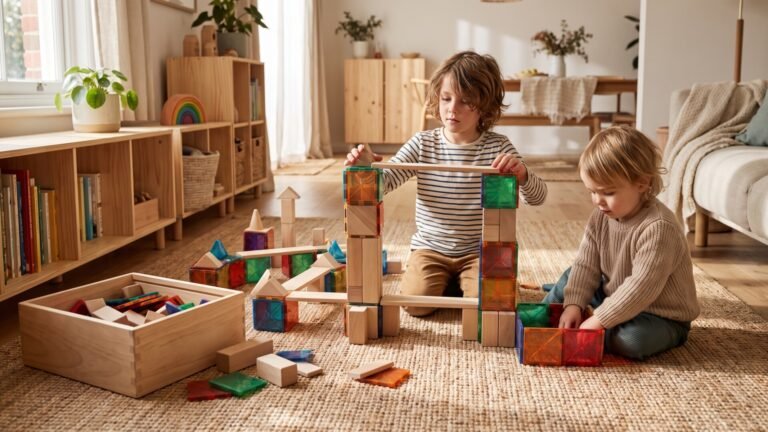
The honest limitation is physics. Blocks fall down. A lot. Balancing requires patience and planning that a three-year-old is still developing, and some children find that genuinely upsetting rather than interesting. If your child melts down when a tower collapses, tiles or bricks will go over better in the short term.
The Verdict: Best budget choice for families who value simplicity, natural materials, and truly open-ended play over fast, elaborate structures.
Best For: Preschoolers who stack, balance, build roads, and combine blocks with other toys.
Pros: Excellent open-ended value, durable, no proprietary system, no batteries, no noise.
Cons: Builds collapse easily, heavy, needs a separate basket or bin.
LEGO Classic Large Creative Brick Box – Best for Older Preschoolers
| Feature | Details |
|---|---|
| Age Range | 4+ |
| Key Features | Standard-size LEGO bricks, wide color and shape range, creative building |
| Price (approx.) | $45-$60 |
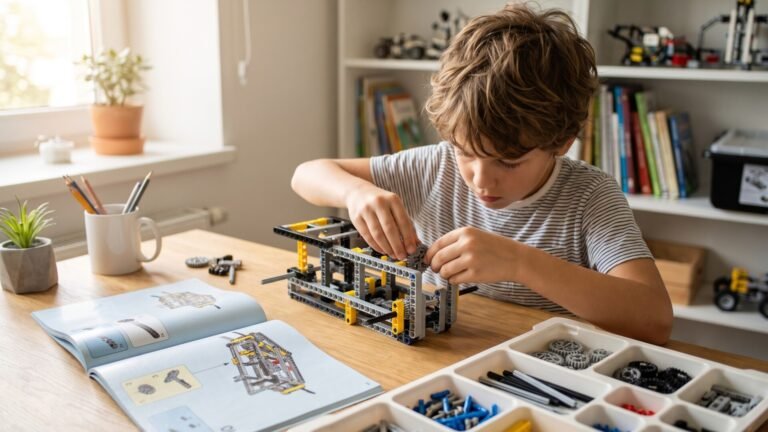
This is the bridge to real LEGO, and the 4+ rating is doing actual work. Standard bricks are smaller, connections are tighter, and separating two plates requires fingernails and patience. A capable five-year-old finds that satisfying. A three-year-old finds it infuriating.
Compared with a single licensed kit, a creative brick box is the better buy for this age. The licensed set gets built once and then lives on a shelf. The brick box gets rebuilt indefinitely, though your child may need help for the first few sessions if they are used to larger pieces.
The Verdict: The strongest choice for a preschooler ready for detailed construction and standard LEGO.
Best For: Four- and five-year-olds with good fine-motor control who want to build their own designs.
Pros: Huge creative range, compact storage, stays useful well past preschool.
Cons: Small pieces need supervision, harder to connect and separate, some kids still need instructions.
Learning Resources Gears! Gears! Gears! – Best for Mechanical Building
| Feature | Details |
|---|---|
| Age Range | 3+ |
| Key Features | Interlocking gears, bases, connectors, cause-and-effect movement |
| Price (approx.) | $25-$40 |
Gears add a different kind of thinking. Instead of asking “how tall can this go,” the child has to work out placement and sequence – which gear turns which, and what happens when one is in the wrong spot. For a certain kind of preschooler, that is the most interesting question in the room.
This is not a good first building toy for every child. It is a system with rules, it is less suited to building houses or freeform towers, and the small connectors need careful handling. It is a specialist pick, and it earns its place on that basis.
The Verdict: A good specialist choice for preschoolers fascinated by spinning parts and cause and effect.
Best For: Children drawn to mechanisms who like experimenting with movement.
Pros: Introduces mechanical reasoning, supports repeated experimentation, pieces reuse across layouts.
Cons: Less open-ended than blocks, less imaginative output, small connectors need care.
What Most Buyers Get Wrong
The biggest piece count is not the best value. A 200-piece bin that no one can tip out, sort, or put away gets used less than a 40-piece set that lives in an open bin at child height. Volume feels like value in the store and behaves like friction at home.
More educational labels do not mean more learning. The real developmental work happens during repeated self-directed building – the failed tower, the redesign, the explanation of what it is. A toy that advertises six skills on the box is not delivering six skills. It is delivering a box.
Themed kits are the third trap. A themed construction set creates a great first session and then asks a hard question: are these pieces useful once the model is done? Sometimes yes. Often they become a pile of oddly specific parts that only fit one build.
Finally, treat age ratings as a starting point, not a promise. A five-year-old may need no instructions at all. A three-year-old may need you sitting on the floor. The rating tells you what is safe and roughly appropriate. It does not tell you what your particular child will do with it.
If you want a deeper comparison of materials and systems, Wooden Blocks vs. Plastic Building Sets covers that ground properly. For a straight head-to-head on the two most common preschool options, Magnetic Tiles vs. Building Blocks: Which Is Better for Different Ages? is the one to read next.
ToyGuideHub Replayability Analysis
Replayability is the only metric that matters after the first week, so it is worth scoring properly. I use a 10-point scale across six factors: whether the child can set it up independently, how many different things it can become, how easy it is to take apart and rebuild, whether it mixes with toys you already own, how much friction storage adds, and whether it works for solo and shared play. Two points maximum per factor, scaled to ten.
Here is how the shortlist lands.
Magna-Tiles: 9/10. Independent setup is near-perfect. The number of possible builds is effectively unlimited. Rebuilding is fast, which is the whole advantage. They mix with animals, cars, and dolls. Storage is the weak point – a shallow bin works, but tiles end up under the sofa regardless. Solo and shared play both work, and a sibling can join without a rulebook.
Wooden blocks: 9/10. They score identically for different reasons. Setup is instant, builds are unlimited, and they mix with everything. Storage is bulky but simple. The one deduction is rebuilding after a collapse, which is emotionally harder for some children than a magnetic tile popping apart.
LEGO DUPLO: 8/10. Independent setup is good. Build variety is high but slightly more constrained than tiles or blocks – DUPLO wants to be a vehicle or a building. Rebuilding takes more hand strength. Compatibility with other DUPLO is excellent, with everything else is not. Storage is easy because the box is the storage.
LEGO Classic: 8/10 for a five-year-old, 5/10 for a three-year-old. The score here is entirely age-dependent, which is the point. For a child with the motor control, it is a decade-long system. For a child without it, it is a frustration generator with a storage problem.
PicassoTiles: 8/10. Functionally similar to Magna-Tiles, with a small deduction for quality variance across sets. If you get a good batch, it scores the same.
Gears: 6/10. Setup is fine, but the number of possible builds is narrower and the pieces do not mix with anything else. Children who love it will return to it for months. Children who do not will be done in three weeks.
The six-month test is simpler than any scoring system. Ask three questions. Is your child choosing it without being prompted? Can it be put away in under three minutes without you? Are they still inventing new builds, or repeating one model? If the answer to the first two is yes, keep it. If they are repeating one model, the toy has become a display piece and you can stop buying expansions for it.
The pattern that holds up: magnetic tiles get used for houses and ramps, DUPLO for repeated pretend scenes, wooden blocks for short focused sessions, and gears for intense bursts by a specific kind of kid. Choose Magna-Tiles for the broadest preschool use, wooden blocks for the best low-cost open-ended value, and DUPLO for the longest construction-plus-pretend lifespan.
Matching the Toy to Your Child
Best for a Three-Year-Old
Large pieces, simple connections, low frustration. Magna-Tiles, DUPLO, and wooden blocks all work. Standard LEGO bricks and detailed kits do not, no matter how gifted you suspect your child is. At three, hand size and patience decide this, not intelligence.
Best for a Four- or Five-Year-Old
This is when LEGO Classic and Gears become genuinely viable. Tighter connections, more planning, more detailed construction. If your child has been building confidently for a year, adding one of these is a real step up rather than a duplicate.
Best for Independent Play
Magnetic tiles, wooden blocks, and creative brick boxes, because none of them require a correct outcome. One caveat: independent play depends on the child already knowing how the pieces work. The first week with any new system is collaborative whether you planned for that or not.
Best for Small Spaces
A smaller magnetic tile set, a compact wooden block set, or a LEGO Classic box with a defined storage bin. Storage decides this more than the toy does. Best Building Toys for Small Spaces has the room-by-room breakdown.
Best for Problem-Solving
Each system asks a different question. Wooden blocks ask about balance. Magnetic tiles ask about spatial planning. LEGO asks about connection sequence. Gears ask about mechanical order. Best Construction Toys for Developing Problem-Solving Skills goes through which one suits which kind of thinker.
Best for a Toy That Grows With the Child
DUPLO is the easiest bridge from toddler play into preschool pretend construction, and it stays useful longer than most parents expect. Magnetic tiles also scale up as structures get more complex. Open-Ended Building Toys That Grow With Your Child covers the long-term picks.
The Hidden Costs Nobody Mentions
The most expensive mistake is buying a set that is too hard. Your child loses interest, you assume they do not like building, and you buy a simpler set three months later. You have now spent twice and lost a quarter of the year. Match the toy to current ability, not to next year’s birthday.
Storage is the second cost, and it is not just the container. Magnetic tiles need a wide, shallow bin or they become a sorting job. Wooden blocks are heavy and bulky and need something that will not split. LEGO needs sorting if your child builds frequently, which is a job that quietly becomes yours. Gears need bases and connectors kept together or the set stops working.
Expansion is the third. Almost every system here is enjoyable with a starter set and expensive once you start adding shapes, wheels, figures, and specialty pieces. Magnetic tiles are the worst offender because bigger builds genuinely need more tiles. DUPLO add-ons are the second, because themed sets are priced for the theme rather than the plastic.
Maintenance is small but real. Inspect magnetic pieces and connectors every few weeks. Remove anything cracked or damaged. Keep small components away from children who still mouth objects. Check manufacturer guidance before mixing systems – most interlock within a brand and not across brands, and a few do not interlock at all.
The Long View
Here is what this looks like in three years. The magnetic tiles will be down to about twenty-eight pieces, and you will still not know where the other four went. The wooden blocks will be scuffed and one corner of the bin will be cracked, and they will still be in rotation. The DUPLO will have been joined by two themed sets you did not plan to buy, and the LEGO Classic box will have quietly become the foundation of a much larger collection that follows your child into elementary school.
The toy that survives is almost never the most impressive one on the shelf. It is the one your child can pick up, build with, knock down, and put away without asking you for anything. Buy for the motor control your child has now, not the motor control you are hoping for by spring. Then buy a bin, put it where they can reach it, and let the pieces go missing.
Check current pricing, age guidance, and availability through our recommended partners.
Frequently Asked Questions About Building Toys For Preschoolers
Are building toys good for preschoolers?
They can support fine-motor coordination, spatial thinking, planning, language, and flexible problem-solving. The benefits come from active, repeated play, not from a label on the box. A toy that sits in a bin teaches nothing, which is why frustration level and storage matter more than the marketing claims.
What is the best building toy for a three-year-old?
Large, easy-to-handle pieces: DUPLO, Magna-Tiles, or wooden blocks. The right pick depends on whether your child prefers connecting, stacking, or pretend play. A child who wants to build a house will do better with tiles. A child who wants to build a farm will do better with DUPLO.
Are magnetic tiles safe for preschoolers?
Follow the age rating, supervise younger children, and inspect tiles regularly for cracks or damage. Remove any piece whose magnet enclosure is compromised and stop using it. Do not keep damaged magnetic pieces in the bin, even if the tile still “works.”
Is LEGO too difficult for preschoolers?
DUPLO and standard LEGO are different products. DUPLO is designed for younger children and is appropriate from toddlerhood. LEGO Classic is generally better for older preschoolers who can manage smaller pieces and tighter connections. A four-year-old with good fine-motor control can often handle it. A three-year-old usually cannot.
How many building blocks does a preschooler need?
There is no universal number. A smaller set is enough for solo towers. Larger collaborative builds need more pieces, and storage capacity should influence the purchase more than the piece count on the box. Buy for the space you have, not the space you wish you had.
Are wooden blocks better than magnetic tiles?
They solve different problems. Wooden blocks are better for balancing, simplicity, and low-cost open-ended play. Magnetic tiles are easier for quick structures and independent success. Wooden Blocks vs. Plastic Building Sets: What Should Parents Choose? and Magnetic Tiles vs. Building Blocks: Which Is Better for Different Ages? cover both comparisons in detail.
How should building toys be stored?
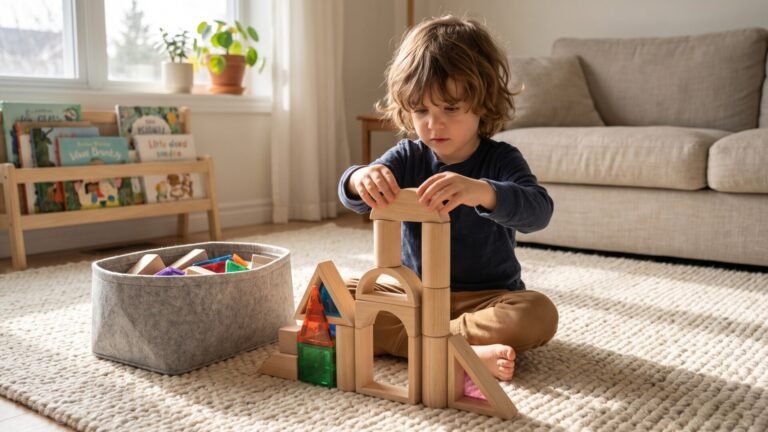
Shallow open bins for magnetic tiles, a basket or lidded container for wooden blocks, divided or broad containers for LEGO and gears. The rule that matters: your child should be able to see and reach the pieces without an adult sorting everything first. If they cannot, the toy will not get used.
Do I need to buy a storage container separately?
Usually, yes. Most sets come in packaging designed for retail, not for daily use. A shallow bin for tiles and a sturdy basket for blocks cost very little and are the difference between a toy that gets played with and a toy that gets avoided.