Best Building Toys for Toddlers: Blocks, Bricks & Simple Construction Sets
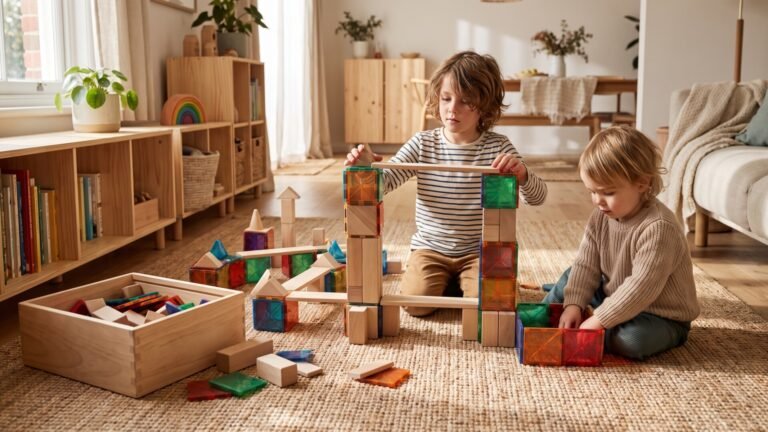
Most toddlers do not need a construction set. They need blocks they can grab, connect without help, and pull apart when the tower falls over, which it will, roughly every ninety seconds. The best building toys for toddlers are oversized and simple for exactly that reason: Mega Bloks First Builders and a solid set of large wooden blocks cover the vast majority of families from about 12 months to 3 years, and LEGO DUPLO is the better long-term buy once your child is closer to 2 and actually wants pieces to stay stuck together.
The complication is that “toddler building toy” covers four or five genuinely different play patterns, and the marketing photos do not tell you which one you are buying. Some sets are stacking. Some are interlocking. Some are magnetic, some are screw-together, and one of them is going to end up as a bin of loose parts by February. This shortlist sorts them by what your child can actually do right now, not by what the box claims.
What Makes a Building Toy Toddler-Appropriate?
The gap between a toy labeled for toddlers and one labeled for preschoolers is not marketing fluff. It is piece size, grip, connection strength, and how much adult help the whole thing requires. A 2-year-old can usually grip a block that is at least an inch and a half across. Below that, they are chasing it around the carpet while you do the actual building.
Age ratings on the box exist for a reason, and the main one is choking risk. Building toys for 1 year olds should have no pieces small enough to swallow, which is why the good ones are deliberately chunky. Follow the manufacturer’s stated age guidance, inspect pieces for cracks or loose parts before and after play, supervise children who still mouth toys, and keep any small accessories, figures, or wheels away from a child who is not past that stage. If you are unsure about a specific set, check the manufacturer’s current safety information rather than a retailer listing.
On the developmental side, the honest version is this: stacking, grasping, and pulling pieces apart build hand strength, hand-eye coordination, and early spatial reasoning through repetition. Toddlers also practice persistence every time a tower falls and they try again, and they build language while narrating what they are making. None of that requires a toy marketed as educational. It requires a toy that lets them try, fail, and try again without you hovering.
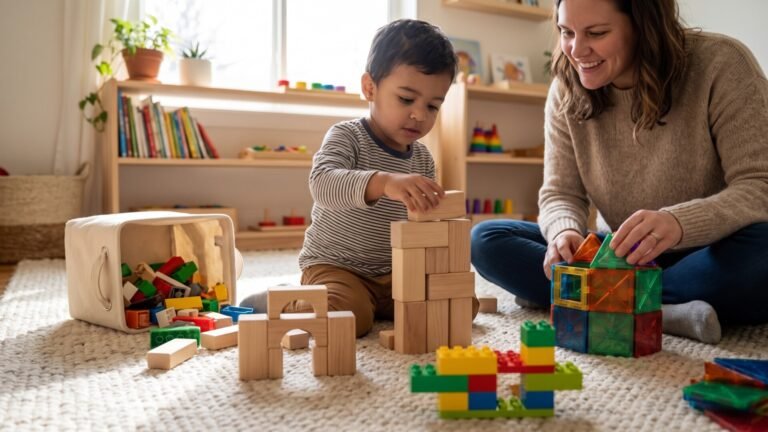
That last point matters more than most parents expect. Open-ended building, where there is no correct finished model, tends to hold attention longer at this age than a set with one intended outcome. A toddler who is told the goal is a specific house will hand you the pieces and wait. A toddler with a pile of blocks will build something worse and be prouder of it.
Key Buying Factors for Parents
Piece size and ease of handling come first. Look for pieces your child can grasp, align, and separate without needing to brace one hand against the floor and use their whole body weight. A connection that is too tight is worse than one that is too loose at this age, because a child who cannot pull pieces apart cannot rebuild, and rebuilding is the entire activity.
Construction difficulty is the second factor, and it splits into four rough types:
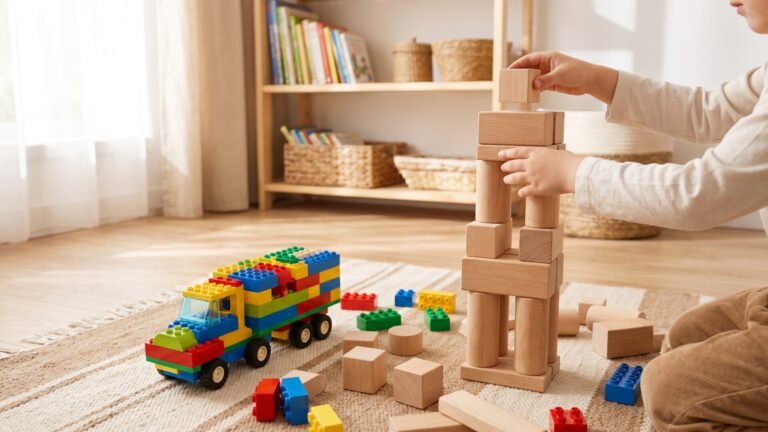
- Stacking blocks. Wooden cubes and shapes. No connection at all. Immediate success, frequent collapse.
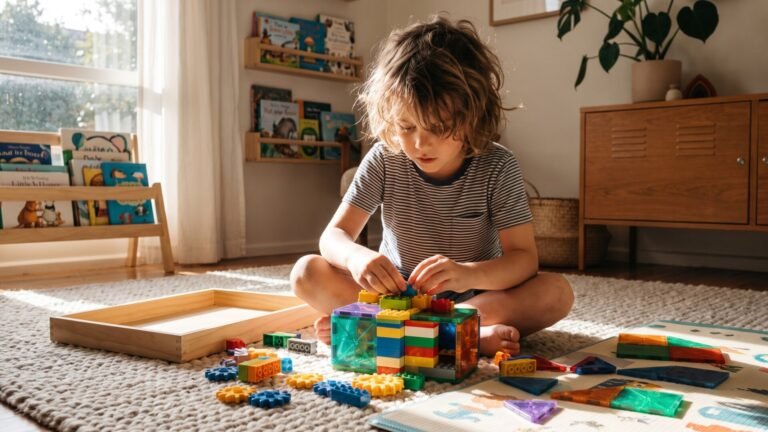
- Chunky interlocking bricks. Mega Bloks and DUPLO. Pieces click together, which is more satisfying but needs more hand control.
- Magnetic pieces. Tegu and similar. Quiet, compact, but the magnets do the work, so the challenge is different.
- Peg-and-hole or screw sets. More deliberate, more adult demonstration required up front.
Match the type to your child, not to the age on the box. A 2-year-old who has never built anything will do better with stacking than with a screw set, no matter how the screw set is labeled.
Durability and cleanup are where the real cost hides. Hard plastic bricks survive being thrown, chewed, and stepped on. Wooden blocks survive everything except a dog. What does not survive is your patience for a set with forty small accessories that all need to go back in a specific tray. A bin is a storage system. A molded tray with designated slots is a nightly chore.
Growth and replay value is the last factor, and it is the one that decides whether you are buying this toy once or three times. Ask whether the pieces work with what you already own, whether an older sibling can build alongside a younger one, and whether the system has anything to add in six months. That question is why DUPLO keeps coming up: the bricks you buy at 18 months still work with the sets you buy at four.
Comparison Table
| Product | Approx. age fit | Best use | Storage burden | Approx. price |
|---|---|---|---|---|
| Mega Bloks First Builders Big Building Bag | 1-3 years | First interlocking construction | Low to moderate | $15-$30 |
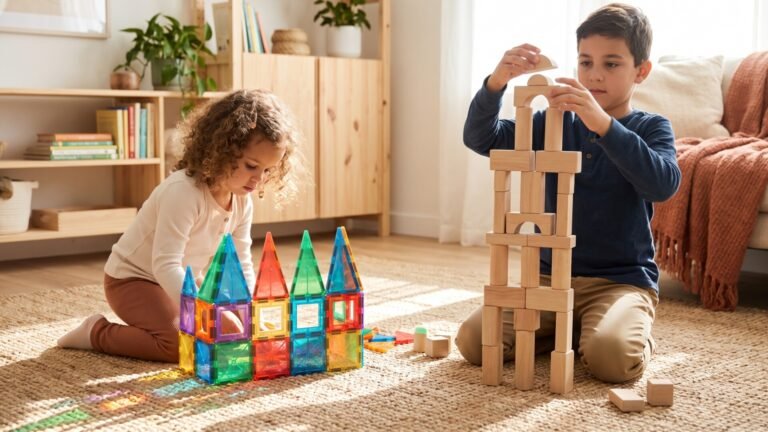
| Melissa & Doug Wooden Building Blocks Set | 2-4 years | Open-ended stacking and pretend play | Moderate | $20-$35 |
| LEGO DUPLO Classic Brick Box | 18 months-5 years | Construction that grows with the child | Moderate | $30-$55 |
| Fisher-Price Mega Bloks 80-Piece Big Building Bag | 1-5 years | Large starter collection and group play | Moderate | $25-$45 |
| PlayMonster My First Lauri Toddler Builder Set | 2-4 years | Chunky peg-and-hole construction | Moderate | $30-$50 |
| Tegu Magnetic Wooden Blocks Starter Set | Varies by set; check guidance | Premium magnetic building and travel play | Low to moderate | $30-$70 |
Prices are approximate and move around with sales and bundle changes. Verify current age guidance and piece counts on the packaging before you buy, since manufacturers revise both.
Main Product Recommendations
Mega Bloks First Builders Big Building Bag
| Feature | Details |
|---|---|
| Age Range | Typically 1-3 years; confirm current packaging |
| Key Features | Oversized interlocking blocks, simple connections, storage bag |
| Price (approx.) | $15-$30 |
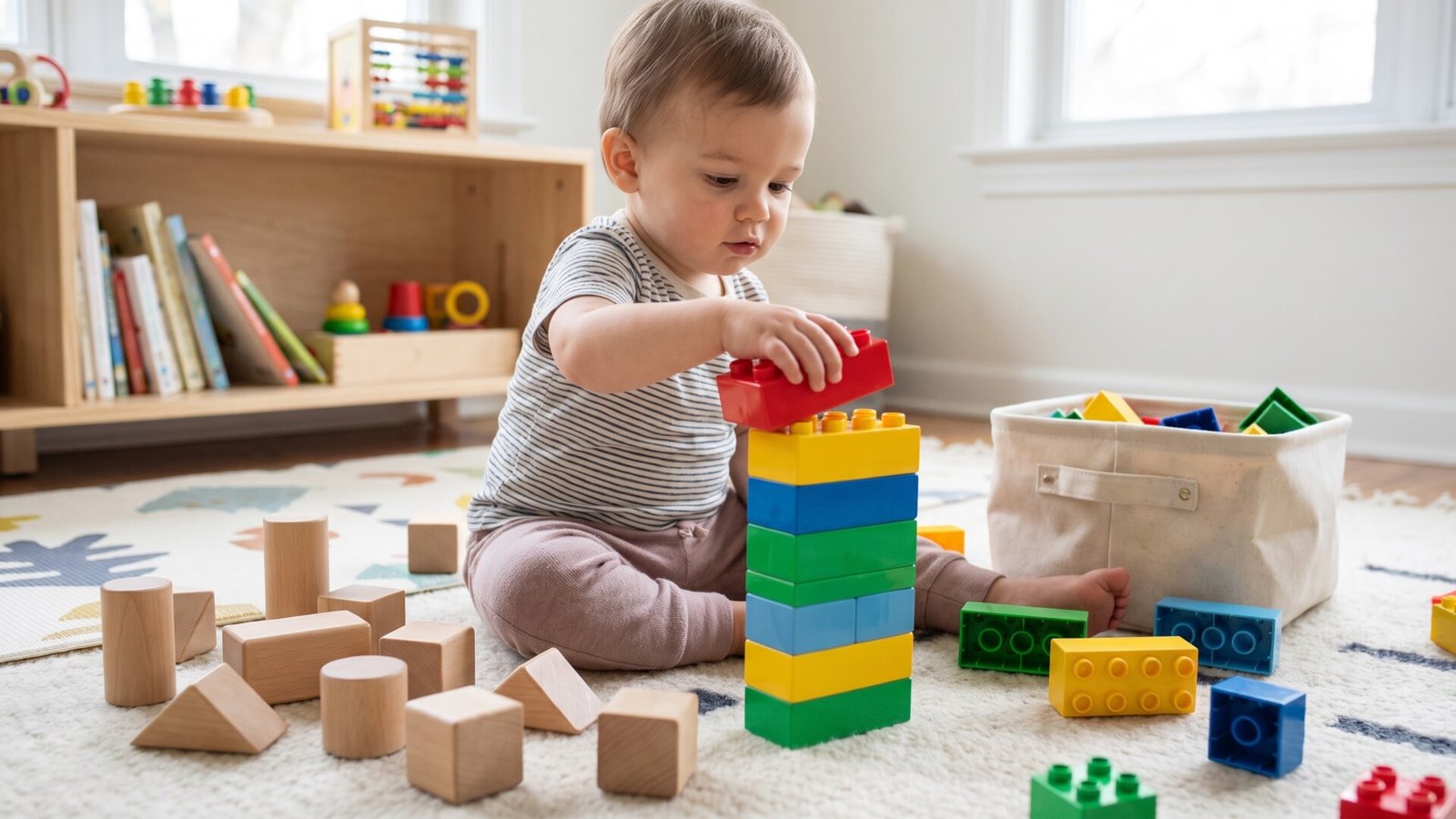
The verdict. This is the best first building toy for most toddlers, and it is not close. The pieces are large enough for a 1-year-old to palm, the connection is forgiving enough that a wobbly push usually works, and the bag means you are not committing shelf space to a system your child might ignore. It is the cheapest way to find out whether your kid is a builder.
Best for. Toddlers around 12 to 24 months, and anyone buying a first construction set for a birthday.
Pros
- Low cost and an approachable first step into construction
- Large pieces are genuinely easier for small hands
- Simple enough that open-ended play happens on its own
Cons
- Towers are less stable than wooden blocks and fall more often
- Older preschoolers will outgrow the challenge quickly
- The bag becomes a mixed-up jumble, which is fine until it is not
[Affiliate: Check current pricing on Mega Bloks First Builders through our recommended partners]
Melissa & Doug Wooden Building Blocks Set
| Feature | Details |
|---|---|
| Age Range | Commonly 2-4 years; confirm current product guidance |
| Key Features | Solid wooden blocks in multiple shapes and colors |
| Price (approx.) | $20-$35 |
The verdict. The best open-ended block set for toddlers who like stacking, knocking things down, sorting by color, and pretending a block is a phone. Nothing locks together, which means more failed towers and more learning per failed tower. It is also the toy on this list most likely to still be in the house when your child is seven, holding up a cardboard castle.
Best for. Families who want a screen-free toy with no proprietary system and no batteries.
Pros
- Supports stacking, balancing, sorting, and pretend play
- Durable and immediately understandable, no demonstration needed
- No connection system to outgrow or replace
Cons
- Towers fall constantly, which frustrates some children
- Takes more floor and shelf space than a bag of bricks
- Smooth wooden pieces can be slippery for the youngest toddlers
[Affiliate: Check current pricing on Melissa & Doug Wooden Building Blocks through our recommended partners]
LEGO DUPLO Classic Brick Box
| Feature | Details |
|---|---|
| Age Range | Typically 18 months-5 years; confirm current guidance |
| Key Features | Large interlocking bricks, wheels, figures, and assorted parts |
| Price (approx.) | $30-$55 |
The verdict. The best long-term building investment for toddlers closing in on 2 who already enjoy joining pieces. It costs more up front than a bag of Mega Bloks, and for a 14-month-old it is not worth the premium. For a 2-year-old, it is the only option here that is still genuinely useful at four, because the system expands instead of topping out.
Best for. Toddlers ready for structured construction, and families who plan to add sets over birthdays and holidays.
Pros
- Strong long-term compatibility and replay value
- Combines construction with figures and pretend play
- Spans toddler and preschool stages without a reset
Cons
- Higher initial price than basic blocks
- Specialized pieces accumulate into clutter faster than you expect
- Younger toddlers may need help pressing connections firmly
[Affiliate: Check current pricing on LEGO DUPLO Classic Brick Box through our recommended partners]
Fisher-Price Mega Bloks 80-Piece Big Building Bag
| Feature | Details |
|---|---|
| Age Range | Commonly 1-5 years; confirm current guidance |
| Key Features | Large blocks, broad color mix, larger collection |
| Price (approx.) | $25-$45 |
The verdict. The best choice when more than one child will build at the same time, or when a starter bag runs out during the first week. Eighty pieces is enough for a tower, a row, a crude house, and a second tower built by someone else. It is also enough to cover a living room floor, so decide where it lives before it arrives.
Best for. Siblings, playrooms, grandparents’ houses, and toddlers who build until the pieces run out.
Pros
- Enough pieces for bigger builds and shared play
- Works for children at different skill levels at once
- Usually strong cost per piece
Cons
- More expensive than the starter bag
- Needs a dedicated bin or bag from day one
- Not every toddler needs eighty pieces to be happy
[Affiliate: Check current pricing on the Fisher-Price Mega Bloks 80-Piece Bag through our recommended partners]
PlayMonster My First Lauri Toddler Builder Set
| Feature | Details |
|---|---|
| Age Range | Often aimed at toddlers and young preschoolers; verify current guidance |
| Key Features | Chunky construction pieces designed for peg-and-hole assembly |
| Price (approx.) | $30-$50 |
The verdict. A reasonable pick for an older toddler who wants a more deliberate challenge than stacking. The action is clear once demonstrated: align, press, connect. Expect to demonstrate it several times. This is the one on the list that can turn into a parent-led activity if your child does not take to it in the first two sessions.
Best for. Older toddlers developing more controlled hand movements and an interest in repeatable structures.
Pros
- More purposeful challenge than simple stacking
- Large parts are easier to handle than small construction pieces
- Bridges toddler and preschool construction play
Cons
- Less intuitive than standard blocks for a first-timer
- Often needs adult setup and demonstration at the start
- Availability and set contents vary, so check what is actually included
[Affiliate: Check current pricing on the My First Lauri Toddler Builder Set through our recommended partners]
Tegu Magnetic Wooden Blocks Starter Set
| Feature | Details |
|---|---|
| Age Range | Varies by set; use the manufacturer’s current guidance |
| Key Features | Magnetic wooden pieces, compact format, open-ended construction |
| Price (approx.) | $30-$70 |
The verdict. The premium, quiet, travel-friendly option, and worth it only under specific conditions. Tegu is beautifully made and genuinely pleasant to have in a bag, but the cost per piece is high and a starter set does not support large builds. It makes sense when the pieces will be used constantly and the compact format solves a real problem. It is not the automatic best buy for every toddler, and the smaller sets in particular need close attention to the manufacturer’s current age and safety guidance.
Best for. Families who want a quiet building toy for supervised travel, restaurants, or small apartments.
Pros
- Quiet compared with hard plastic brick play
- Compact and easy to keep in a bag
- A distinct magnetic building experience children do not get elsewhere
Cons
- Higher price than basic blocks, with fewer pieces
- Smaller sets limit how much can be built at once
- Requires careful attention to the manufacturer’s safety guidance for the specific set
[Affiliate: Check current pricing on Tegu Magnetic Wooden Blocks through our recommended partners]
What Most Buyers Get Wrong About Toddler Building Toys
The biggest mistake is buying the largest set as though volume equals value. A 200-piece tub looks like a better deal per piece, and it is, but a toddler who has not yet learned that two pieces can connect does not need 200 of them. They need six. The rest becomes floor clutter, and you become the person who sorts it.
The second mistake is assuming that tighter connections mean better quality. For a toddler, easy separation matters more than a firm click. The whole play cycle is build, take apart, rebuild, and a child who cannot complete the third step hands the toy back to you. That is how a construction set becomes a parent activity instead of a child activity.
Third, ignore the word “educational” on the packaging. It is a weak buying criterion, because almost every building toy carries it and almost none of them can substantiate it. The question that actually predicts whether a toy gets used is simpler: can my child start this without me?
And a note on magnetic tiles, because they come up in every toddler toy conversation. Large magnetic tiles are excellent, but usually a little later. For a first builder, oversized blocks are more forgiving, cheaper, and easier to grip. If you are weighing the two, our comparison of Magnetic Tiles vs. Building Blocks: Which Is Better for Different Ages? breaks down where each one actually wins.
ToyGuideHub Replayability Analysis: Which Set Still Makes Sense After Six Months?
Six months is the honest test. Almost any building toy survives the first week, because novelty does the work. What separates the keepers is what happens in month seven, when the box has been opened forty times and the pieces are somewhere under the couch.
We score each option on a 25-point Replayability Score across five factors, five points each: independent start (can the child begin without an adult), build variety (how many different things can be made), durability (how the pieces hold up to drops, chewing, and being stood on), growth potential (does the system have somewhere to go), and cleanup burden (how painful is putting it away). This is an editorial framework based on how these toy types behave in a normal house, not a laboratory result.
Mega Bloks First Builders: 21/25. Full marks on independent start, because a 15-month-old can succeed alone. Build variety is moderate, since the pieces mostly make towers, walls, and crude vehicles. Durability is high. Growth potential is the weak spot, because the system tops out around age three. Cleanup is easy if you accept the bag as a bag.
Melissa & Doug Wooden Blocks: 22/25. Slightly harder to start, because nothing connects, but that same limitation is why it lasts. Build variety is the highest on the list, especially once pretend play arrives and a block becomes a sandwich. Durability is excellent. Growth potential is strong through early elementary. Cleanup is the cost, since loose blocks spread further than bricks.
LEGO DUPLO: 23/25. The best all-round score. Independent start is good from about 2. Build variety is high and keeps expanding. Durability is excellent. Growth potential is the highest here by a wide margin, because the same bricks work with sets bought three years later. Cleanup suffers slightly from specialized pieces.
Tegu: 19/25. Strong on durability, quiet play, and compact cleanup. Independent start is good. Build variety is limited by how few pieces come in a starter set, and growth potential depends entirely on buying more, which is where the cost threshold bites.
The pattern worth noticing is that the toy with the most impressive first-day result is rarely the one still in rotation at month seven. A set that produces one striking model has one good afternoon in it. Plain blocks that support hundreds of imperfect, half-collapsing builds have years. Toddlers do not need a better outcome. They need more attempts.
For younger toddlers, Mega Bloks is the strongest value. For older toddlers, DUPLO is the better investment. And for families who want no brand system at all, wooden blocks are the foundation everything else gets added to.
How to Choose the Right Option for Your Toddler
Best first building toy. Choose Mega Bloks First Builders for a child new to construction, especially when easy gripping and immediate success matter more than challenge. Nothing else on this list is as likely to work on the first attempt.
Best for open-ended play. Choose Melissa & Doug Wooden Building Blocks when stacking, balancing, sorting, and pretending are more appealing than snapping pieces together. If your child already turns random objects into phones and sandwiches, this is the set.
Best long-term pick. Choose LEGO DUPLO Classic Brick Box when your child is approaching 2 and you want a system that expands through preschool. It is the only option here that gets more useful as your child gets older.
Best for shared play. Choose the larger Mega Bloks bag when siblings, cousins, or grandparents will be building at the same time. Eighty pieces means two children can each build something without negotiating over the last block.
Best for small spaces or travel. Consider Tegu only when the compact, quiet format genuinely justifies the premium. Otherwise a small Mega Bloks bag gives you more pieces for less money, at the cost of floor space.
Best for a more guided challenge. Choose the My First Lauri Toddler Builder Set for an older toddler ready to practice alignment and connection with purpose. Be prepared to demonstrate it more than once.
The Hidden Cost of Choosing Wrong
Storage is the first hidden cost, and it is the one that shows up fastest. A $25 set that needs a full square meter of floor and a dedicated container is not a $25 set. It is a $25 set plus a storage problem plus a nightly negotiation about whether it gets put away. Before you buy, decide where it lives. If the answer is “I will figure it out,” you have already bought the wrong size.
Compatibility is the second. Specialized systems are only worth their premium if you plan to add to them, and plenty of families buy one themed set and never buy another. If you are not going to expand, a proprietary connection system is just an expensive way to own blocks that only work with themselves.
The third is adult labor, which is the cost nobody counts. A set that requires frequent correction quietly converts your child’s independent play into your activity. That is fine occasionally. As a daily pattern, it means you bought yourself a job.
Skip this if. Skip heavily themed toddler construction sets full of character-specific, single-purpose pieces unless your child already loves that exact theme. They cost more, they build fewer things, and once the show is out of rotation the pieces become oddly shaped clutter. A generic box of bricks will outlast the franchise.
Pros and Cons of Building Toys for Toddlers
Pros
- Encourage hands-on problem-solving, spatial exploration, and early planning through play
- Grow with repeated rebuilding instead of being finished after one use
- Offer a screen-free activity that works alone or with an adult
- Support pretend play, sorting, counting, and simple storytelling alongside construction
Cons
- Pieces scatter and are genuinely annoying to store
- Some sets frustrate children when connections are too tight or towers collapse too easily
- More pieces and more features often raise the price without improving engagement
- Construction toys need age-appropriate supervision, especially when a set includes smaller parts or accessories
The Bottom Line
Mega Bloks First Builders Big Building Bag is the best overall pick for most toddlers, because it is cheap, it works on the first attempt, and it does not require you to supervise every connection. Melissa & Doug Wooden Building Blocks is the best open-ended choice for stacking and pretend play. LEGO DUPLO Classic Brick Box is the best long-term investment once your child is closing in on 2 and ready for pieces that stay together. The Fisher-Price Mega Bloks 80-Piece Bag is the best option for shared play, and Tegu is the best specialized pick for quiet, compact, premium building.
[Affiliate: Check current pricing and availability through our recommended partners]
If you want to see how these systems develop as your child gets older, our Best Building Toys for Preschoolers guide picks up where this one leaves off. For families working with limited floor space, Best Building Toys for Small Spaces covers the compact options, and Open-Ended Building Toys That Grow With Your Child explains why the simplest sets tend to last the longest. You can also start at the Building & Construction Toys hub for the full cluster.
One caveat before you buy anything. Every recommendation here assumes your child is past the stage of putting everything in their mouth and that you are following the manufacturer’s current age guidance for the specific set. If your toddler is still mouthing toys, or if a set includes small accessories, wheels, or figures, that changes the answer, and the right move is to wait rather than to buy the more advanced option early. Blocks are patient. They will still be there in six months.
Frequently Asked Questions About Building Toys For Toddlers
What are the best building toys for toddlers under 2?
Oversized, easy-to-grip blocks such as Mega Bloks First Builders are usually the most practical starting point, because a 1-year-old can hold, connect, and separate them with minimal help. Check the exact product age guidance on the packaging, and supervise closely if your child still mouths toys.
Are wooden blocks or plastic building bricks better for toddlers?
They produce different play patterns rather than one being universally better. Wooden blocks encourage balance, patience, and open-ended stacking, and they last for years. Plastic bricks connect more firmly, hold structures together, and expand into larger systems. Many families end up with both, and our Wooden Blocks vs. Plastic Building Sets: What Should Parents Choose? comparison covers the trade-off in detail.
Is LEGO DUPLO safe for a 2-year-old?
DUPLO is designed for young children, but you should still follow the manufacturer’s current age guidance for the specific set, inspect pieces for cracks or damage, and keep any smaller accessories away from children who are not ready for them. Age ratings vary by set, so check the box rather than assuming.
How many building blocks does a toddler need?
Far fewer than you think. A toddler can begin with a modest collection of twenty to thirty pieces and be perfectly occupied. Larger sets become useful when siblings build together or when an older toddler starts running out of pieces mid-build. Quantity alone does not create better play.
Do toddlers need magnetic tiles?
No. Magnetic tiles are optional, not a developmental requirement, and they tend to work better a little later. Chunky blocks are easier for first builders to grip and connect, and they cost less. If you are trying to decide between the two, start with Magnetic Tiles vs. Building Blocks: Which Is Better for Different Ages?.
How do I store toddler building toys?
Use a low, open bin or a wide basket so your child can reach it without help, and keep smaller accessories in a separate container. Avoid anything with molded slots for individual pieces, because a storage system that takes longer than the play itself will not get used.
When should a toddler move from large blocks to smaller building sets?
Readiness depends on grip, interest, whether they can handle simple connections, and whether they still put things in their mouth, not on age alone. Move up when your child can build and take apart with less adult help, and check the age guidance on the smaller set before handing it over.
Are bigger sets always better value?
Not for toddlers. The cost per piece improves, but a child who has not learned the basic play pattern does not benefit from more pieces, and you inherit the storage and cleanup. Buy small first, then expand once you know the toy gets used.