Building & Construction Toys: The Complete Guide for Parents
The best building toy you can buy is not the one with the most pieces in the box. It is the one your child can pick up without help, build something with in the first ten minutes, and still be using next winter when the novelty has worn off everything else. That single tradeoff, between what a set looks like on the shelf and what it actually does on your floor, decides almost every purchase in this category.
Most parents buy for the finished model. They should be buying for the twentieth rebuild. A set that produces one impressive thing and then sits there is a display piece. A set that produces something different every time is the one that earns its floor space. Building and construction toys sit at the intersection of creativity and practical problem-solving, which is why they outlast almost everything else in the toy box, provided you choose the right system at the right moment.
Last reviewed October 2026: set numbers, age labels, and typical US prices re-checked; three new picks added (a first gear set, Plus-Plus, and a LEGO Technic set for ages 9-12); and the magnetic-tile safety advice updated with this year’s CPSC recall and warning.
What Counts as a Building or Construction Toy?
The category is wider than the shelf label suggests. A building or construction toy is anything a child joins, stacks, balances, connects, arranges, or engineers into a structure, vehicle, model, or imaginary setting. That includes a bucket of plain wooden blocks and a five-hundred-piece licensed spaceship, and those two things behave very differently in your home.
The useful split is between open-ended systems and guided kits.
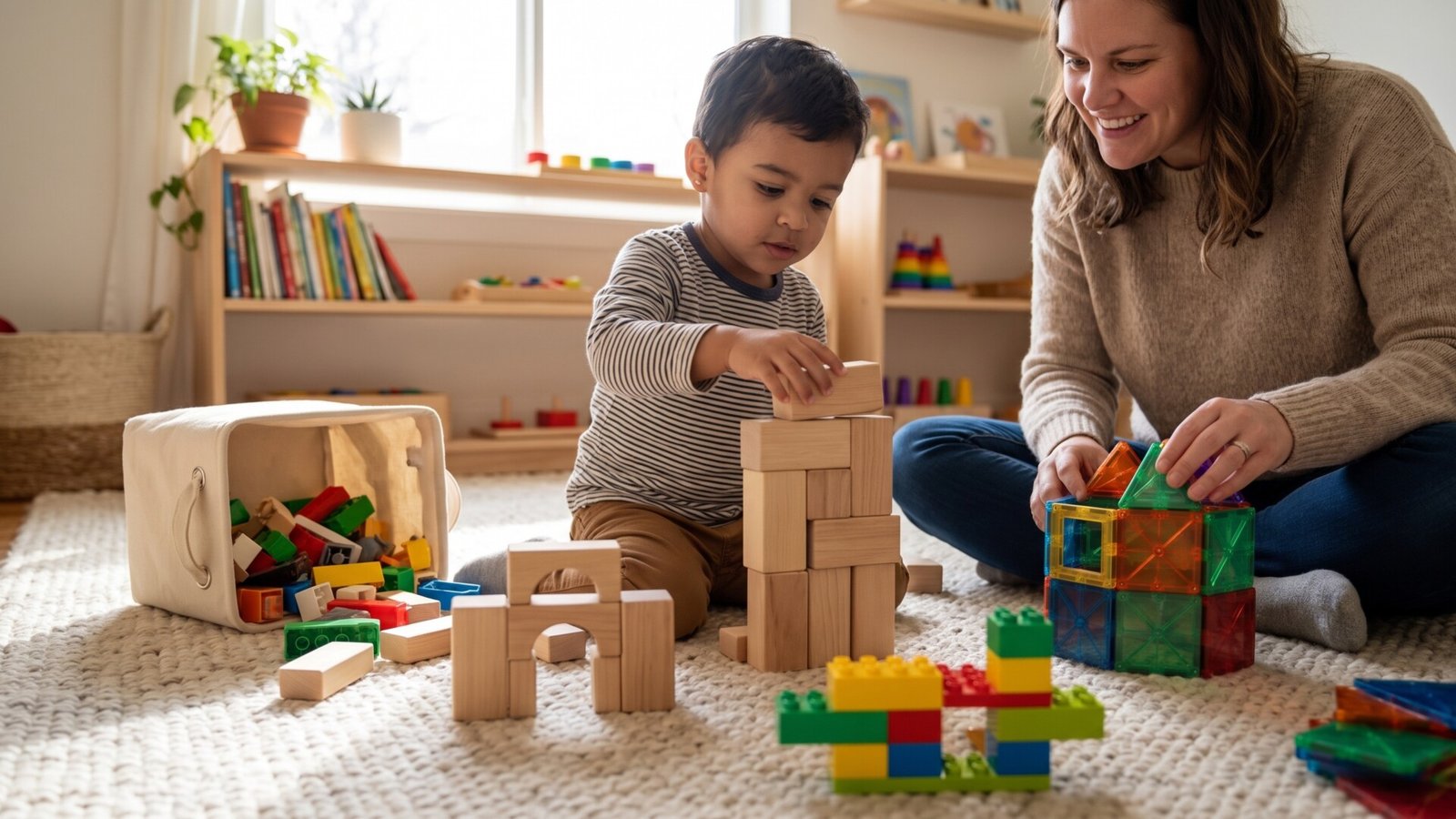
Open-ended systems, such as wooden blocks, magnetic tiles, and loose parts, give the child components and no instructions. The play value comes from what they invent. Guided kits, such as most LEGO City sets or a themed model with one intended result, give the child a destination. Both are legitimate. They just produce different kinds of play, and children often want both at different times.
What separates a genuinely open-ended toy from one that only claims to be is simple: can your child start building without a specific skill, an adult explanation, or an expansion pack they do not own? If the answer is no, it is a kit with a build step, not a construction toy in the fullest sense.
The variables that actually decide whether a set works in your house are motor skills, age, piece count, connection method, cleanup, storage, and how much adult help the thing demands. You will notice price is not on that list. Price matters, but it matters far less than whether the pieces fit your child’s hands and your hallway cupboard.
Building Toy Types and What Each One Does Best
Organizing by brand is how retailers do it. Organizing by the kind of play each system supports is how you should do it, because that is what determines whether the box gets opened twice or two hundred times.
Wooden Blocks and Loose Parts
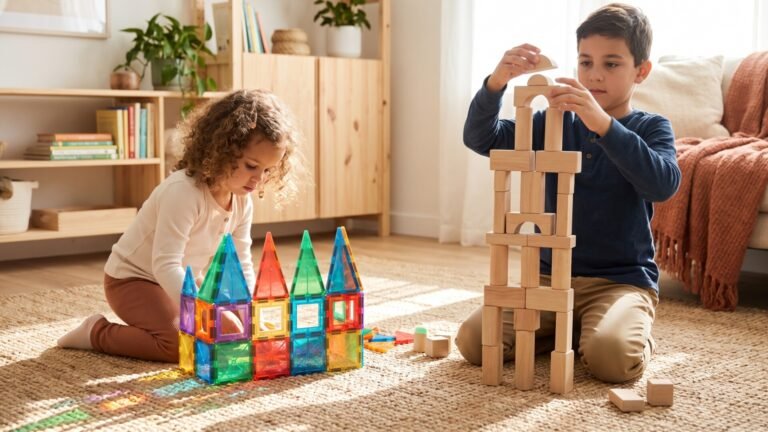
Classic wooden blocks, unit blocks, stacking pieces, and wooden construction sets such as Melissa & Doug Wooden Building Blocks and Tegu magnetic wooden blocks are the oldest answer to this question and still one of the best. They build spatial reasoning, balance, and visual planning, and they do it through low-frustration experimentation. Nothing snaps. Nothing is ruined by a wrong move.
There is research behind the spatial-reasoning claim, with a caveat. In a study of 102 three-year-olds published in Child Development, children who were better at copying block structures also scored higher on early math (Verdine et al., 2014). A nationally representative study of 847 children aged 4 to 7, published in Psychological Science, found that children who played with blocks and puzzles often had stronger spatial reasoning scores than those who rarely did (Jirout & Newcombe, 2015). Both studies show an association, not proof that blocks cause the gains, which is why this guide treats building toys as skill-builders rather than academic shortcuts.
The trade-off is real: fewer built-in connection points means structures collapse more often. For some children that is the whole point, a tower to knock down and rebuild. For others it is a source of genuine rage. Know which child you have before you buy.
Magnetic Tiles and Magnetic Construction Sets
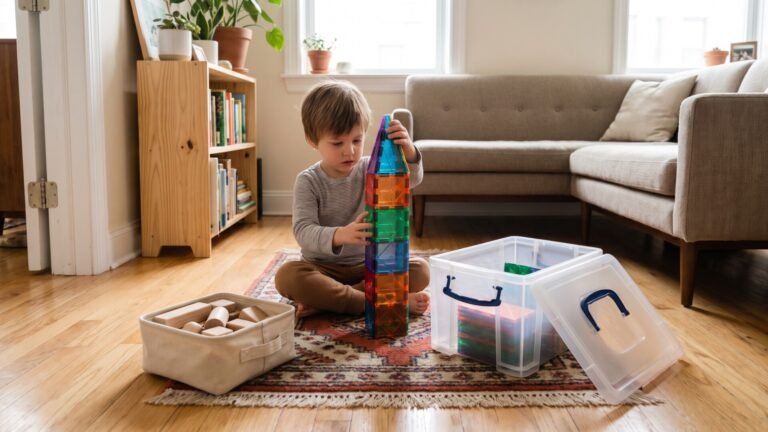
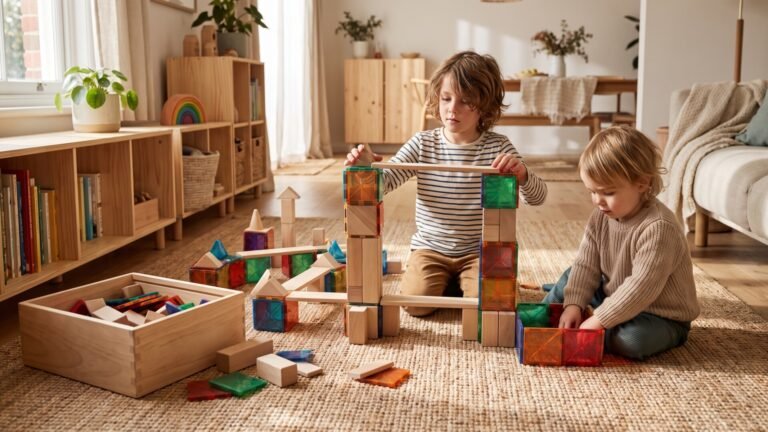
Magna-Tiles and PicassoTiles are the two names most parents encounter first, and the format is genuinely clever. Magnets do the connecting, so a three-year-old gets a wall to stand up on the first attempt. That immediate success is why magnetic tiles work so well for 2D-to-3D transitions and for collaborative floor play with a sibling or a parent.
Two practical warnings. First, a collection of tiles takes up more space than you expect, because they are flat and they spread. Second, magnets and seams need periodic inspection. Check tiles for cracks, keep damaged pieces out of use, and follow the manufacturer’s current safety guidance rather than a rule of thumb from a forum. If you are weighing these against traditional blocks, our comparison of Magnetic Tiles vs. Building Blocks covers the age-by-age differences properly.
Magnet Safety: What Changed in 2026
The risk with magnetic toys is not the tile itself but the magnet inside it. If a child swallows two or more small, strong magnets, or a magnet and a metal object, they can pull together through the walls of the intestine and cause perforations or blockages. Treat a suspected swallowed magnet as a medical emergency, even if the child seems fine.
This is not a theoretical concern. In August 2026 the U.S. Consumer Product Safety Commission announced a recall of about 213,500 Goody King magnetic building cubes and blocks, sold on Amazon between January 2024 and July 2026 for $17 to $50, because the cubes could break or open and expose their magnets. In July 2026 the CPSC also warned parents to stop using Ocensmice magnetic building sets, whose small pieces contained magnets stronger than the toy safety standard allows. Neither action involved the brands recommended in this guide, but both show where the risk sits: cheap, unbranded sets sold online.
- Buy from the brand’s own storefront or an authorized retailer, not a look-alike listing with a generic name.
- Check cpsc.gov/Recalls before buying a budget set, and again if you already own one.
- Retire any tile that is cracked, rattles, or has a seam that opens.
- Keep magnetic sets away from younger siblings who still mouth objects.
None of this is a reason to avoid magnetic tiles. It is a reason to buy them from a name you can trace and to inspect them the way you would inspect a car seat: occasionally, and properly.
Interlocking Bricks and Small Construction Systems
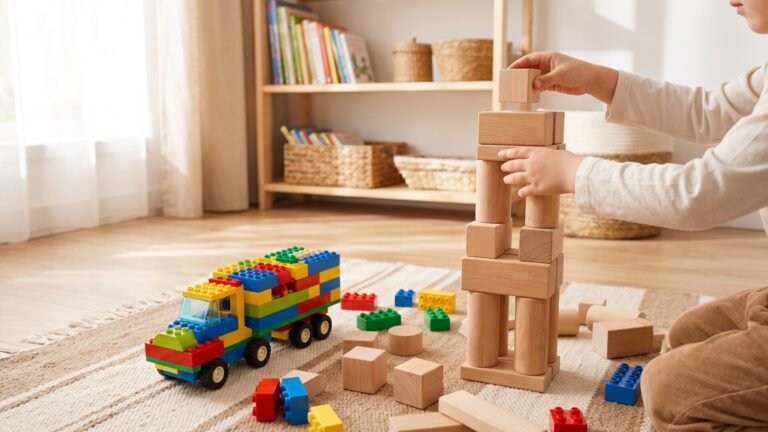
LEGO Classic Creative Brick Box, LEGO DUPLO, and Mega Bloks cover the full range here, from chunky toddler pieces to standard bricks. The important distinction is not brand, it is piece size. Large toddler-friendly pieces, standard bricks, and highly specialized single-purpose elements behave like three different toys.
Brick systems reward persistence and precision. They also have a failure mode: a child who only ever follows instructions stops inventing. The box that gets played with for years is usually the one with a broad mix of generic bricks, not the one with the most themed mini-figures.
Gear, Connector, and Engineering Sets
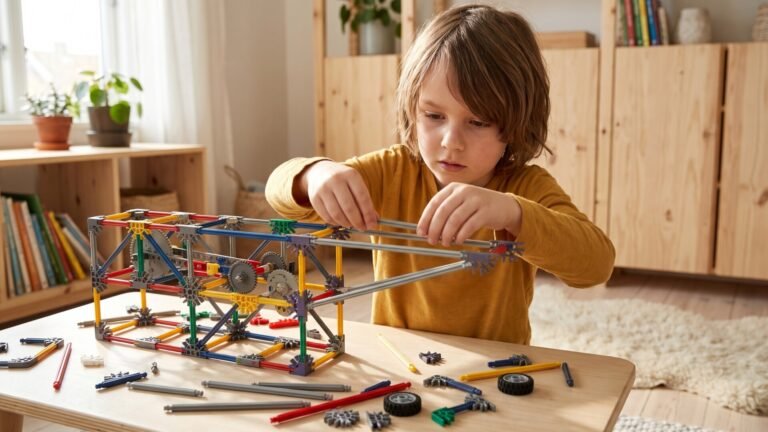
K’NEX, Plus-Plus, and Learning Resources Gears! Gears! Gears! sit in a different tradition. These teach mechanical thinking, pattern recognition, sequencing, and how movement transfers through a structure. They are excellent for the child who wants to know why the thing turns.
They are also less forgiving. Smaller connectors and more complex assembly push these toward older preschoolers and school-age children. Hand a gear set to a three-year-old and you have bought yourself a job.
Model and Pretend-Construction Sets
LEGO City, LEGO Creator 3-in-1, and construction vehicle sets are strongest for the child who wants a finished result, role-play, and a story to act out afterward. That is a legitimate kind of play and it holds attention well for the right kid.
What these sets offer less of is flexible independent building. Once the model is built, the pieces are largely committed. If your child likes inventing more than displaying, a bucket of mixed components will beat a themed set every time.
How to Choose Building Toys by Age and Developmental Stage
Age labels are a starting point, not a verdict. Developmental readiness matters more, and a child who is ahead in fine motor skills will outgrow a label while a child who is not will find it frustrating. Use these as a guide and adjust for the child in front of you.
Toddlers
Large, easy-to-grip pieces are the whole game here. LEGO DUPLO, Mega Bloks, large wooden blocks, and chunky stacking toys all fit. The play at this stage is stacking, knocking down, filling, dumping, matching, and simple vertical structures, and that is genuinely enough.
Choking hazards deserve plain attention. Any set with small components or magnets needs active supervision, and magnets in particular need to be kept away from children who still mouth objects. Follow the stated age range on the package and the manufacturer’s current safety instructions. For a fuller breakdown, see Best Building Toys for Toddlers.
Preschoolers
This is where magnetic tiles, larger interlocking bricks, wooden connector sets, and simple gear systems come into their own. Preschoolers are working on color, shape, balance, simple symmetry, and building familiar structures such as houses, bridges, and towers.
The best sets at this age produce a quick result but still allow experimentation, because a preschooler’s patience for a failed build is short. Our Best Building Toys for Preschoolers guide goes deeper on the specific sets worth the money.
Ages 6-8
LEGO Classic, LEGO Creator 3-in-1, K’NEX, Plus-Plus, and more detailed magnetic systems all work here. The focus shifts to planning, following multi-step directions, revising a design that failed, and combining construction with storytelling.
This is the age where piece count starts to mislead parents. A 500-piece set of tiny specialized parts is not harder than a 300-piece set of general bricks. It is just more fiddly. Challenge comes from the complexity of the build, not the number on the box. See Best Building Toys for Kids Ages 6-8.
Ages 9-12
Complex LEGO Technic or Creator sets, K’NEX engineering sets, robotics and coding-compatible building systems, and advanced model kits all belong here. The skills in play are mechanical reasoning, structural stability, patience, and finishing a long project.
One warning worth stating flatly: do not buy an advanced set just because your child can read the age range. If they dislike lengthy instruction-following, a Technic set becomes a shelf ornament with a guilty feeling attached. Our Best Building Toys for Kids Ages 9-12 guide matches sets to temperament, not just age.
The Key Buying Factors Parents Should Use
Once you know the types and the ages, the decision comes down to a handful of tests. Run each candidate set through these before you spend anything.
Age fit and frustration level. Choose pieces the child can manipulate independently, with a manageable challenge left over. Too easy becomes repetitive within a week. Too hard means you are building it while they watch, which is an adult project with a child present.
Open-ended value versus guided results. Decide whether your child wants freeform building, a themed model to complete, or a blend. Children whose interests shift do best with a mixed system that supports both.
Durability and connection quality. Plastic thickness, magnet enclosure, connector tightness, and wood finishing all determine how the set survives repeated assembly and disassembly. Cheap connectors are the single most common reason a system dies early.
Storage and cleanup. Bins of loose parts, flat magnetic tiles, boxed sets, and systems that need sorting all create different cleanup loads. Storage friction decides whether a toy gets used on a Tuesday evening when everyone is tired. If space is tight, Best Building Toys for Small Spaces is worth reading before you buy anything large.
Independent play and adult involvement. Some systems produce quick solo play. Others need reading, planning, or troubleshooting with a parent. Neither is better, but only one of them gives you twenty minutes to make dinner.
Expansion cost and compatibility. Before committing to a system, check whether future pieces are affordable and compatible with what you already own. A cheap starter set attached to an expensive ecosystem is not cheap.
Safety. Respect age labels. Watch for small parts, magnets, broken components, and splintering or damaged wood. Inspect toys regularly, retire anything cracked or compromised, and follow the manufacturer’s current safety instructions rather than a general rule.
Pros and Cons of Building and Construction Toys
Pros
- Build spatial reasoning, fine motor control, planning, persistence, and creative problem-solving through hands-on play.
- Offer replay value, because the same pieces can become different structures, vehicles, scenes, or machines.
- Support independent play, sibling cooperation, storytelling, and parent-child projects.
- Often grow with the child when the system has enough variety and compatible expansions.
Cons
- Loose pieces create storage and cleanup problems, especially in small homes.
- A set can be age-appropriate on paper and still too frustrating or too instruction-heavy for a particular child.
- Missing pieces, damaged connectors, and lost specialty parts quietly reduce what a system can do.
- Premium systems get expensive once you add expansions, themed sets, and storage.
- Some visually impressive kits offer less replay value than a plain open-ended set at a third of the price.
Best Building and Construction Toys for Different Families
Nine sets, chosen to cover different budgets, ages, and play styles. Prices are approximate, were last checked in October 2026, and move with set size, retailer, and sale season.
How we chose these. We compared manufacturer specifications, age labels, piece counts, and current US retail pricing, then ran each set through the buying factors above: how independently a child can use it, how long it stays useful, what expansion costs, and how much storage it demands. We favor systems with long age spans and compatible add-ons over single-model sets, and we list the exact set number for each pick so you buy the version we describe. Some links on this site are affiliate links; see our affiliate disclosure for details.
LEGO DUPLO Classic Brick Box
| Feature | Details |
|---|---|
| Set Number | LEGO DUPLO 10913 (65 pieces, including 2 figures) |
| Age Range | 18 months and up (marked 1½+ on the box) |
| Key Features | Large interlocking bricks, number bricks, simple shapes, brick-shaped storage box |
| Price (approx) | $25-$35 (list price $29.99) |
The Verdict
The strongest entry point for a toddler who is ready to stack, connect, and take apart large pieces. It gives you the familiar LEGO construction system without the fine-motor demands of standard bricks, which means the child can succeed alone.
Availability note: price trackers disagree on whether set 10913 has been retired, and stock can be patchy. If it is sold out or listed well above its $29.99 list price, a newer or larger DUPLO brick box does the same job. Check that it is mostly generic bricks rather than one themed model.
Best For
Toddlers and younger preschoolers beginning to build independently.
Pros and Cons
Pros
- Easy-to-handle large pieces
- Strong brand ecosystem and expansion options
- Supports both building and pretend play
Cons
- Limited challenge for older children
- Some sets emphasize themed play over open-ended construction
- Add-on purchases add up
Melissa & Doug Wooden Building Blocks Set
| Feature | Details |
|---|---|
| Set Number | Melissa & Doug #481 (100 blocks in 4 colors and 9 shapes) |
| Age Range | Ages 2-8 on the US listing; some retailers label it 3+ |
| Key Features | Solid wooden shapes, natural stacking and balancing, open-ended construction, carry box |
| Price (approx) | $12-$28 (list price $27.99; often discounted) |
The Verdict
A practical first open-ended building set for families who want simple, screen-free construction with no instructions and no batteries. Its value comes from repeat use, not from features. This is the set that is still on the floor in three years.
Best For
Preschoolers, imaginative builders, and homes that favor classic wooden toys.
Pros and Cons
Pros
- Encourages balance, spatial reasoning, and imaginative play
- No proprietary connectors or instructions to lose
- Durable when stored and handled properly
Cons
- Structures collapse more easily than connected builds
- Takes more patience for children who want immediate success
- Bulky to store
Magna-Tiles Clear Colors 32-Piece Set
| Feature | Details |
|---|---|
| Set Number | Magna-Tiles Clear Colors 32-Piece Set (#02132): 16 squares, 16 triangles |
| Age Range | 3 years and up |
| Key Features | Magnetic geometric tiles, flat storage, 2D and 3D construction, compatible with all Magna-Tiles sets |
| Price (approx) | $50-$60 |
The Verdict
The best premium starter system for a child who wants to build something tall in the first five minutes. Magnetic connections make experimentation rewarding rather than punishing. Be aware that a 32-piece set is a starter, not a collection, and two children building together will want more.
Best For
Preschoolers and early school-age children who enjoy fast, visual construction.
Pros and Cons
Pros
- Immediate connections reduce frustration
- Supports flat patterns and three-dimensional builds
- Combines with compatible magnetic tile systems
Cons
- Higher entry price than basic blocks
- Large collections take up more space than expected
- Tiles need periodic inspection for damage
PicassoTiles 60-Piece Magnetic Tiles Set
| Feature | Details |
|---|---|
| Set Number | PicassoTiles 60-Piece Set |
| Age Range | 3 years and up |
| Key Features | Magnetic tiles in multiple shapes, larger starter quantity, open-ended building |
| Price (approx) | $27-$40 |
The Verdict
The value-oriented magnetic tile option, and the honest answer for families who want a bigger starting collection without the premium price. Confirm compatibility and construction quality before mixing brands, and inspect the set when it arrives.
Buy it from the PicassoTiles brand storefront or a major retailer rather than a similar-looking generic listing. The magnetic-cube recall announced in August 2026 involved a no-name brand sold online in the same $17-$50 price band, which is exactly where budget shoppers look.
Best For
Families seeking a budget-friendly magnetic construction set for shared play.
Pros and Cons
Pros
- More pieces for the initial purchase
- Encourages collaborative and open-ended building
- Covers several basic geometric shapes
Cons
- Quality can vary by set and retailer
- More pieces increase cleanup demands
- A lower price does not replace careful inspection
LEGO Classic Creative Brick Box
| Feature | Details |
|---|---|
| Set Number | LEGO Classic 10696 Medium Creative Brick Box (484 pieces in 35 colors) |
| Age Range | 4 years and up (4-99 on the box) |
| Key Features | Assorted standard bricks, wheels, eyes, windows, green baseplate, storage box, building ideas |
| Price (approx) | $18-$35 (list price $34.99; often discounted) |
The Verdict
The best all-purpose construction set for a child ready for standard-size bricks. It balances open-ended creativity with enough prompts to help a child who does not know what to build first, and the generic brick mix is what keeps it alive for years.
Which size? The Medium box (10696) is the one we price and recommend as a starter. It regularly drops well below its $34.99 list price, which makes it one of the cheapest per-piece ways into standard LEGO. Size up to a larger Classic box only once you know your child builds with bricks regularly, or if two children will share it.
Best For
Preschoolers and school-age children who want both free building and simple guided ideas.
Pros and Cons
Pros
- Broad range of brick shapes and colors
- Strong replayability and expansion potential
- Works for solo building and family projects
Cons
- Small pieces require supervision around younger children
- Sorting and storage become important
- Children may need help moving from copying models to inventing
K’NEX Construction Set
| Feature | Details |
|---|---|
| Set Number | K’NEX Imagine Classic Constructions 70 Model Building Set (700+ pieces, 70 models, storage chest); smaller option: K’NEX Rad Rides (206 pieces, 12 models) |
| Age Range | 7 years and up (Kid K’NEX is the version for ages 3-7) |
| Key Features | Rods and connectors, multiple model possibilities, structural building |
| Price (approx) | $45-$60 (Rad Rides around $27) |
The Verdict
For older children who want to understand how parts connect and how a framework holds together. It offers a genuinely different challenge from bricks, with more emphasis on tension, bracing, and planning, and it rewards the child who likes to work out why something failed.
We name the 70 Model set because it is a general parts collection with a storage chest, not a single-model kit, which fits the replay argument of this whole guide. Availability varies by country, and it has been discontinued in some markets, so if it is out of stock pick another general multi-model K’NEX set over a licensed single build. For children under 7, look at Kid K’NEX, the chunkier version designed for ages 3 to 7.
Best For
School-age children interested in engineering-style construction and repeated model building.
Pros and Cons
Pros
- Encourages structural reasoning and persistence
- A different building experience from bricks
- Supports multiple models from one collection
Cons
- Connections require more force and precision
- Less immediately satisfying for younger builders
- Finished builds need careful handling
Learning Resources Gears! Gears! Gears! Beginner’s Building Set
| Feature | Details |
|---|---|
| Set Number | LER9162 (95 pieces) |
| Age Range | 3 years and up (designed for ages 3-10) |
| Key Features | Interlocking gears, pillars, cranks, connectors, and base plates; compatible with all Gears! Gears! Gears! sets |
| Price (approx) | $30-$42 |
The Verdict
The gentlest introduction to mechanical play. Turn the crank and every connected gear moves, which makes cause and effect visible in a way bricks cannot. This is the one exception to the earlier warning about gear sets and three-year-olds: the pieces are large and the goal is simple, though expect to sit with your child for the first build or two.
Best For
Preschoolers and early school-age children who want to know why things turn.
Pros and Cons
Pros
- Makes cause and effect visible immediately
- Expands with any other Gears! Gears! Gears! set
- Large pieces suit younger hands than most engineering sets
Cons
- Narrower play range once the novelty of spinning fades
- Contains small parts; not for children under 3
- Builds stay low and wide rather than tall
Plus-Plus Learn to Build Basic (400 Pieces)
| Feature | Details |
|---|---|
| Set Number | Plus-Plus Learn to Build Basic, 400 pieces (300 basic and 100 neon colors) |
| Age Range | 5 years and up |
| Key Features | One interlocking puzzle-shaped piece, 2D mosaics and 3D builds, baseplate and step-by-step idea guide |
| Price (approx) | $25-$36 |
The Verdict
The strongest pick for small spaces and quiet play. Every piece is the same shape, under an inch long, so there is nothing to sort and the whole set fits in a shoebox. Children start with flat mosaics and move into 3D builds as their confidence grows, which gives it a long useful life for the price.
Best For
School-age children in small homes, travel, and quiet independent play.
Pros and Cons
Pros
- Tiny storage footprint
- Silent, screen-free, and open-ended
- Mixes with any other Plus-Plus set
Cons
- Small pieces are a choking hazard around younger siblings
- 3D builds take patience at first
- Bigger creations need more pieces than this set includes
LEGO Technic Bugatti Chiron Pur Sport Hypercar (42222)
| Feature | Details |
|---|---|
| Set Number | LEGO Technic 42222 (771 pieces, released January 2026) |
| Age Range | 9 years and up |
| Key Features | Working steering, W16 piston engine, opening doors and hood, code for a digital version of the car in a racing game |
| Price (approx) | $55-$65 (list price $64.99) |
The Verdict
Our pick for ages 9 to 12, and a fair introduction to Technic: real mechanisms you can see working, in a build that takes an afternoon or two rather than a week. It is a single-model set, which breaks our usual rule, so buy it for the child who enjoys long instruction builds and wants to understand how steering and engines work. The parts carry over into future Technic projects.
Best For
Children aged 9 to 12 who like following detailed instructions and want a mechanical challenge.
Pros and Cons
Pros
- Working mechanisms teach real engineering ideas
- Manageable size for a first Technic set
- Parts work with other LEGO Technic sets
Cons
- One intended model, so less open-ended than bricks
- Licensed sets carry a price premium
- Not a good fit for children who dislike long instructions
Skip This If: Oversized Theme-Only Construction Sets
The buying trap in this category is the giant themed set with a high piece count and a single intended result. It is not automatically better value. The warning signs are consistent: many specialized pieces, one finished model on the box, a high price, and very little the child can do with the parts once the instructions are complete.
If your child invents rather than displays, a smaller open-ended set or a system with compatible expansions will produce more play for less money. Buy the theme for the child who genuinely collects the theme. Buy the bricks for everyone else.
Which Building Toy Fits Your Family?
| Product | Set # | Typical Age | Pieces | Best For | Adult Help | Approx. Price |
|---|---|---|---|---|---|---|
| LEGO DUPLO Classic Brick Box | 10913 | 18 months and up | 65 | First construction play | Low | $25-$35 |
| Melissa & Doug Wooden Blocks | #481 | 2 years and up (US label) | 100 | Open-ended stacking | Low | $12-$28 |
| Magna-Tiles Clear Colors | #02132 | 3 years and up | 32 | Fast 3D building | Low | $50-$60 |
| PicassoTiles Magnetic Set | 60-piece | 3 years and up | 60 | Budget magnetic play | Low | $27-$40 |
| LEGO Classic Creative Brick Box | 10696 (Medium) | 4 years and up | 484 | All-purpose brick building | Low to medium | $18-$35 |
| Gears! Gears! Gears! Beginner’s Set | LER9162 | 3 years and up | 95 | First mechanical play | Medium at first | $30-$42 |
| Plus-Plus Learn to Build Basic | 400-piece | 5 years and up | 400 | Small spaces, quiet play | Low | $25-$36 |
| K’NEX Classic Constructions 70 Model | 70 Model | 7 years and up | 700+ | Engineering-style builds | Medium | $45-$60 |
| LEGO Technic Bugatti Chiron Pur Sport | 42222 | 9 years and up | 771 | Mechanical model building | Low for confident readers | $55-$65 |
Prices were checked in October 2026, are approximate, and shift with set size, retailer, and sale period. “Adult help” is our estimate of how much setup or troubleshooting a typical child in the stated age range needs for the first few builds. Check current pricing and availability through our recommended partners before committing to a system.
What Most Reviews Miss
Most buying advice in this category is written from the product photo outward. It counts pieces, lists features, and calls a set impressive. That tells you nothing about what happens on day nine, when the model is built and the child looks around for something else to do.
Here is the thing the feature lists cannot tell you. Piece count and play value are not the same number, and past a certain point they move in opposite directions. A 200-piece set with accessible, general-purpose components will out-produce a 900-piece set with dozens of single-use specialty parts, because the child can actually find what they need and put it together without a search party. The bigger set looks like more toy. It is more inventory.
The second thing most reviews miss is the gap between display value and play value. A detailed model looks superb on a shelf and in a product photograph. It also has exactly one configuration, and once your child has built it, the interesting part is over. Basic bricks, tiles, and blocks have no finished state, which is precisely why they get rebuilt for years. The set that photographs worst often plays best.
Third, the “open-ended” label is applied far too generously. A toy is only genuinely open-ended if the child can start building with the pieces in the box, at their current skill level, without an adult explaining the system or a missing expansion pack. By that test, a lot of marketed-as-creative sets fail. They are kits with a build step and a marketing department.
Then there is the ownership test, which is the only one that matters after six months. The best system in your house will be the one your child can reach, understand, and rebuild without a cleanup negotiation first. If getting the pieces out takes ten minutes and putting them away takes fifteen, the toy is not being used, no matter how good it is. Storage friction is the silent killer of construction toys, and it is almost never mentioned in a review.
The practical rule that falls out of all this: buy the smallest set that supports the kind of construction your child actually does. Then expand only after repeated use proves the system fits. You will spend less, store less, and end up with more play. If you want to go deeper on this, Open-Ended Building Toys That Grow With Your Child is the full argument.
How to Choose by Family Situation
General lists are less useful than named recommendations. Here is the decision resolved by situation.
Best for Toddlers
LEGO DUPLO, Mega Bloks, or large wooden blocks. Prioritize large components, easy cleanup, and supervised exploration over advanced construction. Nothing with small parts or magnets.
Best for Preschoolers
Magna-Tiles for fast 3D success, Melissa & Doug wooden blocks for open-ended play, or a larger LEGO DUPLO set for a child who enjoys connecting pieces. All three produce a result within minutes, which is the only thing that matters at this age.
Best for STEM and Engineering Interests
K’NEX, Learning Resources Gears! Gears! Gears!, LEGO Classic, or an age-appropriate LEGO Technic set. Match the system to your child’s patience and fine-motor ability, not to the most complex-looking box on the shelf. Best Construction Toys for Developing Problem-Solving Skills covers this match in detail.
Best for Independent Play
LEGO Classic, magnetic tiles, or a well-organized wooden block collection. Independent play depends on two things: storage the child can access alone, and a child who already knows several things they can build. Both are solvable, and neither is automatic.
Best for Small Spaces
Flat-storing magnetic tiles, a modest LEGO Classic box, Plus-Plus, or a small wooden block set. Best Building Toys for Small Spaces has the storage specifics.
Best for Quiet Indoor Play
Wooden blocks, magnetic tiles, LEGO Classic, or Plus-Plus. No batteries, no sirens, no volume switch to find. See Quiet Building Toys for Indoor and Independent Play.
Best Open-Ended Investment
A system with interchangeable pieces and a long age span: LEGO Classic, magnetic tiles, quality wooden blocks, or Plus-Plus. These are the sets that survive a sibling and a house move.
Which Building Toy Still Makes Sense in Three Years?
Cost per use is the only price that matters, and it looks nothing like the sticker price. A $40 toddler set used daily for eighteen months is cheaper per hour than a $120 mega-set used four times. The question is not what a set costs. It is how many years of use you get out of it and how much of that use is independent.
Ownership patterns differ by system. Toddler sets get heavy daily use across a shorter developmental window, then get handed down or sold. Basic LEGO, magnetic tiles, and wooden blocks tend to stay useful across several years, often across two children, because the pieces do not expire when a stage ends. That is the real argument for buying a system rather than a set.
What actually shortens a toy’s life is predictable. Brittle connectors that snap under repeated assembly. Lost specialty pieces that make a model unbuildable. Damaged magnets that have to be retired for safety. Poor storage that turns cleanup into a chore. And sets that depend on one completed model for their entire appeal.
A simple framework for parents:
- Estimate how often the child will realistically use it, not how often they might.
- Favor systems that can be expanded gradually rather than all at once.
- Check whether younger siblings can eventually use the pieces safely.
- Consider whether the toy supports both construction and pretend play, because that doubles its useful life.
The counterintuitive conclusion is worth stating plainly: a mid-priced starter collection usually beats a premium mega-set bought before your child’s interests are clear. You do not yet know whether you have a brick kid or a tile kid. Buying big before you know is how people end up with a storage problem and a lesson. If you are still deciding between formats, read Magnetic Tiles vs. Building Blocks and Wooden Blocks vs. Plastic Building Sets before you spend the money.
Buying Building Toys as a Holiday Gift
Gift season changes the buying decision slightly, because the toy has to work on the day it is opened, in a house full of visitors and wrapping paper. A few things matter more than usual.
- Pick sets that come with their own storage. The DUPLO 10913 box, the LEGO Classic 10696 box, and the K’NEX 70 Model chest all solve the “where does this live” question on day one.
- Buy the starter, not the mega-set. Everything in this guide still applies: a first set tells you whether you have a brick kid or a tile kid, and expansions make easy gifts later.
- Check the age label against the youngest child in the house. Small parts and magnets matter for siblings as much as for the recipient.
- Check for recalls before you wrap. A quick search at cpsc.gov/Recalls takes a minute, and is worth it for any unbranded magnetic set.
For more gift ideas by age, browse our Toys by Age guides.
Which LEGO Set Should You Buy? A Quick Guide by Age
LEGO is the most searched building brand, and the range can be confusing. The names and set numbers below match the picks earlier in this guide, so you can buy the version we describe. Age labels are safety grades set by LEGO, not skill targets.
| Age | Line | Our pick | What to know |
|---|---|---|---|
| 18 months–4 years | LEGO DUPLO | DUPLO Classic Brick Box 10913 (65 pieces) | Large bricks that a toddler can connect alone; check availability, since stock is patchy |
| 4+ years | LEGO Classic | Classic Medium Creative Brick Box 10696 (484 pieces) | A flexible brick mix with a baseplate and storage box; small pieces, so keep away from under‑3s |
| 9+ years | LEGO Technic | Bugatti Chiron Pur Sport 42222 (771 pieces) | Working steering and a piston engine; a single‑model set that takes an afternoon or two |
If your child is eight and curious about LEGO’s newer interactive bricks, read our LEGO Smart Play System review and the comparison of Smart Play vs. Technic for 8‑year‑olds. For a broader look at the maker behind these sets, see our toy brands guide.
Explore Related Toy Guides
Building toys overlap with many other parts of play. These guides cover the neighbouring topics, so you can go deeper on whichever angle matters most to your family.
- STEM Toys for Kids: The Complete Parent Guide – where building sets meet science, engineering, and coding kits.
- Montessori & Early Learning Toys – simple, open‑ended materials that suit young builders.
- Toys by Age: The Ultimate Guide – what to buy at each stage, from baby to tween.
- Best Toys for Children With Specific Needs – sensory‑friendly and adaptable options, including quieter building play.
- Toy Brands: The Big Names Behind Childhood Play & Learning – LEGO, Magna‑Tiles, and other makers compared.
- Reviews & Comparisons – head‑to‑head toy comparisons to help you decide.
- Play & Activity Ideas – what to do with the blocks once they are out of the box.
- Outdoor & Seasonal Toys – for when building moves outside.
- The Best Magna‑Tiles Sets for 2026 – a deeper look at magnetic tile sets, sizes, and safety.
The Bottom Line
The best building and construction toys are the ones your child can use repeatedly, with enough challenge to grow into and not so much complexity that you end up managing every build. That is the whole decision, and it is why the winners here are systems rather than single sets.
Best Overall: LEGO Classic Medium Creative Brick Box (10696), for age range, replayability, and expansion, and it often sells for under $25.
Best Budget: Melissa & Doug Wooden Building Blocks (#481) for open-ended play, or PicassoTiles if you want magnetic construction.
Best Premium: Magna-Tiles, for quick, accessible 3D building that the whole family uses. Best for Toddlers: LEGO DUPLO Classic Brick Box (10913).
Best for Engineering Interests: K’NEX Classic Constructions 70 Model set.
Best First Mechanical Set: Learning Resources Gears! Gears! Gears! Beginner’s Building Set.
Best for Small Spaces: Plus-Plus Learn to Build Basic.
Best for Ages 9-12: LEGO Technic Bugatti Chiron Pur Sport (42222).
Check current pricing and availability through our recommended partners. If you want the age-specific picks, start with Best Building Toys for Toddlers or Best Building Toys for Preschoolers and work up from there.
Frequently Asked Questions About Building & Construction Toys
What is the best type of building toy for a two-year-old?
Large, easy-to-grip pieces such as LEGO DUPLO, Mega Bloks, and oversized wooden blocks are usually more appropriate than standard bricks, small connectors, or magnetic pieces with small components. At two, the play is stacking, filling, dumping, and knocking down, and the toy should be built for exactly that.
Are magnetic tiles safe for children?
Follow the product’s stated age range, inspect tiles and seams regularly, keep damaged pieces out of use, and follow the manufacturer’s current safety guidance regarding magnets and small parts. Magnets that come loose from a damaged toy are the specific concern, which is why inspection matters more here than with plain blocks. If you suspect a child has swallowed more than one magnet, or a magnet and a metal object, get medical care right away even if they seem fine. Buy from established brands and check cpsc.gov/Recalls, especially for unbranded sets sold online.
Are building toys genuinely educational?
They build practical skills: fine motor control, spatial reasoning, planning, persistence, and problem-solving. That is a real and worthwhile list. Studies have linked frequent block and puzzle play with stronger spatial reasoning and early math skills, though they show an association rather than proof of cause. It is not a guarantee of academic outcomes, and any product claiming more than this is overselling.
How many building pieces does a child need?
It depends on the system, the age, the play space, and whether the child builds alone or with siblings. Access and usability matter more than the maximum count. A child who can find and reach what they need will build more with 150 pieces than with 600 in a sealed box.
Which is better: wooden blocks or plastic building sets?
Wooden blocks are strongest for open-ended balance and imaginative construction. Plastic sets offer more secure connections, detailed models, and easier step-by-step progression. Most families end up with both, and Wooden Blocks vs. Plastic Building Sets gives the full decision rule.
Can building toys help with independent play?
They can, but only when the difficulty matches the child, the pieces are easy to access, and the child already has some starting ideas. No toy guarantees independent play. Storage and skill match do most of the work.
How should building toys be stored?
Shallow bins, divided containers for small connectors, labeled drawers for larger collections, and instruction books kept separately. The test is that starting and cleaning up should be equally easy. If cleanup is harder than setup, the toy loses.
Is LEGO Technic too hard for a 9-year-old?
Not usually, if the child enjoys following long instructions. Mid-size Technic sets such as the Bugatti Chiron Pur Sport (42222, 771 pieces) are labeled 9 and up and take an afternoon or two to build. If your child prefers inventing to following steps, a general K’NEX or LEGO Classic collection will get more use.
What are the best LEGO sets for kids?
It depends on age. For toddlers, a large-brick DUPLO box such as the Classic Brick Box 10913 is a good start. For ages 4 and up, the LEGO Classic Medium Creative Brick Box 10696 gives a flexible mix of bricks. For ages 9 and up who like detailed instructions, a Technic set such as the Bugatti Chiron Pur Sport 42222 offers working mechanisms. The age on the box is a safety grade, so also consider your child’s patience and fine motor skills.
Is it better to buy one big building set or several small ones?
Usually a modest starter set plus gradual add-ons gives more play for the money. A very large themed set often produces one finished model, while a mid-size general set can be rebuilt many ways. Buy big only after you know which system your child enjoys.
Should I check for recalls before buying building toys?
Yes, especially for magnetic sets and unbranded listings. Search the product name on the US Consumer Product Safety Commission recalls page before buying or gifting, and stick to established brands and reputable sellers.