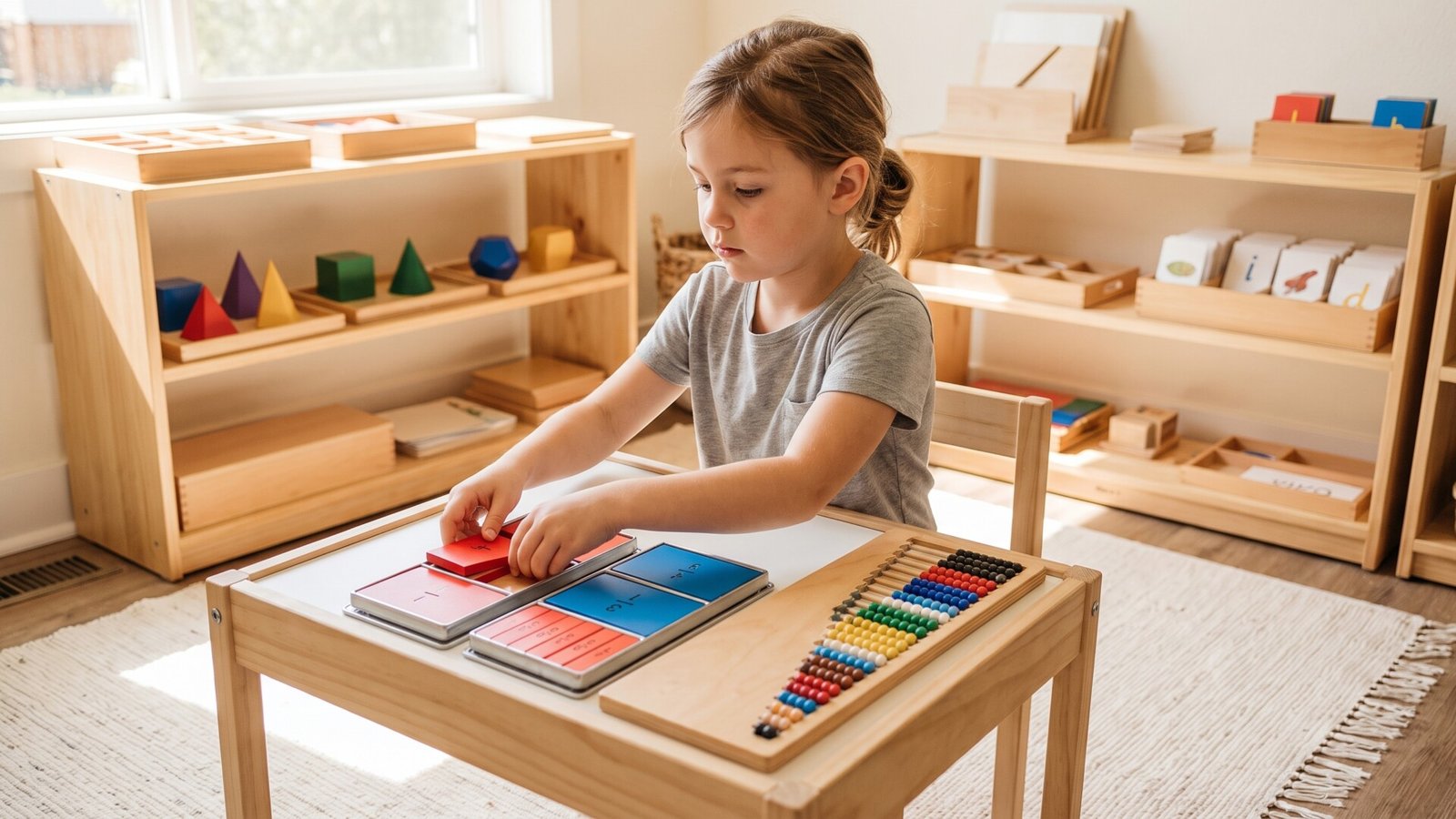
Montessori Toys for Early Elementary (6–9 Years Old)
The early elementary years represent a major cognitive and emotional shift in a child’s development. Between the ages of six and nine, children move beyond foundational skills and begin seeking understanding, reasoning, and connection. They are no longer satisfied with simply knowing that something works—they want to know why.
In Montessori education, this stage marks the transition from the absorbent mind of early childhood to the reasoning mind. Montessori toys and materials for early elementary children are designed to support this transition by offering deeper challenges in logic, problem-solving, math, language, and STEM—while remaining hands-on, self-directed, and intrinsically motivating.
This page serves as a sub-hub for Montessori toys for early elementary-aged children, with a strong focus on advanced Montessori materials, logical thinking, problem-solving, and STEM integration. It also connects outward to more specialized guides and reviews across ToyGuideHub.
For a broader view of Montessori materials across childhood, visit our Montessori Toys & Activities for Kids hub, where toys and activities are grouped by age, skills, and developmental needs.
Understanding the Montessori Early Elementary Stage
Children in early elementary are capable of abstract thinking, sustained concentration, and complex reasoning—but they still learn best when abstract ideas are grounded in concrete experience.
Key characteristics of this developmental stage include:
- A growing interest in logic, rules, and systems
- Increased ability to plan, test, and revise ideas
- Strong curiosity about how the world works
- Desire for intellectual challenge
- Emerging independence in learning
Montessori materials at this level are designed to bridge the gap between concrete and abstract, allowing children to manipulate ideas physically before internalizing them mentally.
Why Montessori Toys Still Matter Beyond Preschool
Some parents assume Montessori toys are only for young children. In reality, Montessori-aligned materials become even more powerful as children grow.
Montessori toys for early elementary:
- Encourage independent problem-solving
- Support deep focus and persistence
- Teach children how to think, not what to memorize
- Reinforce intrinsic motivation
- Integrate academic concepts without worksheets
Rather than replacing hands-on learning with screens or textbooks too early, Montessori materials continue to offer meaningful engagement at increasing levels of complexity.
Core Learning Areas for Montessori Early Elementary Toys
Montessori toys and materials for this age group often integrate multiple disciplines at once. This page focuses on three central areas: logic and problem-solving, advanced math and reasoning, and STEM-focused learning, all grounded in hands-on exploration.
Logic and Problem-Solving Toys
Logic is a cornerstone of early elementary Montessori work. Children at this age enjoy puzzles, patterns, and challenges that require sustained effort and reasoning.
What Makes a Montessori Logic Toy?
Montessori logic toys:
- Have a clear goal or challenge
- Are self-correcting
- Increase in difficulty gradually
- Require reasoning rather than guesswork
These materials invite children to think critically, test hypotheses, and persist through difficulty.
Common Montessori Logic and Problem-Solving Toys
- Pattern blocks and tangrams
- Logic puzzles with graded difficulty
- Sequence and strategy games
- Fraction and equivalency manipulatives
- Geometry construction sets
These toys help children:
- Recognize patterns and relationships
- Develop spatial reasoning
- Strengthen executive function skills
- Learn to approach challenges methodically
Because Montessori logic materials reward effort rather than speed, children build confidence in their ability to think deeply.
Advanced Montessori Math Toys
Montessori math materials extend far beyond counting and basic operations in early elementary. At this stage, children explore place value, fractions, geometry, and early algebraic thinking—all through concrete materials.
Key Math Concepts at This Stage
Montessori math toys support:
- Multi-digit operations
- Fractions and equivalence
- Measurement and units
- Geometry and spatial relationships
- Logical number patterns
Children manipulate quantities physically before transitioning to abstract symbols.
Common Advanced Montessori Math Materials
- Bead frames and bead chains
- Fraction circles and bars
- Geometry solids
- Decimal and place value boards
- Measurement tools and math games
These materials allow children to see mathematical relationships, reducing confusion and anxiety while strengthening understanding.
Why Montessori Math Works for Older Children
Because Montessori math builds conceptually from the ground up, children are less likely to rely on rote memorization. Instead, they understand why mathematical rules work, which supports long-term success.
Early elementary children who use Montessori math toys often:
- Show stronger number sense
- Approach math with confidence
- Develop flexible problem-solving strategies
- Transition smoothly into traditional curricula
STEM Integration in Montessori Toys
STEM learning aligns naturally with Montessori philosophy when it emphasizes exploration, experimentation, and real-world application.
Rather than teaching STEM concepts through screens alone, Montessori-integrated STEM toys encourage children to build, test, observe, and revise.
Montessori-Aligned STEM Toys and Materials
- Engineering and construction sets
- Simple machines kits
- Coding toys with physical components
- Science experiment kits with real tools
- Robotics kits designed for hands-on logic
These materials help children:
- Understand cause and effect
- Apply logic to real-world problems
- Develop early engineering thinking
- Explore scientific concepts through experimentation
Montessori STEM toys prioritize process over outcome, encouraging curiosity rather than performance.
Hands-On Learning and Project-Based Play
Early elementary children thrive on longer, more complex projects. Montessori materials support this by allowing work to unfold over extended periods.
Examples of Montessori-Inspired Projects
- Building functional models or structures
- Designing simple machines
- Conducting science experiments
- Creating math-based games
- Mapping, sorting, and classification projects
These activities strengthen planning, perseverance, and creative thinking—skills that are essential for lifelong learning.
Montessori Toy Recommendations by Early Elementary Stage
Although development varies, early elementary learning often progresses in recognizable phases.
Ages 6–7: Concrete Mastery and Exploration
Children refine foundational skills and explore more complex materials.
Recommended toy types:
- Advanced puzzles
- Fraction manipulatives
- Simple coding toys
- Geometry construction sets
Ages 7–8: Logical Reasoning and Systems Thinking
Children begin connecting ideas across disciplines.
Recommended toy types:
- Strategy games
- Engineering kits
- Measurement and data tools
- Pattern and logic challenges
Ages 8–9: Abstract Thinking and Independent Projects
Children increasingly work independently and tackle abstract concepts.
Recommended toy types:
- Robotics kits
- Advanced math games
- Science experiment sets
- Open-ended STEM materials
Creating a Montessori Learning Environment for Early Elementary
At this stage, the environment becomes more like a learning studio than a playroom.
Key elements include:
- Organized shelves with clearly labeled materials
- Space for long-term projects
- Access to reference books and tools
- Freedom to choose work and manage time
Montessori environments respect the child’s growing independence and intellectual curiosity.
Montessori Toys vs. Traditional Educational Toys
Many “educational” toys marketed to older children rely heavily on digital interfaces or scripted outcomes.
Montessori toys:
- Encourage reasoning over memorization
- Support sustained concentration
- Allow for self-directed learning
- Emphasize real-world relevance
Traditional educational toys often:
- Limit exploration
- Provide step-by-step instructions
- Focus on quick results
- Reduce opportunities for creativity
Over time, Montessori materials help children become independent thinkers rather than passive learners.
How Montessori Early Elementary Toys Support Academic Success
Montessori toys at this level do more than teach content—they develop learning habits.
These include:
- Persistence and grit
- Logical thinking
- Curiosity-driven exploration
- Confidence in tackling challenges
These skills translate directly into success across educational systems, not just Montessori classrooms.
Exploring More Montessori Guides
This early elementary sub-hub connects naturally to other Montessori resources on ToyGuideHub, including:
- Montessori Toys for Preschoolers
- Montessori Math Toys
- Montessori STEM Toys
- Montessori Coding and Logic Games
- Montessori Learning Activities by Age
Each guide dives deeper into specific materials and learning paths while reinforcing Montessori principles.
Choosing Montessori Toys as Gifts for Early Elementary Kids
Montessori toys make excellent gifts for older children because they remain challenging and relevant over time.
When choosing a gift:
- Look for open-ended challenges
- Avoid overly guided or electronic-only toys
- Prioritize quality materials
- Choose toys that grow with the child
A well-chosen Montessori toy often supports months or even years of meaningful engagement.
Common Questions About Montessori Toys for Early Elementary
Are Montessori toys too simple for older kids?
No. Montessori toys become more complex as children grow, supporting advanced reasoning and abstraction.
Can Montessori toys support STEM learning?
Yes. Many Montessori-aligned toys naturally integrate STEM concepts through hands-on problem-solving.
How many Montessori toys should an early elementary child have?
A focused selection of 10–15 high-quality materials, rotated over time, is usually ideal.
Final Thoughts: Building Thinkers, Not Just Learners
The early elementary years are when children begin forming their identity as thinkers and problem-solvers. Montessori toys honor this stage by offering materials that challenge the mind, engage the hands, and respect the child’s growing independence.
By choosing logic-based, problem-solving, and STEM-integrated Montessori toys, parents and educators create an environment where learning feels meaningful, empowering, and deeply satisfying.