Fun Science Experiments to Try at Home
I have a confession to make. For years, I avoided science experiments with my kids. The thought of baking soda volcanoes erupting across my kitchen counters, vinegar fumes filling the air, and glitter-glue concoctions staining my table made me break out in a cold sweat. I was convinced that home science meant home destruction.
But then my daughter asked me why the sky was blue. And I realized I had two choices: give her a half-baked answer I’d memorized in third grade, or actually show her how light interacts with particles in the atmosphere using a flashlight and a glass of milk. The latter took three minutes, cost nothing, and she still remembers it three years later.
That’s when I learned something important. The best science experiments at home aren’t about fancy equipment or pristine instruction manuals. They’re about the moment when a child’s eyes light up because they just made something happen that they didn’t expect. They’re about fostering curiosity, critical thinking, and hands-on learning that no screen can replicate.
The problem most parents face is finding safe, easy, and genuinely engaging experiments that don’t require a chemistry degree or a trip to a specialty store. You want something that works the first time, doesn’t create a disaster zone, and actually teaches something meaningful. I’ve been there. I’ve bought the kits that sat unopened. I’ve attempted the Pinterest experiments that failed spectacularly.
This article answers one question: What are some fun and simple science experiments that families can actually do together at home? I’ll walk you through the educational context, the key buying factors if you want to invest in supplies, and my honest recommendations for products that make this easier. I’ll also share what no one tells you about home science experiments—the hidden realities that separate the successes from the disasters.
Let me also mention that many of the materials and kits I’ll discuss are available through retailers like Amazon and Target. I’ll link to them naturally throughout the article, because I want you to have options, not because I want you to spend money you don’t need to spend.
The Science Behind the Science
Here’s what I wish someone had told me when I started this journey: science experiments at home aren’t just about keeping kids busy. They’re about building the foundation for how children think about the world.
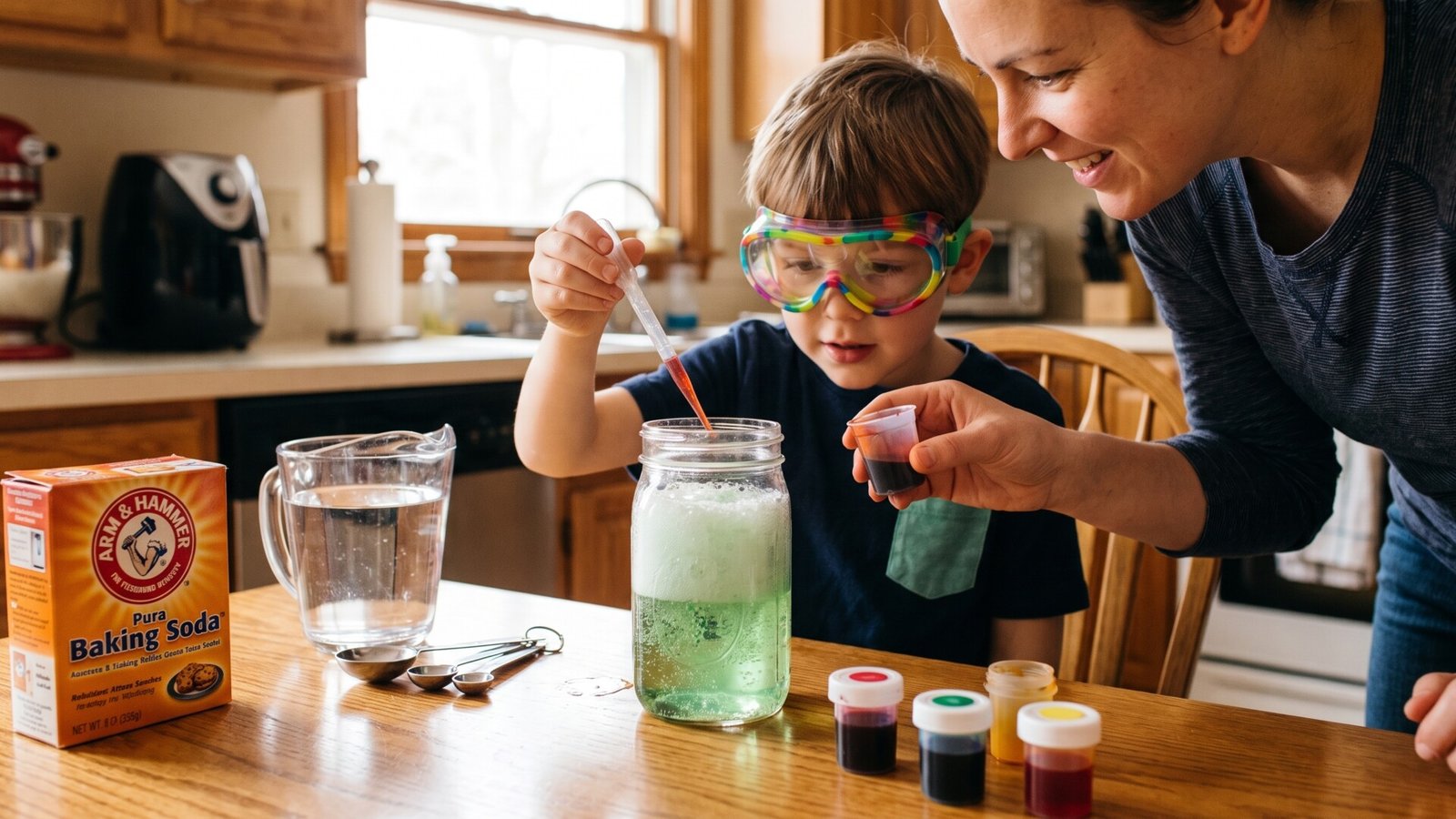
Research from the American Academy of Pediatrics emphasizes that hands-on learning experiences are critical for developing executive function skills—things like planning, flexible thinking, and self-control. When a child mixes baking soda and vinegar and watches it fizz, they’re not just seeing a reaction. They’re forming a hypothesis (“What if I add more vinegar?”), making an observation (“It fizzed higher that time”), and drawing a conclusion (“More vinegar makes a bigger reaction”). That’s the scientific method in action, and it’s happening organically.
The developmental benefits go deeper than STEM skills. Problem-solving becomes second nature when children learn that experiments don’t always work the first time. Observation skills sharpen when they start noticing details—the color change, the temperature shift, the bubble size. And patience? That develops naturally when they have to wait for a crystal to form or a plant to grow.
I know what you’re thinking. “That sounds lovely, but what about the mess?” You’re not wrong. Safety and messiness are the two biggest concerns parents raise when I talk about home experiments. And I get it. I’ve cleaned baking soda paste off my ceiling. I’ve found glitter in places glitter has no business being.
But here’s the counterintuitive insight: the messiest experiments often teach the most valuable lessons. When a child helps clean up after a volcano eruption, they’re learning about responsibility and consequences. When you set up a “mess zone” with newspapers and old towels, you’re teaching preparation and boundaries. The mess isn’t the enemy. The lack of planning is.
Current trends in home education have accelerated since school closures became a reality for many families. DIY science projects have surged in popularity, not just because parents needed activities, but because children genuinely crave hands, eyes, and minds working together. The rise of STEM-focused content on platforms like YouTube and TikTok has shown parents that science doesn’t have to be intimidating.
I remember the first time I let my son conduct an experiment without my hovering supervision. He was seven. He wanted to see if different liquids would make a paper towel absorb faster. Water, oil, juice, milk. He spilled oil on the floor. He dripped juice on the rug. But he also discovered something I never would have predicted: oil actually slowed absorption down. He asked me why. I didn’t know the answer. So we looked it up together.
That moment—the shared discovery, the honest “I don’t know,” the joint research—was worth every drop of oil on my kitchen floor.
What Makes a Good Home Science Experiment?
Let me clarify something. When I say “science experiment,” I’m not talking about a structured lab activity with formal lab reports. I’m talking about any activity where a child asks a question, tests something, and observes what happens. It can be as simple as dropping raisins into carbonated water to see if they float, or as complex as building a simple circuit with a battery and a light bulb.
The key terminology matters, even for young children. A hypothesis is just a prediction—an educated guess about what will happen. Observation is paying close attention to what actually occurs. An experiment is the test itself. And a conclusion is what you learned from the test. You don’t need a whiteboard or a lab coat to use these words. You just need to say, “What do you think will happen? Let’s find out.”
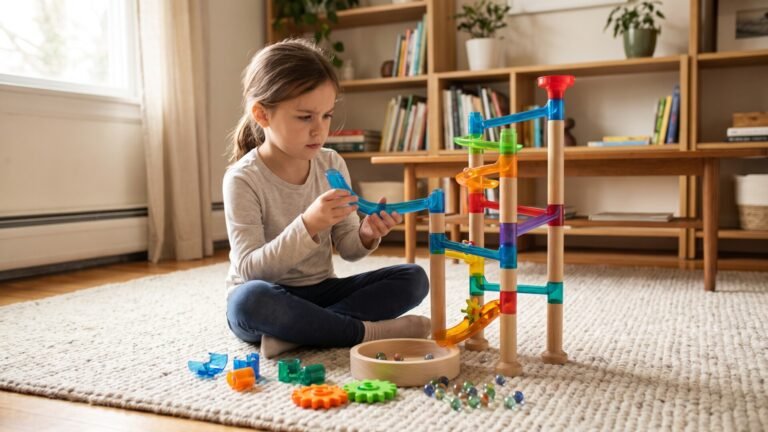
Different types of experiments serve different purposes. Chemical reactions, like the classic baking soda and vinegar volcano, teach about how substances interact and change. Physics experiments, like building a simple catapult or testing how different surfaces affect rolling speed, teach about forces and motion. Biology experiments, like growing beans in a jar or observing ants, teach about living systems and life cycles.
Here’s something most articles won’t tell you: the best experiments don’t need to align perfectly with school curricula. In fact, the ones that diverge from what children learn in school often spark more curiosity because they feel like play, not homework. My daughter learned more about density from a sink-or-float experiment with oranges (did you know oranges float with the peel on but sink without it?) than she did from an entire unit in her fourth-grade science textbook.
That said, many experiments do align beautifully with what children are learning in school. A simple experiment showing how plants absorb colored water through their stems directly connects to lessons about vascular systems. Building a homemade compass connects to lessons about magnetism. The key is to let the experiment lead the learning, not the other way around.
I’ve found that the experiments that excite children most are the ones with visible, dramatic results. The volcano that erupts. The crystal that grows overnight. The egg that floats in saltwater. These create memorable moments that children want to repeat and show others. And repetition is how real learning happens.
What to Look for When Buying Science Experiment Materials
If you’re going to invest in materials or kits for home science experiments, you need to know what actually matters. I’ve learned this the hard way, through kits that disappointed and supplies that underperformed.
Safety comes first, and I don’t mean that as a throwaway line. Non-toxic materials are non-negotiable. Look for kits that explicitly state they are non-toxic and conform to ASTM safety standards. Pay attention to age recommendations, but understand they’re guidelines, not rules. A five-year-old can do a chemistry experiment with close supervision. A ten-year-old might still need help with precise measurements.
Adult supervision is required for most experiments, especially those involving chemicals, heat, or small parts. This isn’t a negative. It’s an opportunity for connection. The best science moments I’ve had with my children happened when we were working side by side, me guiding, them discovering.
Durability matters more than you might think. Cheap plastic beakers crack. Flimsy pipettes break. Low-quality magnifying glasses scratch. If you’re buying a microscope or a chemistry set, invest in something that will survive multiple uses and multiple children. I’ve seen too many parents buy the cheapest option only to replace it within weeks.
Ease of assembly and execution is crucial for maintaining enthusiasm. If a kit requires thirty minutes of setup before the experiment can begin, most children will lose interest. Look for kits with clear, illustrated instructions and minimal prep time. The best kits let children start experimenting within minutes of opening the box.
Educational value varies dramatically between products. Some kits are essentially fancy versions of what you could do with household items. Others introduce concepts that would be difficult to demonstrate without specialized materials. A crystal growing kit, for example, provides a hands-on experience that’s hard to replicate with pantry items. A simple magnetism kit might not justify its cost if you already have magnets at home.
Storage requirements are often overlooked. Experiment kits come with multiple components, and if you don’t have a system for keeping everything organized, you’ll lose pieces within weeks. Consider whether the kit comes with a storage container or whether you’ll need to provide your own. Some of the best kits include compartmentalized boxes that keep everything in its place.
Maintenance and cleanup are the realities that separate occasional experimenters from regular ones. Some experiments leave residue. Some require special disposal. Some create odors that linger. Before you commit to a particular experiment or kit, think about where you’ll do it and how you’ll clean up afterward. I’ve learned to keep a dedicated set of towels, a spray bottle of vinegar solution, and a plastic tablecloth specifically for science projects.
Here’s something most reviews won’t tell you: the cost of replacement materials. Many kits provide enough supplies for one or two rounds of an experiment, but children will want to repeat their favorites. Check whether refill packs are available and how much they cost. A kit that seems affordable initially can become expensive if you need to buy refills frequently.
The Good and the Not-So-Good
Let me be honest about what you’re getting into.
Pros
The engagement factor is off the charts. I’ve never met a child who wasn’t fascinated by watching a volcano erupt or a crystal form. Science experiments tap into something fundamental in children—the desire to understand why things happen. When an experiment works, the excitement is genuine and memorable.
Teamwork and communication flourish naturally during experiments. Siblings who usually argue about everything will suddenly collaborate to measure ingredients and record observations. Parents and children who struggle to find common ground will discover shared wonder. I’ve seen this happen in my own home, and it never gets old.
The love for learning that develops through experiments extends beyond science. Children who learn that asking questions leads to fascinating answers become better learners in all subjects. They develop intellectual curiosity that serves them throughout their education and lives.
Family bonding through experiments creates memories that last. My children still talk about the time we made a baking soda rocket that actually launched. They remember the failed attempts more vividly than the successful ones, because those failures taught them resilience and problem-solving.
Cons
The mess is real. I won’t pretend otherwise. Baking soda gets everywhere. Water spills happen. Food coloring stains. The key is preparation, not avoidance. Set up in a contained area, use protective coverings, and accept that some cleanup will be required. The learning is worth the mess.
Adult supervision is necessary for many experiments, which means you can’t just set children loose and walk away. This requires time and attention. If you’re already overwhelmed, adding a science experiment to your day might feel like too much. Start small. Choose experiments that require minimal supervision and build from there.
Material availability can be frustrating. Some experiments call for items you might not have on hand—baking soda is common, but cream of tartar isn’t. Before you commit to an experiment, check whether you have everything you need. Nothing kills enthusiasm faster than discovering you’re missing a key ingredient mid-experiment.
Products That Make Home Science Easier
After years of trial and error, I’ve found several products that consistently deliver good experiences. These aren’t the only options, but they’re the ones I recommend to friends and family.
Science Experiment Kits for Kids
| Feature | Details |
|---|---|
| Age Range | 5-12 years |
| Key Features | Multiple experiments, safety gear, instructional guides |
| Affiliate Program | Amazon Associates |
Why I Like It: These kits solve the biggest problem parents face: having everything you need in one box. No hunting for missing ingredients. No realizing you don’t have the right container. The instructions are clear enough that children can follow along with minimal help, and the experiments are genuinely engaging.
Best For: Families who want guided, easy-to-follow experiments without the hassle of gathering materials.
Pros:
- Ready-to-use with all materials included
- Engaging projects that spark genuine curiosity
- Multiple experiments in one kit provide variety
Cons:
- Quality varies significantly between brands
- Some kits include experiments children outgrow quickly
[Affiliate: Check current pricing and availability on Amazon]
Microscope Set
| Feature | Details |
|---|---|
| Age Range | 8+ years |
| Key Features | Adjustable magnification, prepared slides, educational guide |
| Affiliate Program | Target Affiliate Program |
Why I Like It: A good microscope opens up an entirely new world. Children can examine leaves, insects, fabric fibers, and their own fingerprints. The prepared slides provide immediate gratification, while the ability to create their own slides encourages ongoing exploration.
Best For: Children who are curious about the details of the world around them.
Pros:
- Durable construction that survives regular use
- Easy to use with clear focus adjustment
- Encourages independent scientific exploration
Cons:
- Requires adult supervision for younger children
- Some models have limited magnification range
[Affiliate: Check current pricing and availability at Target]
Chemistry Experiment Set
| Feature | Details |
|---|---|
| Age Range | 8-14 years |
| Key Features | Safe chemical reactions, detailed instructions, safety equipment |
| Affiliate Program | Melissa & Doug Affiliate Program |
Why I Like It: This set provides hands-on experience with safe, simple chemical reactions that demonstrate real scientific principles. The included safety goggles and gloves teach good lab practices from the start.
Best For: Children fascinated by chemistry who want to conduct real experiments, not just watch demonstrations.
Pros:
- Engaging experiments that produce visible results
- Inspires creativity in scientific exploration
- High-quality materials that last
Cons:
- Some experiments require adult supervision
- Refill packs can be expensive
[Affiliate: Check current pricing and availability through Melissa & Doug]
DIY Volcano Kit
| Feature | Details |
|---|---|
| Age Range | 5-12 years |
| Key Features | All materials included for creating a fun erupting volcano |
| Affiliate Program | Amazon Associates |
Why I Like It: The volcano experiment is a classic for a reason. It’s visually spectacular, easy to set up, and teaches about chemical reactions in a memorable way. This kit includes everything you need, including the volcano mold and eruption materials.
Best For: Families who want a fun, visually exciting project that delivers immediate results.
Pros:
- Simple materials produce spectacular results
- Great for learning about chemical reactions
- Multiple eruption opportunities with refill packs
Cons:
- Can be messy; requires cleanup planning
- Some children may lose interest after the first eruption
[Affiliate: Check current pricing and availability on Amazon]
Electronic Snap Circuits
| Feature | Details |
|---|---|
| Age Range | 8+ years |
| Key Features | Builds electronic circuits with snap-together parts |
| Affiliate Program | Target Affiliate Program |
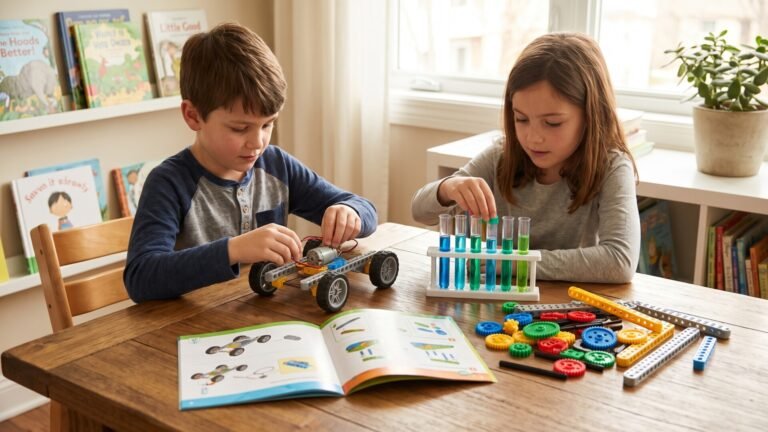
Why I Like It: This product teaches the basics of electronics in an engaging, hands-on way. Children can build working circuits, lights, fans, and even radios without soldering or complex wiring. The snap-together design makes it accessible and frustration-free.
Best For: Children interested in technology, engineering, and how things work.
Pros:
- Multiple projects possible with the same kit
- Encourages independent play and learning
- Teaches real engineering principles
Cons:
- Some parts are small and could pose a choking hazard
- Requires batteries, which aren’t always included
[Affiliate: Check current pricing and availability at Target]
How These Options Compare
| Product | Age Range | Safety | Educational Value | Price Range | Best For |
|---|---|---|---|---|---|
| Science Experiment Kits | 5-12 | ✅ | ⭐⭐⭐⭐⭐ | $30-$50 | Guided Learning |
| Microscope Set | 8+ | ✅ | ⭐⭐⭐⭐⭐ | $40-$70 | Biological Exploration |
| Chemistry Experiment Set | 8-14 | ✅ | ⭐⭐⭐⭐⭐ | $25-$60 | Chemical Reactions |
| DIY Volcano Kit | 5-12 | ✅ | ⭐⭐⭐⭐ | $15-$30 | Fun Visuals |
| Electronic Snap Circuits | 8+ | ✅ | ⭐⭐⭐⭐⭐ | $50-$100 | Engineering |
The price ranges reflect typical retail prices, but sales and discounts are common. I’ve seen the volcano kit drop below $15 during holiday sales, and the snap circuits set can sometimes be found for under $40 during clearance events.
Choosing What’s Right for Your Family
Every family is different, and the best choice depends on your specific situation.
For young scientists (ages 4-7), focus on experiments with immediate, visible results and minimal steps. The DIY volcano kit is perfect for this age group. Simple sink-or-float experiments with household objects also work well. Avoid anything that requires precise measurements or extended waiting periods.
For older children (ages 8-12), look for experiments that introduce real scientific concepts and require some independent thinking. The chemistry set and electronic snap circuits are excellent choices. Children at this age can handle more complex instructions and longer experiments.
For outdoor experiments, prioritize activities that benefit from space and ventilation. Volcano eruptions, rocket launches, and bubble experiments are better outside. The mess is easier to manage, and children have room to explore safely.
For limited space, choose experiments with minimal materials and setup. The microscope set requires only a small table. Crystal growing kits fit on a windowsill. Paper-based experiments like chromatography require almost no space at all.
For family bonding, select experiments that require multiple participants. Building a snap circuits project together or conducting a chemistry experiment with different roles (one person measures, another observes, a third records) creates natural collaboration.
For tight budgets, start with experiments using common household items. Baking soda and vinegar cost pennies. Food coloring lasts for dozens of experiments. Paper towels, string, and empty containers can fuel weeks of exploration. The [Internal: ToyGuideHub Science Experiments hub] has dozens of ideas that cost nothing to implement.
What Most Reviews Don’t Tell You
Here’s the honest truth that no one wants to admit: most science experiment kits get used once, maybe twice, before being abandoned. The initial excitement fades, the materials get mixed up, and the kit ends up in the back of a closet.
The kits that survive are the ones that offer variety and replayability. Snap circuits excel here because children can build different projects each time. Chemistry sets with multiple experiments also perform well. Single-experiment kits, like volcano kits, have limited longevity unless your child is unusually dedicated to repetition.
Another hidden reality: children often prefer the experiments they design themselves over the ones in the instructions. My son spent more time mixing random kitchen ingredients to see what would happen than he ever spent following a kit’s directions. This frustrated me at first, until I realized he was learning more through his own exploration than through guided activities.
The best approach is to use kits as starting points, not strict guides. Let children deviate. Let them ask “what if” questions and test their own ideas. The kit provides the materials and safety framework. The child provides the curiosity.
The Bottom Line
Here’s what I want you to take away from this article: home science experiments don’t have to be complicated, expensive, or perfect. The best experiments are the ones you actually do together, not the ones you plan perfectly and never execute.
If I had to recommend one product for most families, it would be a comprehensive science experiment kit for the 5-12 age range. It removes the barrier of gathering materials and provides enough variety to maintain interest. For children specifically interested in electronics, the snap circuits set is worth the investment. For budget-conscious families, the DIY volcano kit delivers maximum excitement for minimal cost.
But honestly? The best investment you can make isn’t a product at all. It’s your willingness to say “I don’t know, let’s find out together.” It’s your patience when the experiment fails and your enthusiasm when it works. It’s the time you spend kneeling beside your child, watching baking soda bubble, and sharing a moment of genuine wonder.
That is the secret at the heart of home science experiments. They’re not about the materials or the instructions. They’re about the connection you build with your child through shared discovery.
Frequently Asked Questions About Science Experiments
What age is appropriate for science experiments?
Children as young as three can participate in simple experiments with close supervision. By age five, most children can follow basic instructions and understand cause and effect. The key is matching the complexity of the experiment to the child’s attention span and fine motor skills.
Are home science experiments safe for children?
Yes, when proper precautions are taken. Use non-toxic materials, provide appropriate supervision, and establish clear rules about tasting or touching unknown substances. Avoid experiments involving open flames, high heat, or toxic chemicals. Stick to kitchen-safe ingredients and age-appropriate kits.
What materials are typically needed for home experiments?
Most experiments require common household items: baking soda, vinegar, food coloring, water, containers, paper towels, and measuring spoons. More advanced experiments may need specific supplies like magnifying glasses, thermometers, or pH paper. Kits provide everything needed for their specific experiments.
How can parents encourage their kids to engage with science?
Start with experiments that align with your child’s existing interests. If they love dinosaurs, explore fossil-making activities. If they’re into cooking, investigate the science of baking. Ask open-ended questions during experiments: u0022What do you think will happen if we add more?u0022 u0022Why do you think that happened?u0022
What are some common mistakes to avoid in home experiments?
Skipping the planning phase is the biggest mistake. Read instructions completely before starting. Gather all materials in advance. Set up your workspace with protective coverings. Have cleanup supplies ready. Another common mistake is expecting perfectionu2014experiments fail sometimes, and that’s part of the learning.
How do I ensure the experiments are educational?
Focus on the process, not just the result. Ask questions that encourage observation and prediction. Have your child record what they see, even if it’s just drawing a picture. Connect the experiment to real-world phenomena: u0022This is the same reaction that makes volcanoes erupt in nature.u0022
How can I store the materials after the experiments?
Use clear, labeled containers for different categories of supplies. A small plastic bin with compartments works well for small items like measuring spoons and pipettes. Store chemicals in their original containers with labels intact. Keep everything in a dedicated location where children can access it safely.