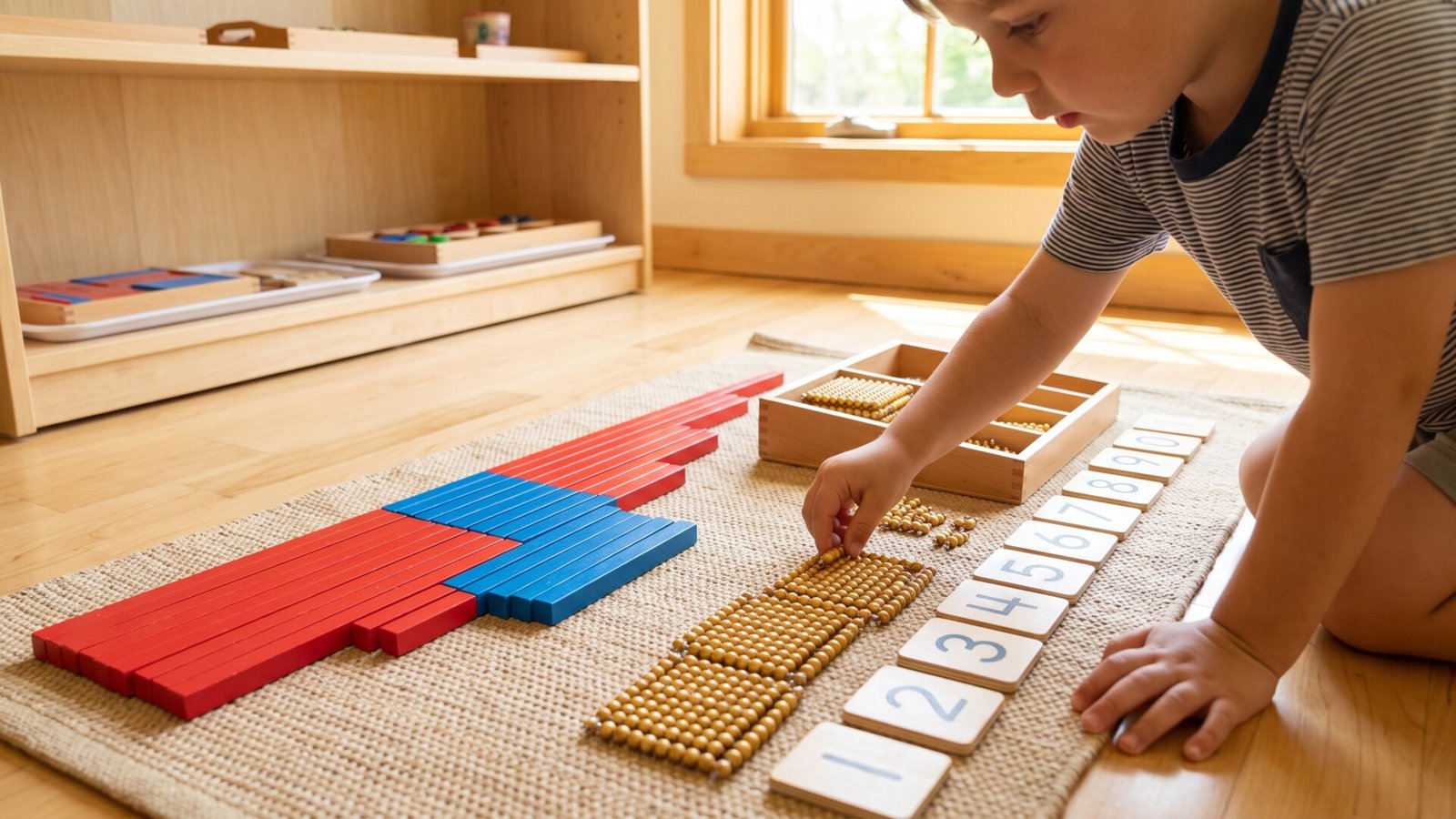
Montessori Math Games for Kids
Mathematics is more than numbers and symbols—it is a language of patterns, relationships, and logical thinking. Montessori math games allow children to experience numbers, operations, and geometry through hands-on, purposeful play, building deep understanding that lasts far beyond the preschool years.
Unlike traditional worksheets or screen-based math games, Montessori math activities teach children to think critically, problem-solve, and explore abstract concepts through concrete materials, making learning intuitive, engaging, and fun.
This page serves as a Montessori math games sub-hub, connecting families and educators to age-appropriate materials, games, and activities from toddlers through early elementary. It is part of the complete Montessori Toys & Activities for Kids hub, where we cover hands-on learning tools and play-based activities that help children build number sense, problem-solving skills, and confidence through the Montessori approach.
What Are Montessori Math Games?
Montessori math games are structured, tactile activities that guide children to understand mathematical concepts naturally. The games are often self-correcting, multi-sensory, and designed to progress from concrete experiences to abstract reasoning.
Key features include:
- Hands-on manipulatives for counting, measuring, and sorting
- Self-correction to encourage independent learning
- Progressive complexity tailored to age and developmental stage
- Focus on reasoning, pattern recognition, and problem-solving
These games make math tangible, helping children internalize concepts rather than memorize procedures.
Why Montessori Math Is Unique
Traditional math often begins with symbols, formulas, and abstract instruction. Montessori flips this approach, starting with concrete, meaningful experiences. Children manipulate beads, rods, tiles, and other tactile materials to understand quantity, sequencing, and relationships.
Montessori math games support:
- Number sense and counting
- Operations (addition, subtraction, multiplication, division)
- Fractions, decimals, and place value
- Geometry, measurement, and pattern recognition
- Logical thinking and problem-solving
By connecting hands-on experiences with abstract symbols, children develop a strong foundation in mathematical reasoning.
Core Categories of Montessori Math Games
Montessori math materials and games are generally organized around numbers, operations, geometry, and measurement. These categories provide a roadmap for progressing from concrete manipulation to mental calculation.
Number Sense and Counting Games
Number sense is the cornerstone of mathematical understanding. Montessori games help children explore quantities, one-to-one correspondence, and symbolic representation.
Examples of Number Sense Games
- Number rods and bead chains
- Counting boards with physical counters
- Object-to-number matching games
- Number puzzles and sequencing activities
Benefits include:
- Understanding quantity and order
- Linking physical objects to numeric symbols
- Strengthening visual and tactile memory
Operations Games (Addition, Subtraction, Multiplication, Division)
Once number sense is established, children explore operations through hands-on games rather than abstract calculations.
Common Montessori Operations Games
- Bead bars for addition and subtraction
- Golden bead materials for multiplication and division
- Math equation puzzles
- Game-based problem-solving cards
These activities teach children to:
- Visualize operations concretely
- Understand mathematical relationships
- Develop independent problem-solving skills
- Reduce reliance on memorization alone
Fractions and Place Value Games
Fractions and place value can be abstract concepts for children. Montessori materials make these tangible through color-coded beads, bars, and boards.
Montessori Fraction and Place Value Games
- Fraction circles and bars
- Decimal bead boards
- Place value charts
- Fraction dominoes and matching games
These games help children:
- Compare quantities
- Understand equivalence
- Build mental calculation strategies
- Connect visual representation with numeric concepts
Geometry and Spatial Reasoning Games
Geometry is not limited to shapes on paper. Montessori geometry games engage children in hands-on exploration of forms, spatial relationships, and symmetry.
Examples of Geometry Games
- Geometric solids and shape puzzles
- Pattern block games
- Tangram puzzles
- Constructive triangles and modular shapes
These games develop:
- Spatial awareness and visualization
- Classification and pattern recognition
- Logical reasoning
- Fine motor skills
Measurement and Data Games
Montessori encourages children to explore measurement and data through real-world, interactive games.
Common Measurement Games
- Rulers, scales, and measuring cups
- Volume and weight comparison activities
- Time and calendar exercises
- Sorting and graphing manipulatives
Benefits include:
- Hands-on understanding of units and quantities
- Early data interpretation skills
- Connection between math and everyday life
- Observational and analytical thinking
Montessori Math Games by Age Group
Toddlers (1–3 Years)
At this stage, children focus on pre-math skills like counting, sorting, and matching.
Recommended activities:
- Counting with objects and toys
- Simple shape sorting games
- Matching number cards with items
- Pattern recognition games
Goal: Establish familiarity with numbers, shapes, and sequences.
Preschoolers (3–6 Years)
Preschoolers begin exploring basic operations and quantity relationships.
Recommended activities:
- Number rods and bead chains
- Simple addition and subtraction games
- Shape classification and patterning
- Early measurement activities
Goal: Build foundational math skills through tangible experiences.
Early Elementary (6–9 Years)
Older children engage in more complex operations, fractions, geometry, and problem-solving.
Recommended activities:
- Multiplication and division with golden beads
- Fraction and place value activities
- Tangrams and advanced geometry puzzles
- Measurement-based games and data activities
Goal: Deepen reasoning skills and connect concrete materials to abstract concepts.
Creating a Montessori Math Area at Home
A prepared math area encourages independent exploration and repeated practice.
Key elements:
- Low shelves for accessible materials
- Organized trays or baskets for each game
- Limited, rotating activities to maintain focus
- Space for manipulation and extended work sessions
Consistency and accessibility help children engage with materials meaningfully.
Montessori Math Games vs. Traditional Math Toys
Montessori math games differ from typical “educational” math toys in several key ways:
Montessori Math Games:
- Hands-on and tactile
- Self-correcting
- Progressive and developmental
- Emphasize understanding over speed
Traditional Math Toys:
- Often digital or screen-based
- Rely on memorization or drill
- Limited in developmental progression
- Focus on quick results rather than comprehension
Montessori math games foster long-term reasoning, attention, and problem-solving skills rather than short-term achievement.
How Montessori Math Games Support Academic Readiness
Math games develop numeracy, logical thinking, and problem-solving, supporting success in formal schooling.
Benefits include:
- Strong number sense
- Confidence with calculations
- Ability to reason through problems
- Connection between concrete and abstract concepts
Children with Montessori math experience often transition smoothly into elementary and beyond.
Choosing Montessori Math Games as Gifts
Math games make excellent gifts because they grow with the child and remain relevant across age levels.
When choosing:
- Prefer manipulatives over electronic toys
- Select games that are self-correcting
- Choose durable, natural materials
- Ensure developmental appropriateness
High-quality Montessori math games often engage children for months or years.
Common Questions About Montessori Math Games
Do children need to be able to read to play these games?
No. Many games use objects, beads, and manipulatives to teach concepts before reading skills emerge.
Can these games support children struggling with math?
Yes. Hands-on, self-correcting materials allow children to explore and understand concepts at their own pace.
How many math games should a child have?
A focused selection of 8–12 well-chosen materials, rotated periodically, works best.
Final Thoughts: Learning Through Manipulation and Exploration
Montessori math games transform learning from abstract numbers on a page into tangible, joyful experiences. By connecting hands-on manipulation to reasoning and problem-solving, children develop strong mathematical foundations, logical thinking, and confidence that last a lifetime.
Where do we go from here?
Give your preschooler a head start with hands-on learning. Our guide, Montessori Math Kits for 3–5 Year Olds, highlights age-appropriate kits that make counting, pattern recognition, and basic operations fun and interactive. These kits are perfect for children who thrive on tactile and visual learning.
Looking for toys that lay the groundwork for lifelong numeracy? Toys That Build Early Math Foundations walks you through games and manipulatives that encourage problem-solving, sequencing, and early arithmetic skills — all aligned with Montessori principles.
Introduce your child to early computational thinking in a playful way. Montessori Coding and Logic Games provides simple, screen-free activities that teach sequencing, pattern recognition, and logical thinking while keeping the fun intact.
Combine STEM exploration with math skills through hands-on experiments. The Top 5 Simple Science Kits for 4-Year-Olds are designed for curious young learners and help reinforce counting, measurement, and observation — all while keeping play engaging and educational.