Montessori Language Games for Kids
Language development in Montessori education begins long before children learn to read or write. From the first spoken words to early literacy skills, Montessori language games are designed to help children absorb language naturally, through movement, repetition, and meaningful interaction.
Rather than worksheets or rote memorization, Montessori language games focus on oral language, vocabulary building, phonemic awareness, and symbolic understanding, all introduced at the child’s developmental pace. These activities are playful, hands-on, and deeply connected to real-world experiences.
This page serves as a language games sub-hub, guiding parents and educators toward Montessori-aligned language activities across ages and skill levels. This collection is part of our main Montessori Toys & Activities for Kids hub, where we share thoughtfully designed games, toys, and activities that support early reading, vocabulary building, and communication skills through hands-on Montessori learning.
What Are Montessori Language Games?
Montessori language games are structured activities that help children explore spoken and written language through concrete experiences. They are called “games” not because they are competitive, but because they invite joyful participation and repetition.
Key characteristics of Montessori language games:
- Hands-on and interactive
- Progress from oral language to written language
- Often self-correcting
- Designed for independent or guided use
- Integrated into daily life
Language is treated as something children discover, not something they are forced to memorize.
Why Language Development Is Central in Montessori
Maria Montessori viewed language as a natural human instinct that flourishes when children are surrounded by rich, meaningful communication.
Montessori language work helps children:
- Expand vocabulary naturally
- Develop clear pronunciation
- Understand sentence structure
- Build confidence in communication
- Prepare for reading and writing
Importantly, Montessori language games prioritize spoken language first, laying a strong foundation before introducing letters and symbols.
How Montessori Language Games Differ from Traditional Language Toys
Many conventional language toys focus on early reading drills, flashcards, or electronic prompts. Montessori language games take a more developmental approach.
Montessori language games:
- Begin with listening and speaking
- Introduce letters only after sound awareness
- Avoid screens and electronics
- Emphasize real objects and experiences
This ensures children truly understand language rather than simply recognizing symbols.
Core Categories of Montessori Language Games
Montessori language activities progress in a natural sequence, moving from oral language to written expression.
Oral Language Games (Listening & Speaking)
Oral language is the foundation of all later literacy skills.
Common Montessori Oral Language Games
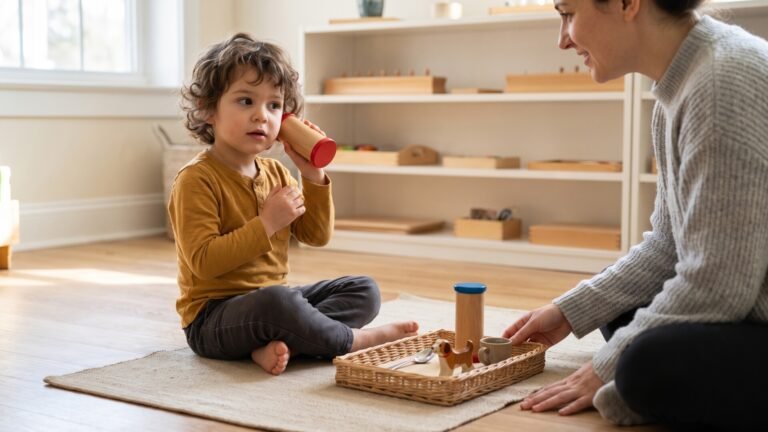
- Object naming games
- Classified vocabulary sets (animals, food, tools)
- “I Spy” sound games
- Conversation prompts and storytelling cards
These games help children:
- Expand expressive vocabulary
- Improve listening skills
- Learn descriptive language
- Gain confidence speaking
Many oral language games require no materials at all, making them easy to use daily.
Phonemic Awareness Games (Sound Recognition)
Before children can read, they must recognize and manipulate sounds in words.
Common Montessori Phonemic Games
- “I Spy” with initial sounds
- Rhyming word games
- Sound sorting activities
- Object-to-sound matching sets
These activities develop:
- Sound discrimination
- Auditory memory
- Early decoding readiness
Montessori introduces sounds first, not letter names, which aligns with how reading actually works.
Letter Recognition & Symbol Games
Once children are comfortable with sounds, they are ready to connect them to symbols.
Common Montessori Letter Games
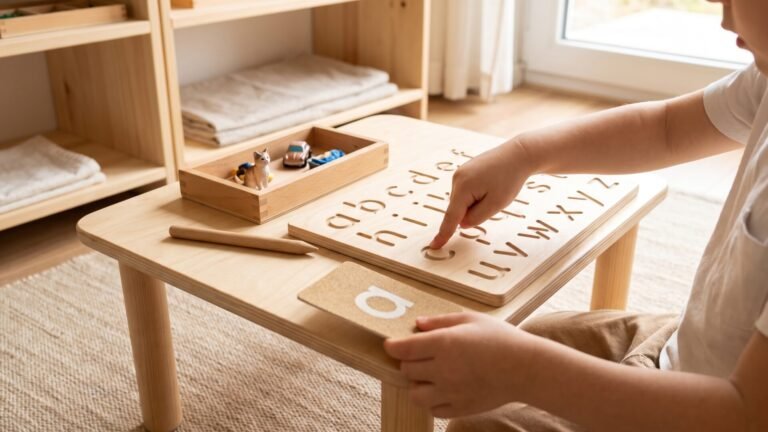
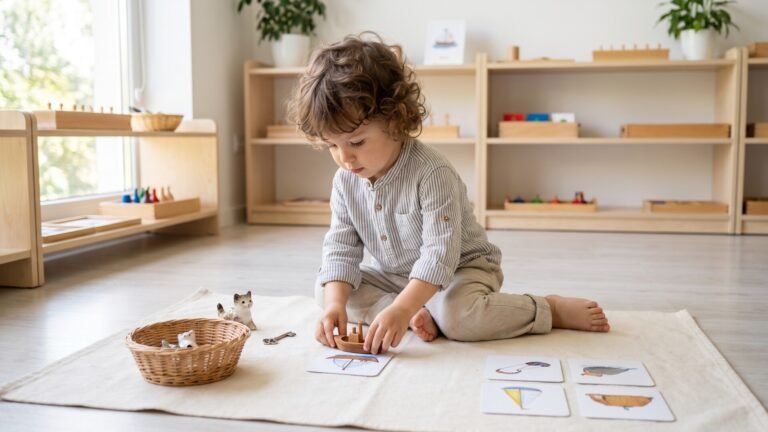
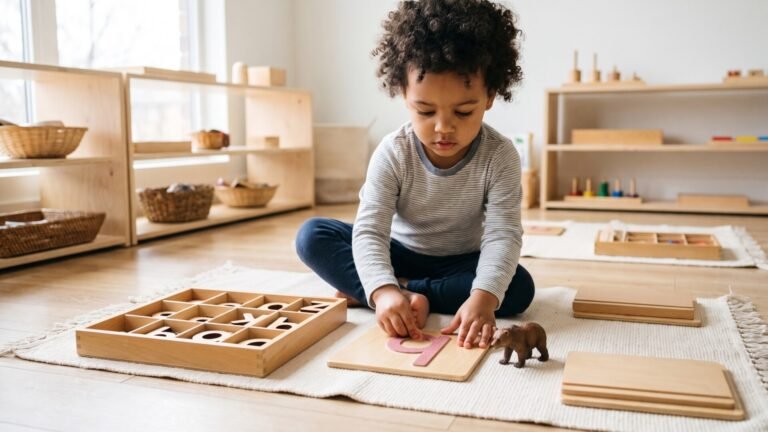
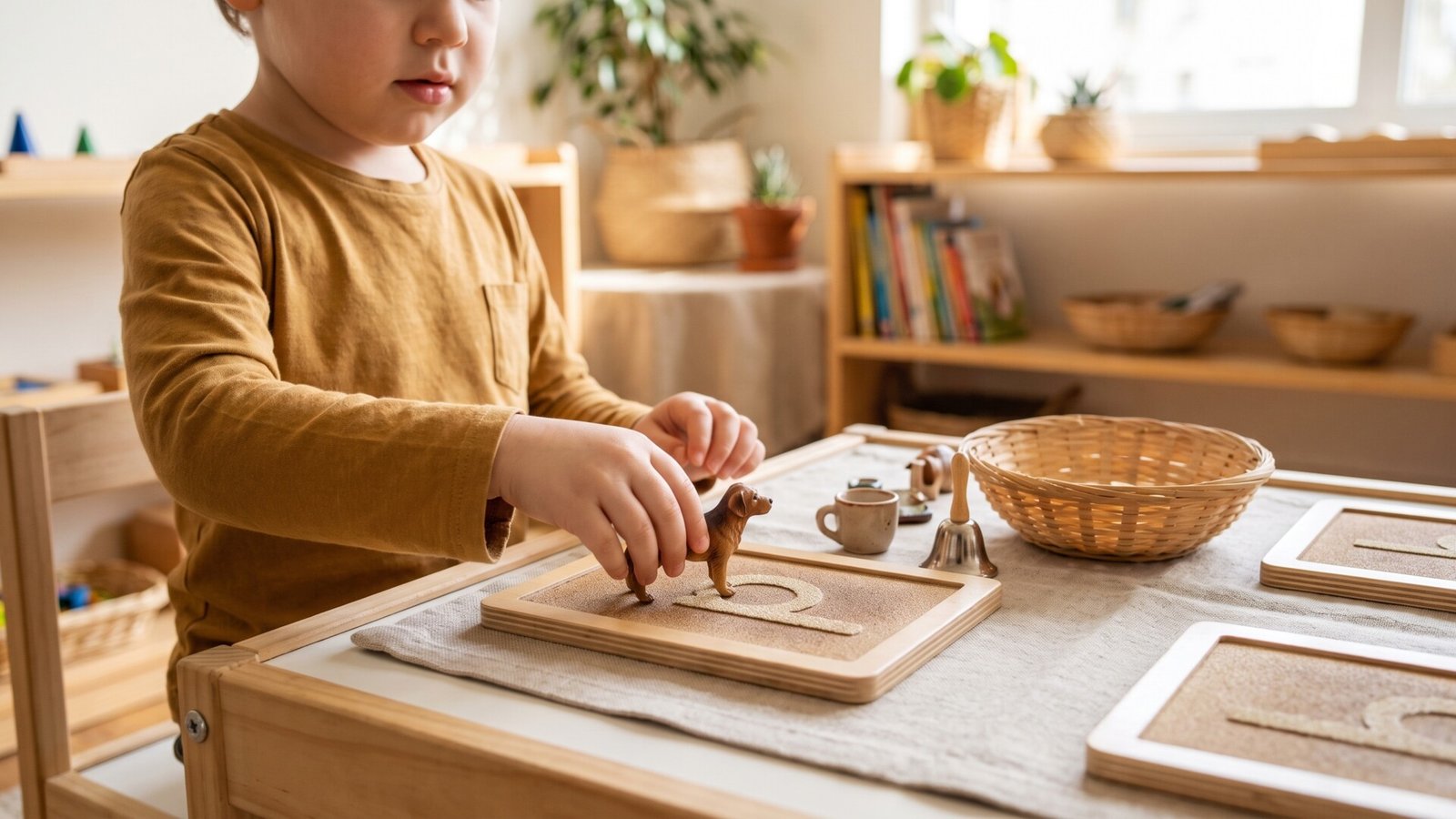
- Sandpaper letters
- Letter matching boards
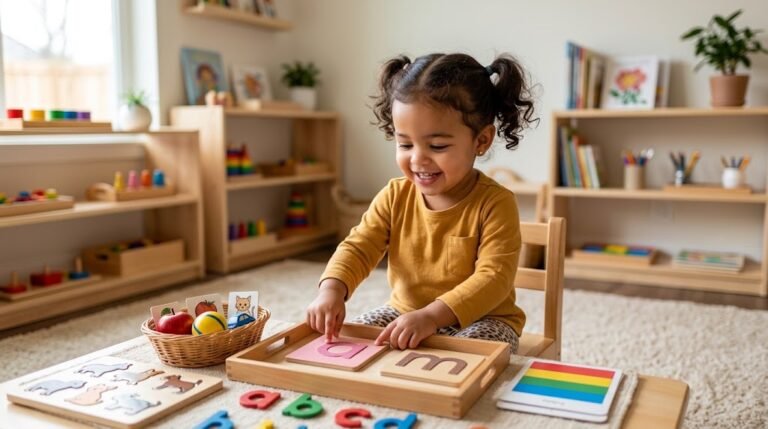
- Alphabet object trays
- Moveable alphabet exploration
These games support:
- Muscle memory through tracing
- Visual-symbol association
- Fine motor development
Children often learn to write words using the moveable alphabet before they read them.
Early Reading Games
Reading emerges naturally when sound-symbol connections are strong.
Montessori Reading Games Include
- Phonetic word cards
- Object-to-word matching
- Simple command cards
- Early reading booklets
These activities help children:
- Decode words independently
- Build reading confidence
- Understand meaning, not just symbols
Reading is never rushed—children progress when they are ready.
Writing & Expression Games
Writing in Montessori begins as a physical and expressive process, not a test of spelling accuracy.
Common Montessori Writing Games
- Moveable alphabet storytelling
- Labeling real objects
- Drawing and dictation
- Journaling with prompts
These games encourage:
- Creative expression
- Sentence construction
- Confidence in communication
Spelling and grammar are refined later, after fluency develops.
Montessori Language Games by Age Group
Toddlers (1–3 Years)
Language games at this stage focus on naming and listening.
Recommended activities:
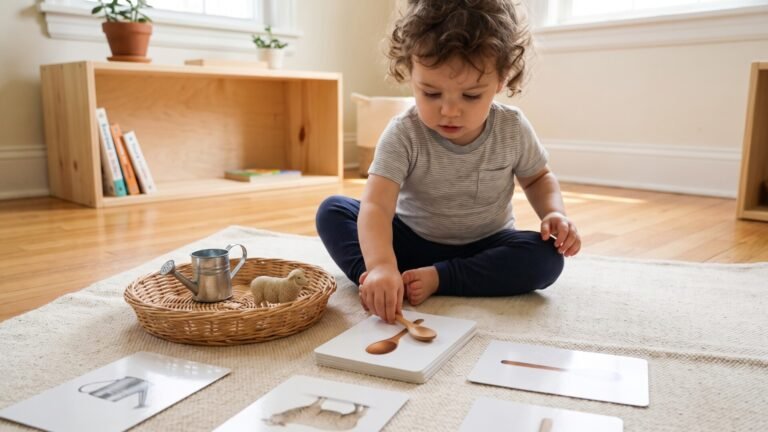
- Object naming with real items
- Simple songs and rhymes
- Picture vocabulary cards
- Daily conversation routines
The goal is vocabulary explosion and joyful communication.
Preschoolers (3–6 Years)
This is the most active period for Montessori language work.
Recommended activities:
- Sound games
- Sandpaper letters
- Moveable alphabet
- Early reading cards
Children often show intense interest in words and sounds during this stage.
Early Elementary (6–9 Years)
Language games evolve into structured literacy and expression.
Recommended activities:
- Grammar symbol games
- Sentence analysis
- Creative writing prompts
- Reading comprehension cards
Language becomes a tool for thinking and reasoning.
Creating a Montessori Language Area at Home
A prepared environment supports independent language exploration.
Key elements:
- Low shelves with limited materials
- Real objects instead of pictures when possible
- Quiet reading and writing space
- Rotating language materials
Consistency and calm matter more than quantity.
Montessori Language Games for Multilingual Homes
Montessori language principles work exceptionally well in bilingual or multilingual environments.
Best practices include:
- Clear separation of languages
- Rich oral exposure in each language
- Consistent sound-based instruction
- Avoiding translation-based drills
Children can absorb multiple languages naturally when supported correctly.
Language Games and Academic Readiness
Montessori language games prepare children for school without pressure.
They support:
- Reading fluency
- Writing confidence
- Strong comprehension
- Clear communication
Children who build language skills naturally often transition smoothly into formal education.
Choosing Montessori Language Games as Gifts
Language materials make excellent long-term gifts.
When choosing:
- Prefer physical, hands-on materials
- Avoid electronic “talking” toys
- Choose open-ended language tools
- Focus on durability and clarity
Well-made language materials can be used for years.
Common Questions About Montessori Language Games
Do children need to know the alphabet first?
No. Montessori introduces sounds before letter names.
Are worksheets ever used?
Typically no, especially in early years. Hands-on work is preferred.
Can Montessori language games help struggling readers?
Often yes, especially by rebuilding sound awareness.
Final Thoughts: Language as a Living Skill
Montessori language games respect language as something children live, not something they memorize. By focusing on sound, meaning, and expression, these games nurture confident communicators and thoughtful readers.
When children are given time, structure, and meaningful materials, language learning becomes a joyful and lasting process.