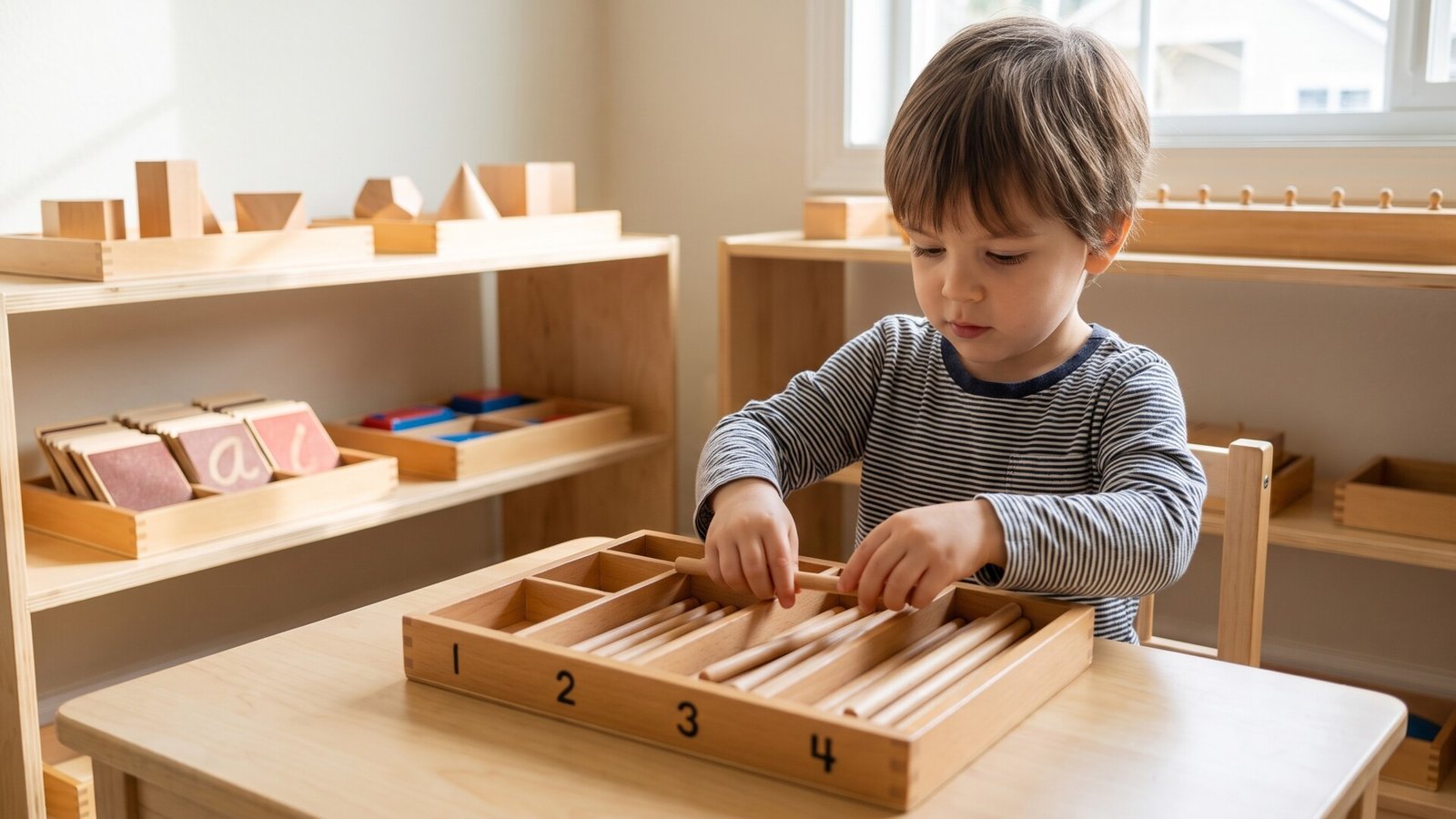
Montessori Toys for Preschoolers (3–6 Years Old)
The preschool years mark a profound shift in how children think, communicate, and interact with the world. Between the ages of three and six, children move from learning primarily through movement to learning through reasoning, language, and purposeful work. In Montessori education, this stage is considered one of the most powerful periods of development, often referred to as the conscious absorbent mind.
Montessori toys for preschoolers are designed to meet children at this moment—when curiosity is intense, concentration deepens, and the desire to understand how things work becomes central. These materials support early academic foundations in language and math while remaining deeply hands-on, self-directed, and engaging.
This page serves as a sub-hub for Montessori toys and activities for preschool-aged children, with a particular focus on language development, early math concepts, sensory refinement, and practical hands-on learning. It also acts as a gateway to more specialized guides, reviews, and activity ideas across ToyGuideHub.
For a broader view of Montessori materials across childhood, visit our Montessori Toys & Activities for Kids hub, where toys and activities are grouped by age, skills, and developmental needs.
Understanding the Montessori Preschool Stage
Preschoolers are no longer satisfied with simple exploration. They want to name, classify, compare, count, and explain. They ask endless questions, repeat activities until mastery, and take pride in completing work independently.
Key characteristics of Montessori-aged preschoolers include:
- Rapid language expansion and interest in symbols
- Growing ability to concentrate for extended periods
- Sensitivity to order, sequence, and logic
- Interest in numbers, letters, and patterns
- Strong intrinsic motivation to learn
Montessori toys for this age group are carefully designed to harness these traits, transforming play into meaningful learning without pressure or external rewards.
Why Montessori Toys Are Especially Effective for Preschoolers
At the preschool level, Montessori toys and materials begin to look more “academic,” but their purpose remains the same: learning through hands-on experience.
Montessori preschool toys:
- Introduce abstract concepts through concrete materials
- Allow children to correct their own mistakes
- Encourage independent work and decision-making
- Support deep focus rather than quick stimulation
Rather than rushing children into worksheets or screens, Montessori materials give them physical tools to explore language, numbers, and sensory concepts in ways their developing brains can fully absorb.
Core Learning Areas for Montessori Preschool Toys
Montessori preschool toys are typically organized around a few key developmental domains. This page focuses on the three most central: language, math, and sensory learning, while also highlighting the importance of hands-on activities.
Montessori Language Toys for Preschoolers
Language development accelerates dramatically between ages three and six. Montessori language materials are designed to support spoken language, vocabulary, sound awareness, and early reading and writing—without forcing children before they are ready.
Key Goals of Montessori Language Toys
Montessori language toys help preschoolers:
- Refine vocabulary and sentence structure
- Develop phonemic awareness
- Connect spoken language to symbols
- Build confidence in communication
Language learning in Montessori begins with spoken language, then moves gradually toward written language through tactile, visual materials.
Common Montessori Language Toys and Materials
- Sandpaper letters for tracing sounds
- Movable alphabets for word building
- Object-to-word matching cards
- Classified picture cards (animals, food, transportation)
- Early reading puzzles and phonics games
These materials allow children to touch, see, and manipulate language rather than memorizing it abstractly.
Why Hands-On Language Materials Matter
Preschoolers learn best when multiple senses are engaged. Tracing letters, arranging word cards, or matching objects to names activates visual, tactile, and auditory pathways at once, making learning more durable and meaningful.
Montessori language toys are especially valuable for:
- Children developing early literacy skills
- Preschoolers who learn best through movement
- Multilingual households
- Children who resist traditional instruction
Montessori Math Toys for Preschoolers
Montessori math materials are one of the most distinctive aspects of the method. Rather than teaching numbers as symbols first, Montessori introduces math through concrete quantities, allowing children to physically experience numbers.
Core Math Concepts Introduced in Preschool
Montessori math toys support:
- Number recognition
- Quantity and counting
- One-to-one correspondence
- Basic operations (addition and subtraction)
- Early place value awareness
Children build a strong intuitive understanding of math long before they are expected to perform abstract calculations.
Common Montessori Math Toys and Materials
- Counting rods or number rods
- Number boards and counters
- Bead chains and bead bars
- Spindle boxes
- Simple math games using real objects
These materials allow preschoolers to see and feel math, reducing anxiety and building confidence.
Why Montessori Math Builds Long-Term Confidence
Because Montessori math materials are self-correcting and hands-on, children learn that mistakes are part of the process. This fosters resilience and curiosity rather than fear of failure.
Preschoolers who work with Montessori math toys often:
- Develop a positive relationship with numbers
- Show strong number sense later
- Approach problem-solving with confidence
- Transition more easily to formal schooling
Sensory Toys for Preschoolers
While sensory learning begins in infancy, it becomes more refined and analytical during the preschool years. Montessori sensory toys help children compare, categorize, and describe their sensory experiences.
Purpose of Sensory Work at the Preschool Level
Montessori sensory toys help preschoolers:
- Notice subtle differences in size, shape, and texture
- Develop descriptive language
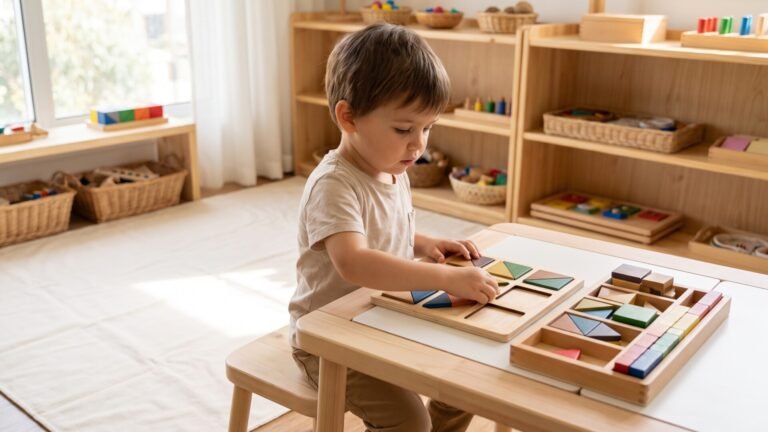
- Prepare for math and geometry concepts
- Improve concentration and observation skills
Sensory materials at this stage are more structured and purposeful than those used for toddlers.
Common Montessori Sensory Toys
- Pink towers and size-grading blocks
- Color tablets and matching games
- Texture tablets and fabric boards
- Sound cylinders
- Smelling jars or sensory matching sets
These toys isolate one variable at a time, allowing children to focus deeply and refine perception.
Hands-On Activities and Practical Learning
Although language and math take on greater importance in the preschool years, hands-on activity remains central to Montessori learning.
Practical, Hands-On Montessori Activities
Preschoolers benefit greatly from activities such as:
- Food preparation tasks (cutting soft foods, pouring)
- Gardening and plant care
- Sorting and organizing materials
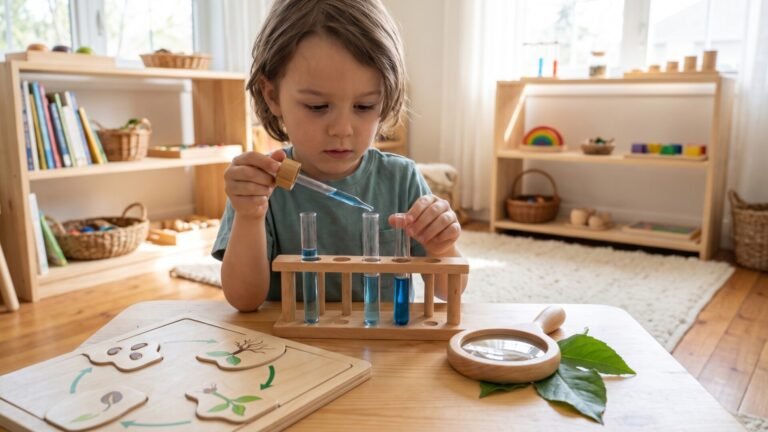
- Simple science exploration kits
- Building and construction with open-ended materials
These activities strengthen executive function skills like planning, sequencing, and sustained attention.
Montessori Toy Recommendations by Preschool Stage
Preschool development spans a wide range, and children progress at different speeds. Still, general patterns tend to emerge.
Early Preschool (3–4 Years)
Children focus on foundational language, sensory refinement, and simple math.
Recommended toy types:
- Sandpaper letters
- Counting materials
- Simple matching and sorting games
- Sensory grading toys
Mid Preschool (4–5 Years)
Language and math skills become more complex.
Recommended toy types:
- Movable alphabet sets
- Early phonics games
- Bead chains and counting boards
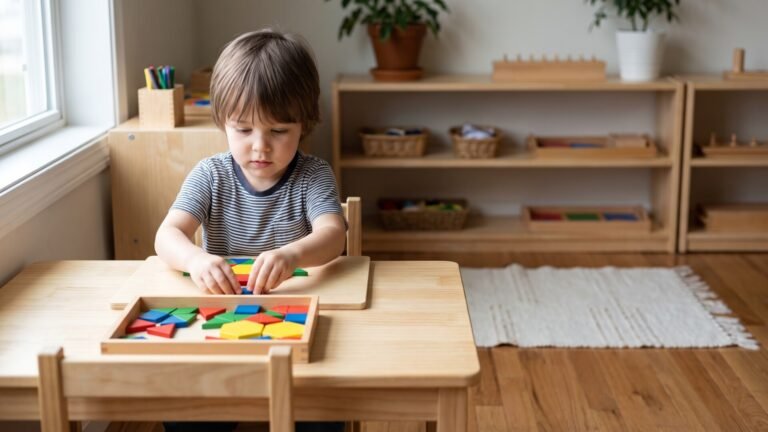
- Beginner math puzzles
Late Preschool (5–6 Years)
Children prepare for early elementary concepts.
Recommended toy types:
- Early reading games
- Simple addition and subtraction materials
- Advanced classification cards
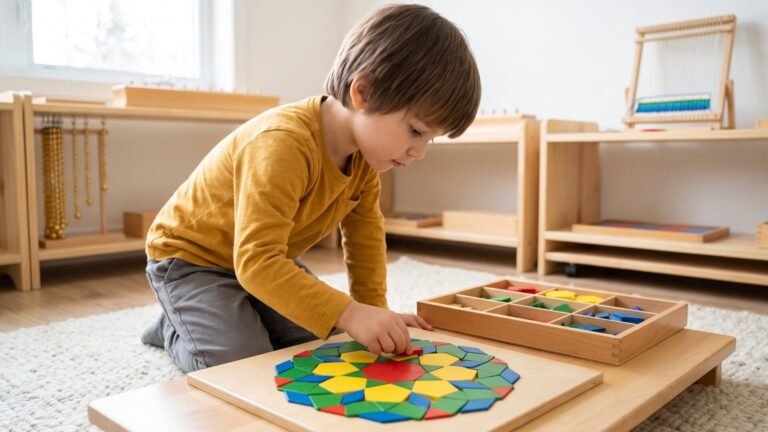
- Geometry and pattern-based toys
Creating a Montessori Preschool Toy Environment at Home
Montessori preschool toys are most effective when placed in a prepared environment that encourages independence.
Key elements include:
- Clearly organized shelves
- Materials arranged from simple to complex
- Defined work areas (table and floor)
- Freedom to choose activities
Preschoolers thrive when they can select their own work and repeat it without interruption.
Montessori Toys vs. Traditional Preschool Toys
Montessori preschool toys differ significantly from many mainstream educational toys.
Montessori toys:
- Teach concepts through physical interaction
- Encourage long periods of concentration
- Allow self-correction
- Avoid overstimulation
Traditional toys often:
- Emphasize entertainment over learning
- Rely on electronic instruction
- Limit creativity
- Encourage surface-level engagement
Over time, Montessori materials help children develop deeper thinking skills and intrinsic motivation.
How Montessori Preschool Toys Prepare Children for School
Montessori toys do not aim to “push” children academically. Instead, they prepare children by building the underlying skills that make learning easier.
These include:
- Focus and attention
- Fine motor control
- Logical thinking
- Language confidence
- Emotional regulation
As a result, children often enter formal schooling with strong foundations, regardless of the educational system they join.
Exploring More Montessori Guides
This preschool sub-hub connects naturally to other Montessori resources on ToyGuideHub, including:
- Montessori Toys for Infants
- Montessori Toys for Toddlers
- Montessori Language Games
- Montessori Math Toys
- Montessori Sensory Activities
Each guide dives deeper into specific materials and activities while reinforcing the same educational philosophy.
Choosing Montessori Toys as Gifts for Preschoolers
Montessori toys make excellent gifts for preschoolers because they grow with the child and support meaningful learning.
When choosing a gift:
- Look for open-ended materials
- Avoid battery-operated toys
- Prioritize quality over quantity
- Choose toys that invite repetition
A thoughtfully chosen Montessori toy often becomes a long-term favorite rather than a passing novelty.
Common Questions About Montessori Toys for Preschoolers
Are Montessori toys too structured for creative kids?
No. Montessori materials provide structure, but creativity emerges naturally through exploration and mastery.
Can Montessori toys be used alongside traditional schooling?
Yes. Montessori toys complement many educational approaches and support learning at home.
How many Montessori toys does a preschooler need?
A focused selection of 8–12 materials, rotated regularly, is usually ideal.
Final Thoughts: Learning Through Purposeful Play
The preschool years are a time of intense curiosity, imagination, and growth. Montessori toys honor this stage by giving children the tools they need to explore language, math, and the sensory world through direct experience.
By choosing hands-on, thoughtfully designed materials, parents create an environment where learning feels natural, joyful, and deeply satisfying—not forced or rushed.
Our Montessori Toys for Preschoolers hub features a wide range of age-appropriate toys that support hands-on learning and skill development. For early STEM and coding exploration, check out:
- Beginner Coding Toys for Preschoolers – Perfect for introducing sequencing, logic, and problem-solving without screens.
- Montessori Coding Robots for Preschoolers – Montessori-inspired robots that make coding interactive, engaging, and fun while building critical thinking skills.