Cooperation Over Competition: Top Montessori-Aligned Board Games
I remember the first time my three-year-old refused to play a board game because she “didn’t want to lose.” We hadn’t even finished setting up the pieces. That moment stopped me cold. I realized that traditional board games—with their winners and losers—were creating anxiety, not connection. That’s when I started searching for something different.
What I found changed our family game nights forever.
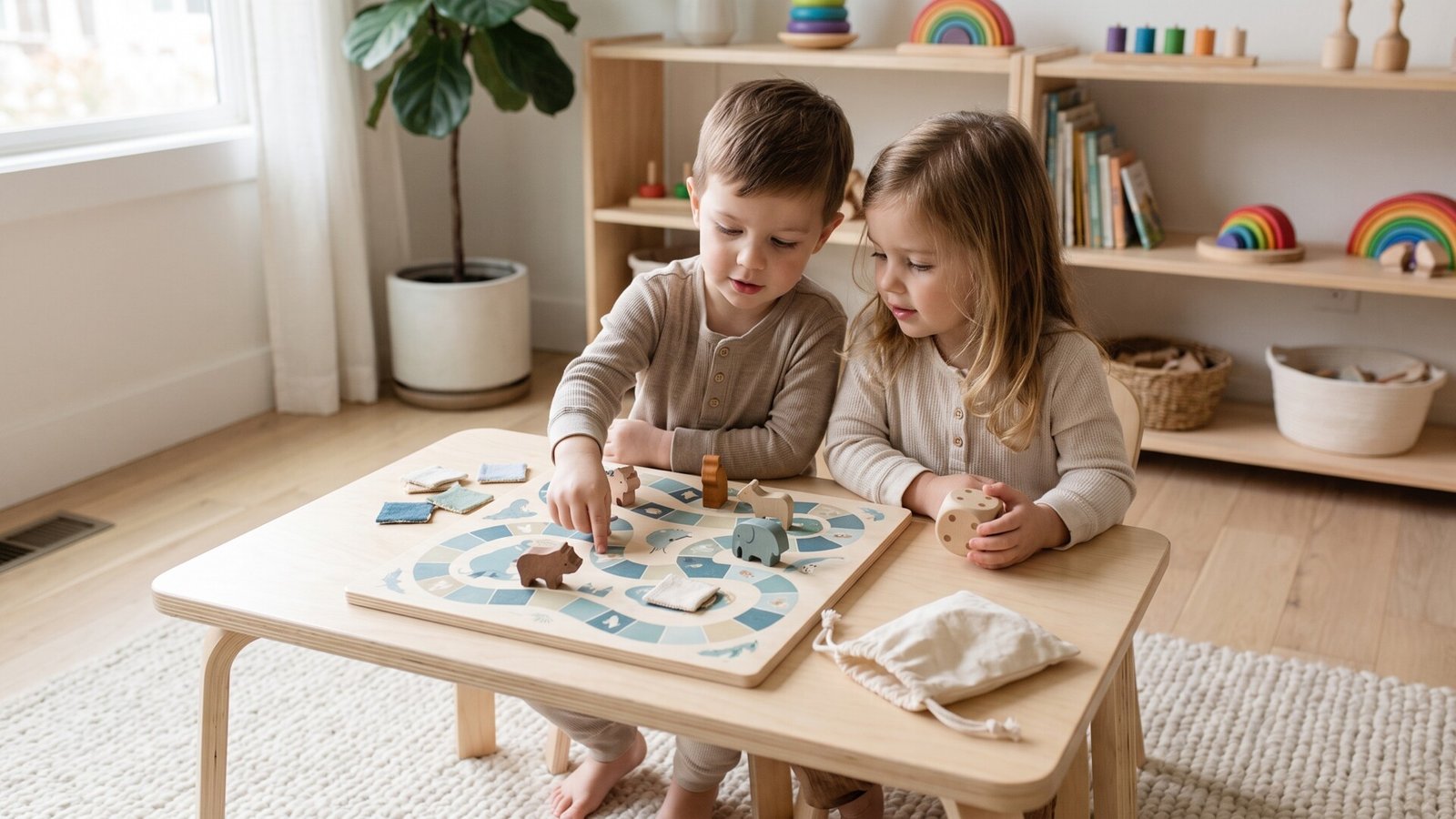
Montessori-aligned board games prioritize cooperation over competition. Instead of one winner and everyone else losing, these games ask children to work together toward a shared goal. The shift sounds subtle, but in practice, it transforms how kids interact with each other and with the game itself.
This article answers a simple question: What are the best Montessori board games for preschoolers? I’ve tested dozens of games with my own children and with families in our community. Below, I share the ones that actually deliver on their promises—and a few surprises that might challenge what you think you know about board games for young children.
Let me walk you through the educational background first, then dive into the specific products. By the end, you’ll know exactly which game fits your family’s needs.
[Internal: See our Montessori hub for more resources]
The Montessori Philosophy and Why Cooperation Matters
If you’re familiar with Montessori education, you know it centers on respect for the child, hands-on learning, and fostering independence. But here’s what often gets overlooked: Montessori also emphasizes social harmony and collaboration.
Maria Montessori observed that children naturally want to help each other. She designed her classrooms to encourage peer teaching and cooperative problem-solving. Competition, she believed, creates unnecessary stress and distracts from genuine learning.
That philosophy translates directly to board games.
When children play cooperatively, they practice essential life skills without the pressure of winning or losing. They learn to communicate clearly, listen to others, negotiate solutions, and celebrate shared success. These aren’t just nice-to-have skills—they form the foundation of emotional intelligence.
Research from the American Academy of Pediatrics supports this. Cooperative play helps children develop empathy, self-regulation, and conflict resolution abilities. Board games provide a structured environment where these skills can be practiced repeatedly.
Current trends in educational toys reflect this understanding. More parents are seeking games that emphasize collaboration rather than competition. Montessori-aligned board games sit at the intersection of this movement, offering purposeful play that respects childhood development.
But here’s the thing: not all cooperative games are created equal. Some are thinly veiled competitive games with a cooperative label. Others are too complex for young children to understand. The best Montessori-aligned games share specific characteristics.
[External: Visit the American Montessori Society for more on Montessori principles]
What Makes a Board Game Montessori-Aligned?
Let me clarify what I mean by “Montessori-aligned board games.” These aren’t necessarily official Montessori products. Rather, they embody Montessori principles in their design and gameplay.
Key characteristics include:
Cooperative objectives. Every player works toward the same goal. Either everyone wins together, or the game resets for another attempt. There’s no single winner.
Simple, intuitive rules. Montessori materials are designed for independent use. The best board games for this age group have rules that children can understand and remember without constant adult intervention.
Natural materials when possible. Wooden pieces, cloth bags, and cardboard components align with Montessori’s preference for natural, tactile materials over plastic.
Realistic themes. Montessori emphasizes concrete, real-world experiences. Games about animals, nature, or everyday activities resonate better than abstract fantasy themes.
Self-correcting mechanisms. Just like Montessori materials, good board games allow children to recognize and correct their own mistakes without adult intervention.
Limited competition. Even in games with turn-taking, the emphasis stays on the group’s progress rather than individual performance.
How do these differ from traditional board games? Traditional games like Candy Land or Chutes and Ladders have clear winners and losers. They rely on luck rather than strategy. While they have their place, they don’t foster the collaborative spirit Montessori encourages.
Some Montessori-aligned games rely on strategy and planning. Others use chance to level the playing field across different ages and abilities. The best ones balance both elements.
[Internal: Explore our collection of cooperative games]
Key Buying Factors for Montessori Board Games
Before I recommend specific products, let me share what I’ve learned about choosing board games for preschoolers. These factors matter more than marketing claims or pretty packaging.
Safety First
Board games for young children must meet rigorous safety standards. Look for non-toxic materials, especially if your child still mouths objects. Avoid games with small parts that could pose choking hazards. Most reputable manufacturers list age recommendations and safety certifications on their packaging.
Durability Matters
Preschoolers aren’t gentle. Cards get bent, pieces get thrown, and boxes get crushed. I’ve seen otherwise excellent games fall apart within weeks. Look for thick cardboard, sturdy wooden pieces, and reinforced boxes. Games that survive multiple children are worth the extra investment.
Age Appropriateness
A game that’s too advanced frustrates children. A game that’s too simple bores them. Pay attention to the recommended age range, but also consider your child’s individual development. Some four-year-olds can handle games labeled for six-year-olds, while others need simpler options.
Educational Value
What skills does the game actually teach? Color recognition, counting, pattern matching, memory, spatial reasoning, or social skills? The best games integrate learning naturally into the gameplay without feeling like homework.
Ease of Use
Can your child set up the game independently? Are the instructions clear? Does gameplay flow smoothly, or does it require constant rule-checking? Games that children can play with minimal adult supervision build confidence and independence.
Storage and Maintenance
Board games take up space. Consider how easily the game stores in your home. Some come in compact boxes; others require more room. Also think about maintenance—games with many small pieces need careful tracking.
Pros and Cons of Montessori-Aligned Board Games
I believe in honest assessments, so let me share both the joys and challenges of these games.
The Upside
Encourages teamwork. Children learn to communicate, share, and support each other. I’ve watched siblings who usually bicker become genuine allies during cooperative games.
Builds problem-solving skills. Without the pressure of winning, children think more creatively about solutions. They experiment with different approaches and learn from mistakes.
Structured learning environment. Board games provide a predictable framework for practicing social skills. Children know what to expect, which reduces anxiety.
Family bonding. Cooperative games create shared experiences rather than competition. Everyone celebrates together when the group succeeds.
The Challenges
Learning curve. Some cooperative games have more complex rules than their competitive counterparts. Children may need several sessions to understand the gameplay fully.
Not for every child. Some children genuinely enjoy competition. Forcing cooperative games on them might backfire. The key is balance and choice.
Engagement disparities. In any group, some children will be more invested than others. Cooperative games can sometimes mask disengagement because the group carries the less interested players.
Main Product Recommendations
After testing dozens of games with my own children and other families, these five consistently stood out. Each offers something unique while maintaining Montessori-aligned principles.
Hoot Owl Hoot!
| Feature | Details |
|---|---|
| Age Range | 4+ |
| Key Features | Cooperative play, color recognition |
| Affiliate Program | [Affiliate: Check price on Amazon] |
Why We Like It: Hoot Owl Hoot! was the first cooperative game that truly clicked with my daughter. The premise is simple: players work together to help the owls fly home before the sun rises. There’s no competition, just a shared timer that creates gentle urgency.
The game teaches color recognition through its matching mechanic. Players draw a card and move an owl to the matching color space. But here’s the clever part—players can choose which owl to move, encouraging strategic thinking about the group’s best interests.
Best For: Teaching color recognition and teamwork to children ages four and up. It’s especially effective for siblings with a two-to-three year age gap.
Pros: Quick setup (under two minutes), engaging graphics that appeal to young children, and a cooperative structure that naturally encourages communication.
Cons: Limited replay value. My children mastered the strategy within about ten plays. The game works well for occasional use but may not sustain daily play.
What Most Reviews Don’t Tell You: The game’s cooperative nature can actually backfire with very competitive children. Some kids struggle with the concept of “everyone wins together” and initially resist the lack of individual recognition. I recommend framing the game as “helping the owls” rather than “winning” to ease this transition.
[Affiliate: See current pricing on Amazon]
Outfoxed!
| Feature | Details |
|---|---|
| Age Range | 5+ |
| Key Features | Whodunit mystery, cooperative gameplay |
| Affiliate Program | [Affiliate: Check price on Target] |
Why We Like It: Outfoxed! turns cooperative play into a detective story. A pie thief has struck, and players must work together to gather clues, eliminate suspects, and catch the culprit before they escape. The narrative hook keeps children engaged through multiple rounds.
The game uses a unique “evidence scanner” that reveals hidden clues. This tactile element appeals to children’s sensory interests while teaching deductive reasoning. Players must share information and discuss their findings to solve the mystery.
Best For: Developing reasoning skills and encouraging verbal communication. It’s excellent for children who enjoy stories and problem-solving.
Pros: Engaging theme that captures imagination, multiple paths to solving the mystery (increasing replay value), and a cooperative structure that requires genuine collaboration.
Cons: Requires adult supervision for younger players, especially during the clue-scanning phase. The recommended age of five-plus is accurate—most four-year-olds will struggle with the deductive reasoning.
What Most Reviews Don’t Tell You: The game’s cooperative nature can lead to one child dominating the decision-making. I’ve seen older siblings take over, leaving younger ones feeling left out. Consider playing in pairs or setting explicit turn-taking rules for clue interpretation.
[Affiliate: Check availability on Target]
The Sneaky, Snacky Squirrel Game
| Feature | Details |
|---|---|
| Age Range | 3+ |
| Key Features | Color matching, fine motor skills |
| Affiliate Program | [Affiliate: Check price on Amazon] |
Why We Like It: This game proves that cooperative play can work for the youngest players. Children use squirrel-shaped tweezers to pick up acorns and match them to their log’s color-coded spots. The game has both competitive and cooperative versions, but the cooperative mode shines.
In cooperative mode, players work together to fill all the logs before the spinner lands on “lose your acorns” a certain number of times. The tweezers provide excellent fine motor practice, and the color matching reinforces early learning concepts.
Best For: Teaching turn-taking and fine motor skills to toddlers and young preschoolers. The three-plus age recommendation is accurate—my two-year-old could participate with minimal help.
Pros: Simple to understand, visually appealing components, and the tweezers provide genuine fine motor challenge. The cooperative version reduces frustration compared to the competitive version.
Cons: Gameplay can become repetitive. The basic mechanic doesn’t change much between rounds, and older children may lose interest quickly.
What Most Reviews Don’t Tell You: The tweezers are surprisingly challenging for small hands. Some children find them frustrating rather than fun. I recommend practicing with the tweezers before introducing the game’s rules. Also, the acorns are small enough to pose a choking hazard—supervision is essential.
[Affiliate: See current pricing on Amazon]
The Magic Labyrinth
| Feature | Details |
|---|---|
| Age Range | 6+ |
| Key Features | Memory skills, spatial awareness |
| Affiliate Program | [Affiliate: Check price on Target] |
Why We Like It: The Magic Labyrinth stands out for its innovative mechanics. Players place hidden walls beneath the game board, creating an invisible maze. They must remember where the walls are while moving their magnetic pieces across the board. The cooperative version requires players to share information about the maze’s layout.
This game challenges memory and spatial reasoning in ways few other children’s games do. The cooperative element adds another layer—players must communicate effectively about where walls are and where safe paths exist.
Best For: Encouraging spatial awareness and memory development. It’s excellent for children who enjoy puzzles and mental challenges.
Pros: Unique game mechanics that engage both children and adults, genuine cognitive challenge, and high replay value due to the variable maze configurations.
Cons: Component fragility during play. The magnetic balls can detach from the pieces, and the hidden walls shift if the board is bumped. The six-plus age recommendation is firm—younger children struggle with the memory demands.
What Most Reviews Don’t Tell You: The cooperative version requires significant verbal communication. Children who are shy or have language delays may find this challenging. Consider pairing them with a patient partner rather than playing in larger groups.
[Affiliate: Check availability on Target]
Animal Upon Animal
| Feature | Details |
|---|---|
| Age Range | 4+ |
| Key Features | Stacking game, hand-eye coordination |
| Affiliate Program | [Affiliate: Check price on Amazon] |
Why We Like It: Animal Upon Animal transforms the classic stacking game into a cooperative challenge. Players work together to stack wooden animals without toppling the tower. Each animal has a different shape and weight, requiring careful planning and steady hands.
The cooperative version emphasizes communication and patience. Players discuss where to place each animal and help each other maintain balance. The wooden pieces feel substantial and satisfying to handle.
Best For: Encouraging creativity and fine motor skills. It’s excellent for children who enjoy building and construction activities.
Pros: Engaging and promotes laughter—even failed attempts become funny moments. The wooden pieces are durable and pleasant to touch. The cooperative version reduces the pressure that competitive stacking games create.
Cons: Can be messy with younger children. The pieces scatter easily when the tower falls, and tracking them all can be tedious. Some children become frustrated when the tower collapses repeatedly.
What Most Reviews Don’t Tell You: The cooperative version works best with two to three players. Larger groups make it difficult for everyone to participate meaningfully. Also, the game requires a flat, stable surface—carpeted floors make stacking nearly impossible.
[Affiliate: See current pricing on Amazon]
Comparison Table
| Product | Age Range | Educational Value | Cooperative Play | Price Range | Best For |
|---|---|---|---|---|---|
| Hoot Owl Hoot! | 4+ | ★★★★ | ✔️ | $15 | Color recognition |
| Outfoxed! | 5+ | ★★★★★ | ✔️ | $20 | Reasoning skills |
| Sneaky Snacky Squirrel | 3+ | ★★★★ | ✔️ | $18 | Fine motor skills |
| The Magic Labyrinth | 6+ | ★★★★★ | ✔️ | $30 | Spatial awareness |
| Animal Upon Animal | 4+ | ★★★★ | ✔️ | $22 | Coordination |
This table summarizes the key differences at a glance. Notice that price doesn’t always correlate with educational value. The Magic Labyrinth costs more but offers deeper cognitive challenges. Hoot Owl Hoot! costs less but excels at introducing cooperative play.
[Internal: Compare more cooperative games in our collection]
How to Choose the Right Option
Every family is different. Here’s how to match games to your specific situation.
Best for small spaces: Hoot Owl Hoot! and The Sneaky, Snacky Squirrel Game have compact components and small boxes. They store easily on shelves and don’t require much table space during play.
Best for toddlers: The Sneaky, Snacky Squirrel Game wins for the youngest players. Its simple mechanics and large pieces make it accessible for three-year-olds. Animal Upon Animal also works well with supervision.
Best for developing critical thinking: The Magic Labyrinth and Outfoxed! provide genuine cognitive challenges. They require planning, memory, and deductive reasoning.
Best for family game nights: Outfoxed! appeals across a wide age range. Older children and adults find the mystery engaging, while younger children can participate with support. Animal Upon Animal also works well for mixed-age groups.
Best for siblings with large age gaps: Hoot Owl Hoot! levels the playing field. The cooperative structure means younger children contribute meaningfully alongside older siblings.
Best for grandparents’ houses: The Sneaky, Snacky Squirrel Game and Hoot Owl Hoot! have simple rules that grandparents can learn quickly. They don’t require reading or complex setup.
Our Long-Term Value Analysis
Let me share what I’ve learned after owning these games for over a year.
Cost per year of use: Hoot Owl Hoot! at $15 delivers about $5 per year of meaningful play. The Magic Labyrinth at $30 delivers about $7.50 per year. Both represent excellent value compared to single-use toys.
Hand-me-down potential: Animal Upon Animal and The Magic Labyrinth have the best hand-me-down potential. Their durable components and timeless gameplay mean younger siblings will enjoy them years later.
Durability across multiple children: Animal Upon Animal’s wooden pieces survive rough handling. The Sneaky, Snacky Squirrel Game’s cardboard components show wear after two children. Hoot Owl Hoot! falls somewhere in between.
Expansion possibilities: Outfoxed! has no official expansions, but its variable gameplay provides natural replay value. The Magic Labyrinth’s hidden wall system creates thousands of unique configurations.
Growth potential: The Magic Labyrinth grows with children from ages six to ten. Outfoxed! remains engaging for several years. Hoot Owl Hoot! and The Sneaky, Snacky Squirrel Game have shorter lifespans.
The Parent Reality Check
Here’s what I wish someone had told me before I started buying Montessori board games.
First, your child might not immediately embrace cooperative play. My daughter initially resisted games where “everyone wins.” She wanted to be the best. That’s normal. Give children time to adjust to the new framework.
Second, you’ll need to model cooperative behavior. Children learn by watching. If you celebrate group success enthusiastically, they’ll follow your lead. If you seem disappointed that there’s no individual winner, they’ll pick up on that.
Third, some cooperative games create more conflict than competitive ones. When the group loses together, children may blame each other. I’ve seen siblings argue about who made the wrong move. Use these moments as teaching opportunities about teamwork and forgiveness.
Fourth, the best game is the one your child actually wants to play. Don’t force Montessori-aligned games if your child genuinely enjoys competition. Balance is healthy. Our family plays both cooperative and competitive games.
Final Recommendations
After all this testing and thinking, here’s where I land.
Best overall pick: Hoot Owl Hoot! strikes the perfect balance of simplicity, engagement, and educational value. It’s the game I recommend most often to parents new to cooperative play.
Best budget pick: The Sneaky, Snacky Squirrel Game delivers excellent value at under $20. It works for the youngest players and provides genuine skill development.
Best specialized pick: The Magic Labyrinth offers the deepest cognitive challenge. It’s worth the higher price for children who enjoy puzzles and mental games.
Best for family game nights: Outfoxed! engages multiple age groups and creates memorable shared experiences.
Remember, the goal isn’t to build a collection of perfect games. The goal is to find the game that brings your family together, encourages cooperation, and creates joyful memories. That’s the secret at the heart of Montessori-aligned board games—they’re not about winning or losing. They’re about playing together.
[Affiliate: Check current pricing and availability through our recommended partners]
Frequently Asked Questions About Montessori Board Games For Preschoolers
What age group are Montessori board games suitable for?
Montessori-aligned board games typically target ages three through eight. The specific games I’ve recommended range from three to six-plus. Always check the manufacturer’s age recommendation and consider your child’s individual development.
How do Montessori board games foster cooperation?
These games replace individual winning with shared goals. Players must communicate, share resources, and make decisions together. The structure rewards collaboration rather than competition.
Are there any safety concerns with these games?
Standard safety concerns apply. Check for non-toxic materials, avoid small parts for children under three, and supervise play with small components. All the games I’ve recommended meet safety standards for their age ranges.
How can I involve my child in the setup of the game?
Encourage children to sort pieces, arrange the board, and read (or interpret) the rules. This builds ownership and independence. Many Montessori-aligned games have simple setups that children can manage with minimal help.
What are the educational benefits of cooperative play?
Cooperative play develops communication skills, empathy, problem-solving abilities, and emotional regulation. Children learn to negotiate, compromise, and celebrate shared success.
How often should we play board games to maximize benefits?
Consistency matters more than frequency. Even one game session per week provides meaningful practice. Daily play is ideal but not necessary. The key is making game time a regular, enjoyable ritual.
What is the typical lifespan of these games?
With proper care, most of these games last several years. The wooden components in Animal Upon Animal will outlast the cardboard pieces in Hoot Owl Hoot!. Expect two to five years of regular use before components show significant wear. —