Low-Stimulation Toys
It’s a Tuesday afternoon and you are standing in the toy aisle holding two boxes. One of them plays a song. The other is a wooden stacker with five pieces and no off switch because it has no switch at all. You have read enough to know the first one might be too much, and you are quietly wondering whether the second one is too little.
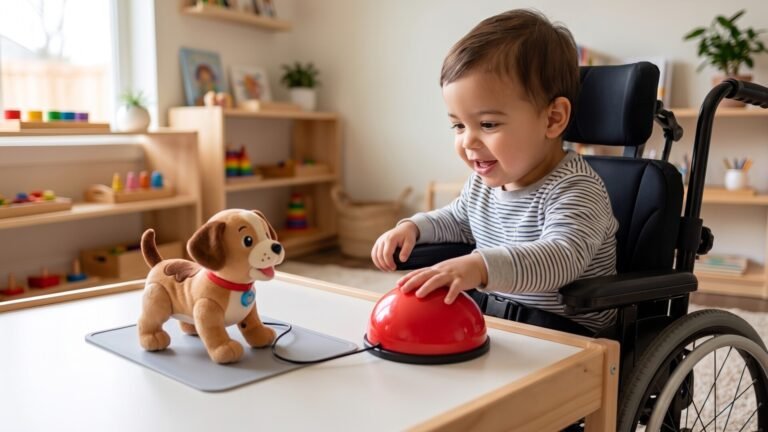
Here is the correction: a low-stimulation toy is not a joyless toy. The useful distinction is not “no sensory input” but input the child can control. Some children need fewer sounds and lights. Others happily seek out texture, motion, and color, as long as they decide when it starts and stops. A low-stimulation toy is one that hands the remote to the child instead of grabbing it for itself.
That is the whole buying decision in one line, and everything below is about applying it to real products at real prices.
What Makes a Toy Low-Stimulation?
Low-stimulation is a practical description, not a clinical one. In parent terms, it means quiet operation, limited visual clutter, predictable cause and effect, slower pacing, and few competing features running at the same time. When your child pushes a wooden piece onto a peg, the toy does exactly one thing. When your child presses a button on a plastic console, the toy may play a song, flash three colors, and start a countdown whether or not anyone asked.
That gap is the entire category.
Plenty of toys sold as “sensory” sit on the wrong side of it. Flashing lights, vibrating handles, looping music, and five simultaneous effects are sensory input, but they are not low-stimulation input. They arrive on the toy’s schedule. The label on the box describes what the toy does, not what your child needs from it.
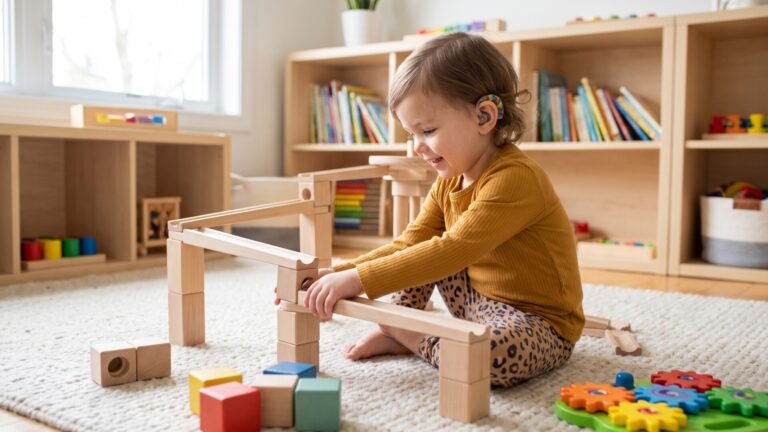
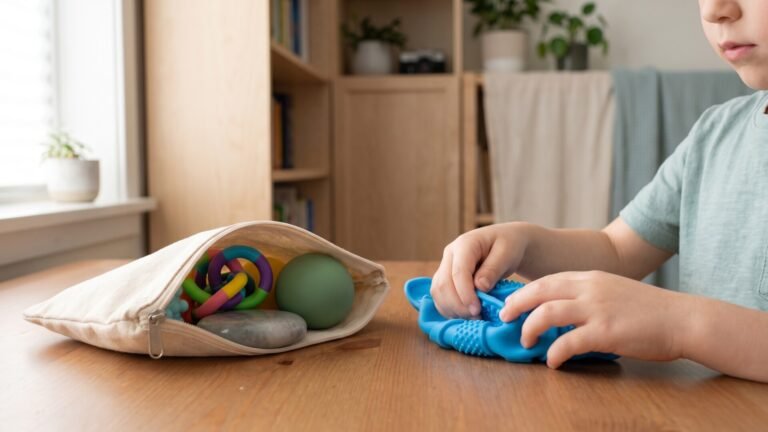
Control matters more than silence. A child who enjoys texture can push a silicone bubble fifty times and stop. A child who likes color can sort wooden arches by shade and walk away mid-sort. A child who likes movement can stack, knock down, and rebuild at whatever speed suits them. None of that requires the toy to be inert. It requires the toy to wait.
Age, setting, and fatigue change the answer too. The same puzzle that feels calm at nine in the morning can feel impossible at five in the afternoon. A toy that works in a quiet bedroom may not work in a living room with a television on, a sibling practicing scales, and a dog. Judge the toy in the room it will actually live in.
Key Buying Factors for Calm, Manageable Play
Control and predictability
Favor toys where the child starts, stops, repeats, or changes the activity. Anything that activates on its own, runs a fixed sequence, or insists on being finished is working against you. The test is simple: if your child walks away mid-play, does the toy keep going? If yes, it is not a low-stimulation toy, whatever the packaging says.
Noise and visual intensity
Check the volume, the lights, the music loop, and whether the electronic effects can actually be turned off. Many toys have a volume switch that offers “loud” and “slightly less loud,” and an off switch buried under a flap a four-year-old will find before you do. If you are paying a premium for a feature you plan to disable permanently, you are paying for packaging.
Visual intensity matters as much as sound. A high-contrast, densely patterned board can be harder to process than a plain wooden shape, even with no noise at all. Simple forms in a small number of colors give the eye somewhere to rest.
Open-ended use and independent play
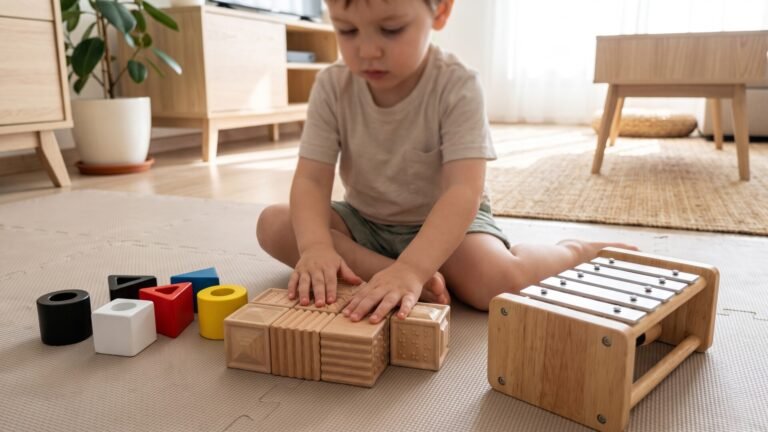
Simple materials tend to last longer because they support several kinds of play without adult setup. A pile of large bricks becomes a tower, a wall, a garage, a cake. A single-purpose electronic toy becomes a single-purpose electronic toy, usually within a fortnight.
Independent play depends on familiarity and access as much as on the toy itself. Something on a low shelf that your child has used before will get picked up. Something in a lidded bin at the top of a wardrobe will not, no matter how good it is. See our guide to toys for children who prefer solitary play for more on setting that up.
Safety, storage, and supervision
Follow the manufacturer’s age label and read it properly, because it reflects small-part and choking guidance rather than a suggestion about maturity. Check for loose components, magnets, cords, and battery compartments that need a screw rather than a fingernail. Washable surfaces matter more than you think, and so does whether the thing has a home when it is not in use.
This article cannot tell you what is safe for your specific child. The manufacturer can, and the label is the place to start.
What Most Buyers Get Wrong About Low-Stimulation Toys
The most common mistake is buying the most sensory product on the shelf when the child’s actual need is fewer things happening at once. More input is not more help. A toy that delivers five effects is five things to process, and a child who is already at capacity does not need a sixth.
The second mistake is assuming fewer features means less play. A feature-heavy electronic toy is often fully understood by week two, at which point it becomes either boring or irritating, and frequently both. A plain set of bricks is not fully understood by week two, or by year two, because the child keeps finding new things to do with it. Complexity in the toy is not the same as complexity in the play.
The third mistake is choosing based on an adult’s idea of calm. A muted, beige, tastefully arranged toy shelf photographs well and tells you nothing about your child. Watch what they repeatedly seek out, avoid, and control. If they return to the same stacking action every day, that is your answer. If they hand you the toy and walk away, that is also your answer.
And quiet does not automatically mean low-stimulation. A visually busy jigsaw, a rapidly changing animation, or a toy with a fifteen-minute assembly ritual can overwhelm a child without making a sound. Volume is one input among several.
Recommended Low-Stimulation Toys
Prices below are approximate and move around with sales and retailer stock, so check before you commit. The shortlist deliberately mixes tactile, construction, pretend-play, and tabletop options, because not every child wants the same kind of calm.
Best Overall: LEGO DUPLO Classic Brick Box
| Feature | Details |
|---|---|
| Age Range | Approximately 1.5-5 years, depending on the set |
| Key Features | Large bricks, simple construction, open-ended play, storage box |
| Price (approx) | $25-$50 |
The child controls the pace, the noise level, the repetition, and the complexity here, which is exactly the point. There is no correct outcome and no reward sequence. If your child wants to build the same three-brick tower eleven times, the toy is fine with that.
Large pieces suit younger children and children who find small construction parts frustrating. They are also easier to find under a sofa, which matters more than any feature list. [Internal: See our building toys hub] for expansion sets and compatible options.
The Verdict: A strong all-around option because it offers structure without forced sound, lights, or a single correct outcome.
Best For: Toddlers and preschoolers who enjoy building, sorting, and repeatable play.
Pros: Quiet; expandable; supports many play styles.
Cons: Pieces spread across the floor; some children need an adult to introduce ideas; not suitable below the labeled age range.
Best Budget Pick: Melissa & Doug Wooden Geometric Stacker
| Feature | Details |
|---|---|
| Age Range | Typically 18 months and older; verify the current label |
| Key Features | Wooden stacking pieces, simple shapes, color and size matching |
| Price (approx) | $15-$25 |
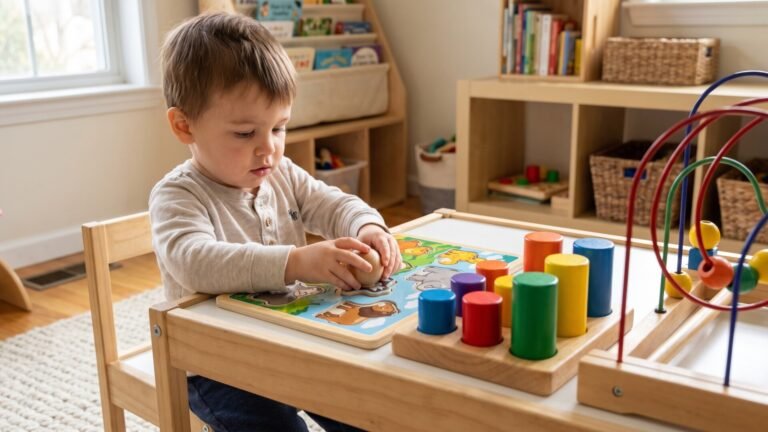
This is about as straightforward as cause and effect gets. A piece goes on, a piece comes off, and nothing beeps to congratulate anyone. It supports sorting, stacking, and repeated practice without a loud reward system attached.
The Verdict: A sensible low-cost entry point for a compact, quiet activity with a clear beginning and end.
Best For: Toddlers who like arranging, matching, and repeating a simple sequence.
Pros: Affordable; compact; easy to understand.
Cons: Limited play variety compared with open-ended building sets; wooden pieces clatter when dropped; younger children need supervision.
[Internal: See our Montessori toys hub] if you want the same principle applied to a wider shelf.
Best for Open-Ended Pretend Play: Hape All Seasons Dollhouse
| Feature | Details |
|---|---|
| Age Range | Typically 3 years and older; verify the current label |
| Key Features | Wooden dollhouse structure, rooms for pretend play, non-electronic design |
| Price (approx) | $100-$180, depending on configuration |
Pretend play can be genuinely low-stimulation when the child controls the characters, the pace, the dialogue, and the repetition. Nobody else is talking. Nothing lights up. The story stops when your child stops.
The trade-off is clutter. A dollhouse becomes visually busy the moment you add forty accessories to it, and the accessories are where the money quietly goes. Start with a small number of familiar pieces and add only what gets used.
The Verdict: A premium choice for children who prefer quiet storytelling and predictable routines over flashing or talking toys.
Best For: Preschool and early school-age children who enjoy solitary or parallel pretend play.
Pros: No batteries; flexible storytelling; grows with accessories.
Cons: Needs floor or shelf space; accessories add cost and clutter; assembly required.
Best Tactile Option: Fat Brain Toys Dimpl
| Feature | Details |
|---|---|
| Age Range | Commonly 2 years and older; verify the current label |
| Key Features | Silicone bubbles, push-and-pop action, compact frame |
| Price (approx) | $10-$20 |
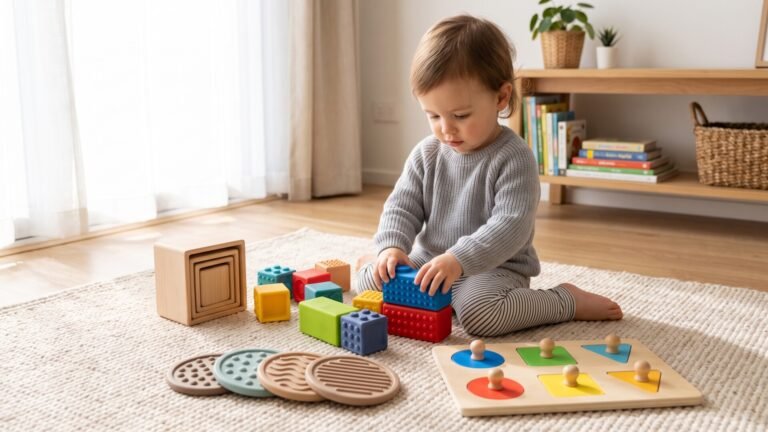
A repetitive, child-controlled action in a frame the size of a paperback. The appeal is that it does one thing, does it immediately, and stops the moment your child stops.
Tactile feedback is welcome for some children and actively unpleasant for others. Let the child’s response guide whether it stays in rotation. This is not a calming device and does not claim to be one.
The Verdict: A compact option for children who enjoy predictable hand movements and a small, contained activity.
Best For: Children who seek simple tactile repetition, and families who need something portable.
Pros: Portable; quiet compared with electronic toys; easy to use.
Cons: Limited play pattern; silicone collects lint and dirt; not a substitute for a broader toy rotation.
Best Quiet Tabletop Activity: Ravensburger My First Puzzles
| Feature | Details |
|---|---|
| Age Range | Varies by set, often preschool and early school age |
| Key Features | Large puzzle pieces, simple scenes, graded difficulty |
| Price (approx) | $10-$25 |
A small puzzle gives a defined activity with no lights, no music, and a very small visual footprint on the table. It also has an endpoint, which some children find reassuring and others find stressful, so match the difficulty carefully. Familiar, uncluttered artwork beats a busy scene every time.
The Verdict: A useful choice for children who prefer contained tasks and visible progress, provided the image and difficulty are well matched.
Best For: Preschoolers and young children who enjoy quiet tabletop work.
Pros: Compact storage; clear endpoint; multiple difficulty levels.
Cons: Frustration rises fast if the difficulty is wrong; pieces get lost; some designs are busier than others.
Best for Older Children: Plus-Plus BIG or Standard Plus-Plus Construction Sets
| Feature | Details |
|---|---|
| Age Range | BIG sets are generally for younger children; standard sets for older children; verify each package |
| Key Features | Repetitive interlocking pieces, construction prompts, quiet building |
| Price (approx) | $15-$35 |
Repetitive construction suits children who prefer predictable, focused activity. The pieces interlock the same way every time, which is either the appeal or the problem, depending on your child. BIG pieces are easier to handle; standard pieces allow finer designs and demand closer attention to age guidance.
The Verdict: A strong option for children who have outgrown toddler construction but still prefer quiet, contained building.
Best For: School-age children who enjoy patterns, repetition, and independent projects.
Pros: Quiet; portable; supports both following designs and free building.
Cons: Standard pieces need age awareness; finished models are fragile; pieces scatter.
Best Premium Natural-Material Option: Grimm’s Large Rainbow
| Feature | Details |
|---|---|
| Age Range | Often marketed for children 1 year and older, but check the current safety guidance |
| Key Features | Wooden arches, open-ended construction, simple colors and forms |
| Price (approx) | $80-$120 |
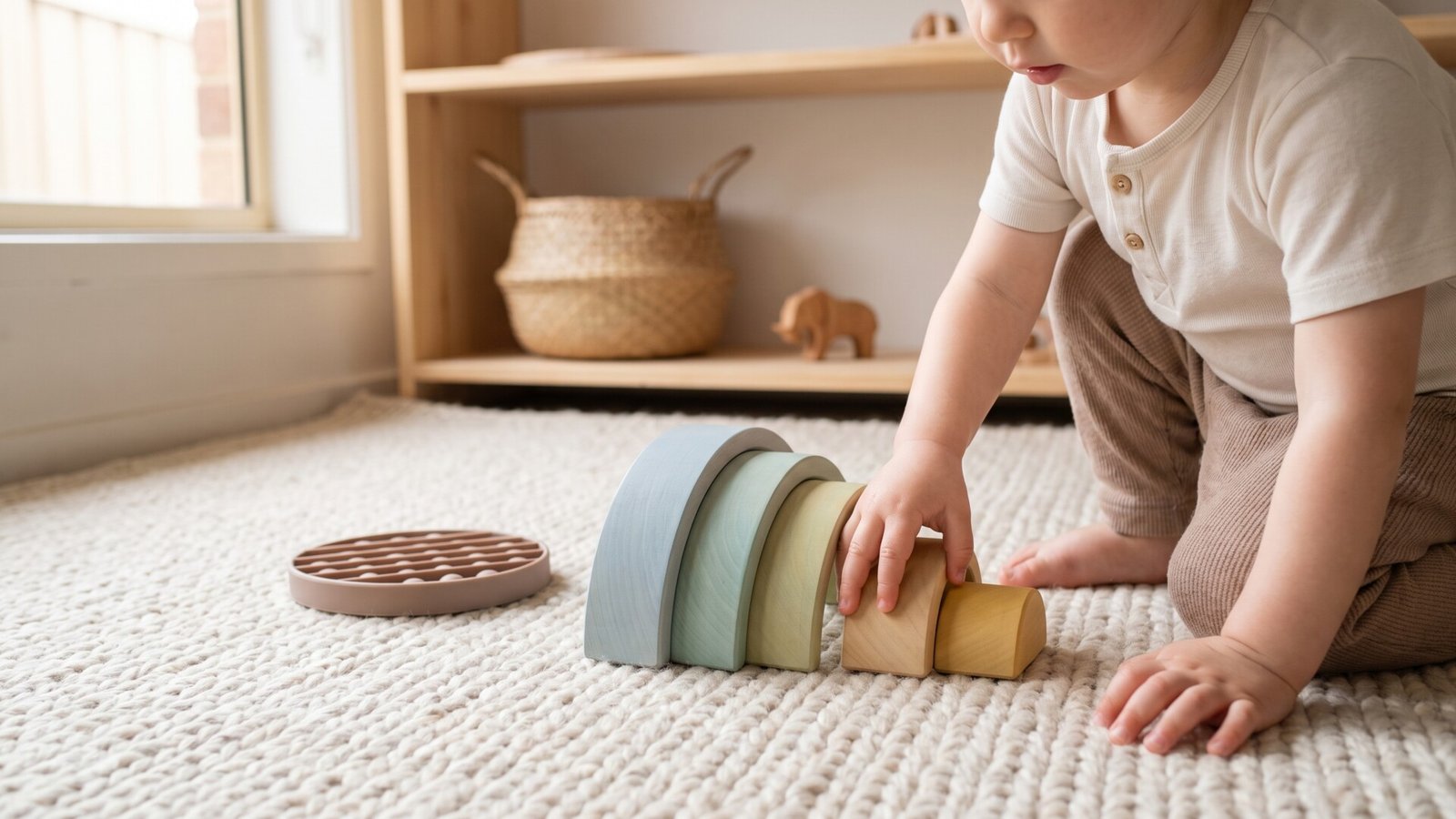
A premium material choice is exactly that: a material choice. It is not a guaranteed developmental benefit, and any listing implying otherwise is selling you something the wood cannot deliver. What you get is durability, simple forms, and a lot of possible uses: stacking, enclosing, balancing, sorting, and pretend play.
Whether it earns its price depends entirely on whether your child enjoys open-ended arranging. Plenty do not.
The Verdict: An attractive, durable premium option for families prioritizing quiet, screen-free, open-ended play, but not the best value for every budget.
Best For: Families with shelf space and children who enjoy arranging and building.
Pros: No electronics; many possible uses; visually simple.
Cons: Expensive; takes up shelf space; wooden pieces are heavy and need age-appropriate supervision.
Skip This If: Feature-Heavy Electronic Sensory Toys
This is a category, not a brand, and it is worth naming plainly. Toys with unavoidable music, flashing lights, automatic sequences, or several simultaneous effects are a poor match for a child specifically seeking lower stimulation, and no amount of “educational” copy on the box changes that.
An electronic toy with a reliable volume switch, a light control, and genuinely simple modes can still work for some children. Just do not pay extra for features you intend to disable permanently, because that is the most common way parents spend $60 on a $20 toy.
Comparison Table
| Product | Approx. Price | Stimulation Profile | Best For | Ownership Consideration |
|---|---|---|---|---|
| LEGO DUPLO Classic Brick Box | $25-$50 | Quiet, child-controlled construction | Best overall | Expandable, but pieces need storage |
| Melissa & Doug Wooden Geometric Stacker | $15-$25 | Simple tactile and visual matching | Best budget | Compact but limited in play variety |
| Hape All Seasons Dollhouse | $100-$180 | Quiet pretend play | Open-ended storytelling | Higher cost and space needs |
| Fat Brain Toys Dimpl | $10-$20 | Repetitive tactile action | Portable tactile play | Small activity with limited progression |
| Ravensburger My First Puzzles | $10-$25 | Focused visual tabletop play | Quiet task-based play | Pieces can be lost |
| Plus-Plus Construction Set | $15-$35 | Repetitive, focused building | Older independent builders | Standard pieces need age awareness |
| Grimm’s Large Rainbow | $80-$120 | Open-ended visual and tactile play | Premium natural-material choice | Expensive but highly reusable |
[Affiliate: Check current pricing and availability through our recommended partners] on any of the above before you decide, since these ranges move.
ToyGuideHub Parent Hassle Score
This is our own scoring system, not a clinical measure. We rate each toy from 1 to 5, where 1 means low parent hassle and 5 means high parent hassle, based on setup, noise management, cleanup, storage, supervision, and replacement risk.
| Product | Parent Hassle Score | Why |
|---|---|---|
| Fat Brain Toys Dimpl | 1/5 | Compact, little setup, easy to carry |
| Melissa & Doug Wooden Geometric Stacker | 1/5 | Few pieces and simple storage |
| Ravensburger My First Puzzles | 2/5 | Easy setup but pieces disappear |
| LEGO DUPLO Classic Brick Box | 2/5 | Flexible use but requires piece storage |
| Plus-Plus Construction Set | 3/5 | Small pieces and longer cleanup |
| Grimm’s Large Rainbow | 3/5 | Easy to use but bulky and costly to replace |
| Hape All Seasons Dollhouse | 4/5 | Takes space and grows more complex with accessories |
A lower score does not automatically mean a better toy. It means less work for you. Those are different things, and the gap between them is where most of this decision lives.
The counterintuitive finding from running these numbers is that the most engaging open-ended options often carry more cleanup, while the simplest toys carry less. The Dimpl is a one-minute tidy and a five-minute play. DUPLO is a ten-minute tidy and a two-hour play. If your child is the sort who returns to things, the higher hassle score is usually worth paying. If they are not, the low-hassle toys are the honest choice.
ToyGuideHub Real-World Ownership Verdict
Novelty fades on a schedule, and it is worth knowing where each of these lands. The Dimpl is fully understood within about a week. The geometric stacker, similarly, is a solved puzzle by month two for most toddlers. That does not make them bad purchases. It makes them short purchases, and the price reflects that.
The toys that survive the novelty cliff are the ones supporting more than one form of play. DUPLO does this best in the under-five bracket: it is a tower, a sorting task, a pretend object, and a thing to knock down, and the child decides which one it is on any given day. The dollhouse does it for children who narrate. Plus-Plus does it for older children who like patterns. The Grimm’s rainbow does it for children who arrange.
The toys most likely to stay in actual rotation are the portable ones, because retrieval is the hidden variable everyone ignores. A toy your child can reach, carry to a different room, and use without asking you for anything gets used. A toy that requires clearing the table, finding the box, and locating the missing piece does not, however good it is.
Hidden ownership costs are real and rarely mentioned in roundups. A dollhouse is the structure plus accessories plus a shelf, and the accessories are where the budget goes. Plus-Plus pieces migrate under furniture and get replaced in bags. Puzzles lose a piece and become unusable, which is a full replacement rather than a repair. The wooden rainbow is durable but expensive to replace if a piece is lost outdoors, and it occupies shelf space permanently because it does not fold.
The pattern across all of it is that the best low-stimulation toy is usually not the quietest item on the list. It is the one your child can approach repeatedly without adult setup, without complicated instructions, and without unwanted effects arriving on their own. Quiet is a property of the toy. Approachable is a property of the whole arrangement, and the arrangement is what determines whether the thing gets played with.
So the ownership conclusion splits three ways. Choose a simple tactile or matching toy for a low-risk trial, because the cost of being wrong is small. Choose DUPLO or another open-ended construction option when long-term replayability is the priority, because it holds up across years rather than months. Choose premium wooden toys only when your child already enjoys that style of play, because the material quality is real but it does not create the interest. It only survives it.
How to Choose the Right Low-Stimulation Toy
Best for Toddlers
Prioritize large pieces, simple actions, and no detachable small parts where the age guidance rules them out. The Melissa & Doug Wooden Geometric Stacker or an age-appropriate LEGO DUPLO set will cover most of what a toddler needs from this category. A small number of pieces is more useful than a large activity set, because toddlers do not process variety the way adults assume they do.
Best for Portable Play
The Dimpl and a compact, age-appropriate puzzle are the two easiest things to throw in a bag. Check the noise level in shared spaces, and avoid anything with loose pieces that are hard to track in a car seat or under a restaurant table. A zippered pouch solves most of this for a few dollars.
Best for Independent Play
Plus-Plus for older children, DUPLO for younger ones, or a simple dollhouse setup with limited accessories. Independent play depends on familiarity, accessibility, and genuine interest, not on a label. If the toy is on a shelf your child can reach and they have used it before, the odds improve considerably.
Best for Small Spaces
The stacker, the Dimpl, and small puzzles all store in a shoebox. The bigger principle is rotation: keep a small number of toys available and store the rest, rather than displaying everything at once. A crowded shelf is its own kind of visual noise, and it makes every individual toy harder to choose.
Best for a Montessori-Inspired Home
The wooden stacker, the Grimm’s Large Rainbow, and open-ended building materials fit the style. Be clear about what “Montessori-inspired” means here: it describes a way of presenting and using toys, not a certification and not a developmental guarantee.
Best Budget Strategy
Start with one compact, quiet toy under roughly $25 before committing to a large premium set. Then run a two-week rotation: keep that one toy available, watch whether your child returns to it unprompted, and let the answer decide whether expansion is justified. This costs you $20 and two weeks instead of $150 and a shelf.
Conclusion
The decision resolves cleanly if you match the toy to the child rather than to the category. Best Overall is the LEGO DUPLO Classic Brick Box for most families, because it hands over control and keeps earning its place. Best Budget is the Melissa & Doug Wooden Geometric Stacker, which does one thing well for under $25. Best Portable is the Fat Brain Toys Dimpl. Best for Older Independent Builders is Plus-Plus. Best Premium Open-Ended Option is the Grimm’s Large Rainbow, if your child already arranges things for fun. Best for Quiet Pretend Play is the Hape All Seasons Dollhouse, provided you resist the accessory aisle.
The strongest choice in every case is the one that gives your child control over pace, repetition, and intensity. Follow the manufacturer’s age and safety guidance, and let your child’s actual response decide what stays. [Affiliate: Check current pricing and availability through our recommended partners] when you are ready, and see our hub on the best toys for children with specific needs if you want the wider picture before you buy anything.
Frequently Asked Questions About Low-Stimulation Toys
Are low-stimulation toys only for autistic children?
No. Any child may prefer quieter, simpler, or more predictable play at some point, and preferences shift with age, tiredness, and setting. Some children seek them out consistently and some do not. Nothing here is a diagnosis or a screening tool.
What is the difference between a low-stimulation toy and a sensory toy?
Sensory toys deliberately provide tactile, visual, movement, or auditory input. Low-stimulation toys aim to keep that input limited, predictable, and under the child’s control. A toy can be both, but plenty of products marketed as sensory are the opposite of low-stimulation.
Are wooden toys always low-stimulation?
No. Wooden construction does not guarantee a calm experience. Shape, color, how loud the pieces are when handled, complexity, and how the toy is presented all matter. A wooden toy with fifty small pieces in twelve colors is not a quiet toy.
How can I tell whether a toy is too stimulating?
Watch for avoidance, distress, covering ears, leaving the activity, repeated requests to stop, or difficulty settling afterward. Those observations are useful information about your child’s preferences. They are not a diagnosis, and a pediatric professional is the right person to talk to about anything that concerns you.
Should low-stimulation toys be completely silent?
No. Some children enjoy gentle, predictable sound or tactile feedback, and removing all of it can make a toy less appealing rather than more. The practical goal is controllable input rather than absolute silence.
Are low-stimulation toys good for independent play?
They can support it when the toy is accessible, familiar, age-appropriate, and matched to your child’s interests. No product guarantees independent use, and a toy that gets ignored on a high shelf is not evidence about your child.
How many low-stimulation toys should I buy?
Start with one or two distinct formats, such as a quiet construction toy and a compact tactile or tabletop activity. Add only after you have watched what gets used. Most toy collections fail through volume rather than through poor individual choices.