Best Educational Montessori Toys for 3-Year-Olds
I have a confession. When my oldest turned three, I went absolutely overboard. I bought every brightly colored, button-pushing, sound-making toy I could find, convinced I was building a miniature university in our living room. Within a month, half of those toys sat ignored in a corner while my child spent forty minutes stacking wooden blocks and pouring water between cups. That was my first real lesson in Montessori philosophy, even if I didn’t know the name for it yet.
The truth is, three-year-olds don’t need flashy electronics or complicated play sets. They need toys that respect their developing minds, challenge their growing hands, and allow them to figure things out on their own. Montessori toys do exactly that. They are designed to support independence, concentration, and real skill-building, not just passive entertainment.
This article will walk you through the best educational Montessori toys for three-year-olds, broken down by developmental area. I will share specific recommendations, explain why each toy works, and give you the practical framework to choose wisely. Because I learned the hard way that more toys does not mean better learning.
What Makes a Toy Montessori
Before we talk about specific products, let me clarify what Montessori actually means in the context of toys. Maria Montessori was an Italian physician and educator who developed an approach to learning based on observation of how children naturally develop. Her method emphasizes hands-on learning, self-directed activity, and collaborative play.
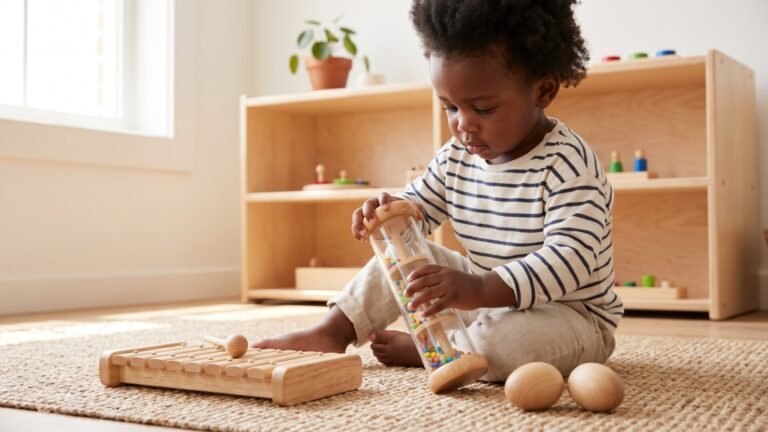
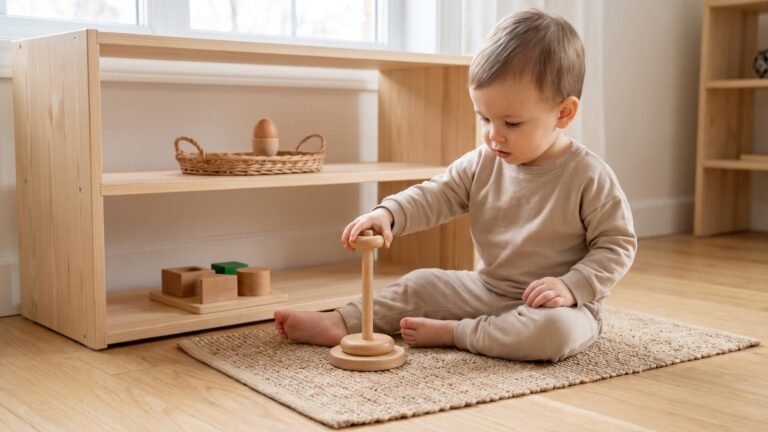
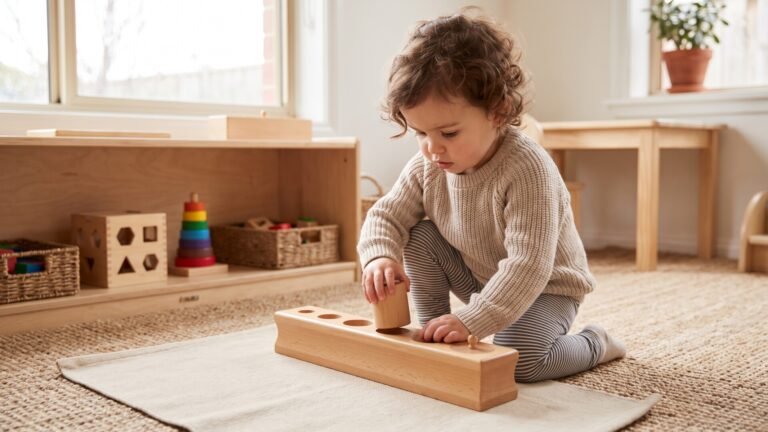
A true Montessori toy has several characteristics. It is made from natural materials like wood, metal, or fabric rather than plastic. It has a single purpose or a clear learning goal. It allows the child to self-correct, meaning the toy itself shows whether the task was done correctly. And it is aesthetically pleasing, because Montessori believed that beauty in the environment supports concentration and respect for materials.
For a three-year-old, the right Montessori toy sits at the edge of their ability, challenging them just enough to stay engaged but not so much that they become frustrated. This is what Maria Montessori called the “sensitive period” for order, language, and sensory refinement, and the right toys meet children exactly where they are developmentally.
At three years old, most children are working on several key developmental milestones. They are refining their fine motor control, learning to dress themselves, beginning to recognize letters and numbers, developing social skills through parallel and cooperative play, and building vocabulary at an astonishing rate. The toys I will recommend target these specific areas.
Types of Montessori Toys for 3-Year-Olds
Fine Motor Skills Development
Fine motor skills are the foundation for everything from writing to buttoning a shirt to using scissors. At three years old, children are moving from gross motor control toward more precise hand movements. They can hold a crayon with a tripod grasp, string large beads, and turn pages one at a time.
The best Montessori toys for fine motor development involve grasping, twisting, stacking, and threading. These actions strengthen the small muscles in the hands and fingers while building hand-eye coordination. Wooden puzzles with knobs, stacking rings, lacing beads, and peg boards are classic examples.
I remember watching my daughter spend twenty minutes trying to fit a wooden peg into a hole that was slightly too small. She would rotate it, try a different angle, and eventually succeed. The look on her face was not frustration but determination. That is the magic of a well-designed fine motor toy. It teaches persistence without requiring external rewards.
Cognitive Skills Enhancement
Cognitive development at three years old involves understanding cause and effect, sorting and classifying, recognizing patterns, and solving simple problems. Montessori toys in this category often involve matching, sequencing, and building.
Shape sorters, nesting blocks, memory games, and simple puzzles all support cognitive growth. The key is that these toys require the child to think through a problem rather than simply pressing a button for a reward. When a child tries to fit a square block into a round hole and it does not work, they must figure out why and try something different. That process builds neural pathways that passive toys cannot touch.
I have found that the best cognitive toys for this age are those that offer graduated difficulty. A set of stacking blocks that can be arranged by size, color, or pattern provides months of evolving challenge. The child does not outgrow the toy; they simply use it in more sophisticated ways.
Social and Emotional Development
Three-year-olds are beginning to understand that other people have feelings and perspectives different from their own. They engage in parallel play, where they play alongside other children, and are just starting to move toward cooperative play, where they interact and collaborate.
Montessori toys for social and emotional development include role-play sets, puppets, and cooperative games. A play kitchen, a dollhouse, or a set of animal figures allows children to act out social scenarios and practice empathy. They learn to take turns, share, and negotiate through play.
I have watched two three-year-olds spend an hour negotiating who would be the parent and who would be the child in a kitchen play scenario. That play taught them more about social dynamics than any lesson I could have given. The toy simply provided the stage; the children wrote the script themselves.
Language and Communication Skills
Language explodes between ages two and four. A three-year-old typically has a vocabulary of several hundred words and is beginning to form sentences of three to five words. They ask questions constantly and love stories, songs, and rhymes.
Montessori language toys focus on real objects, pictures, and words rather than abstract symbols. Picture books with clear, realistic images, alphabet puzzles, and matching games that pair objects with words all support language development. The Montessori approach emphasizes naming objects precisely and using rich vocabulary.
I made the mistake of buying a phonics toy that spoke for my child instead of letting her speak. She pressed a button, the toy said “A is for apple,” and she moved on. She learned nothing about the letter A or the sound it makes. A simple set of sandpaper letters, where she could trace the shape with her finger while I said the sound, was infinitely more effective.
Recommended Montessori Toys
Fine Motor Skills Development Toys
Melissa & Doug Wooden Puzzles
I have owned at least a dozen Melissa & Doug puzzles over the years, and they remain my top recommendation for fine motor development. The wooden knobs on the pieces are perfectly sized for small hands, and the images are realistic and engaging. The “chunky” puzzles with thick pieces are especially good for three-year-olds who are still developing precision.
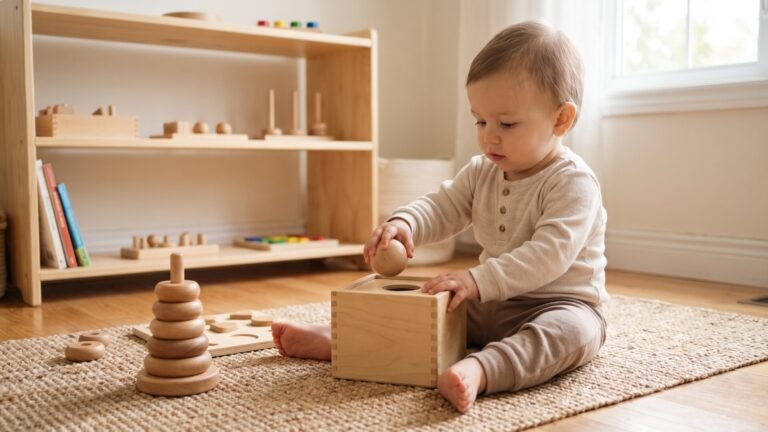
The self-correcting nature of puzzles means children know immediately whether a piece fits. There is no adult intervention required. They simply try, observe, and adjust. This builds confidence and problem-solving skills simultaneously.
The wooden construction means these puzzles survive drops, throws, and the occasional teething attempt. I have passed down puzzles through three children, and they still look nearly new. At around $15 to $20 per puzzle, the cost-per-use is negligible.
Tegu Magnetic Wooden Blocks
Tegu blocks are unlike any building set I have encountered. Each block contains a magnet inside, so the pieces click together with a satisfying connection. This allows children to build structures that would be impossible with regular wooden blocks, like cantilevers and floating elements.
The magnetic connection provides sensory feedback that children find deeply satisfying. They can feel the blocks align and lock into place. This builds hand strength and coordination while encouraging creative construction.
The blocks come in sets of varying sizes, from pocket-sized travel sets to large classroom sets. For a three-year-old, I recommend the 24-piece or 42-piece set. The blocks are made from sustainably sourced hardwood and finished with non-toxic water-based lacquer. They are safe for chewing, which matters at this age.
Cognitive Skills Enhancement Toys
Hape Wooden Shape Sorter
The Hape shape sorter is a classic for good reason. It includes eight geometric shapes in bright, natural colors, each with a corresponding hole on the wooden cube. The shapes are chunky and easy to grasp, and the cube has a lid that opens for easy retrieval.
What sets this shape sorter apart is the quality of the wood and the precision of the cuts. Each shape fits its hole with just enough resistance to require effort but not enough to cause frustration. The child learns to rotate and manipulate the shape to find the correct orientation.
The cube itself becomes a toy. Children stack things on top of it, roll it, and use it as a stool. It is one of those rare toys that serves its intended purpose while also inspiring creative repurposing.
Mags360 Magnetic Building Blocks
Mags360 blocks are a step up from traditional building blocks. Each piece contains a magnet that rotates 360 degrees, so the blocks connect on any side. This allows for complex three-dimensional structures that would be impossible with fixed magnets.
For a three-year-old, these blocks teach spatial reasoning, symmetry, and cause and effect. When they place a block at an angle, they see immediately whether the structure will stand or fall. They learn to balance weight, distribute force, and plan ahead.
The blocks are made from durable ABS plastic with embedded magnets. They are large enough to pose no choking hazard and lightweight enough for small hands. The set I bought three years ago still works perfectly, and my children still play with them regularly.
Social and Emotional Development Toys
Hape Kitchen Playset
The Hape kitchen playset is the gold standard for pretend play. It is made from solid wood with realistic details like a turning knob, a clicking oven dial, and a fabric curtain. The set includes pots, pans, utensils, and play food.
What makes this kitchen Montessori-aligned is its realism. The knobs actually turn. The oven door opens and closes. The play food looks like real food. Children engage in deep, sustained imaginative play because the props feel authentic.
I have watched children use this kitchen to cook meals for their stuffed animals, host tea parties, and run a restaurant. Each scenario teaches social skills like turn-taking, cooperation, and negotiation. The kitchen becomes a stage for practicing real-life relationships.
Lego Duplo Town Family House
Lego Duplo is the perfect introduction to building for three-year-olds. The blocks are large enough to be safe and easy to handle, but they require real pressure to connect and separate. This builds hand strength while teaching the basic principles of construction.
The Family House set includes figures, furniture, and accessories that encourage narrative play. Children can act out daily routines like eating breakfast, putting toys away, and going to bed. This helps them process their own experiences and develop emotional understanding.
Duplo sets are also endlessly expandable. One set can be combined with others to create larger worlds. This encourages long-term engagement and creative thinking. The blocks are made from durable plastic that withstands years of play.
Language and Communication Skills Toys
The Very Hungry Caterpillar Board Book
No Montessori toy list is complete without a mention of Eric Carle’s classic. The board book format is sturdy enough for three-year-olds to handle independently, and the story is simple, repetitive, and engaging. Children learn days of the week, counting, and the life cycle of a butterfly.
What makes this book especially valuable for language development is the predictable text. Children quickly memorize the pattern and begin “reading” along. This builds confidence and phonemic awareness. The illustrations are realistic enough to support vocabulary development.
I have read this book so many times that I can recite it from memory. My children have done the same. That repetition is exactly what supports language acquisition at this age.
LeapFrog Letter Factory Phonics
I was skeptical of electronic toys for a long time, but the Letter Factory Phonics system won me over. Each letter tile plays the letter name and sound when pressed, and the board encourages children to match letters to their sounds.
The key is that the child must actively participate. They press the tile, hear the sound, and then place it on the board. This multisensory approach supports learning in a way that passive screen time cannot.
The system includes 26 letter tiles and a base that plays songs and games. It is durable enough for rough handling and portable enough for car trips. At around $25, it is one of the most cost-effective language development tools I have found.
Practical Application
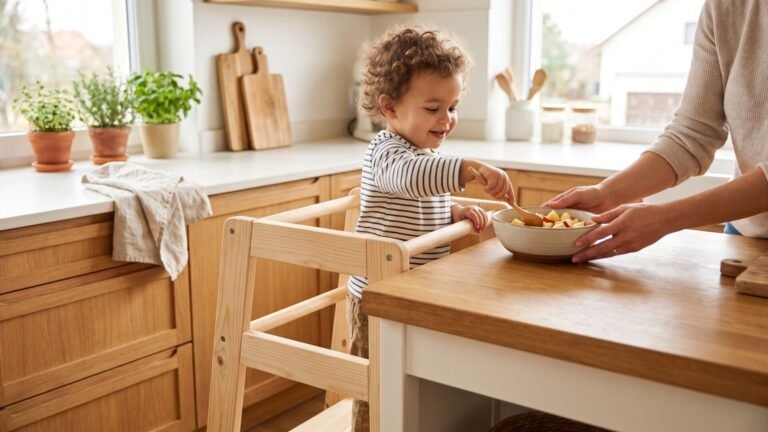
Knowing which toys to buy is only half the battle. The other half is creating an environment where those toys can do their work. Montessori philosophy emphasizes the prepared environment, a space that is organized, accessible, and inviting.
Start by reducing the number of toys available at any given time. I rotate my children’s toys every two weeks, keeping only six to eight options visible. This prevents overwhelm and encourages deep engagement. When children have fewer choices, they play more creatively and for longer periods.
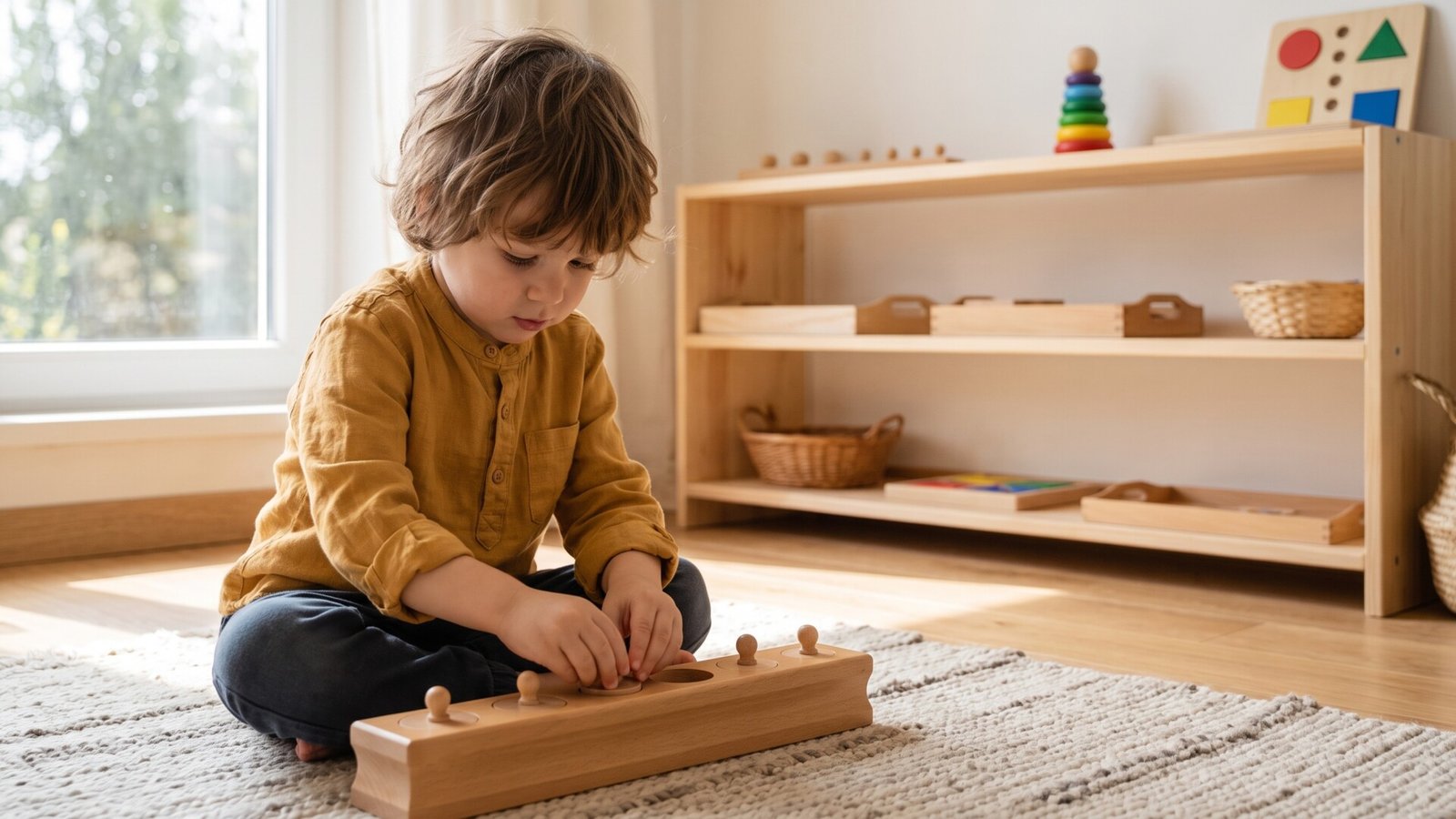
Arrange toys on low, open shelves where children can see and reach everything. Use baskets or trays to group related items. A puzzle tray with a puzzle, a small basket with shape sorter pieces, a book stand with one or two books. This visual organization helps children make choices independently.
Set up designated play areas for different types of activity. A small table and chairs for puzzles and fine motor work. A floor mat for building blocks. A play kitchen in a corner. This spatial organization helps children understand what kind of play is expected in each area.
Most importantly, resist the urge to direct play. Montessori toys are designed for self-directed learning. When your child picks up a toy, let them explore it in their own way. If they use the shape sorter as a hat, that is fine. They are learning about the world through experimentation.
I learned this lesson the hard way. I used to sit next to my daughter and show her the “right” way to use each toy. She would lose interest within minutes. When I stepped back and let her discover the toy on her own, she played for much longer and learned more deeply.
The Value of Investing in Montessori Toys
Let me address the elephant in the room. Montessori toys are not cheap. A single wooden puzzle can cost $20, while a plastic alternative might cost $5. I understand the hesitation.
But here is what I have learned after a decade of buying children’s toys. Cheap toys break. They lose pieces. They stop working. They end up in the trash within months. Montessori toys, made from solid wood and high-quality materials, last for years. They can be passed down to siblings, donated, or sold.
Let me give you a real example. I bought a $15 plastic shape sorter for my oldest. Within three months, the lid cracked, and one shape was lost. I bought a $25 Hape wooden shape sorter for my second child. It has survived three children and still looks new. The cost-per-use of the Hape sorter is pennies.
The same logic applies to building blocks, puzzles, and play kitchens. High-quality toys cost more upfront but deliver dramatically more value over time. They hold up to rough play, they do not require batteries, and they engage children for years rather than weeks.
Resale value is another consideration. Montessori toys from reputable brands like Hape, Melissa & Doug, and Tegu hold their value well. I have sold used wooden puzzles for nearly what I paid for them. The same cannot be said for plastic toys from mass-market brands.
When you calculate cost-per-use, the expensive Montessori toy often becomes the more economical choice. A $50 set of magnetic blocks that gets used twice a week for three years costs about 16 cents per use. A $10 plastic toy that gets used twice and breaks costs $5 per use. The math is clear.
Where to Buy
You can find these toys at major retailers like Amazon, Target, and Walmart, as well as specialty educational toy stores. I recommend checking the product links in this article for current pricing and availability.
[Affiliate: Shop Montessori Toys on Amazon]
[Affiliate: Browse Hape Toys Collection]
[Affiliate: Explore Melissa & Doug Puzzles]
When purchasing through affiliate links, you support this website at no additional cost to yourself. I only recommend products I have personally used and believe in.
Final Thoughts
I started this journey believing that more toys meant more learning. I ended it understanding that the right toys, used in the right environment, create the conditions for real development. The best Montessori toy is not the most expensive or the most popular. It is the one that your child returns to again and again, the one that sparks their curiosity and challenges their mind.
Every child is different. My daughter loved puzzles; my son preferred building blocks. The Montessori approach honors those individual differences. It gives children the freedom to follow their own interests and develop at their own pace.
The toys I have recommended here are not magic. They will not make your child a genius or guarantee academic success. But they will provide the foundation for independent thinking, problem-solving, and a love of learning. And that is worth far more than any toy’s price tag.
Frequently Asked Questions About Best Educational Montessori Toys For 3 Year Olds
What are Montessori toys?
Montessori toys are educational toys designed to support hands-on learning and development based on the principles of Maria Montessori. They are typically made from natural materials, have a clear learning purpose, and allow children to self-correct without adult intervention.
How do I choose the right Montessori toy for my child?
Look for toys that align with your child’s developmental stage and interests. Observe what they are naturally drawn to and choose toys that challenge them slightly beyond their current ability. Focus on hands-on, open-ended play rather than passive entertainment.
Are Montessori toys worth the investment?
Yes. These toys tend to be durable, promote educational play, and can be used for several years across multiple children. The cost-per-use is typically much lower than cheaper alternatives that break quickly or lose their appeal.
Can Montessori toys be used for children of other ages?
While they are particularly designed for three-year-olds, many Montessori toys can be adapted for different age groups. A shape sorter might be too simple for a five-year-old, but magnetic blocks and building sets grow with the child.
How do Montessori toys differ from traditional toys?
Montessori toys emphasize independence, open-ended play, and developmental learning rather than just entertainment. They are designed to teach specific skills through hands-on exploration rather than passive consumption.
Where can I buy high-quality Montessori toys?
Look for reputable retailers that specialize in educational toys, both online and in-store. The links provided in this article offer a curated selection of high-quality options. —