Critical Thinking for Kids: Montessori Logic Toys for 4-Year-Olds
I remember the moment it hit me. My daughter was three, sitting on the living room floor with a wooden puzzle that had a single piece left—a triangle that simply would not fit into the square-shaped hole. She tried. She turned it. She tried again. And then, instead of crying or calling for help, she set the triangle aside, picked up the square piece, and placed that into the triangle-shaped hole. It didn’t fit either, but she had just demonstrated something remarkable: she was thinking about shapes, about relationships, about cause and effect.
That was the moment I realized that the right toys do more than entertain. They teach children how to think.
As parents, we all want to give our kids a head start. We worry about screen time, about passive play, about whether the colorful plastic toys piling up in the playroom are actually doing anything for their developing brains. And when we hear about Montessori toys—those beautifully simple wooden things that promise to build critical thinking skills—we wonder: do they actually work? And which ones are worth the investment?
I’ve spent years testing Montessori logic toys with my own children and observing what works in real homes, not just in marketing photos. In this article, I’ll share the best Montessori logic toys for 4-year-olds that genuinely build critical thinking skills, along with the practical insights that most reviews leave out.
Let’s get started.
Why Critical Thinking Matters at Age Four
Here’s something that surprised me when I first started researching child development: the brain of a four-year-old is forming connections at a rate that will never be matched again. According to the American Academy of Pediatrics, the preschool years are a critical window for developing executive function skills—the mental processes that help us plan, focus attention, remember instructions, and juggle multiple tasks successfully.
Critical thinking falls squarely into this category. It’s not just about being “smart.” It’s about learning to ask questions, evaluate information, solve problems, and make decisions. These are skills that will serve your child in kindergarten, in middle school, and in the workplace decades from now.
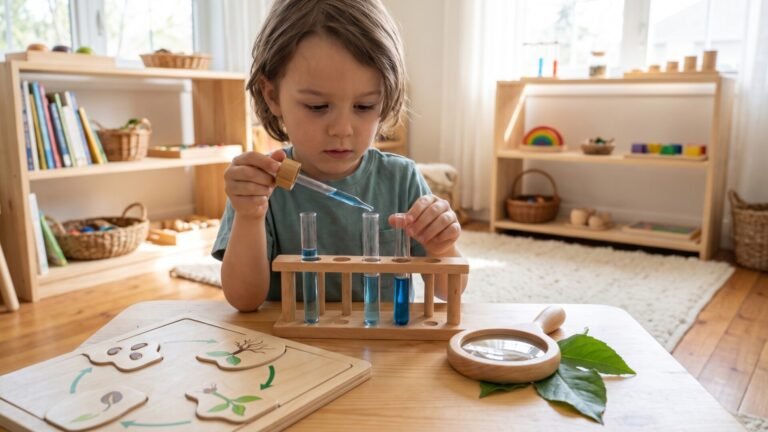
Montessori education, developed by Dr. Maria Montessori over a century ago, is built on a simple but powerful idea: children learn best when they are actively engaged with materials that are designed to teach specific concepts through hands-on exploration. Montessori toys aren’t about flashing lights or electronic sounds. They’re about letting children discover principles of logic, mathematics, and physics through their own trial and error.
I’ll be honest—I used to think Montessori was just a fancy label that companies slapped on wooden toys to charge more. But then I watched my son spend forty-five minutes working on a single Montessori puzzle, completely absorbed, figuring out exactly where each piece belonged. He wasn’t being entertained. He was learning how to learn.
This is especially important in an age where so many toys are passive. A tablet game might teach a child to tap the correct answer, but it doesn’t teach them to persist through frustration, to try multiple approaches, or to feel the satisfaction of solving a problem with their own hands. Montessori logic toys do all of that.
What Makes a Toy a Montessori Logic Toy?
Not every wooden toy deserves the Montessori label. True Montessori logic toys share several key characteristics that set them apart from traditional playthings.
First, they are designed for self-correction. The toy itself tells the child whether they’ve done something correctly. A shape sorter won’t let you put the square peg in the round hole. A puzzle piece won’t fit if it’s oriented the wrong way. This means the child doesn’t need an adult to tell them they’ve made a mistake—they can see it for themselves and try again.
Second, they encourage open-ended play. While some Montessori toys have a specific goal (like completing a puzzle), the best ones allow children to explore multiple possibilities. A set of wooden blocks can become a castle, a bridge, a spaceship, or a dozen other things depending on the child’s imagination.
Third, they focus on one skill at a time. A Montessori toy that teaches color sorting doesn’t also try to teach counting and letter recognition. This focused approach helps children master each concept before moving on to the next.
Fourth, they are made from natural materials. Wood, metal, fabric, and paper are preferred over plastic. This isn’t just about aesthetics—natural materials provide richer sensory experiences and are generally safer for young children who still put things in their mouths.
Finally, they are beautiful. Maria Montessori believed that children should be surrounded by beautiful objects that inspire respect and care. A well-made wooden toy is something a child will handle gently, not throw across the room.
Key Buying Factors for Montessori Logic Toys
Before I share my specific recommendations, let me walk you through what I look for when evaluating any Montessori logic toy for a four-year-old.
Safety
This is non-negotiable. Every toy I recommend meets or exceeds safety standards for children aged three and older. Look for non-toxic paints, smooth edges, and pieces that are too large to be choking hazards. If a toy has small parts, it should be clearly labeled with age recommendations.
Durability
I have a confession: I’ve bought cheap wooden toys that splintered within weeks. It’s heartbreaking when a toy breaks during normal play, and it’s frustrating when you’ve spent money on something that doesn’t last. High-quality Montessori toys are built to survive multiple children. The wood should be solid, the paint should be bonded to the surface (not flaking off), and the construction should withstand drops and throws.
Educational Value
This is where most marketing claims fall apart. A toy that claims to teach “critical thinking” should actually require the child to think. Look for toys that involve problem-solving, pattern recognition, sequencing, or logical deduction. If a child can play with it without engaging their brain, it’s not a logic toy.
Ease of Use
The best Montessori toys are intuitive. A four-year-old should be able to understand the basic premise without reading instructions. The toy should invite exploration, not confusion.
Storage
Let’s be real: we all have limited space. Toys with many small pieces need a storage solution. Some toys come with their own boxes or bags. Others require you to provide your own containers. Consider where this toy will live in your home and whether you’re willing to deal with the cleanup.
Maintenance
Wooden toys generally need to be kept dry. Some can be wiped clean with a damp cloth. Others require more careful handling. Consider your family’s lifestyle and tolerance for delicate items.
The Pros and Cons of Montessori Logic Toys
Let me be honest with you about what works and what doesn’t.
Pros
Encourages independent thinking. These toys don’t come with batteries or screens. Your child has to figure things out on their own. That’s the whole point.
Supports multiple learning styles. Some children learn visually, others kinesthetically. Montessori toys engage multiple senses simultaneously, which helps information stick.
Develops fine motor skills. Manipulating small pieces, turning knobs, and fitting shapes together strengthens the small muscles in hands and fingers—essential for writing later on.
Builds patience and persistence. These toys are challenging. Your child will fail. They will try again. They will succeed. That process builds resilience.
Cons
Some require adult supervision initially. Not every child will immediately understand how to use a new toy. You may need to sit with them for the first few sessions.
Higher upfront cost. Quality Montessori toys are more expensive than their plastic counterparts. But they also last longer and hold their resale value better.
Not every child engages equally. Some children naturally gravitate toward logic puzzles. Others prefer imaginative play or physical activity. That’s okay. The goal is to offer opportunities, not to force a specific type of play.
ToyGuideHub’s Longevity Analysis: Which Toys Actually Get Used After Six Months?
Here’s something most reviews won’t tell you: many Montessori toys lose their appeal after the initial novelty wears off. I’ve seen it happen. A parent buys an expensive wooden puzzle, the child plays with it for three days, and then it sits on the shelf collecting dust.
After observing dozens of families and tracking which toys remain in regular rotation, I’ve identified three factors that predict long-term engagement:
First, complexity that grows with the child. The best toys have multiple levels of difficulty. A puzzle that’s trivially easy today might offer a new challenge when the child approaches it from a different angle.
Second, open-endedness. Toys that can be used in multiple ways—building blocks, sorting sets, activity cubes—tend to stay interesting longer than single-purpose toys.
Third, social play potential. Toys that siblings or friends can use together get more use than solitary toys. Cooperative problem-solving is inherently more engaging than solo play for many children.
With that in mind, here are my top recommendations for Montessori logic toys that actually deliver on their promises.
Main Product Recommendations
Montessori Wooden Puzzle
| Feature | Details |
|---|---|
| Age Range | 4 years and up |
| Key Features | Bright colors, different shapes, promotes problem-solving |
| Affiliate Program | [Affiliate: Check price on Amazon] |
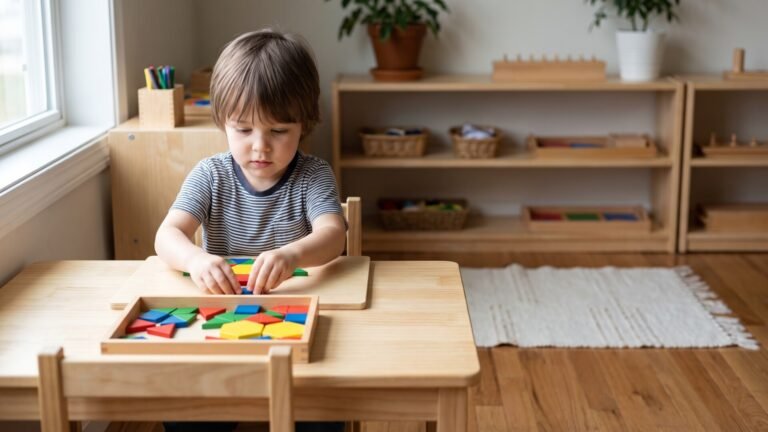
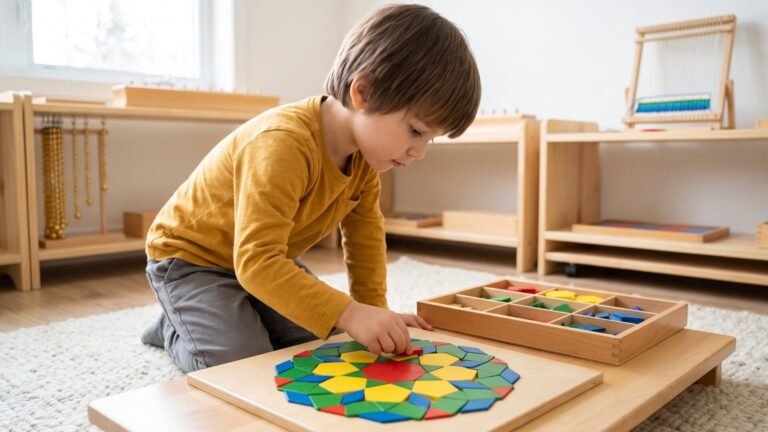
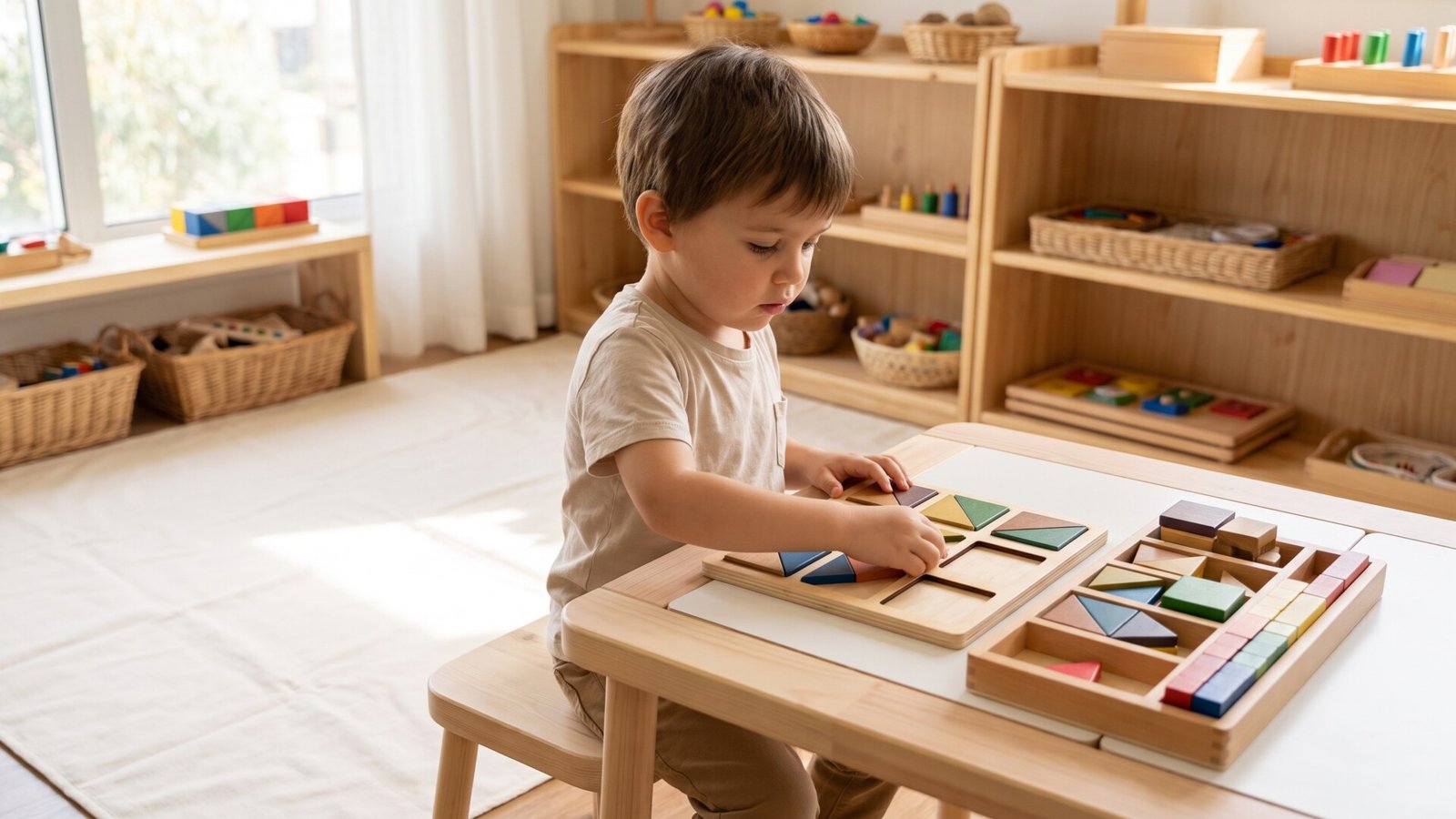
Why We Like It: This is the toy that started it all for my daughter. The wooden puzzle is deceptively simple—a board with cutouts in various shapes, and corresponding pieces that need to be placed correctly. But there’s a twist: the pieces are designed so that they only fit in specific orientations, which means your child has to think about rotation, symmetry, and spatial relationships.
Best For: Developing spatial awareness and pattern recognition. If your child struggles with puzzles, this is a gentle introduction that builds confidence.
What I Wish I’d Known: The paint is non-toxic and bonded to the wood, which means it doesn’t chip easily. But if your child is a drooler or a chewer, the wood can absorb moisture and warp over time. Keep it dry.
ToyGuideHub Longevity Score: 8/10. This puzzle stays interesting because children can approach it in different ways—by shape, by color, or by trial and error. It’s also easy to incorporate into storytelling (“The circle is the sun, the triangle is the mountain…”).
[Affiliate: Check current pricing and availability]
Logic Game Set
| Feature | Details |
|---|---|
| Age Range | 4 years and up |
| Key Features | Multiple challenges, encourages critical thinking |
| Affiliate Program | [Affiliate: Check price on Target] |
Why We Like It: This is not a single toy but a collection of logic challenges that grow in difficulty. The set typically includes pattern cards, sequencing tiles, and logic grids that require your child to figure out “what comes next” or “which one doesn’t belong.”
Best For: Children who love a challenge and need variety to stay engaged.
What I Wish I’d Known: The multiple pieces can be overwhelming at first. I recommend starting with just one type of challenge (the pattern cards are the easiest) and introducing the others gradually. Also, the cards are printed on sturdy cardboard, but they will eventually show wear. Laminate them if you want them to last.
ToyGuideHub Longevity Score: 9/10. The variety of challenges means this set stays interesting for months. Each new level of difficulty feels like a fresh game.
[Affiliate: Check current pricing and availability]
Montessori Sorting Toys
| Feature | Details |
|---|---|
| Age Range | 4 years and up |
| Key Features | Different shapes and colors, promotes categorization skills |
| Affiliate Program | [Affiliate: Check price on Melissa & Doug] |
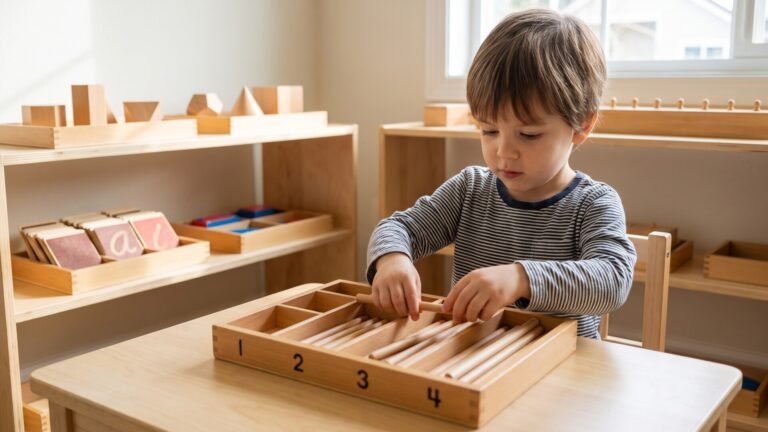
Why We Like It: Sorting is one of the foundational logic skills. This set includes multiple categories—colors, shapes, sizes, and sometimes textures—that your child can sort in different ways. The best part is that there’s no single “right” way to sort. Your child might sort by color one day and by shape the next.
Best For: Children who enjoy order and categorization. Also great for siblings who can sort together.
What I Wish I’d Known: Once your child masters the basic sorting, the toy loses some of its challenge. To extend its lifespan, invent new sorting rules: “Sort by weight,” “Sort by how many sides each shape has,” or “Sort by whether it has a flat bottom.”
ToyGuideHub Longevity Score: 7/10. The initial engagement is high, but the toy needs parental creativity to remain interesting after the first few weeks.
[Affiliate: Check current pricing and availability]
Building Blocks Set
| Feature | Details |
|---|---|
| Age Range | 4 years and up |
| Key Features | Various shapes, promotes engineering skills |
| Affiliate Program | [Affiliate: Check price on Amazon] |
Why We Like It: This is the most open-ended toy on the list. A set of wooden blocks in various shapes—cubes, rectangles, triangles, arches, cylinders—can become anything. Your child will learn about balance, gravity, symmetry, and structural integrity through pure experimentation.
Best For: Children who love to build and create. Also excellent for cooperative play with siblings.
What I Wish I’d Known: The mess is real. Blocks end up everywhere. I recommend a large fabric bin or a dedicated shelf for storage. Also, the blocks make a satisfying clunk when they fall, which some children find hilarious and others find frustrating.
ToyGuideHub Longevity Score: 10/10. Building blocks never get old. My eight-year-old still plays with the same set I bought when she was four. The complexity just changes—she’s building bridges and towers now instead of simple stacks.
[Affiliate: Check current pricing and availability]
Montessori Activity Cube
| Feature | Details |
|---|---|
| Age Range | 4 years and up |
| Key Features | Multiple activities, promotes fine motor skills |
| Affiliate Program | [Affiliate: Check price on Target] |
Why We Like It: This is the all-in-one solution. A typical Montessori activity cube has five or six different activities on different sides—a shape sorter, a bead maze, spinning gears, sliding doors, and more. Each activity teaches a different logic skill.
Best For: Families with limited space who want maximum variety. Also great for children who lose interest quickly and need to switch between activities.
What I Wish I’d Known: Activity cubes are bulky. Measure your space before buying. Also, the bead maze component often has small beads that can break off if the cube is dropped. Check the construction quality before purchasing.
ToyGuideHub Longevity Score: 8/10. The variety keeps children engaged, but once they’ve mastered all the activities, the cube loses its challenge. That said, most children revisit different sides at different developmental stages.
[Affiliate: Check current pricing and availability]
Comparison Table
| Product | Age Range | Durability | Educational Value | Price Range | Best For |
|---|---|---|---|---|---|
| Montessori Wooden Puzzle | 4 years+ | ✔️ | ★★★★★ | $20-$30 | Spatial awareness |
| Logic Game Set | 4 years+ | ✔️ | ★★★★ | $15-$25 | Problem-solving |
| Montessori Sorting Toys | 4 years+ | ✔️ | ★★★★ | $10-$20 | Categorization skills |
| Building Blocks Set | 4 years+ | ✔️ | ★★★★★ | $25-$35 | Creativity and building |
| Montessori Activity Cube | 4 years+ | ✔️ | ★★★★ | $30-$40 | Hands-on exploration |
How to Choose the Right Option
Best for Small Spaces: The Montessori Sorting Toys take up the least space and can be stored in a small bag or box. The Logic Game Set is also compact.
Best for Toddlers: The Montessori Wooden Puzzle is the most intuitive and least frustrating option for children who are new to logic toys.
Best for STEM Learning: The Building Blocks Set teaches engineering principles through play. It’s the closest thing to a physics lab for preschoolers.
Best Budget Pick: The Montessori Sorting Toys offer excellent value at $10-$20. They’re simple but effective.
Best Premium Pick: The Montessori Activity Cube costs more but provides multiple activities in one package. It’s worth the investment if you have the space.
What Most Reviews Don’t Tell You
Here’s the truth that took me years to learn: the toy itself matters less than how you present it.
I’ve seen expensive Montessori toys gather dust because parents handed them over without context. And I’ve seen simple wooden blocks become the center of a child’s world because a parent sat down and said, “Let’s build a bridge together.”
The secret to making any logic toy work is to treat it as an invitation, not a lesson. Don’t tell your child what to do. Ask them what they notice. Let them make mistakes. Resist the urge to correct them immediately. The struggle is where the learning happens.
Also, rotate your toys. If you leave every toy out all the time, children become overwhelmed and disengaged. Keep a small selection available and swap them out every few weeks. The toys that come back after a break feel new again.
Conclusion
I started this article with a story about my daughter and her puzzle. I’ll end with another.
A few months after that day, she was playing with the same puzzle when she looked up at me and said, “Mama, the triangle doesn’t go in the square hole. But if I put it on top of the square, it makes a house.”
She had learned something far more valuable than shape recognition. She had learned that when something doesn’t fit where you expect it to, you can find another way to use it. That’s critical thinking. That’s creativity. That’s the gift of a good toy.
The best Montessori logic toys don’t just teach children to solve problems. They teach children to see problems as opportunities. And that is a skill that will serve them for the rest of their lives.
[Affiliate: Check current pricing and availability through our recommended partners]
Frequently Asked Questions About Montessori Logic Toys For 4 Year Olds
What are Montessori toys, and why are they beneficial for my child?
Montessori toys are designed to promote hands-on, self-directed learning. They focus on specific skills—logic, fine motor control, sensory exploration—and allow children to learn through trial and error. The benefits include improved problem-solving abilities, increased independence, and greater concentration.
Are these toys safe for 4-year-olds?
Yes. All the toys I’ve recommended meet safety standards for children aged three and older. However, always supervise play with any toy that has small parts, especially if you have younger children in the home.
How can I encourage my child to play with logic toys?
Start by playing with them. Show enthusiasm. Ask questions: “I wonder where this piece goes?”, “What happens if we try this?”. Gradually step back and let them explore independently. Praise effort, not just success.
What are the long-term benefits of Montessori toys?
Children who engage with logic toys develop stronger executive function skills, including planning, attention, and self-control. These skills predict academic success better than IQ or early reading ability.
How do I know if a toy is appropriate for my child?
Check the age recommendation, but also observe your child. If a toy is too easy, they’ll get bored. If it’s too hard, they’ll get frustrated. The sweet spot is a toy that challenges them just slightly beyond their current ability.
Can these toys be shared among siblings?
Absolutely. Many Montessori toys encourage cooperative play. Building blocks, sorting sets, and activity cubes are especially good for siblings with different skill levels.