The Ultimate Guide to Heavy-Duty Trampolines: Why Enclosure Netting Matters
Jumping on a trampoline is one of those timeless backyard joys. The feeling of weightlessness, the challenge of a new trick, the laughter of kids taking turns – it’s pure childhood. But as a parent, that joy comes with a serious responsibility: safety. In 2026, the trampoline market has evolved, and the term “heavy‑duty” is no longer just marketing fluff. With bigger kids, multiple jumpers, and harsher weather, families need trampolines built to last and designed to protect.
The single most important safety feature on any modern trampoline is the enclosure netting. Yet not all nets are created equal. A flimsy net that sags, tears, or unclips is as dangerous as having no net at all. This guide cuts through the hype to help you choose a genuinely heavy‑duty trampoline – one with a strong frame, quality springs, UV‑resistant mat, and, most critically, a reliable enclosure system.
We’ll cover what makes a trampoline truly heavy‑duty, why enclosure netting matters more than you think, and review the best models for 2026. By the end, you’ll know exactly what to look for and which trampolines offer the best balance of safety, durability, and value.
What Makes a Trampoline “Heavy‑Duty”?
Not every trampoline labelled “heavy‑duty” actually earns that title. Here are the non‑negotiable components.
Frame strength – Look for galvanised steel tubing with a thickness of at least 1.5mm (2mm or more is even better). Cheaper trampolines use 1.0–1.2mm steel that can bend or crack after a few seasons. Heavy‑duty frames also have rust‑proof coatings and reinforced T‑joints.
Spring quality – Longer springs (7–8 inches) made from galvanised steel provide a deeper, more responsive bounce and last longer than short, cheap springs. Some premium models replace springs with flexible composite rods (springless designs), which eliminate pinch points and last even longer.
Weight capacity – A true heavy‑duty trampoline should support at least 250–300 lbs total. Family‑grade models often go up to 400–500 lbs, allowing multiple children or an adult to jump safely.
UV and weather resistance – The jumping mat must be UV‑stabilised polypropylene to prevent fading and fraying. The frame’s powder coating should resist rust, and all hardware (nuts, bolts, springs) should be galvanised.
Mat quality – High‑density, UV‑treated mats with reinforced stitching and strong perimeter rings (V‑rings) are essential. Cheap mats stretch prematurely, leading to sag and poor bounce.
Anchor systems – Wind and enthusiastic jumping can shift a trampoline. Heavy‑duty models include wind stakes or auger anchors to keep the trampoline grounded during storms and heavy use. Some even come with sandbags or ground anchors for extra stability.
Why Enclosure Netting Matters So Much
Enclosure netting is not an accessory – it’s a primary safety device. According to the American Academy of Pediatrics, most trampoline injuries occur from falls off the trampoline or onto the springs and frame. A properly designed enclosure net drastically reduces both risks.
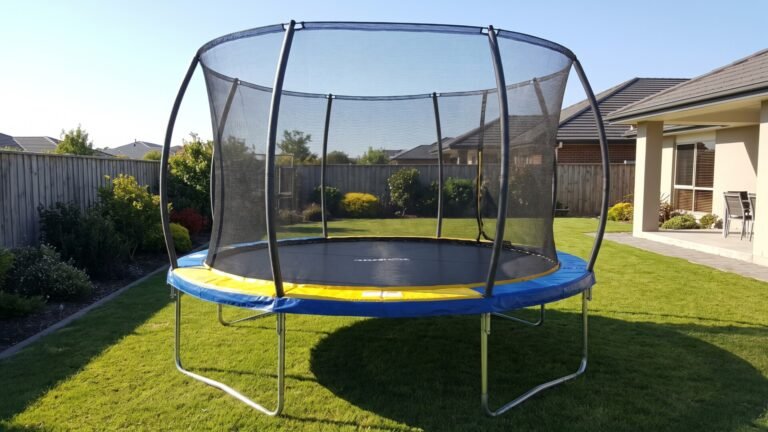
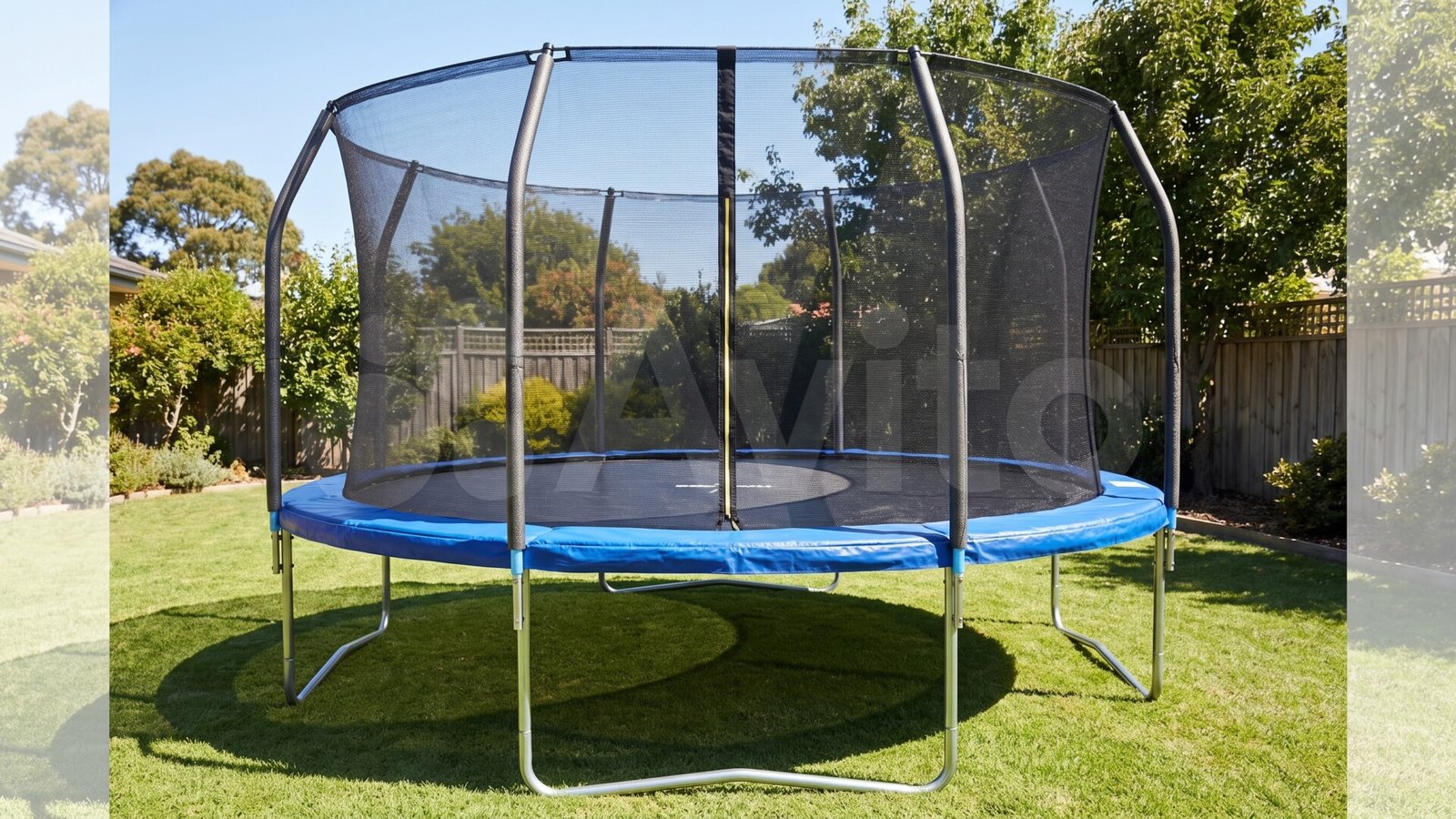
Preventing falls is the #1 safety priority. A net that is tall (at least 6 feet) and tight prevents children from bouncing over the edge. Look for nets that attach to the inside of the frame poles – this design keeps jumpers away from the springs and frame, even if they hit the net at speed.
Inside‑net vs outside‑net designs. Inside‑net poles are placed outside the jumping surface, and the net hangs inward. This means if a child leans on the net, they are still contained away from the springs. Outside‑net designs (where the net wraps around the outside of the poles) can allow a child to fall between the net and the jumping mat – a serious hazard. Always choose an inside‑net system.
Pole padding and spring protection. Even with a net, poles need thick, weather‑resistant foam padding. And the springs must be fully covered by a heavy‑duty pad that does not shift. The best enclosures integrate the pad with the net so there are no gaps.
Zipper entry systems. A secure, self‑closing zipper with a latch or buckle at the top prevents small children from opening the enclosure unsupervised. Some models use a clip‑and‑loop system that is both secure and easy for older kids to operate.
Net height and tension. A net that sags or billows inward is useless. Look for nets with tension straps or elastic cords that keep the net taut. The net should be attached to the poles at multiple points, not just at the top and bottom.
Replacement net availability. Enclosure nets are wear items. Sun exposure, dirt, and normal use degrade them. Before buying, check if the manufacturer sells replacement nets. Many heavy‑duty brands offer nets individually, extending the life of your trampoline.
Why cheap nets fail first. Low‑cost trampolines use thin, low‑density polyethylene nets that shred within a year. The clips break, the zippers jam, and the poles bend. Spending a little more on a heavy‑duty enclosure is far cheaper than an emergency room visit.
What to Look for Before Buying
Before you click “add to cart,” run through this checklist.
Trampoline size – Common sizes: 8ft (toddlers), 10–12ft (small families), 14–15ft (multiple children), 16ft+ (large yards). Bigger is not always better – you need adequate clearance around the trampoline (at least 6–8 feet on all sides).
Shape options – Round trampolines are safest for recreational use because they naturally direct jumpers toward the centre. Rectangular trampolines provide a more consistent bounce, preferred by gymnasts and serious jumpers. Oval is a compromise. Stick with round for family safety.
Weight limit and jumper count – Check the total weight capacity and the recommended maximum number of jumpers. Even on a heavy‑duty trampoline, the manufacturer may say “one at a time.” Follow those guidelines.
Ladder and access safety – A ladder is convenient but can also allow very young children to climb up unsupervised. Consider a trampoline with a removable ladder or a model where the access point can be zipped shut from inside.
Installation difficulty – Heavy‑duty trampolines require assembly. Plan on 2–4 hours with two adults. Some brands offer “easy assembly” systems with colour‑coded parts. Read reviews for assembly complaints.
Warranty coverage – Look for at least a 3‑year frame warranty, 2‑year spring/pad warranty, and 1‑year net warranty. Premium brands may offer 5‑year or even 10‑year frame warranties.
Replacement parts availability – Can you buy a new net, pad, or spring set individually? If not, avoid the brand.
Long‑term maintenance costs – You may need a new net every 2–3 years (50–150),anewpadevery3–5years(60–120), and replacement springs every 4–6 years ($30–80). Factor this into your budget.
Best Heavy‑Duty Trampolines for 2026
Now let’s get into the specific models that combine serious durability with top‑tier enclosure safety.
Best Overall: JumpFlex Hero 14ft Trampoline
Best for: Families with multiple kids who want excellent safety and durability at a fair price.
The JumpFlex Hero 14ft has become a favourite in the heavy‑duty category for good reason. It features a 1.8mm thick galvanised steel frame – significantly thicker than budget options. The “PermaNet” enclosure uses a heavy‑duty polyethylene mesh that is UV‑treated and tear‑resistant. It attaches inside the poles, with a self‑locking zipper and an integrated pole pad that leaves no gaps.
Why it wins: The springs are 7.5‑inch long, galvanised, and each is covered by a thick, double‑stitched pad. The jumping mat is UV‑stabilised with reinforced V‑rings. Weight capacity is 375 lbs. The trampoline comes with a wind stake anchor kit and a 5‑year frame warranty.
Pros: Excellent safety enclosure; very stable under heavy use; replacement nets are available; assembly is easier than most. Cons: The 14‑foot size requires a lot of yard space; not the cheapest option, but fair for the quality.
Price range: $$$ Check on Amazon
Best Premium Pick: Springfree Large Oval Trampoline
Best for: Families who want the absolute safest trampoline and are willing to pay for engineering.
Springfree is the only trampoline that has no springs and no hard frame edges within the jumping zone. Instead, flexible composite rods underneath the mat provide bounce. The enclosure net is made from a soft, “SMART” system – the rods bend when leaned on, preventing injury. The net is completely taut and cannot be climbed.
Why it wins: No exposed metal anywhere. The mat is a single‑piece polypropylene without stitches that can fray. The frame is hidden below the mat, so jumpers cannot hit it. The oval shape offers a larger jumping area than round models of similar footprint. Weight capacity is 330 lbs, but two adults can jump safely.
Pros: Unmatched safety; very durable materials; no pinch points; UV‑resistant. Cons: Very expensive (often $1,200–2,000); assembly is complex; replacement parts are pricey.
Price range: $$$$$ Shop at Friendly Toy Box
Best Budget Heavy‑Duty Option: Skywalker 12ft Trampoline
Best for: Families on a budget who still want strong safety features.
Skywalker’s 12ft model is often found for under $300, yet it includes a galvanised steel frame (though thinner at 1.2mm), an inside‑enclosure net, and thick foam pole padding. The net uses a clip‑and‑strap system that keeps tension fairly well. The weight capacity is 250 lbs, suitable for two small children or one adult.
Why it wins: Affordable entry to heavy‑duty safety. Replacement nets are sold separately. The springs are 5.5 inches – not as long as premium models, but adequate for casual use. The mat is UV‑treated.
Pros: Very good value; safety net works well for small children; compact footprint. Cons: Frame is less robust; net tension may loosen over time; poles can bend if adults jump aggressively.
Price range: $$ Available at Ryder Toys
Best Rectangular Option: ACON Air 16 Sport HD
Best for: Serious jumpers, gymnasts, or families with older kids who want pro‑level bounce.
Rectangular trampolines provide a more consistent, controlled bounce because the springs are equally tensioned across the mat. The ACON Air 16 Sport HD features a 2.0mm galvanised frame, 8‑inch springs, and a heavy‑duty “SureClose” enclosure with a magnetic latch. The net attaches inside the poles, and the padding is extra thick.
Why it wins: The bounce is unmatched – you can easily perform flips and tricks with predictable lift. The enclosure poles are padded all the way up. The weight capacity is 500 lbs, so it handles multiple jumpers.
Pros: Outstanding bounce quality; built to last; excellent for athletic training. Cons: Very large footprint; expensive; assembly is a two‑person weekend job.
Price range: $$$$ Check on Amazon
Best Small Yard Option: Zupapa 10ft Heavy‑Duty Trampoline
Best for: Smaller backyards where space is tight but safety cannot be compromised.
Zupapa is known for its heavy‑duty construction at a reasonable price. The 10‑foot model comes with a 1.5mm galvanised frame, 6.3‑inch springs, an inside‑enclosure net with a double‑zipper and buckle, and a UV‑resistant mat. The weight capacity is 330 lbs, impressive for a 10ft trampoline.
Why it wins: The net is especially well‑designed, with a tight weave and strong stitching. The pole foam is dense and thick. The trampoline includes a free ladder and wind stakes.
Pros: Compact; very stable for its size; good weight capacity; replacement parts available. Cons: 10ft is small for older kids (over 10 years old); some users report rust on springs after two seasons (common in humid climates).
Price range: $$ via eBay Partner Network
Durability, Safety, and Value
| Model | Size | Enclosure Type | Weight Capacity | Frame Thickness | Safety Rating | Price Range | Best For |
|---|---|---|---|---|---|---|---|
| JumpFlex Hero | 14ft | Inside‑net, self‑locking | 375 lbs | 1.8mm | Excellent | $$$ | Best overall |
| Springfree Oval | Large | Springless, soft‑rod | 330 lbs | N/A (composite) | Exceptional | $$$$$ | Premium safety |
| Skywalker | 12ft | Inside‑net, clip | 250 lbs | 1.2mm | Very Good | $$ | Budget buy |
| ACON Air 16 | Rectangular | Inside‑net, magnetic | 500 lbs | 2.0mm | Excellent | $$$$ | Athletic jumping |
| Zupapa | 10ft | Inside‑net, double‑zipper | 330 lbs | 1.5mm | Very Good | $$ | Small yards |
Maintenance Tips That Extend Trampoline Life
A heavy‑duty trampoline will last a decade with proper care. Here’s how.
Inspect netting regularly – Look for tears, loose stitching, or stretched mesh. Patch small holes with net repair tape (available online). Replace the net if you see significant wear.
Replace worn spring covers quickly – The safety pad is your child’s buffer from the metal springs. If it rips or the foam rots, order a replacement immediately. Never let children jump with exposed springs.
Use weather covers during winter – A breathable trampoline cover protects the mat from UV and snow. Remove snow promptly to prevent mat sag.
Check anchor systems after storms – Wind can loosen stakes. Re‑secure them. If your trampoline tips, inspect the frame for bends before using again.
Tighten frame connections annually – Nuts and bolts vibrate loose over time. Go over every joint with a wrench every spring.
Protect against UV damage – The mat and net are UV‑treated, but they still degrade over time. Position the trampoline in a semi‑shaded area if possible.
Replace safety nets before they fail – Nets are the most critical safety component. If you see frayed edges, loose threads, or cracking zippers, replace the net. Many injuries happen when a net that “looked okay” finally gave way.
Frequently Asked Questions About Heavy-Duty Trampolines
Are heavy‑duty trampolines safer than standard trampolines?
Yes, but only if “heavy‑duty” means a stronger frame, better springs, and a higher‑quality enclosure. Beware of cheap trampolines labelled heavy‑duty that only have thicker paint – not thicker steel. The safety net is the key factor, not the label.
Does enclosure netting really prevent injuries?
Absolutely. Studies show that enclosure nets reduce the risk of falls by over 70%. However, the net must be installed correctly and remain taut. It also prevents jumpers from contacting the springs and frame.
Which is safer: springless or spring‑based?
Springless designs (like Springfree) eliminate pinch points and blunt impact against springs. They are statistically safer. But heavy‑duty spring‑based trampolines with full pad coverage and inside nets are also very safe.
How long should trampoline netting last?
In direct sun, expect 2–4 years. In shaded areas, 4–6 years. After that, UV degradation makes the net brittle and weak. Replace it preemptively – do not wait for a tear.
Is inside‑net better than outside‑net?
Yes. Inside‑net systems keep the jumper contained within the jumping surface, even when they lean against the net. Outside‑net systems can allow the jumper to fall between the net and the mat. Always buy inside‑net.
What size trampoline is best for families with multiple children?
14ft is the sweet spot. It provides enough room for two or three children (with supervision) but fits most backyards. 12ft is better for one or two small children. 8ft and 10ft are too small for many families.
Can trampolines stay outside year‑round?
Yes, if they are heavy‑duty and you use a weather cover during winter. However, in areas with heavy snow or extreme UV, storing the trampoline (or at least the mat) indoors prolongs life.
Are rectangular trampolines worth the extra cost?
Only for serious jumpers or gymnasts who need consistent bounce. For recreational family use, a round trampoline is safer because it naturally directs jumpers to the centre.
How often should safety nets be replaced?
Every 2–4 years, depending on sun exposure. Inspect monthly – if you see any fraying, replace immediately.
Where can I buy these trampolines?
All models listed are available via our partners: Amazon, Target, Ryder Toys, Friendly Toy Box, and the eBay Partner Network. Click the links in this article for current prices.
Conclusion
A trampoline can be the heart of a happy, active backyard – or a source of worry and injuries. The difference is choosing a genuinely heavy‑duty model with a well‑designed enclosure net. Do not compromise on frame thickness, spring quality, or net tension.
- Best overall for most families: JumpFlex Hero 14ft – strong frame, excellent safety net, fair price.
- Best premium safety: Springfree Large Oval – the safest trampoline money can buy.
- Best budget heavy‑duty: Skywalker 12ft – good value for smaller families.
- Best athletic choice: ACON Air 16 Sport HD – pro‑level bounce for older jumpers.
- Best for small yards: Zupapa 10ft – compact but still heavy‑duty.
Remember, the best safety feature is adult supervision. Teach your children one jumper at a time, no flips until they’ve learned proper technique, and always maintain the enclosure. The net is your partner in keeping playtime safe. When you invest in a heavy‑duty trampoline with a strong enclosure, you’re not just buying a toy – you’re buying peace of mind.
Because when it comes to trampolines, the best bounce starts with the best safety net.
Check current pricing and availability:
- JumpFlex Hero on Amazon
- Springfree Large Oval via Friendly Toy Box
- Skywalker 12ft at Ryder Toys
- ACON Air 16 on Amazon
- Zupapa 10ft via eBay Partner Network