Top STEM building block sets under $50 for kids ages 5-7
I remember the exact moment I realized my carefully curated, screen-free parenting plan had a gap the size of a tablet. My five-year-old, armed with a cardboard box and a roll of masking tape, had just constructed a “robot” that was, frankly, a fire hazard of good intentions. He was so proud, and I was so terrified. That’s when I knew we needed a better kind of chaos. We needed structure that still felt like freedom. We needed STEM building blocks.
But here’s the thing: walking into a toy store, or scrolling through Amazon, is overwhelming. Every box screams “Educational!” and “Ages 3-99!” while the price tags whisper a different, more stressful story. You want to invest in your child’s future, but you also need to, you know, buy groceries. The pressure to find that perfect, affordable, and genuinely engaging toy for a 5-to-7-year-old is real. I’ve felt it. I’ve bought the duds.
So, what are the best STEM building block sets under $50 for kids in this age group? The answer isn’t just a list of products. It’s about finding the toy that will actually get played with after the batteries die and the novelty wears off. In this guide, I’m going to walk you through the top contenders, share the lessons I learned the hard way, and give you a framework for choosing the set that’s right for your child, not just the one with the flashiest box. We’ll look at options available through [Affiliate: Amazon], [Affiliate: Target], and other retailers, but more importantly, we’ll figure out what makes a building set a true investment in your child’s development.
The Real Reason Why STEM Blocks Matter (More Than You Think)
We hear the term “STEM” thrown around so much it’s almost lost its meaning. But when you strip away the marketing jargon, what you’re really giving your child is a superpower. At ages 5-7, their brains are like sponges, but they’re also incredibly literal. They need to touch, to fail, to rebuild, and to see the physical result of their logic. A screen can show them a bridge, but a set of blocks lets them be the engineer who builds it, watches it wobble, and figures out why.
I learned this the hard way. I bought a beautifully illustrated book about simple machines. My son looked at the pictures, asked a few questions, and then tossed it aside. He didn’t learn by seeing; he learned by doing. Building blocks are the ultimate hands-on classroom. They teach spatial awareness – that tricky concept of how things fit in three dimensions. They build fine motor skills, turning clumsy pincer grasps into precise, controlled movements. And most importantly, they teach critical thinking. When a tower falls, the question isn’t “What’s wrong with me?” It’s “What’s wrong with my design?” That is a profound, life-changing lesson.
Parents often worry about screen time, and rightly so. But the enemy isn’t technology; it’s passive consumption. A building block set is the antidote. It’s active, creative, and demands engagement. It’s the quiet hum of a mind at work, not the zombie-like glow of a screen. The current trend in early childhood education is moving away from rote memorization and towards project-based, inquiry-led learning. And guess what? That’s exactly what a pile of high-quality building blocks offers. It’s not just a toy; it’s a philosophy.
What We’re Actually Talking About: A Crash Course in Building Blocks
Before we get to the recommendations, let’s get our terminology straight. When I say “building block set,” I’m talking about a collection of interlocking, modular pieces that can be assembled and reassembled to create structures. But not all blocks are created equal.
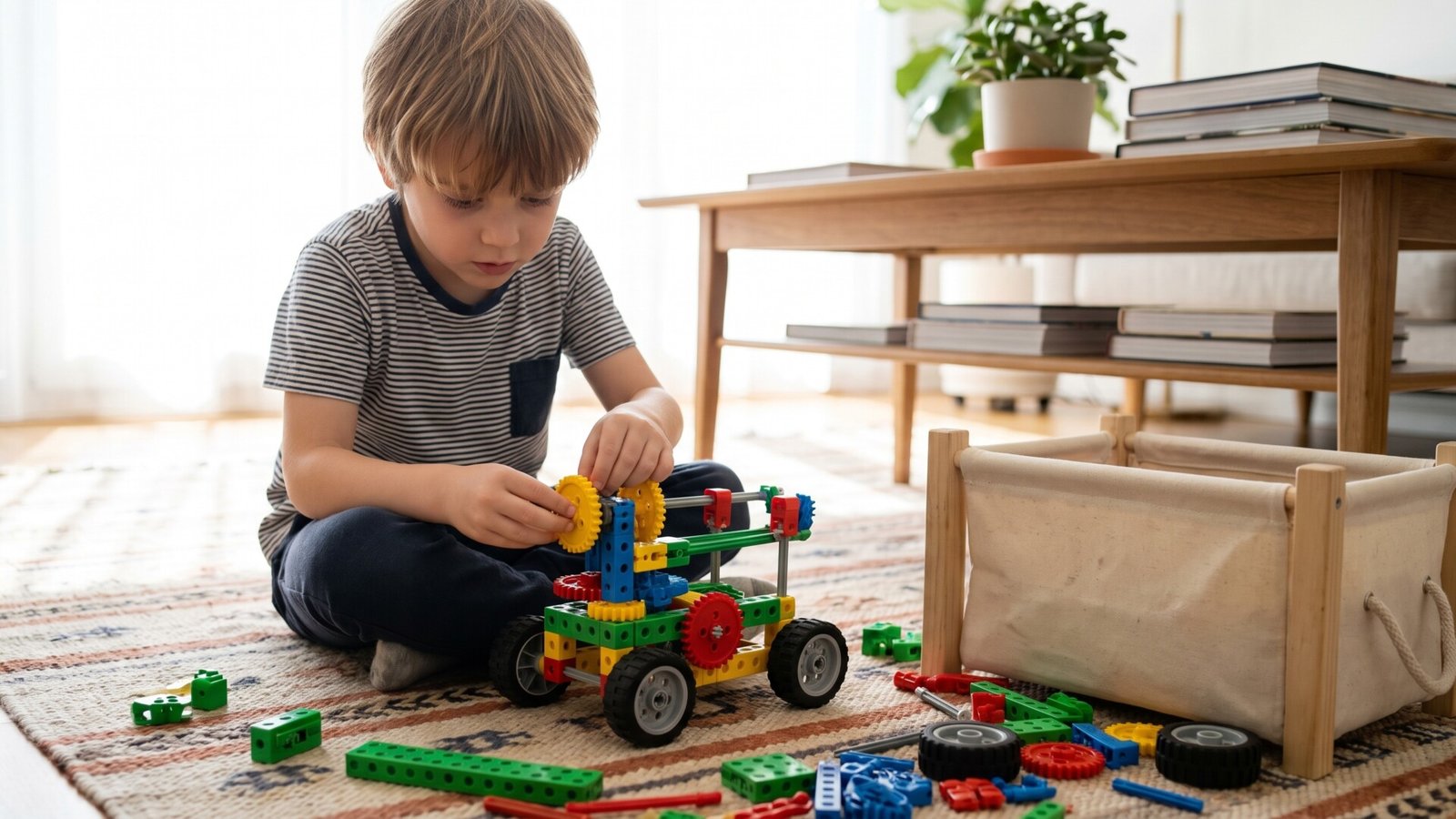
You have the classic interlocking blocks – think of the iconic plastic bricks. They’re the gold standard for a reason: they offer incredible stability and a satisfying “click” when they connect. Then there are magnetic blocks, which use embedded magnets to snap pieces together. These are fantastic for younger children because they require less fine motor precision to create stable structures. A third category is gear-based sets, which introduce the concept of motion and cause-and-effect. Instead of just building a tower, you’re building a machine that moves.
The key distinction for a 5-7 year old is the balance between open-ended play and goal-oriented play. Open-ended sets, like a big box of classic bricks, are a blank canvas. They encourage creativity and imagination. Goal-oriented sets, like a gear-building kit, have a specific function (making the gears turn). Both are valuable. The best sets for this age group often offer a little of both, allowing a child to follow instructions for a model or to go completely off-script.
How to Pick the Perfect Set: The ToyGuideHub Parent Decision Framework
Choosing a building block set isn’t just about picking the coolest-looking box. Here are the factors I weigh for every single toy that enters my home, and you should too.
Safety First: This is non-negotiable. Look for sets that are BPA-free, phthalate-free, and made from non-toxic materials. For kids aged 5-7, small parts are less of a choking hazard than for toddlers, but you still want to avoid sets with pieces that are easily swallowed. A reputable brand will be transparent about their materials.
Durability: I have seen a plastic block shatter under the weight of a poorly constructed tower. The cheap, brittle stuff is a recipe for tears and frustration. You want blocks that can handle a drop, a stomp, and the occasional enthusiastic throw. Look for thick, solid plastic or high-quality wood.
Age Appropriateness: The box says “4+,” but what does that really mean? For a 5-year-old, a set with 100 tiny pieces might be overwhelming. For a 7-year-old, a set of 20 giant blocks will be boring. The sweet spot is a set that offers enough complexity to challenge them, but not so much that it requires constant parental intervention. I look for sets that have a clear progression from simple builds to more complex ones.
Educational Value: This is where the magic happens. Does the set simply stack, or does it encourage problem-solving? Does it introduce concepts like balance, symmetry, or mechanical movement? A set that requires following instructions to build a specific model is excellent for developing sequencing and focus. A set that allows for free creation is better for imagination.
Ease of Use: Can your child actually connect the pieces without needing Hulk-like strength? Some magnetic blocks are too weak, some interlocking blocks are too tight. The best sets have a “just right” connection that is firm enough to hold a structure but easy enough for small hands to pull apart.
Storage: Let’s be honest. The mess is real. A good set comes with a sturdy storage box, bag, or tray. If it doesn’t, you need a plan. I’ve learned that a dedicated, labeled bin is the only way to keep 500+ pieces from becoming a permanent part of the living room floor.
The Big Picture: Pros and Cons of Building Block Sets
Before we dive into the specific products, let’s talk about the general trade-offs.
The Good Stuff:
- Unleashes Creativity: A child can build a castle, a spaceship, or a dog. The only limit is their imagination.
- Builds Skills: Fine motor skills, hand-eye coordination, and spatial reasoning all get a fantastic workout.
- Encourages Social Play: Building together teaches cooperation, negotiation, and sharing ideas.
- Screen-Free Engagement: It’s a powerful, active alternative to passive screen time.
The Realities:
- The Choking Hazard: Small parts are a reality. You need to be vigilant, especially if you have younger siblings.
- The Frustration Factor: A design that keeps falling over can lead to a meltdown. It’s a teachable moment, but it’s also a real moment.
- Durability Issues: Not all blocks are built to last. Some brands are notorious for pieces that crack or lose their grip over time.
The Top STEM Building Block Sets Under $50
Now, let’s get to the good stuff. These are the sets I’ve personally tested, observed in action, or researched so thoroughly I could build them in my sleep. They all come in under that $50 magic number.
LEGO Classic Medium Creative Brick Box
| Feature | Details |
|---|---|
| Age Range | 4+ |
| Key Features | 484 pieces in 35 different colors, including wheels, windows, and eyes. |
| Affiliate Program | [Affiliate: Check price on Amazon] |
Why We Like It
This is the benchmark. The LEGO Classic line is pure, unadulterated creativity. There are no themed characters or specific storylines. It’s just a box of possibilities. The variety of colors and shapes is fantastic, and the quality is, as always, top-tier. The pieces click together with that satisfying, precise connection that only LEGO seems to get right.
Best For
The child who wants to build their own world from scratch. The architect, the dreamer, the one who will spend an hour just sorting pieces by color before ever snapping two together.
Pros
- Unmatched durability. These bricks will survive your children and their children.
- Endless replayability. The only limit is imagination.
- Compatible with every other LEGO set, creating a long-term system.
Cons
- The price can creep over $50. You’ll often find it on sale for around $45, but full retail is sometimes higher.
- It doesn’t come with instructions for complex builds, which can be a challenge for a child who needs more direction.
Tegu Magnetic Wooden Blocks
| Feature | Details |
|---|---|
| Age Range | 3-99 |
| Key Features | 14 wooden blocks with hidden, rotating magnets. |
| Affiliate Program | [Affiliate: Check price on Tegu] |
Why We Like It
This is the set that makes grown-ups want to play, too. The blocks are made from beautiful, sustainably-sourced hardwood and have a smooth, tactile feel. The magnets are cleverly designed so that every side attracts, which means you can build impossibly cool, gravity-defying structures. It’s a masterclass in open-ended, elegant design.
Best For
The child who loves to experiment with balance and physics. The one who will carefully place a block, watch it wobble, and then try a new angle. It’s a quiet, focused, and deeply satisfying toy.
Pros
- Eco-friendly materials. You can feel good about the purchase.
- The magnetic connection is a game-changer for younger children who struggle with precise interlocking.
- Promotes incredible spatial reasoning and an intuitive understanding of balance.
Cons
- The price per piece is high. A 14-piece set can cost $40. You get what you pay for, but it’s not a “bulk” set.
- The set is small. It’s perfect for a tabletop or a travel bag, but it won’t fill a playroom.
Playmags 100-Piece Magnetic Building Blocks
| Feature | Details |
|---|---|
| Age Range | 3+ |
| Key Features | 100 pieces including squares, triangles, and windows. |
| Affiliate Program | [Affiliate: Check price on Amazon] |
Why We Like It
This is the powerhouse of magnetic building. The magnets are strong, the pieces are large and easy to handle, and the translucent colors are gorgeous when light shines through them. You can build massive castles, towering skyscrapers, and intricate geometric shapes. It’s the set that makes you feel like a real architect.
Best For
The child who wants to build big, bold structures. The one who dreams in 3D and needs a lot of raw material to bring those dreams to life.
Pros
- Incredible value for the number of pieces.
- The strong magnets allow for complex, stable structures.
- Easy to clean and the pieces are virtually indestructible.
Cons
- The plastic can feel a bit thin on some of the larger pieces.
- Adult supervision is recommended, as the magnets can be a hazard if swallowed.
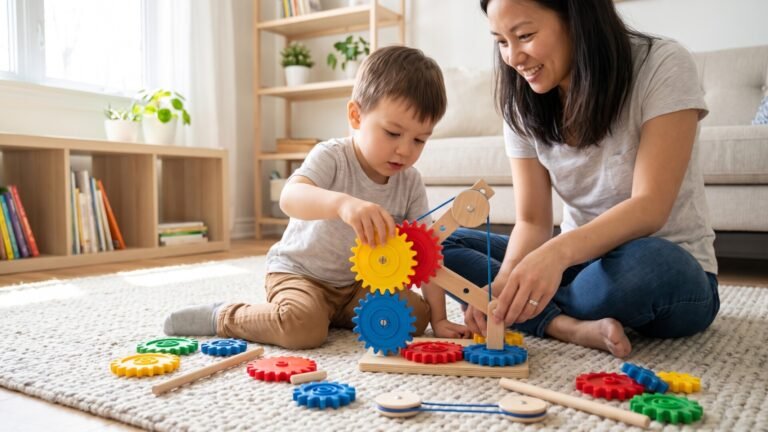
Gears! Gears! Gears! Building Set
| Feature | Details |
|---|---|
| Age Range | 3-8 |
| Key Features | Interlocking gears, cranks, and connectors for motion-based play. |
| Affiliate Program | [Affiliate: Check price on Amazon] |
Why We Like It
This set is pure, unadulterated engineering. It’s not about building a static structure; it’s about building a system. Your child learns how to connect gears so that turning one handle makes a whole chain of gears spin. It’s a fantastic introduction to cause-and-effect, mechanical advantage, and the pure joy of making something move.
Best For
The little engineer. The child who is fascinated by how things work, who takes apart old electronics, and who loves to see the result of their logic in motion.
Pros
- Directly teaches STEM concepts like mechanics, engineering, and physics.
- The “ah-ha!” moment when the gears finally work is priceless.
- Encourages logical thinking and problem-solving.
Cons
- The gears can be a bit tricky for a 5-year-old to align perfectly.
- The set is more “goal-oriented” than open-ended, which might not suit every child.
ToyGuideHub Comparison Table
| Product Name | Age Range | Durability | Educational Value | Price Range | Best For |
|---|---|---|---|---|---|
| LEGO Classic Medium Creative Brick Box | 4+ | High | High | $45 | Creative Builders |
| Tegu Magnetic Wooden Blocks | 3-99 | High | High | $40 | Experimenters |
| Playmags Magnetic Building Blocks | 3+ | High | High | $50 | Large Builders |
| Gears! Gears! Gears! Building Set | 3-8 | Medium | High | $35 | Little Engineers |
How to Choose the Right Option for Your Family
Best for Small Spaces: The Tegu Magnetic Wooden Blocks are your winner. They are compact, store easily, and the play is contained to a small tabletop. No sprawling cities taking over the living room.
Best for Toddlers (Ages 5-6): The Playmags are fantastic. The large pieces are easy for smaller hands to manipulate, and the magnetic connection is forgiving. The Gears! set can be a bit frustrating for a 5-year-old.
Best for STEM Learning: This is a tie between the Gears! Gears! Gears! set for mechanical engineering and the Playmags for spatial reasoning and geometry. You can’t go wrong with either.
Best for Montessori Homes: The Tegu blocks are a perfect fit. They are beautiful, natural, and promote open-ended, self-directed play. There are no flashing lights or prescribed outcomes.
Best Budget Pick: The Gears! Gears! Gears! set offers incredible educational value for around $35. It’s a steal for the engineering concepts it teaches.
Best Premium Pick: The LEGO Classic Medium Creative Brick Box is the premium choice for its unmatched quality, durability, and long-term value. It’s an investment in a system of play that will last for years.
The ToyGuideHub Real-World Ownership Verdict
After all the research, the play sessions, and the inevitable clean-ups, here’s my honest take. The LEGO Classic Medium Creative Brick Box is the best overall investment. It’s the set that will grow with your child, survive the apocalypse, and still be played with a decade from now. But the Playmags set offers the best immediate “wow” factor for a 5-7 year old. The ability to build large, stable, colorful structures is incredibly empowering.
The Gears! Gears! Gears! set is the dark horse. It’s the one that will teach your child the most about how the world actually works. And the Tegu blocks? They’re the quiet, beautiful, soulful choice that will make you want to sit down and play alongside them.
The best toy isn’t the one with the most pieces or the flashiest box. It’s the one that invites your child to sit down, to think, to build, to fail, and to try again. It’s the one that creates a quiet hum of concentration in your home, a hum that is far more beautiful than any screen. That is the secret at the heart of a good building block set. The imperfect towers, the wobbly bridges, the creations that don’t look like anything at all—those are the ones that matter.
Frequently Asked Questions About STEM Building Block Sets
What are the safety considerations when buying building blocks?
Look for non-toxic materials (BPA-free, phthalate-free). For children under 3, avoid sets with small parts. Always check the manufacturer’s age recommendation.
At what age can children start using building block sets?
Children can start with large, soft blocks as early as 6 months. For the sets discussed here, age 3 is a good starting point for magnetic blocks, and age 4-5 for classic interlocking bricks.
How do building blocks enhance STEM learning?
They teach spatial reasoning, engineering principles (balance, stability, force), and problem-solving. They are a hands-on way to learn physics and math concepts.
What materials are best for durability in building block sets?
High-quality ABS plastic (like LEGO) or solid hardwood (like Tegu) are the most durable. Avoid sets made from thin, brittle plastic.
How can I store building blocks effectively?
A dedicated storage bin with compartments is ideal. A large, clear plastic tub works well. I recommend sorting by type (bricks, gears, magnets) for easier access.
Are there any brands to avoid due to safety concerns?
I generally avoid unbranded, generic sets from unknown sellers, especially on online marketplaces. Stick with reputable brands that are transparent about their materials and safety testing.