Thames & Kosmos Sky-Hi Roller Coaster: The Best Physics Kit for 10‑Year‑Olds
Physics can feel like a distant, abstract subject when it’s stuck in a textbook. But when you watch a tiny steel marble climb a lift hill, race down a track, loop upside down, and sail into a waiting catch basket – that’s physics you can see, hear, and feel. Roller coaster building kits have exploded in popularity because they turn potential energy, momentum, and friction into a thrilling, hands‑on challenge that kids actually want to solve.
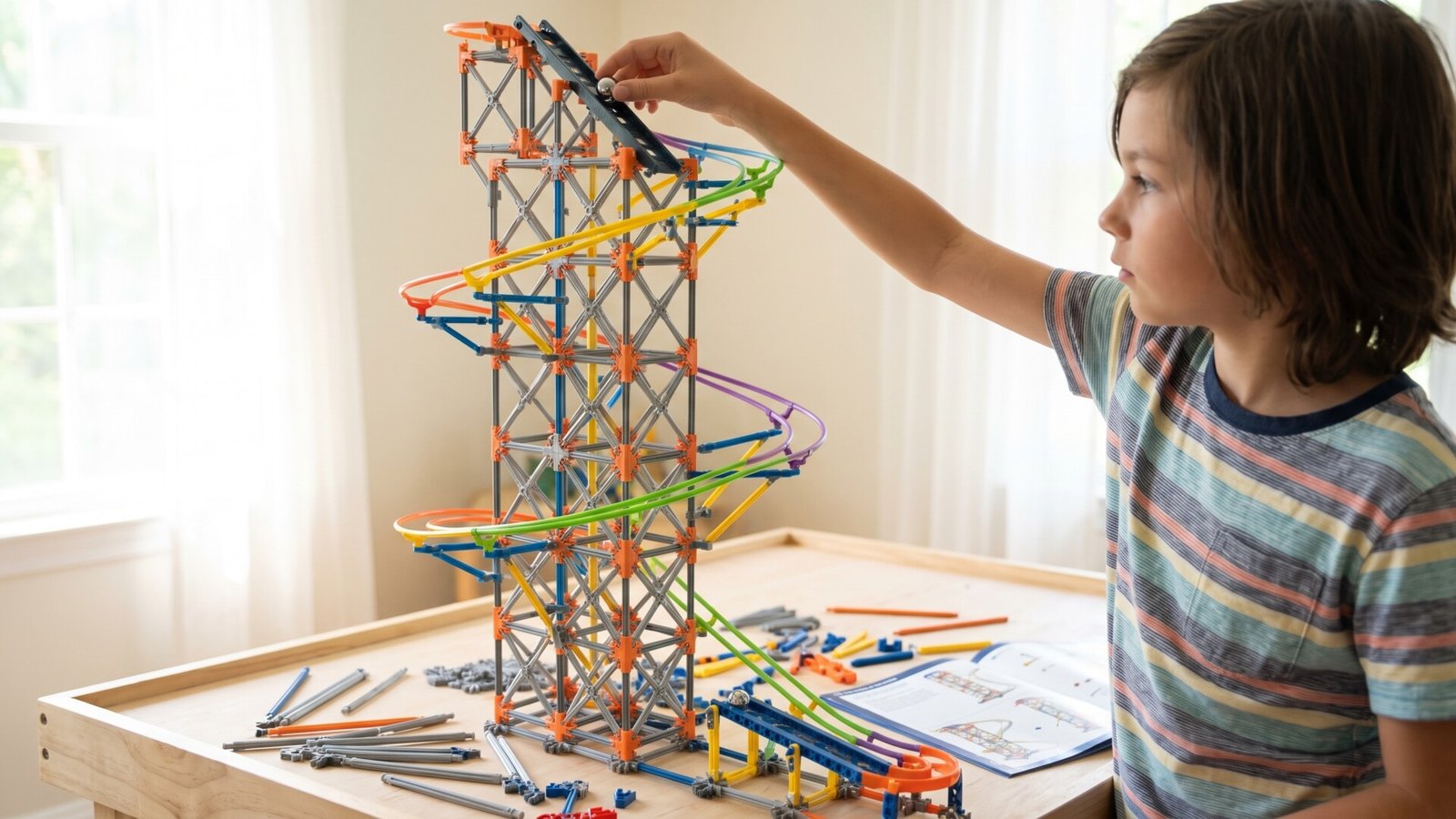
The Thames & Kosmos Sky‑Hi Roller Coaster is one of the most ambitious kits in this category. Designed for ages 10 and up, it asks builders to construct a multi‑level, 2‑meter‑tall roller coaster that uses gravity alone to propel a ball from start to finish. No motors, no batteries – just smart engineering and a deep understanding of how energy behaves.
But is the Sky‑Hi Roller Coaster truly the best physics kit for 10‑year‑olds, or is it just a complicated build‑and‑display toy with limited educational payoff? In this guide, I’ll break down how it works, what it teaches, where it frustrates, and how it stacks up against other STEM construction kits. By the end, you’ll know exactly whether this towering structure belongs on your family’s project table.
Why Roller Coaster Physics Kits Are So Effective for Learning
Roller coaster kits aren’t just fun – they’re one of the most efficient ways to teach core physics concepts. Here’s why they work so well for 10‑year‑olds.
STEM learning through motion – A marble rolling down a track demonstrates gravitational potential energy (energy stored by height) converting into kinetic energy (energy of motion). When the marble climbs a loop, kids see firsthand that it needs enough starting height to make it through. That’s the conservation of energy in action, without a single equation.
Why kids engage more with roller coasters – The excitement factor is unmatched. Unlike a static pulley system or a simple inclined plane, a roller coaster creates anticipation – will it clear the loop? Will it derail? That emotional investment dramatically increases retention. Children who build roller coasters remember the relationship between height and speed years later.
Engineering thinking development – Building a functional coaster requires iterative design: you assemble, test, watch the marble crash, then adjust track height or curve radius. This trial‑and‑error process mirrors real engineering. Kids learn that failure isn’t an endpoint – it’s data.
Real‑world physics introduction – Roller coasters incorporate simple machines (lift hills act as inclined planes), friction (why track smoothness matters), and centripetal force (what keeps the marble on the loop). These concepts are directly applicable to amusement parks, transportation, and even space travel. The Sky‑Hi kit leverages all of these in one towering package.
What Is the Thames & Kosmos Sky‑Hi Roller Coaster Kit?
The Sky‑Hi Roller Coaster is a modular, gravity‑powered marble racetrack that stands nearly two meters tall when fully assembled. It’s part of Thames & Kosmos’s “Physics Workshop” line, designed specifically for upper elementary and middle school learners.
Core concept – You build a multi‑level track system using plastic support columns, flexible track rails, connectors, and a launch platform. A small metal ball (the “coaster car”) is released from the top; it then travels down while navigating loops, jumps, and curves before landing in a target basket. The entire system is powered only by gravity – no batteries, no motors.
Build structure – The kit includes:
- Color‑coded plastic struts and base plates
- Flexible track rails that can be bent into curves and loops
- Connectors and clamps
- A ball release mechanism
- A detailed, full‑color instruction manual with 20+ pre‑designed track configurations
The recommended build height is over 6 feet, but you can create smaller layouts depending on space.
Mechanical operation – After assembly, you place the ball at the highest point. It rolls down, gaining speed, then enters loops, banked turns, or jumps. The track pieces are designed to be adjustable, so you can experiment with different slopes, loop diameters, and even add “launch” sections (using elastic bands in some configurations).
Age target – The kit is rated for ages 10 and up. The complexity is intentional: it’s challenging enough to require patience and problem‑solving, but not so difficult that a motivated 10‑year‑old can’t succeed with occasional adult help.
Key Educational Features
The Sky‑Hi Roller Coaster isn’t just a toy – it’s a portable physics lab. Here are the specific concepts it teaches.
Physics principles covered:
- Gravity: The driving force behind the coaster. Kids learn that steeper slopes produce faster speeds.
- Momentum: Why the marble continues through loops and why it sometimes doesn’t have enough speed to complete them.
- Energy conservation: The relationship between starting height and the ability to clear obstacles. A classic experiment: raise the starting point vs. lower it and observe the difference.
- Friction: Different track surfaces (smooth plastic vs. rougher connectors) affect distance traveled. Kids can experiment by cleaning the track or adjusting alignment.
- Centripetal force: What keeps the marble on a loop – the inward force provided by the track’s curve.
Engineering skills:
- Structural stability: Towers must be straight and well‑connected. If the frame wobbles, the marble derails.
- Iterative building: The manual provides baseline designs, but the real learning happens when kids modify and test their own layouts.
- Problem‑solving cycle: Build → test → observe failure → hypothesize cause → adjust → retest.
Spatial reasoning – Assembling a 3D structure from 2D instructions challenges children to visualize how parts fit together in space. This skill is directly linked to success in geometry, engineering, and even video game design.
STEM curriculum alignment – The kit aligns with Next Generation Science Standards (NGSS) for grades 5–8, specifically around energy transfer, forces, and engineering design. Many homeschool families and teachers use it as a hands‑on supplement to physics units.
Pros and Cons of the Sky‑Hi Roller Coaster Kit
| Pros | Cons |
|---|---|
| Highly engaging – The thrill of watching the marble complete a successful run is genuinely exciting. | Time‑intensive assembly – First build can take 2–4 hours, which may test a child’s patience. |
| Strong educational depth – Covers multiple physics concepts in a memorable way. | Requires adult supervision – While a 10‑year‑old can do it, younger or less patient kids need help. |
| Teaches real engineering – Iterative design process mirrors professional work. | Structure can be fragile – If connections aren’t tight, the tower can lean or collapse. |
| Modular and reconfigurable – Dozens of possible track layouts; not a one‑and‑done build. | Limited “free play” – Once built, the main interaction is releasing the marble; no additional moving parts. |
| Satisfying visual feedback – Watching the marble’s motion is intrinsically rewarding. | Requires dedicated space – The full 2‑meter height needs ceiling clearance and floor area. |
What the kit is not
It’s not a “quick‑play” toy. This is a project. A child who expects instant action may become frustrated. Also, it’s not motorized – the entire experience is about gravity and precise alignment. If you’re looking for a battery‑powered robotic kit, this isn’t it.
The “Eureka” moment is real
The best part of the Sky‑Hi Coaster is the moment a child realizes why a modification worked. When they raise the starting height and the marble suddenly clears a loop that previously failed, they’ve just discovered the conservation of energy through their own experimentation. That “aha!” is what makes this kit worth the price.
Storage and durability considerations
The kit uses lightweight plastic parts that are durable but not indestructible. Dropping the tower or storing it in a damp basement could lead to cracks in connectors. The manual includes instructions for disassembly, but many families choose to keep it assembled on a high shelf as a display and occasional play piece.
Best Physics and Engineering Kits for Kids in 2026
The Sky‑Hi Roller Coaster is our top pick, but it’s not the only option. Here’s how it compares to other excellent physics kits on the market.
Best Overall: Thames & Kosmos Sky‑Hi Roller Coaster
This kit hits the sweet spot between educational depth, build challenge, and fun. The 20+ pre‑designed layouts provide guidance, but the real value comes from the open‑ended experimentation. The included manual explains the physics behind each element (loops, jumps, banked curves) in kid‑friendly language. Recommended for ages 10+.
| Pros | Cons |
|---|---|
| Excellent physics coverage | Large space required |
| High replay value through reconfiguration | Time‑consuming assembly |
| Rewarding for patient, curious kids | Not suitable for under 10 |
Price range: $$ (approx $60–80)
Best for: STEM‑focused 10–13 year olds, homeschoolers
Best Advanced Alternative: Thames & Kosmos Roller Coaster Engineering Set (Deluxe)
For older or more experienced builders (ages 12+), the Deluxe version offers a larger scale, more track pieces, and additional challenges like a “corkscrew” element and a battery‑powered lift chain. It requires even more assembly time and costs significantly more, but it’s a true engineering centerpiece.
| Pros | Cons |
|---|---|
| More complex and taller | Higher price |
| Motorized lift adds realism | Even larger space requirement |
| Advanced physics challenges | Not for beginners |
Price range: $$$ (approx $120–150)
Best Budget Physics Kit: National Geographic Air Rocket Launcher Set
If you’re looking for a lower‑cost, simpler introduction to physics, the Air Rocket Launcher is excellent. Kids stomp on an air bladder to launch foam rockets up to 100 feet. It teaches kinetic energy, air pressure, and trajectory – with minimal assembly. Ideal for ages 8–12.
| Pros | Cons |
|---|---|
| Very affordable | Limited to projectile motion |
| No assembly required | Less engineering depth |
| Great for outdoor play | Shorter educational lifespan |
Price range: (approx25–35)
Best Compact STEM Option: Klutz LEGO Chain Reactions Kit
This kit combines LEGO building with physics concepts like levers, gears, and domino effects. Kids build 10 different chain reaction machines, each demonstrating a mechanical principle. It’s compact, fits on a table, and works with standard LEGO bricks. Best for ages 8–12.
| Pros | Cons |
|---|---|
| Small footprint | Less dramatic than roller coaster |
| Uses familiar LEGO pieces | Some mechanisms require fine tuning |
| Highly replayable | Focuses on mechanics, not energy physics |
Price range: $$ (approx $40–50)
Best Classroom Physics Kit: Gigo STEM Engineering Structures Set
Designed for group learning, this kit includes enough parts for 2–3 students to build simultaneously. It covers structural engineering (bridges, towers, cranes) rather than roller coasters. Comes with lesson plans and alignment to standards. Best for ages 9–13.
| Pros | Cons |
|---|---|
| Group‑friendly | No exciting “rolling” element |
| Very durable parts | More expensive for individual use |
| Includes teacher guide | Less engaging for some kids |
Price range: $$ (approx $70–90)
Comparison Table — Physics Kit Performance
| Kit | Complexity | Physics Depth | Build Time | Replay Value | Durability | Price Range | Best For |
|---|---|---|---|---|---|---|---|
| Sky‑Hi Roller Coaster | High | Very High | High (2‑4 hrs) | High | Medium | $$ | Best overall, ages 10+ |
| Deluxe Roller Coaster | Very High | Very High | Very High (4‑6 hrs) | High | Medium | $$$ | Advanced users |
| Air Rocket Launcher | Low | Medium | Low (10 min) | Medium | High | $ | Beginnings, outdoor play |
| LEGO Chain Reactions | Medium | Medium | Medium (1‑2 hrs) | High | High | $$ | Compact builds |
| Gigo Structures | Medium | High | Medium | Medium | Very High | $$ | Classrooms |
Who Should Buy the Sky‑Hi Roller Coaster Kit?
The Sky‑Hi Roller Coaster is a specialized product. It’s not for every family, but for the right child, it’s a transformative learning experience.
- Best for STEM‑focused kids (ages 10–13) – If your child already enjoys building kits, asks “why” questions about how things work, and has the patience for multi‑step projects, this kit will be a hit.
- Ideal for hands‑on learners – Children who struggle with textbook learning but thrive when they can manipulate physical objects will benefit enormously from seeing physics in action.
- Great for parents teaching physics at home – Homeschool families can use this as a centerpiece for a unit on energy, forces, or simple machines. The manual provides enough background for non‑expert parents.
- Not for quick‑play toy expectations – If your child expects instant gratification or loses interest after 20 minutes, this kit may become a source of frustration rather than joy.
- Requires patience and problem‑solving mindset – The manual is clear, but the build is intricate. Kids who give up at the first obstacle will need encouragement.
- Strong educational gift for school‑age children – For birthdays or holidays, this is the kind of present that stands out: not another video game, but a genuine learning tool that feels like play.
FAQ
1. Is the Sky‑Hi Roller Coaster really educational?
Absolutely. It teaches gravitational potential energy, kinetic energy, conservation of energy, friction, centripetal force, and engineering design principles – all through hands‑on experimentation.
2. How long does it take to build?
The first build typically takes 2–4 hours, depending on the child’s experience with construction kits and the complexity of the chosen layout.
3. Can kids build it alone?
A motivated 10‑year‑old can follow the illustrated manual and build independently, but occasional adult help with structural alignment and troubleshooting is useful. Younger children (under 10) will need significant assistance.
4. Does it break easily?
The plastic parts are sturdy, but the towers can become wobbly if connections aren’t tightened properly. Once built, the structure is stable if placed on a level surface and not bumped. Disassembly and reassembly may cause wear over time.
5. Can it be rebuilt multiple times?
Yes. The kit is designed to be reconfigured. The manual includes over 20 different track layouts, and kids can invent their own designs. Parts are reusable.
6. What physics concepts does it teach?
Gravity, potential and kinetic energy, momentum, friction, centripetal force, and energy conservation. Also structural engineering and iterative design.
7. Is it better than LEGO STEM kits?
They serve different purposes. LEGO kits are excellent for mechanics, gearing, and chain reactions. The Sky‑Hi Coaster is uniquely focused on gravity‑powered motion and energy conversion. For a child fascinated by roller coasters, this is far superior.
8. Is it suitable for classrooms?
Yes, but it works best as a small‑group or demonstration kit. The large footprint means it’s not practical for 30 students to each build one. However, a single set can be used for class demonstrations or after‑school STEM clubs.
9. Does it require batteries or electronics?
No. It is entirely gravity‑powered. The only “energy input” is lifting the marble to the starting point.
10. Where can I buy it?
Available through major retailers including Amazon, Target, Thames & Kosmos’s official website, and educational supply stores. Links are included in this article to support ToyGuideHub.
Conclusion
The Thames & Kosmos Sky‑Hi Roller Coaster is not a casual toy. It’s a serious educational project that trades instant gratification for deep, lasting understanding. For the right 10‑year‑old – one who loves building, asks “why,” and doesn’t give up when a marble flies off the track – this kit is a treasure. It turns abstract physics into visible, thrilling motion and teaches engineering thinking through joyful trial and error.
Is it the best physics kit for 10‑year‑olds? Yes – because no other kit at this price point combines the wow factor of a 2‑meter‑tall structure with such a rich curriculum of energy and force concepts. However, it requires patience, space, and a child who sees failure as an invitation to improve.
- Best overall pick: Thames & Kosmos Sky‑Hi Roller Coaster
- Best advanced option: Thames & Kosmos Deluxe Roller Coaster Engineering Set
- Best budget option: National Geographic Air Rocket Launcher Set
- Best compact option: Klutz LEGO Chain Reactions Kit
- Best classroom option: Gigo STEM Engineering Structures Set
Because sometimes the best way to understand physics isn’t reading about it – it’s building something that refuses to work until you get it right. The imperfect loops, the marbles that crash, and the shouts of success when it finally runs: those are the moments that stick.
Check current pricing and availability:
- Thames & Kosmos Sky‑Hi Roller Coaster on Amazon
- Deluxe Engineering Set via Target
- National Geographic Air Rocket Set on Amazon
- Klutz LEGO Chain Reactions via LEGO Affiliate Program
- Gigo STEM Kits through educational retailers