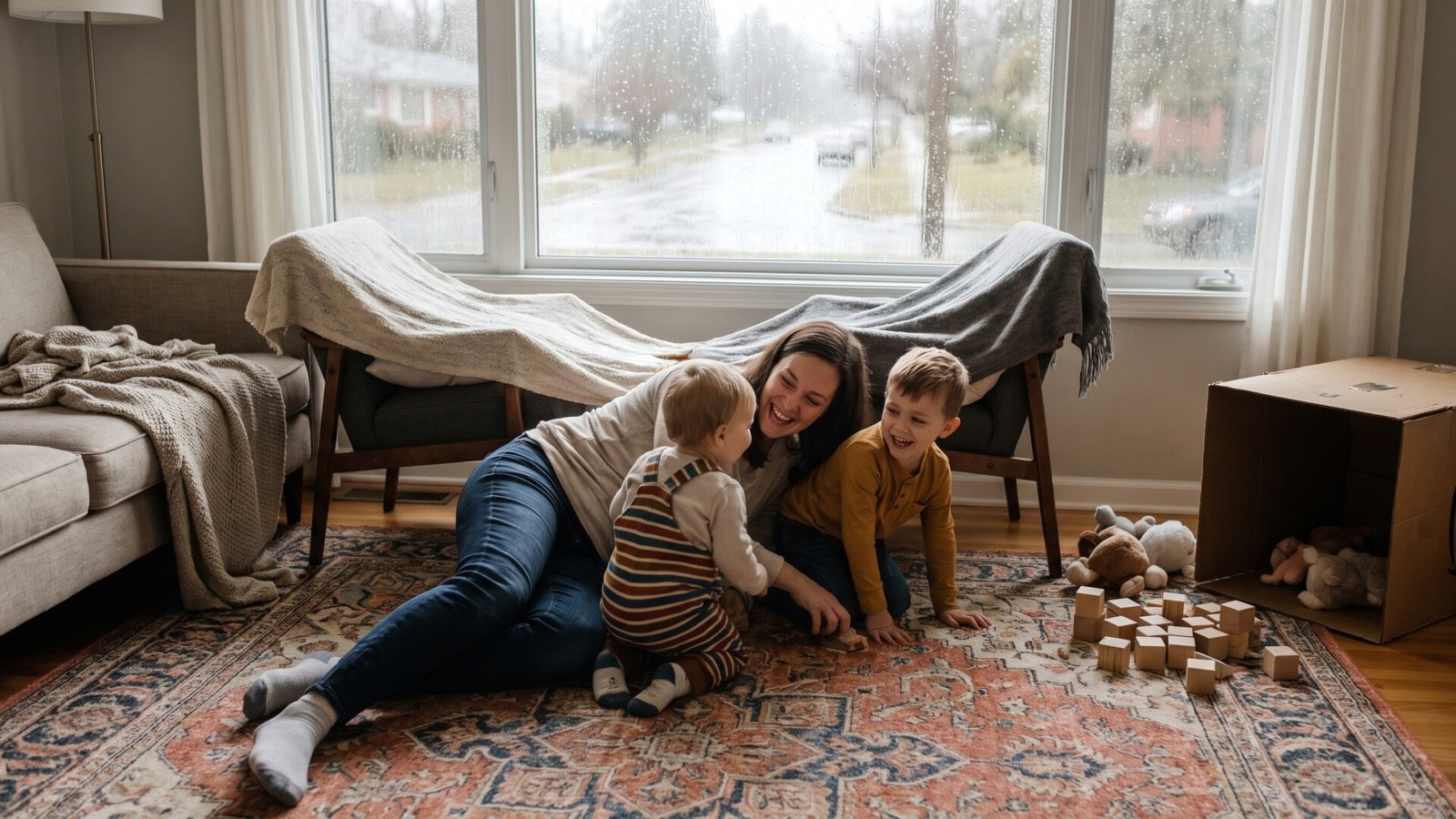
Indoor & Rainy Day Activities: A Parent’s Guide to Surviving (and Enjoying) Days Spent Inside
Every parent knows the feeling. You wake up, glance out the window, and see rain pounding against the glass. Or snow. Or extreme heat. Or any of the countless weather conditions that transform your child from an outdoor adventurer into a captive indoor resident with seemingly limitless energy and nowhere to direct it.
The day stretches ahead, long and full of potential—for both magic and mayhem.
Here’s what I’ve learned after countless indoor days: the goal isn’t simply to survive until bedtime. The goal is to transform being stuck inside from a disappointment into an opportunity. Indoor days can be when creativity sparks, when family bonds deepen, when children discover activities they’d never try outdoors. The right preparation and mindset turn confinement into adventure.
This guide offers ideas for every type of indoor play—high-energy for burning steam, sensory for deep engagement, creative for expression, and STEM for satisfying curious minds. Whether you’re facing a single rainy afternoon or a week of forced indoor living, you’ll find activities here that work for real families with real homes and real limits on patience and mess tolerance.
Check our in depth Play & Activity Ideas Hub
Rainy Day Indoor Games for Toddlers and Preschoolers
Simple, Active Fun When You’re Stuck Inside
The first challenge of any indoor day is energy. Children who would normally run, jump, and climb outdoors still need to move—but now must do so within the confines of your home. The key is channeling that energy into games that work indoors while acknowledging the space constraints.
The best indoor games share common qualities. They require minimal setup. They can be played in available space, whether that’s a spacious living room or a cramped apartment. And they’re engaging enough to hold attention through multiple rounds.
Animal walks combine movement with imagination. Hop like frogs across the room. Crawl like bears on hands and feet. Slither like snakes on bellies. Waddle like penguins with feet close together. Stomp like elephants with heavy feet. The sillier the animal, the more engaging the game. Children love choosing which animal comes next, and the physical variety works different muscle groups while burning energy.
Freeze dance deserves its reputation as an indoor classic. Play music and dance wildly; when the music stops, everyone freezes in place. Anyone caught moving is out (or simply laughs and continues—adapt rules to your child’s age and temperament). The game builds self-regulation as children learn to stop their bodies on cue. Take turns being the DJ who controls the music, letting children practice the thrill of making others freeze.
Indoor scavenger hunts require minimal preparation but provide maximum engagement. Create a simple list of items to find: something red, something soft, something that makes noise, something smaller than your thumb, something that starts with the first letter of your child’s name. For non-readers, use pictures instead of words. Hide items in advance for more challenge, or simply have children search for things that already exist in your space. The hunt can be repeated with new criteria as long as interest holds.
Balloon games work beautifully indoors because balloons move slowly enough for young children to track and hit, and they won’t damage anything they contact. Keep a balloon in the air as long as possible. Play balloon volleyball over a cushion net. See who can keep the balloon off the floor using only their head, only their feet, or only ELBOWS. The slow motion gives children time to react, building confidence and coordination.
Parachute play with a bedsheet brings the preschool classroom favorite home. A regular bedsheet or light blanket becomes a parachute when adults hold two corners and children hold others. Lift it high, lower it low, make it ripple like waves. Place soft toys on top and watch them bounce. Run underneath together. The cooperative movement builds social skills while providing gentle physical activity.
Obstacle courses channel energy productively when designed for your space. Use pillows to jump over, cushions to crawl under, tape lines on the floor to walk along, chairs to weave between, laundry baskets to toss balls into. Time each child going through, then let them redesign the course for round two. The building process itself occupies time, and the physical challenge meets movement needs.
Connection to Age-Based Guides matters because indoor games must match developmental abilities. Toddlers need simpler directions and more adult participation. Preschoolers can manage multi-step courses and more complex rules. Knowing what’s developmentally appropriate helps you choose games that challenge without frustrating.
Explore More Rainy Day Indoor Games
DIY Sensory Play Ideas for Small Spaces
Deep Engagement That Doesn’t Require a Playroom
Sensory play deserves its reputation as a powerful engagement tool. Activities that engage multiple senses capture attention deeply, often holding children far longer than traditional toys. The good news: most sensory materials cost very little, use ingredients already in your kitchen, and work in small spaces with proper containment.
The key to sensory play in small spaces is containment. A waterproof tablecloth or shower curtain on the floor defines the play area and protects surfaces. A large plastic bin or toddler pool contains materials while allowing access. Clear rules about where materials stay prevent mess from spreading. With these basics in place, sensory play becomes possible in any home.
Play dough remains the sensory activity gold standard. Homemade play dough takes minutes to make and costs pennies compared to store-bought versions. Basic recipe: 2 cups flour, 1 cup salt, 2 tablespoons cream of tartar, 2 tablespoons oil, 1.5 cups boiling water, and food coloring. Mix dry ingredients, add oil and water, stir until combined, knead when cool. The process of making dough together is itself an activity. Store in airtight containers for months of reuse.
Variations keep play dough fresh. Add scents with extracts (peppermint, vanilla, almond) or spices (cinnamon, pumpkin pie spice). Add glitter for sparkle. Split dough into batches with different colors. Provide tools—child-safe scissors, rolling pins, plastic knives, cookie cutters, garlic presses—for endless manipulation. Play dough builds fine motor strength while engaging imagination.
Cloud dough offers a completely different sensory experience. Mix 8 cups flour with 1 cup baby oil (or vegetable oil) until combined. The result feels like soft, moldable sand—it holds shape when squeezed but crumbles when released. Cloud dough works beautifully in a shallow bin with scoops, molds, and small toys. Unlike play dough, it doesn’t dry out and can be used repeatedly. The texture fascinates children and adults alike.
Rice and sensory bins provide hours of engagement with minimal investment. A large plastic bin filled with rice (buy in bulk for affordability) becomes a medium for play. Add scoops, small containers, funnels, and toys that relate to a theme—dinosaurs for a “fossil dig,” farm animals for “field” play, ocean creatures with blue rice. The sound and feel of rice pouring and shifting captivates young children. For variety, dye rice with food coloring and vinegar, then dry before use.
Water beads offer mesmerizing sensory exploration. Dehydrated water beads (available online or at dollar stores) expand dramatically when soaked overnight. The resulting gel beads are slippery, squishy, and fascinating to touch. Provide scoops, containers, and toys for exploration. Supervise closely with young children who might mouth beads, and dispose of responsibly when play ends. The sensory experience is unique and deeply engaging.
Oobleck provides science and sensory play simultaneously. Mix cornstarch with water (about 2 cups cornstarch to 1 cup water) until it forms a substance that behaves as both solid and liquid. Squeeze it and it feels solid; release and it flows like liquid. Children can’t believe their senses. Add food coloring for visual appeal. Play in a bin or tray—cleanup is simple with water once dry cornstarch vacuums easily.
Sensory bottles work for children who need calming input or for spaces where loose materials aren’t practical. Clear plastic bottles sealed tightly contain water, glue, glitter, beads, and small toys. Children shake and watch the contents settle, the visual input providing regulation. Make bottles with different themes—ocean with blue water and small sea creatures, discovery with rice and hidden small items, calm-down with glitter that settles slowly.
Connection to Sensory Toys enriches DIY sensory play. Commercial sensory bins, play dough tools, and sensory bottles offer inspiration and sometimes convenience. But DIY versions often work as well or better, cost less, and can be customized to your child’s exact interests. The best approach combines homemade and purchased materials based on your family’s needs.
Explore DIY Sensory Play Ideas
Low-Mess Indoor Crafts
Creative Expression Without Destroying Your Home
Not every family embraces crafts. The mess, the materials, the clean-up—it can feel overwhelming, especially in small spaces. But creative expression matters for children’s development, and low-mess options make it possible without the dread.
The secret to low-mess crafts is choosing activities where the mess is contained by design. Materials that don’t spread, surfaces that clean easily, and processes that minimize chaos all contribute to creative success.
Contact paper collages may be the perfect low-mess craft. Tape a piece of contact paper to a table or window with the sticky side facing out. Provide lightweight materials—tissue paper squares, fabric scraps, feathers, craft foam shapes, leaves from outside. Children arrange materials on the sticky surface, creating designs without any glue. When finished, cover with another piece of contact paper or simply admire the creation on the window. No glue, no paste, no messy cleanup.
Tape resist art delivers stunning results with minimal mess. Place painter’s tape on paper in any design—stripes, geometric shapes, letters, abstract patterns. Children paint over everything with watercolors or thinned tempera. When paint dries, peel off the tape to reveal white lines where the tape protected the paper. The reveal feels like magic, and the process involves only paint on paper. Painter’s tape removes easily from most surfaces, so accidental tape on tables isn’t disaster.
Magazine collages use existing images rather than creating new ones, which means no paint, no glue puddles, no stained fingers. Provide old magazines, child-safe scissors, glue sticks, and paper. Children cut images that appeal to them and arrange them on paper. The collage can tell a story, explore a theme (all animals, all things that are red), or simply be an arrangement of pleasing images. Scissors practice builds fine motor skills, and the variety of images maintains interest.
Sticker activities satisfy creative urges with zero mess beyond the sticker sheets themselves. Sticker books with scenes to complete give structure to creativity. Blank paper with stickers invites open-ended creation. Reusable sticker sets allow endless repositioning and redesign. For children who love stickers, a fresh book provides hours of engaged creative time with nothing to clean up afterward.
Window clings turn your windows into art galleries without any adhesive mess. Unlike stickers, window clings don’t lose stickiness and can be repositioned endlessly. Sets with multiple themes—animals, vehicles, letters, seasonal images—let children create scenes that change throughout the day. The clings store flat in a folder or bag, taking almost no space while providing years of potential use.
Watercolor painting can be low-mess with the right setup. Use washable watercolors, a small cup of water with a tight lid (or a no-spill paint cup), and watercolor paper that won’t buckle. A vinyl tablecloth protects the surface. Children paint, you wipe the table when done. For even less mess, try watercolor pencils—children color on dry paper, then use a wet brush to turn colors into paint.
Modeling clay offers sculptural creativity without the drying-and-crumbling mess of traditional play dough. Clay stays soft and reusable indefinitely when stored in airtight containers. It doesn’t stick to surfaces the way play dough can. Children sculpt, squish, and resculpt endlessly. Add simple tools—plastic knives, forks for texture, small rollers—for expanded possibilities.
Connection to Motor Skills makes low-mess crafts doubly valuable. Cutting with scissors builds hand strength and coordination. Manipulating small materials develops fine motor control. Drawing and painting build the hand skills children need for writing. The creativity is valuable in itself, but the developmental benefits running alongside it matter just as much.
Explore Low-Mess Craft Ideas
Indoor Obstacle Courses for Energy Release
Burning Steam When You Can’t Go Outside
Children need to move. Their bodies demand physical activity in ways that adults who sit at desks all day may have forgotten. When outdoor play isn’t possible, indoor obstacle courses provide the movement children crave while working within home constraints.
The beauty of obstacle courses is their flexibility. They can be elaborate or simple, using whatever you have available. They engage children in designing as well as running, doubling the time investment. And they can be modified endlessly as children master each version.
Living room courses work in most homes with some furniture rearrangement. Move coffee tables aside (or incorporate them). Use couch cushions as things to climb over. Create tunnels by draping blankets over chairs. Tape lines on the floor to walk along like balance beams. Place pillows to jump between like stepping stones. A basic course might include: crawl under the table, jump over three cushions, walk the tape line, toss a soft toy into a laundry basket, crawl through the blanket tunnel, and ring a bell to finish.
Stairs as equipment add vertical dimension if your home has them. Climb stairs one way (up on feet, down on bottom). Slide down on a pillow (with supervision). Toss soft toys up or down stairs into a basket. Time how fast you can go up and down safely. Always supervise stair play closely, but incorporating stairs expands course possibilities significantly.
Tape courses work in any space with floor you can tape on. Painter’s tape (which removes easily from most floors) creates paths to follow, lines to walk, shapes to jump between, targets to throw at. Create a maze on the floor for children to navigate. Make a hopscotch grid for jumping practice. Tape X’s marking where to place hands and feet for a simple obstacle course. When play ends, peel up the tape and the space returns to normal.
Pillow and cushion courses use what you already have. Arrange pillows as stepping stones that can’t be stepped off (the floor is “lava”). Stack cushions to climb over. Create balance challenges by walking on couch cushions placed on the floor. The soft materials make falls safe, encouraging physical confidence.
Timing and competition adds motivation. Time each child going through the course, then let them try to beat their own time. Race against siblings (with clear safety rules). Compete as teams, adding times together. The competition should feel playful rather than pressuring—the goal is movement, not winning.
Design involvement extends engagement. Let children design the course, choosing which elements go where. Provide materials and supervise safety, but let their creativity guide the layout. Running a course you designed yourself feels different than running one an adult created. Children learn spatial thinking through design, and the process of building the course becomes part of the activity.
Variations keep obstacle courses fresh. Try moving through the course backward (with supervision). Add challenges like carrying a small object without dropping it. Require certain movements—hop on one foot in some sections, crawl in others, walk backward in another. Themed courses (pirate adventure, jungle expedition, space mission) add imaginative elements that engage children differently than pure physical challenge.
Connection to Motor Skills makes obstacle courses developmentally valuable. Gross motor skills develop through climbing, jumping, and balancing. Motor planning engages as children figure out how to move their bodies through challenges. Spatial awareness grows as they navigate courses. The physical play that feels like pure fun is actually building foundational movement abilities.
Explore Indoor Obstacle Course Ideas
Easy STEM Activities at Home
Science Learning with Household Materials
STEM activities (Science, Technology, Engineering, and Math) translate beautifully to indoor days. They satisfy curious minds, provide structure without rigidity, and use materials you already have. The best STEM activities for young children are simple, open-ended, and focused on observation and questioning.
The adult role in STEM play is facilitator, not teacher. Ask questions that invite thinking: What do you notice? What do you think will happen? How could we find out? Why do you think that happened? The goal isn’t delivering information—it’s supporting children’s own investigation.
Sink and float investigations require only a container of water and a collection of objects. Gather items from around the house—a cork, a coin, a plastic toy, a fruit, a rock, a sponge. Have children predict which will sink and which will float, discussing reasons for predictions. Test each item, comparing results to predictions. The objects that surprise everyone—the heavy-looking thing that floats, the light-looking thing that sinks—spark the best conversations. Try modifying objects: does a ball of foil sink or float? What if you shape it into a boat?
Magnet explorations reveal invisible forces at work. Provide a magnet wand or strong magnet and a collection of test items—paper clips, coins, aluminum foil, plastic toys, nails, keys. Children discover which items attract, which don’t, and whether magnetism works through materials (paper, plastic, thin wood). Try moving a paper clip through a maze drawn on cardboard by holding the magnet underneath. Test whether magnets work in water. The wonder of invisible forces captivates young scientists.
Kitchen chemistry uses food to explore reactions. Baking soda and vinegar experiments never get old—the fizzing reaction delights every age. Try different ratios: more vinegar, more baking soda. Add food coloring for visual appeal. Freeze vinegar in ice cube trays and drip baking soda solution onto frozen cubes. Put baking soda in a balloon, vinegar in a bottle, attach balloon and watch it inflate from the gas produced. The chemical reaction happening visibly engages scientific thinking.
Color mixing explorations teach observation and prediction. Provide primary colors of washable paint or food coloring in water. Have children predict what will happen when they mix blue and yellow, red and blue, yellow and red. Test predictions, observing results. Try mixing all three. Use eye droppers with colored water on paper towels to watch colors spread and mix. The visual results satisfy while building understanding of color theory.
Shadow play explores light and its properties. Darken a room and shine a flashlight on a wall. Experiment with moving the light closer and farther, changing shadow size. Create shadow puppets with hands or paper cutouts. Trace shadows of toys at different times of day to observe how sun position changes shadow length. Add colored transparencies or gels to explore color mixing with light. The play feels like magic while building scientific understanding.
Building challenges engage engineering thinking. Provide materials—blocks, cardboard, tape, recycled containers—and a challenge: build the tallest tower that stands alone, create a bridge that spans this gap and holds weight, construct a house for this small toy figure. The iterative process of building, testing, and rebuilding teaches engineering design thinking. Children learn that failure is information, not defeat.
Ramp explorations introduce physics concepts. Use cardboard tubes cut in half, blocks for support, or simply books propped up to create ramps. Test how different objects roll or slide down. Does a marble roll faster than a toy car? What happens if you change the ramp angle? Add bumps or obstacles to test how they affect movement. The experimentation builds understanding of motion, gravity, and force.
Connection to STEM Toys can enrich these activities. Magnifying glasses, simple microscopes, magnet sets, and science kits extend investigation possibilities. But the heart of STEM play is the questioning and exploring, not the equipment. Household materials work perfectly for introducing scientific thinking.
Explore Easy STEM Activities
Bringing It All Together: Making Indoor Days Work for Your Family
After exploring all these activities, a larger truth emerges: indoor days aren’t obstacles to survive. They’re opportunities for a different kind of connection, a different pace, a different set of experiences than outdoor days provide.
Have a mental menu, not a rigid plan. You don’t need to schedule every moment. Knowing several activities in each category—active, sensory, creative, STEM—lets you pivot based on your child’s energy and interest. Offer choices rather than directives: “Would you rather do an obstacle course or a scavenger hunt?” Children who choose engage more deeply.
Accept some mess, contain the rest. Some activities will create cleanup, and that’s okay. A waterproof tablecloth, a plastic bin, and clear rules about where activities happen keep mess manageable. Involve children in cleanup—it’s part of the activity, teaching responsibility while extending engagement.
Follow energy with calm. Active play should precede quiet activities. Run the obstacle course, then settle into sensory play. Dance to music, then read books. Matching activities to energy levels prevents the overstimulation that leads to meltdowns.
Connection to Developmental Toys reminds us that quality materials support quality play. Sensory bins with good tools, STEM supplies that invite investigation, craft materials that work properly—these make indoor play richer. But the materials matter less than the engagement. A cardboard box and imagination often outperform expensive toys.
Remember why indoor days matter. In our overscheduled, constantly moving world, being forced indoors can be a gift. Slower pace. More connection. Time to notice details. Opportunities for creativity that busy days don’t allow. The children building forts, mixing colors, conducting experiments, and laughing through obstacle courses aren’t just passing time until they can go outside again. They’re having experiences they’ll remember.
The rain will stop eventually. The snow will melt. The heat wave will break. But the memories of what you did together inside—the games you invented, the experiments you conducted, the creations you made—those last forever.
Return to the main Play & Activity Ideas Hub