Best World Map Floor Puzzles for Kids
A practical, parent-focused guide to choosing the right giant map puzzle for every age
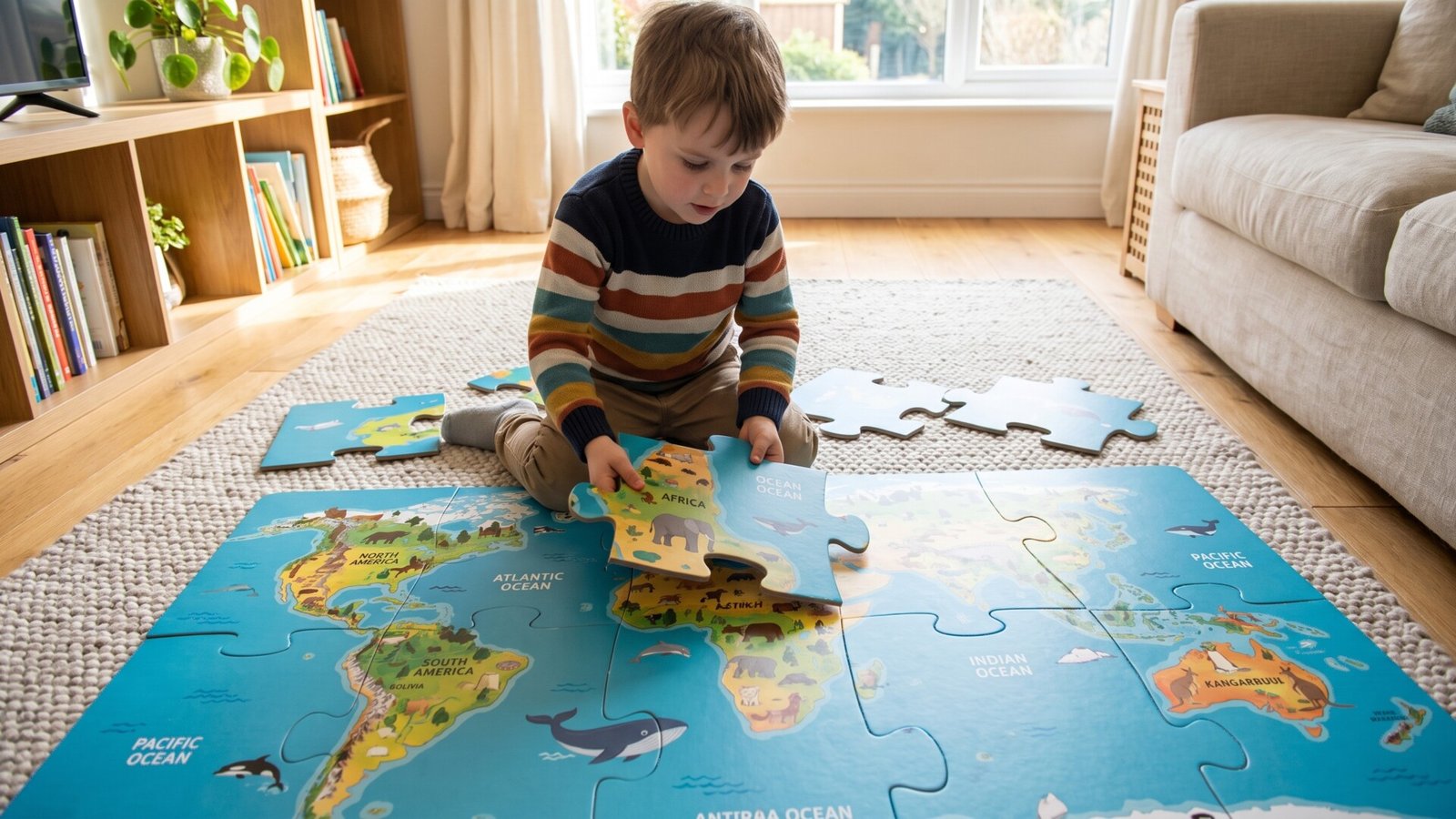
World map floor puzzles are one of those magical toys you bring into your home thinking, “This will be fun,” and then suddenly you realize your child is learning continents, oceans, animals, landmarks, and even basic map-reading without you doing anything special. It’s hands-on geography disguised as playtime—big pieces, big pictures, big movement, and big learning.
If you’ve ever wondered which world map puzzle will actually hold your child’s attention, survive the rough handling of real kids, fit on your living room floor, and teach meaningful geography, this guide walks you through it. You’ll find explanations for what makes a great map puzzle, how to choose the right type for your child’s age, and a list of the very best world map floor puzzles that truly shine.
Let’s dive in (or crawl across the continents—your child definitely will).
Why World Map Floor Puzzles Are Worth Having
Before comparing puzzle options, it helps to understand what makes world map puzzles so powerful for kids.
They turn something abstract into something kids can touch.
A flat map in a book is tiny and overwhelming. But when the world is laid out across the floor, kids suddenly “get it.” They can see how continents fit together and how the world has shape and structure.
Kids love BIG play.
Floor puzzles allow full-body learning. Kids stretch, crawl, pick pieces up, rotate them, slide them into place—this movement strengthens learning far more than a worksheet or app.
World puzzles introduce global awareness early.
Kids naturally ask questions when they see different animals, foods, buildings, or people illustrated on each continent.
“Why are penguins here?”
“Why is the Eiffel Tower in France?”
“What’s that big desert in Africa?”
You get effortless learning moments.
They support multiple developmental skills at once.
While building, kids practice:
- spatial reasoning
- problem solving
- concentration
- memory
- fine motor strength
- perseverance
And they come away knowing more about the world, too.
They grow with your child.
A three-year-old may only match pieces by color or animal.
A six-year-old will memorize continents.
An eight-year-old reads labels and countries.
A ten-year-old follows borders and compares regions.
A world map puzzle is a long-lasting toy—much longer than many toddler toys that are forgotten in a year.
What Makes a World Map Floor Puzzle “Good”?
Not all world map puzzles are equal. Some are gorgeous but flimsy. Some are educational but visually bland. Some look promising on the box but are horribly frustrating to assemble.
Here are the traits that matter:
1. Thick, durable pieces
The best floor puzzles use sturdy cardboard that doesn’t peel or warp.
If you’ve ever bought a flimsy puzzle, you know how frustrating it is when pieces bend or delaminate after a few uses.
2. Clear artwork—not cluttered or overly busy
Kids need bold, readable illustrations.
Great puzzles use color-coded continents, distinct landmasses, and visual icons (like animals or landmarks) that instantly make sense.
3. Age-appropriate piece count
This is the #1 factor in whether a child sees the puzzle as exciting versus overwhelming.
Toddlers need fewer pieces.
Older kids want more challenge.
4. Accurate (or at least reasonable) map layout
Many children’s puzzles distort country sizes or shapes to fit artwork. That’s fine, but the basic layout should still teach real geography.
5. Size matters
Some puzzles are enormous—great for big spaces, not so great for apartments.
Think about your floor space before choosing.
6. Educational add-ons
Some puzzles include:
- labels
- animals
- greetings
- flags
- climate zones
- major cities
These layers enrich the learning experience.
7. Good color contrast
Young kids need clearly defined edges, distinct continents, and readable labeling.
If a puzzle checks most of these boxes, it’s likely a winner for your home.
Choosing the Right Puzzle by Age
To make this truly useful, here’s a quick age guide.
Ages 2–3: Choose simple illustrations + fewer pieces
Look for:
- 24–36 pieces
- bold colors
- animal illustrations
- large, chunky pieces
Kids this age are not learning detailed geography. They are learning:
- shapes
- matching
- recognition
- building confidence
A simple world map with animals is perfect.
Ages 4–5: Kids can handle bigger puzzles now
Look for:
- 48–60 pieces
- clear continent boundaries
- basic labels
At this age, kids start to remember continent names and identify oceans.
Ages 5–7: Kids want detail
Look for:
- 60–100 pieces
- landmarks
- country outlines
- richer artwork
This is a sweet spot for world map puzzles.
Ages 7+: Go for accuracy + challenge
Look for:
- 100+ pieces
- accurate geography
- clear labeling
- detailed illustrations
Kids this age can start memorizing locations and comparing the puzzle to a globe.
The Best World Map Floor Puzzles for Kids (Ranked & Explained)
Below are the strongest, most parent-approved world map floor puzzles.
Each section explains what makes it great, who it’s best for, and what your child will learn from it.
You can add affiliate links wherever you prefer—they fit naturally in these sections.
1. Melissa & Doug World Map Floor Puzzle
Best all-around world map puzzle for ages 3–6
This is one of the most popular world map puzzles for a reason. The artwork is colorful and inviting without being overwhelming. Each continent is color-coded, and the illustrations make geography feel playful. Animals, plants, and landmarks show up across the map, which helps kids form connections immediately.
Why it works well:
- Large pieces are easy to handle
- Thick, durable cardboard that lasts
- Clear, simple visuals that young kids understand
- Continent shapes are reasonably accurate
- Finished size is impressively large (great for big floor play)
What kids learn:
Continents, oceans, climates, animals, and big-picture geography concepts.
Best for:
Preschoolers and early elementary kids building their first world map.
2. Mudpuppy World Map Puzzle
Best puzzle for kids who love bright, modern artwork
Mudpuppy puzzles always have rich colors, dynamic illustrations, and a modern feel. Their world map puzzle includes animals and landmarks but with stylish, almost storybook-like artwork. It’s slightly smaller than some floor puzzles, so it fits better in smaller homes.
Why it stands out:
- Gorgeous, high-contrast colors
- Durable pieces that don’t bend
- More compact size works in tighter spaces
- Includes animals on every continent
What kids learn:
Continents, oceans, animal habitats, cultural landmarks.
Best for:
Ages 4–7, especially visual learners who respond to bold artwork.
3. Melissa & Doug World Map Jumbo 100-Piece Puzzle
Best “challenge puzzle” for kids ready for a step up
If you have a child who has outgrown 48-piece puzzles, this is the time to introduce a 100-piece world map. It’s still approachable for young kids but offers significantly more complexity.
Why kids love it:
- Extra-large finished size
- Clear continent outlines
- Large icons kids recognize (Big Ben, giraffes, the Great Wall)
- The challenge feels “big kid,” but not frustrating
Learning benefits:
- Improved spatial reasoning
- Country shapes start to make sense
- Kids gain a stronger sense of global layout
Best for:
Ages 6–10 who want something more substantial.
4. Eurographics World Map XXL Puzzle
Best for older kids who want accuracy
Eurographics puzzles lean more toward realistic map design. This XXL version uses bright, appealing colors but keeps the map structure accurate. It includes country names, capitals, flags, and major cities.
This isn’t a cartoon-style kid puzzle—it’s a legit map in puzzle form, which older children (and adults) appreciate.
Why it’s excellent:
- Accurate country layout
- Clear labeling
- High-quality pieces
- A true map without childish artwork
Learning benefits:
- Country recognition
- Flags and capitals
- Geographic relationships
Best for:
Kids 7–12, homeschool families, or anyone wanting a map puzzle that doubles as a teaching tool.
5. Ravensburger World Map XXL Puzzle
Best premium quality puzzle
Ravensburger puzzles are easily the highest quality of any children’s puzzle line. Their pieces fit together with a smooth, satisfying “click,” and the puzzle lies flat without warping. Their world map puzzle blends accuracy with beautiful illustrations.
Why parents love it:
- Unmatched piece quality
- Gorgeous artwork
- Highly durable
- Great balance of realism and child-friendly style
Learning benefits:
Continent layout, animal habitats, major world features, visual categories.
Best for:
Ages 6+, especially kids who use puzzles frequently and need something that lasts for years.
6. Crocodile Creek World Map Puzzle
Best artistic world map puzzle for animal lovers
Crocodile Creek puzzles always have stunning illustrations, and their world map is no exception. Animals dominate the artwork, which makes this puzzle especially engaging for kids who relate to animals more than map shapes.
Why it’s appealing:
- Beautiful, almost poster-like artwork
- Thick, sturdy pieces
- Strong focus on animal habitats
- Includes a reusable storage canister
Learning benefits:
Animal distribution, land vs. ocean awareness, continent recognition.
Best for:
Animal-obsessed kids ages 4–8.
7. Melissa & Doug Giant Soft World Map Puzzle (Foam)
Best puzzle for toddlers
If you want something your child can sit on, throw around, chew on, and still have it survive—this is the puzzle. It’s made of thick foam, so it doubles as a playmat. Toddlers love taking the giant pieces out and stomping them back into place.
Why it’s great:
- Safe, soft foam pieces
- Simple, bright illustrations
- Can be used as a floor mat
- Easy to wipe clean
Learning benefits:
Early map exposure, matching, spatial awareness.
Best for:
Ages 2–3, and younger siblings who want to join puzzle time without ruining anything.
8. PuzzleTwist Discover! World Map Puzzle
Best “interactive” geography puzzle
This puzzle includes fun hidden details and small surprises throughout the map, encouraging kids to search, compare, and ask questions as they build. It’s more like a puzzle-and-game combo.
Why it’s unique:
- Hidden images within the map
- Encourages searching and curiosity
- Detailed artwork
- Ideal for family puzzle time
Learning benefits:
Observation skills, memory, geography basics, discovery-based learning.
Best for:
Kids 6–10 who love “finding” things in pictures.
9. Learning Resources Smart Puzzle Globe Set
Best puzzle + globe combo for multi-format learning
This set includes both a floor puzzle and a small foam globe. Kids build the map on the floor, then compare what they built to the 3D globe. This builds a deeper understanding of how the Earth curves and how continents connect.
Why parents pick it:
- Two formats reinforce learning
- Foam globe is tactile and durable
- Puzzle has large, easy-to-handle pieces
- Great for homeschool or thematic units
Learning benefits:
3D spatial reasoning, real-world map connections, globe familiarity.
Best for:
Ages 4–7.
10. Round World Map Floor Puzzles (various brands)
Best for understanding the globe’s shape
Round puzzle designs are underrated but incredibly valuable. They mimic the shape of the Earth better than rectangular map projections. Many circular puzzles feature animals or landmarks, which keeps them engaging.
Why it’s helpful:
- Makes the spherical nature of Earth clearer
- A fun challenge because the shape is unique
- Works well for older puzzle builders
Learning benefits:
Understanding distortion, continent layout, global relationships.
Best for:
Kids 5–10 who are ready for something different.
How to Use World Map Puzzles to Teach Geography Naturally
You never need to treat a puzzle like a lesson. Instead, work learning into the play.
Here are simple ways:
Start with animals.
Ask your child:
“Where do you think this lion piece goes?”
Animals help kids connect continents to something familiar.
Use “continent hunts.”
Pick a piece and ask:
“Can you find where this belongs on the puzzle?”
Kids learn to scan and compare.
Point out the oceans.
Kids need repetition to remember ocean names.
Point at the big blue areas:
“This is the Pacific Ocean. It’s HUGE.”
Compare the puzzle to a globe or book.
Kids quickly notice differences:
“Why does Africa look smaller on this one?”
This improves visual reasoning.
Talk about places your family knows.
If you’ve traveled somewhere, show it on the puzzle.
Connect puzzles to books and videos.
When reading a story set in another country, pull out the puzzle and locate it.
Let kids walk “around the world.”
Have them stand on South America and step across to Africa.
Movement cements memory.
What to Do if Your Child Gets Frustrated
Some kids love world map puzzles instantly; others need a little support.
Break the puzzle into sections.
Most puzzles visually separate continents.
Start with one.
Begin with the edges.
Kids love the satisfying “frame” method.
Sort by color first.
Color-coded continents make this easy.
Offer help only through questions.
“How does this shape match the space?” works better than “Here, let me do that.”
Keep the puzzle displayed after completion.
Kids love revisiting their work and pointing things out.
Final Thoughts
A world map floor puzzle is one of the most valuable educational toys you can add to your home. It’s tactile, large-scale, visually rich, and endlessly replayable. Whether your child is two and exploring animal maps or nine and memorizing countries and landmarks, world puzzles provide long-lasting, meaningful learning in the most natural way.
Kids take ownership of the world piece by piece—literally—until the entire globe makes sense to them.
Bring one into your home and watch how quickly your child becomes curious about the places, animals, and people beyond their immediate surroundings.