Floor Puzzles That Teach Geography
A parent-friendly guide to big puzzles that build big world knowledge
Floor puzzles are one of those magical toys that manage to feel fun, hands-on, and almost… effortless. Kids think they’re just building a giant picture on the floor, but behind the scenes they’re strengthening spatial reasoning, practicing concentration, working fine motor skills, and—when the image is a map—they’re absorbing geography in the most natural way possible.
If you’ve ever wondered how to help your child learn about continents, oceans, states, landmarks, or even animals around the world without sitting them down for a “lesson,” geography floor puzzles are a perfect place to start. They’re tactile, oversized, colorful, and active. Kids get to move their whole bodies while learning, which gets them far more engaged than a worksheet or app ever could.
This guide walks you through why geography-themed floor puzzles are such powerful tools, what types to look for, which ones are best for different ages, and how to use them to spark genuine curiosity about the world—right from your living room floor.
Why Geography Clicks Better With Floor Puzzles
Kids are naturally visual and physical learners. Geography—maps, borders, landforms, continents—can feel abstract when it’s tiny on a screen or static on a page. But when it’s big, colorful, and spread across the floor? Suddenly it makes sense.
Here’s why floor puzzles work so well:
1. They make maps “big enough to understand.”
A map shrunk to the size of a book doesn’t show enough detail for young kids. A floor puzzle lets them see the big picture. They can physically move from one region to another, crawl from continent to continent, and notice relationships between places.
2. Kids learn through movement.
When kids reach across to connect puzzle pieces—like matching South America to North America—they’re building physical memory. Movement helps the brain store information more deeply.
3. The pictures teach as much as the shapes do.
Many geography puzzles include animals, landmarks, flags, foods, plants, or cultural symbols. While putting together the puzzle, kids naturally ask questions:
- “Why are kangaroos in Australia?”
- “What’s that castle on the Europe piece?”
- “Why is the Statue of Liberty in New York?”
You get built-in conversation starters.
4. They help kids understand categories and relationships.
Instead of memorizing: Asia is the largest continent, kids see it—visually, clearly, in context.
5. Map puzzles build confidence.
Geography can feel intimidating, even to adults. But a puzzle lets kids master the world piece by piece, literally.
Different Types of Geography Floor Puzzles
Not all geography puzzles focus on the same skills. Depending on your child’s age and stage, you may prefer different types. Here are the most helpful categories.
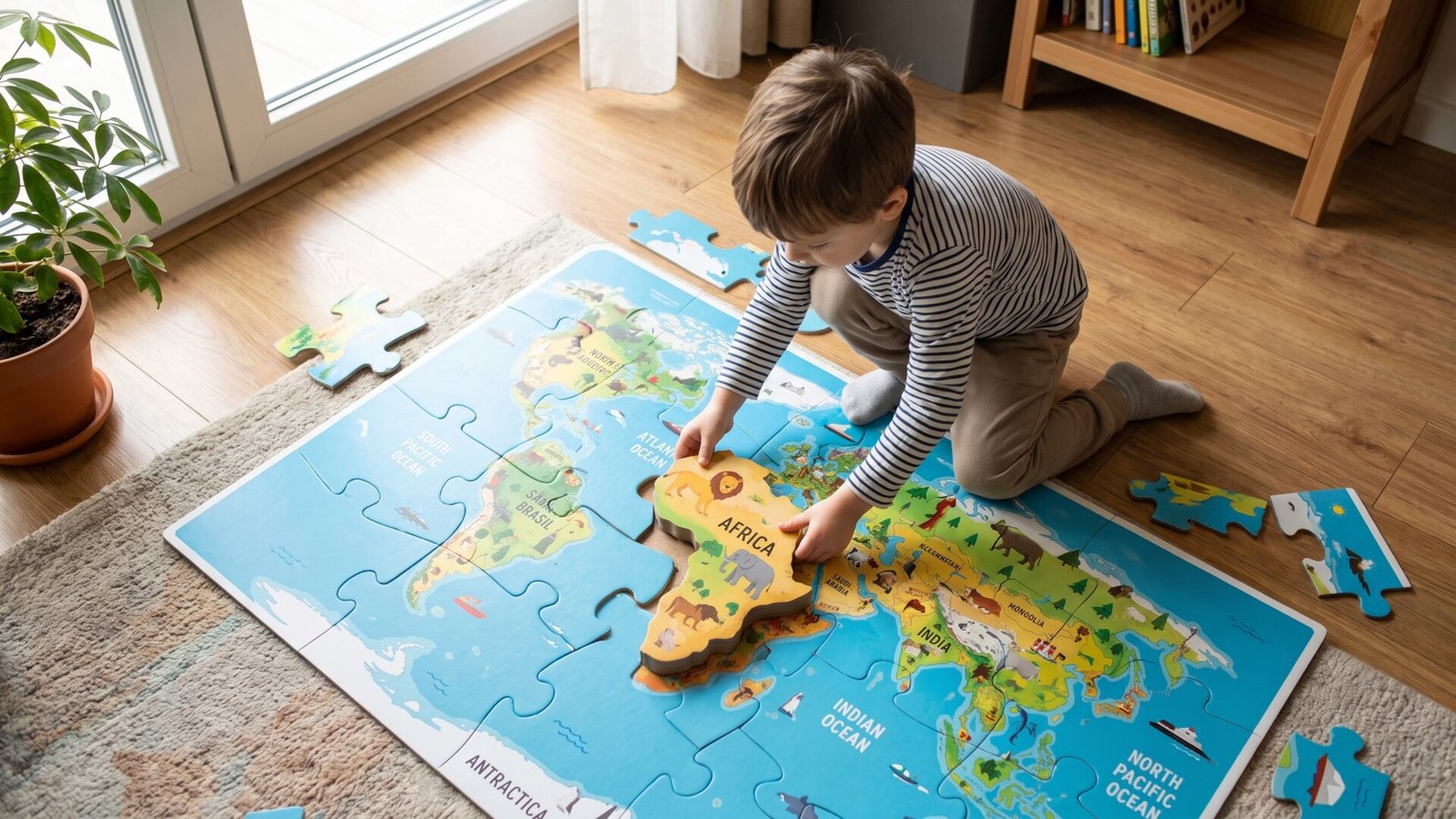
1. World Map Floor Puzzles
These show the entire globe in one oversized layout. Kids learn:
- continents
- oceans
- major landmarks
- important animals
- climate regions
- big countries
Puzzles like Melissa & Doug World Map, Mudpuppy World Map, or Eurographics XXL World Maps are great examples.
2. United States Floor Puzzles
These puzzles break the U.S. into states, often with:
- capitals
- state symbols
- famous landmarks
- geography features
These are extremely good for ages 4–8. Kids start learning state shapes much earlier than you might expect.
3. Continent-Specific Puzzles
These focus on one continent at a time—Africa, Asia, or Europe, for instance.
They’re excellent for older kids who want deeper knowledge or for homeschool families focusing on a specific region.
4. Landmark & Cultural Floor Puzzles
These puzzles highlight:
- monuments
- architecture
- cultural traditions
- historical sites
They’re less about geography borders and more about helping kids recognize the world’s uniqueness.
5. Animal Habitat Floor Puzzles
Technically these aren’t “maps,” but they help kids learn where animals live across the world.
Examples include:
- Arctic habitat puzzles
- African savanna puzzles
- Rainforest puzzles
- Ocean world maps
These are fantastic for younger children who connect more with animals than borders.
6. Giant Globe or Circular World Puzzles
Some puzzles come in large round designs, which feel more like a “real” globe flattened out. Kids see how regions relate more accurately than in rectangular map projections.
Choosing Geography Floor Puzzles by Age
To make this practical, here’s a breakdown of what types of floor puzzles generally match each developmental stage.
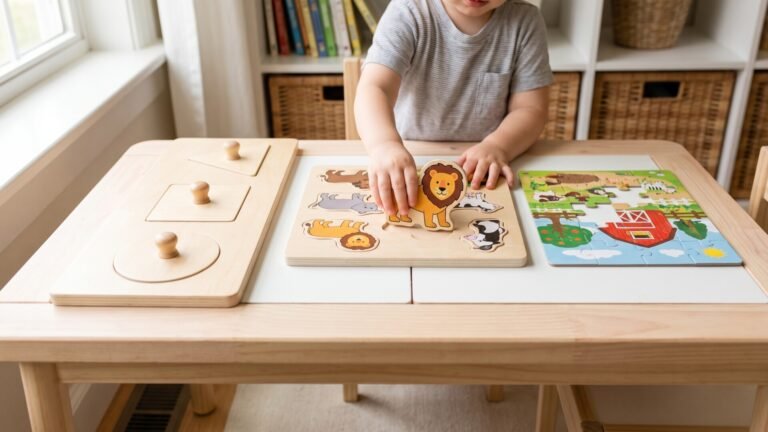
Ages 2–3: Early Exposure Without Pressure
At this age, floor puzzles should focus on:
- big pieces
- bold colors
- basic categories
Great options include:
- simple animal world maps
- continent puzzles with only a few large sections
- oversized puzzles with thick cardboard
Kids this age won’t grasp geography details, but exposure is the goal.
Ages 3–4: Simple World Maps & U.S. Overview Puzzles
Kids start noticing:
- shapes
- patterns
- animals
- landmarks
They may not place all the pieces, but they become aware of continents and oceans.
Look for puzzles with:
- 24–36 pieces
- large regions
- colorful illustrations
A puzzle showing animals on each continent works beautifully.
Ages 4–6: True Geography Learning Starts Here
This is the ideal age for:
- 50-piece world maps
- U.S. state puzzles
- landmark puzzles
- habitat maps
Kids begin to:
- recognize continent names
- notice the shape of the U.S.
- understand where different animals live
- see how states fit together
A puzzle with clear outlines and labels works well here.
Ages 6–8: Real Map Skills Take Off
Kids can now handle:
- 70–100 piece floor puzzles
- puzzles with detailed illustrations
- puzzles with lots of small countries
This is a perfect time for:
- U.S. puzzles where each state is its own piece
- world maps with country borders
- puzzles showing capital cities
Many children at this age start memorizing facts without even meaning to.
Ages 8+: Advanced Maps & Geography Challenges
Older kids can handle:
- 100–200 pieces
- fine details
- topographical maps
- puzzles with climate zones
- puzzles that require strategy
Some really enjoy “challenge puzzles” like:
- all-blue ocean puzzles
- 3D globe puzzles
- puzzles shaped like continents
This age group thrives on challenge, so let them choose bigger goals.
Skills Kids Learn From Geography Floor Puzzles
Here’s what makes geographic puzzles so uniquely valuable.
1. Spatial Thinking
Placing South America beneath North America requires visualizing orientation and placement.
2. Map Reading Basics
Kids recognize colors for land vs. water, see borders, and learn to interpret symbols.
3. Memory & Pattern Recognition
Kids begin remembering where certain regions belong or where certain animals live.
4. Cultural Awareness
Puzzles naturally spark questions about people, places, and traditions.
5. Patience & Focus
Geography puzzles take time, which builds concentration.
6. Confidence Through Mastery
When a child can assemble the world themselves, they feel incredibly capable.
How to Use Geography Floor Puzzles as Learning Tools
You don’t need a lesson plan—just small nudges.
Try simple prompts like:
- “Where do you think this animal lives?”
- “Do you see where the water is on this puzzle?”
- “Can you match the shape of South America to the right space?”
- “Let’s find a place that’s really cold.”
Kids will take the lead naturally.
Make puzzles interactive:
- Walk around the puzzle like you’re taking a “world tour.”
- Have your child sit on different continents.
- Bring in toy animals to match with regions.
- Use a globe afterward and compare the shapes.
- Match books or YouTube videos to the region they built.
These small integrations make the puzzle far more meaningful.
Recommended Geography Floor Puzzle Picks
Here are types worth including:
- World Map Floor Puzzle (colorful continents + animals)
- Detailed World Map Puzzle (borders, larger piece count)
- U.S. States Floor Puzzle (state-shaped pieces)
- Animal Habitat World Map
- Landmark Floor Puzzle (global monuments)
- Circular World Puzzle
- Continent-Focused Floor Puzzle (Africa, Europe, etc.)
Troubleshooting Common Puzzle Struggles
If your child gets overwhelmed:
Work on a small section first—like “Let’s build Europe together.”
If they give up quickly:
Start with continents that have bold colors and clear boundaries.
If pieces get scattered or lost:
Store puzzles in zippered pouches instead of the original box.
Tape the puzzle image on the front of the pouch.
If your child insists on help:
Guide, don’t solve.
Ask questions like:
“Where do you see this animal on the puzzle picture?”
Turning Geography Puzzles Into a Routine
You can expand the value of puzzles by making them a weekly ritual:
- “World Map Wednesday” — Build a continent and read a book about it.
- Puzzle challenges — Time how long it takes to build the U.S.
- Family puzzle nights — Work together on a giant map.
- Seasonal geography themes — Explore cold regions in winter, ocean maps in summer.
Kids learn through repetition, so routines work beautifully.
Conclusion
Floor puzzles are one of the easiest ways to bring geography into your home without formal lessons. They give kids a giant, hands-on, visually rich version of the world that they can literally build with their own hands.
Whether your child is stacking simple continent pieces at age three or tackling a 100-piece U.S. map in early elementary, geography puzzles grow with them, challenge them, and spark curiosity about the world.
A puzzle isn’t just a toy—it’s an entire world your child gets to assemble, explore, and understand.