Fisher-Price Through the Years: Evolution of Learning Toys
Few toy brands have had the same lasting impact on childhood as Fisher-Price. For nearly a century, the company has combined play, education, and innovation to create toys that support development from infancy through early childhood. If you’re a parent curious about how Fisher-Price toys have evolved—or wondering which ones might be right for your child—this guide takes you through the history, iconic toys, and the educational benefits that have made Fisher-Price a household name.
The Birth of Fisher-Price
Founded in 1930 by Herman Fisher, Irving Price, and Helen Schelle, Fisher-Price began with a simple goal: create durable, safe, and imaginative toys for young children. Their first catalog included only a handful of wooden toys, but even in these early designs, the emphasis on learning through play was clear.
- Early Innovation: Toys were designed to encourage interaction and imagination, not just passive play.
- Durable Design: Wooden construction meant toys could withstand heavy use—a hallmark of the brand even today.
Iconic Fisher-Price Toys Over the Decades
Fisher-Price has introduced countless toys, but some have stood out for their lasting popularity and educational impact.
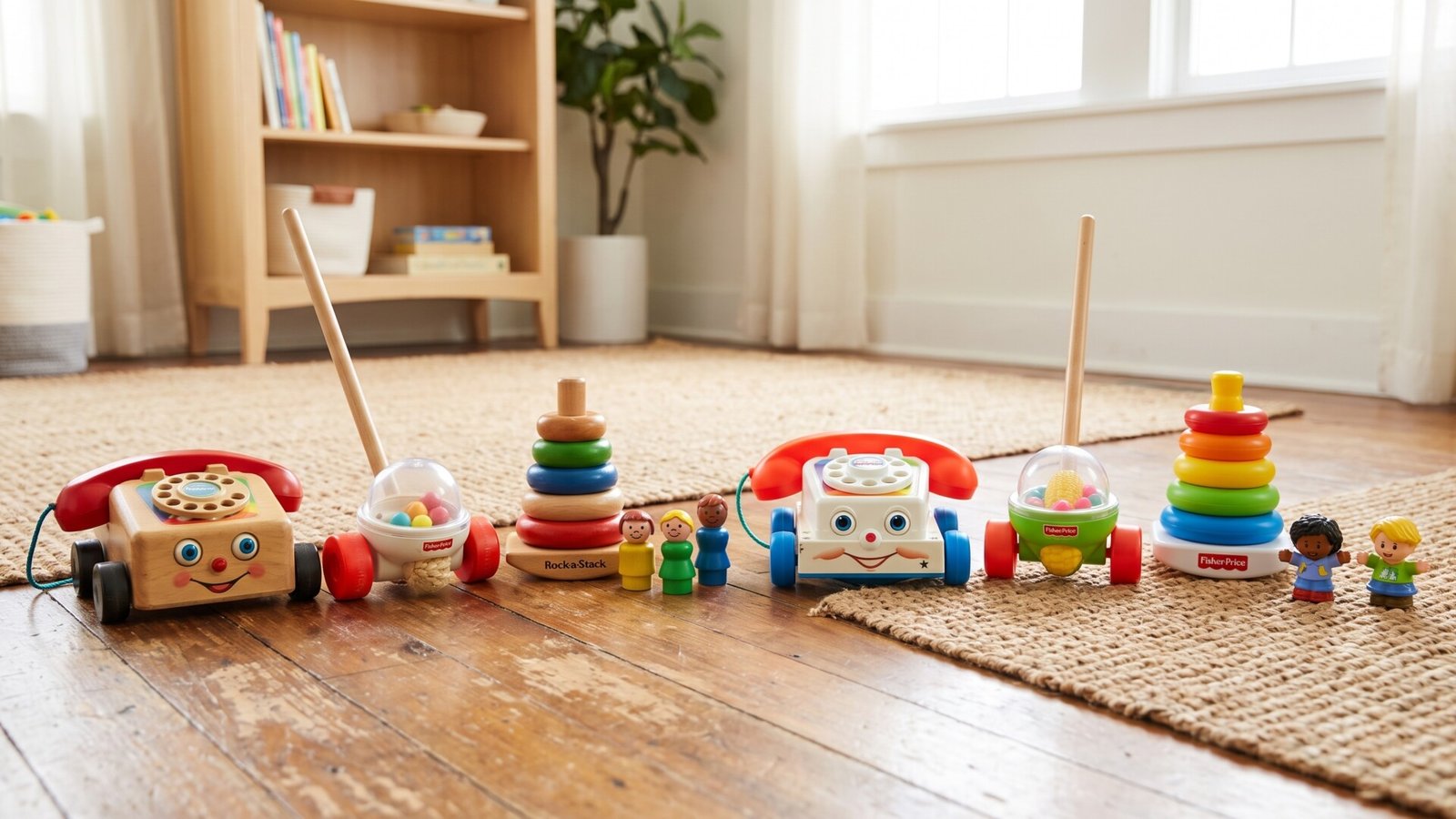
1. The Chatter Telephone (1961)
- Design: A classic rotary dial phone with eyes that move when pulled along
- Educational Benefit: Encourages pretend play, social interaction, and fine motor skills
- Why It Endures: Combines nostalgia for parents with playful engagement for children
2. Little People (1960s–Present)
- Design: Small, chunky figures that fit little hands
- Educational Benefit: Supports role-play, storytelling, and social-emotional development
- Evolution: Originally wooden and simple, today’s Little People sets include houses, vehicles, and interactive features
3. Corn Popper (1957)
- Design: Push toy with rolling balls that pop inside a clear dome
- Educational Benefit: Promotes gross motor development, walking skills, and cause-and-effect understanding
- Appeal: Kids love the visual and auditory feedback as they push and watch the balls bounce
4. Music and Activity Toys
- Examples: Pound & Tap Bench, Spin & Learn Record Player
- Educational Benefit: Introduces music, rhythm, and early hand-eye coordination
- Developmental Focus: Combining movement with sound helps children develop auditory discrimination and fine motor skills
5. Smart and Interactive Toys (2000s–Present)
- Fisher-Price Smart Stages products adjust learning content as children grow
- Examples: Laugh & Learn Smart Stages Tablet, Learning Lights Deluxe Laptop
- Educational Benefit: Introduces numbers, letters, problem-solving, and early STEM concepts in an engaging, adaptive format
- Parent-Friendly: Toys evolve with the child’s developmental stage, offering progressive learning opportunities
The Educational Philosophy Behind Fisher-Price
Fisher-Price has always believed that play is learning. Their toys are designed to:
- Encourage Exploration: Open-ended play allows children to discover cause-and-effect relationships
- Support Developmental Milestones: Toys are carefully crafted to promote fine and gross motor skills, cognitive growth, and social-emotional skills
- Foster Creativity and Imagination: Role-playing toys help children learn empathy, communication, and problem-solving
- Offer Age-Appropriate Challenges: Products often include multi-level learning to grow with the child
By blending fun and learning, Fisher-Price toys bridge the gap between playtime and skill-building, making developmental milestones part of everyday enjoyment.
Modern Fisher-Price Innovations
In recent years, Fisher-Price has embraced technology and STEM concepts while maintaining a focus on hands-on learning:
- Laugh & Learn Smart Stages Tablet: Introduces letters, numbers, shapes, and songs with interactive features
- Think & Learn Smart Cycle: Combines physical activity with educational games, teaching math, reading, and problem-solving
- STEM-Oriented Building Sets: Encourage basic engineering, spatial reasoning, and problem-solving skills
The company continues to prioritize screen-free and low-tech options for younger children, ensuring developmental benefits remain the focus.
How Fisher-Price Supports Parents
Fisher-Price isn’t just for children—they also provide resources and guidance for parents:
- Learning Guides: Many toys include tips for expanding play into developmental activities
- Age Recommendations: Helps parents choose toys appropriate for each stage of growth
- Durability and Safety: Designed to last and meet safety standards, offering peace of mind for parents
Classic vs. Modern Fisher-Price Toys
| Feature | Classic Toys | Modern Toys |
|---|---|---|
| Technology | Minimal | Interactive features, adaptive learning |
| Focus | Imagination, motor skills | STEM, language, cognitive skills |
| Materials | Wood, hard plastic | BPA-free plastic, electronic components |
| Play Style | Open-ended | Open-ended + structured learning |
| Longevity | Durable, simple | Durable, tech-integrated |
Takeaway: Classic toys emphasize timeless developmental skills, while modern Fisher-Price toys incorporate technology and adaptive learning without losing the essence of playful education.
Tips for Choosing Fisher-Price Toys for Your Child
- Consider Age and Development Stage
- Toddlers: Duplo, Chatter Telephone, Corn Popper
- Preschoolers: Little People, Spin & Learn, Pound & Tap Bench
- Early Elementary: Smart Stages Tablet, STEM and coding kits
- Mix Classic and Modern
- Combining open-ended play with interactive toys balances creativity with structured learning
- Focus on Developmental Goals
- Identify which skills you want to encourage: motor skills, language, STEM, or imaginative play
- Rotate Toys Regularly
- Keeps play engaging and encourages new ways to explore
The Timeless Appeal of Fisher-Price
Fisher-Price toys endure because they grow with children. From the first push toy to smart, interactive tablets, the company has maintained a focus on:
- Playful learning that aligns with developmental milestones
- Durability and safety, ensuring toys withstand real-world use
- Fun and engagement, making learning feel like play
For parents, Fisher-Price toys are more than just playthings—they’re tools to support skills, confidence, and curiosity at every stage.
Recommended Fisher-Price Toys for Parents Today
- Duplo My First Number Train – Early counting and motor skill practice
- Little People Playsets – Imaginative role-play and social development
- Chatter Telephone – Classic interactive play
- Smart Stages Laugh & Learn Tablet – Adaptive learning for language, numbers, and shapes
- Think & Learn Smart Cycle – Combines physical activity with educational content