Hape x The Met Art Blocks: Building Masterpieces with Hokusai & Van Gogh
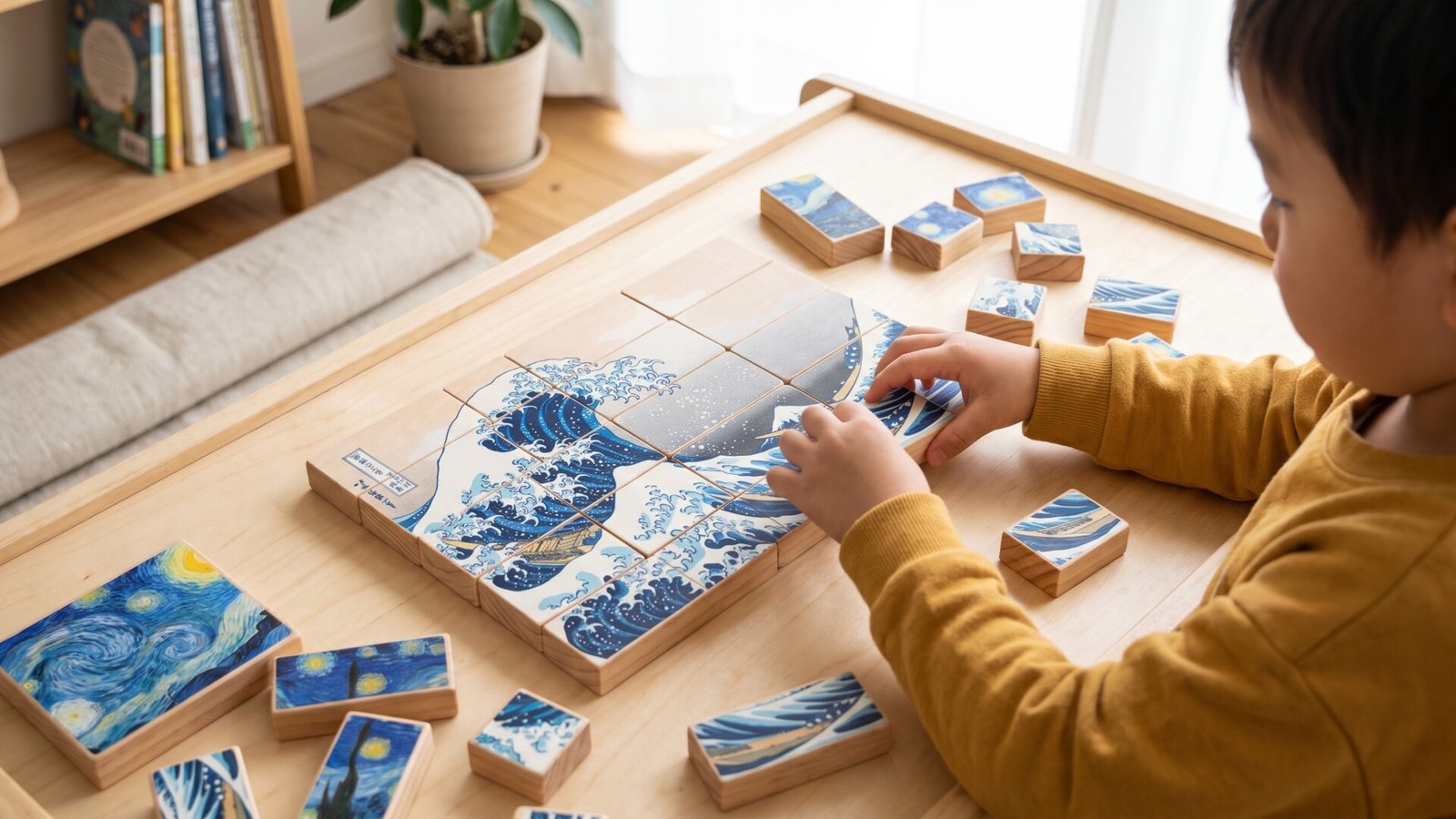
Imagine handing your child a box of beautifully crafted wooden blocks. But instead of building a castle or a spaceship, they’re reconstructing The Great Wave off Kanagawa – tile by tile, swirl by swirl. That’s the magic of Hape x The Met Art Blocks, one of the most unique educational toy releases of 2026. This collaboration between Hape Toys and The Metropolitan Museum of Art transforms famous masterpieces into hands‑on, buildable puzzles.
The concept is deceptively simple: wooden blocks printed with fragments of iconic artworks. When assembled correctly, they reveal full reproductions of paintings like Hokusai’s Great Wave or Van Gogh’s Starry Night. But beneath the surface lies a powerful learning tool. Children aren’t just stacking blocks – they’re studying colour gradients, understanding composition, and absorbing art history without cracking a textbook.
Why does this matter? Traditional art education often relies on passive viewing – a gallery wall, a slideshow, a museum audio guide. Hape x The Met flips that script. By reconstructing art with their own hands, kids internalize the artist’s choices: why Van Gogh used swirling brushstrokes, how Hokusai created depth with layered blues. It’s STEM‑style spatial reasoning applied to cultural heritage.
In this guide, I’ll explore how the system works, which sets deliver the most value, and whether this museum‑approved toy line truly teaches art appreciation or just looks pretty on a shelf.
What Are Hape x The Met Art Blocks?
The Hape x The Met Art Blocks are a series of building kits where each block is a puzzle piece of a famous artwork. The collection launched with two marquee sets: Hokusai’s The Great Wave off Kanagawa and Van Gogh’s The Starry Night, with additional museum pieces released throughout 2026.
Core concept – Each set contains dozens of laser‑engraved, colour‑printed wooden blocks. The blocks are designed to fit together in a specific order, similar to a 3D jigsaw puzzle. When completed, they form a faithful reproduction of the original masterpiece, scaled down to tabletop size. The blocks aren’t identical – each one shows a unique fragment of the painting, from a sliver of wave crest to a patch of starry sky.
Museum collaboration – The Metropolitan Museum of Art (The Met) curated the selection and provided high‑resolution scans of their collection pieces. Each set includes an educational booklet written by museum educators, explaining the artwork’s history, the artist’s techniques, and the cultural context. This isn’t generic art trivia – it’s the same depth you’d get from a gallery audio guide.
Featured artworks – The flagship sets are:
- Hokusai, The Great Wave off Kanagawa (c. 1831) – a ukiyo‑e woodblock print that defined Japanese art in the West.
- Van Gogh, The Starry Night (1889) – the post‑impressionist icon known for its emotional, swirling night sky.
Additional 2026 releases include Hokusai’s Fine Wind, Clear Morning (also known as Red Fuji) and a Vermeer study, with plans for expansion.
How the system works – The blocks are colour‑coded on the back (or by edge pattern) to guide placement. Younger builders can follow the colour map; older children can work from the reference image alone, making it a true puzzle. The layering system mimics artistic composition: you build the background first, then middle layers, then foreground details. This teaches the concept of depth in a tactile way.
Target age range – Officially rated for ages 6–12, but the complexity varies by set. The Starter Pack suits ages 5–8, while Van Gogh’s Starry Night (with over 150 pieces) challenges 10‑year‑olds and adults. Many collectors buy these sets for themselves – the finished models are stunning display pieces.
Why Art‑Based Building Toys Matter
At first glance, art blocks might seem like a niche product – a toy for museum gift shops and cultured households. But they address a genuine gap in children’s learning.
The art education gap – Most kids’ exposure to classical art is limited to a few school field trips or picture books. Famous paintings become wallpaper – seen but not understood. Block‑based reconstruction forces children to look closely, to notice small details, to ask “why did the artist put that there?”
Learning through reconstruction – Building a replica of The Great Wave requires studying the original. You notice the repeat of wave crests, the off‑balance composition, the tiny white spray. These observations become internalized. After building the set, a child can spot a Hokusai print across a room – their brain has mapped the visual pattern.
Visual‑spatial development – Traditional building toys (LEGO, blocks) teach spatial reasoning through geometry. Art blocks add another dimension: colour and texture. Matching a blue‑grey block to its correct position among dozens of similar blues sharpens colour discrimination. It’s like a training exercise for the visual cortex.
Cultural literacy benefits – Art is a universal language, but fluency requires exposure. Hape x The Met introduces children to non‑Western art (Japanese woodblock prints) alongside European masterpieces. This early exposure builds cultural appreciation and counters the narrow art history often taught in schools.
Hands‑on learning vs passive viewing – Studies show that active engagement dramatically improves retention. A child who builds Starry Night will remember Van Gogh’s name and the painting’s style far longer than one who merely saw it in a slideshow. The tactile, problem‑solving nature of the activity creates durable memories.
Educational Features of the Art Blocks System
Beyond the novelty, these sets embed real learning outcomes. Here’s what children (and adults) gain.
Color theory in practice – Van Gogh’s Starry Night uses a narrow palette: blues, yellows, greens, and white. But within those blues, there are dozens of shades. Matching blocks to the correct hue forces a child to discriminate between ultramarine, cerulean, and indigo – a lesson in colour nuance that no worksheet can replicate.
Composition and structure learning – Hokusai’s Great Wave is a masterclass in asymmetry. The massive wave dominates the left, Mount Fuji sits small on the right. Building the set reveals how the artist balanced elements – something you might never notice by simply looking at the print. The blocks become a dissection tool for composition.
Fine motor skill development – The blocks are small (typically 1–2 inches per side). Precision placement requires careful pincer grip, which strengthens fine motor muscles. Unlike loose creative play, art blocks have a defined goal, which encourages focus and patience.
Storytelling through art – The included booklets don’t just list facts; they tell stories. Why did Hokusai paint a wave that threatens the fishermen? Why did Van Gogh paint the sky from his asylum window? These narratives connect art to human emotion, making the works relatable.
Museum‑curated learning guides – This is the killer feature. The booklets are written by Met educators, not toy marketers. They include:
- Historical context (Edo period Japan, post‑impressionist France)
- Artist biographies (Hokusai’s seventy years of work, Van Gogh’s struggle)
- Technical notes (woodblock printing vs oil impasto)
- Discussion questions (“How does the wave make you feel?”)
These guides transform a toy into a curriculum. Homeschool parents and teachers can build entire lessons around a single set.
Pros and Cons of Hape x The Met Art Blocks
| Pros | Cons |
|---|---|
| Strong cultural and educational value – authentic museum partnership ensures accuracy. | Less “open‑ended” than traditional blocks – there’s a right way to build. |
| Beautiful display‑worthy finished models – looks like miniature art gallery pieces. | May feel abstract for younger kids – requires sustained attention. |
| Durable wooden materials – Hape’s quality is excellent; blocks withstand repeated use. | Limited number of artworks per set – you get one masterpiece per box. |
| Encourages creativity and patience – not a quick gratification toy. | Higher price due to licensing, design, and wood construction ($40–80+ per set). |
| Museum‑curated booklets add serious educational value. | Slower build pace – a full set can take 1–3 hours, which may frustrate some children. |
| Cross‑generational appeal – adults enjoy building these as much as kids. | No mixing across sets – each set is standalone. |
The “Open‑Ended” Debate
Some parents worry that guided building stifles creativity. That’s a valid concern – if your child loves unstructured play, LEGO Classic or plain wooden blocks are better. But art blocks aren’t meant to replace those; they serve a different purpose: focused, analytic, art‑historical puzzle solving. Think of it as a hybrid between a jigsaw puzzle and a construction toy.
Quality and Safety
Hape is known for eco‑friendly, non‑toxic finishes. The wood is birch or beech, smooth and splinter‑free. Paint is sealed and resistant to fading. These blocks will last for years and can be passed down.
Price Justification
A single set ranges from 30(Starter)to80 (Van Gogh premium). That’s comparable to a mid‑range LEGO set. Given the museum licensing, educational booklet, and wooden construction, the price is fair. However, it’s not a budget toy.
Best Art Block Sets in the Collection
Here are the standout sets, from beginner to collector.
Best Overall: Hokusai “Great Wave” Art Block Set
The Great Wave is the perfect introduction to Hape x The Met. It features approximately 80–100 blocks (depending on edition), depicting Hokusai’s most famous print. The colour palette is limited (blue, white, beige, orange), making it easier to sort than Van Gogh’s Starry Night. The finished size is about 10×8 inches.
Why it wins: The wave’s dynamic composition is visually stunning, and the block layering makes the depth obvious. The included booklet explains ukiyo‑e woodblock printing, the history of Japanese art, and Hokusai’s obsession with Mount Fuji. Children as young as 6 can complete it with guidance.
| Pros | Cons |
|---|---|
| Most visually striking set | Some small pieces (watch for toddlers) |
| Balanced difficulty – not too hard, not too easy | Blue blocks can look similar under low light |
| Excellent cultural education (non‑Western art) | No alternative build creations |
Price range: $40–55
Best for: Ages 6–12, first‑time buyers, Japanese art enthusiasts.
Available via Amazon and Hape official retailers.
Best Premium Set: Van Gogh “Starry Night” Masterpiece Build
This is the crown jewel. With over 150 pieces, Starry Night takes 2–3 hours to assemble. The blocks feature Van Gogh’s iconic swirls, with small inserts for the bright yellow stars and moon. The premium edition includes an acrylic display stand and an optional LED backlight that makes the painting “glow” – a stunning effect.
Why it wins: The level of detail is remarkable. The blocks are shaped to follow the painting’s brushstrokes – curved pieces for the sky, angular ones for the village. The educational guide discusses Van Gogh’s mental health, his use of impasto, and the symbolism of the cypress tree. This set appeals to older children (10+) and adults.
| Pros | Cons |
|---|---|
| Museum‑quality finished piece | Expensive (approx $70–90) |
| LED option adds drama | Requires patience – not for impulsive kids |
| Teaches brushstroke–style recognition | Many small pieces – easy to misplace |
Price range: $$$
Best for: Ages 10+, collectors, Van Gogh fans.
Available via Amazon and Target.
Best Beginner Set: Mini Museum Art Blocks Starter Pack
This set includes three miniature builds: a simplified Great Wave, a small Starry Night excerpt, and a Hokusai Red Fuji. Each uses 20–30 blocks, making them perfect for ages 5–8. The pieces are larger and chunkier, with easy‑to‑follow colour guides printed on the back.
Why it wins: Low frustration. A child can complete one miniature in 15 minutes, gaining confidence before tackling bigger sets. The starter pack also includes a basic art history foldout and a storage tray.
| Pros | Cons |
|---|---|
| Affordable (~$25–30) | Smaller finished pieces – less impressive |
| Great for young children or short attention spans | Only excerpts, not full artworks |
| Travel‑friendly | May feel “too easy” for older kids |
Price range: $
Best for: Ages 5–8, first exposure to art blocks.
Available via Amazon and educational retailers.
Best Cultural Expansion Set: Asian Art Series Bundle
This bundle includes three full sets: Hokusai’s Great Wave, Hokusai’s Red Fuji, and Utagawa Hiroshige’s Sudden Shower over Shin‑Ōhashi Bridge. It provides a broader view of Japanese ukiyo‑e art, comparing different artists’ styles. The bundle includes a bonus booklet on Edo period culture.
Why it wins: Value. Buying the bundle saves about 20% over individual sets, and the cultural comparison is educational gold. Children can see how Hiroshige used vertical composition vs Hokusai’s horizontal, and how both influenced Western art (including Van Gogh).
| Pros | Cons |
|---|---|
| Best value for multiple sets | Higher upfront cost (~$100–120) |
| Deep cultural learning | Requires storage space |
| Includes rare Hiroshige set | Some overlap if you already own Great Wave |
Price range: $$–$$$
Best for: Homeschool families, art enthusiasts, ages 8+.
Available via Hape official store and Amazon.
Best Collector Display Set: The Met Gallery Wall Edition
This limited‑edition set includes framing materials and a backdrop to turn your finished Starry Night or Great Wave into a gallery‑ready wall hanging. It comes with a museum‑style label card and a certificate of authenticity.
Why it wins: It transforms the toy into art. The frames are wooden, with a mat board and hanging hardware. The finished piece looks legitimate on a wall – even adults will be impressed. This is the ultimate gift for a creative family or as a shared project.
| Pros | Cons |
|---|---|
| Beautiful presentation | Very expensive (~$120–150 per set) |
| Framing materials included | Only for specific sets (Van Gogh or Hokusai) |
| Holds resale value | Less playable – designed for display |
Price range: $$$
Best for: Collectors, art‑focused families, ages 12+.
Available via museum shops and eBay Partner Network.
Art Blocks vs Traditional Building Toys
| Set | Art Education | Creativity Level | Build Complexity | Display Value | Replay Value | Price Range | Best For |
|---|---|---|---|---|---|---|---|
| Hokusai Wave Set | Very High | Medium | Medium | Very High | Medium | $$ | Best overall, ages 6–12 |
| Van Gogh Starry Night | Very High | Medium | High | Excellent | Medium | $$$ | Collectors, older kids |
| Starter Pack | Medium | High | Low | Medium | High | $ | Beginners ages 5–8 |
| Asian Art Bundle | High | High | Medium | High | High | $$–$$$ | Cultural learning |
| Gallery Wall Edition | Very High | Low | Medium | Excellent | Low | $$$ | Display collectors |
Who Should Buy Hape x The Met Art Blocks?
This product line isn’t for everyone. Here’s how to know if it fits your family.
Best for parents focused on educational value – If you want to supplement school art lessons with hands‑on activities, these sets are exceptional. The museum‑curated guides are more rigorous than typical toy inserts.
Ideal for art‑interested children – Does your child already enjoy drawing, painting, or visiting museums? They’ll love reconstructing masterpieces. The sets also appeal to kids who like jigsaw puzzles or “slow” activities.
Great for homeschool or classroom use – These sets work beautifully as group projects or learning stations. Teachers can build one together while discussing composition, colour theory, and art history.
Strong gift option for creative families – For a birthday or holiday, these sets stand out from the usual plastic toys. They signal “thoughtful gift” and are something the whole family can work on together.
Not ideal for fast‑paced builders – If your child lives for action and instant gratification, they’ll likely find art blocks tedious. Stick to traditional building sets or active toys.
Better for patience‑based, reflective play – These kits require focus and attention to detail. If your child enjoys puzzles, Lego architecture sets, or model building, they’ll thrive.
FAQ about Hape x The Met
1. What are Hape x The Met Art Blocks?
Wooden building block sets designed to reconstruct famous artworks from The Met collection. Each set includes a guidebook with art history lessons.
2. Are they actually educational or just decorative?
Genuinely educational. The included booklets are written by museum educators and cover artist biographies, techniques, and cultural context. Building the blocks teaches composition and colour theory.
3. What age are they best for?
The Starter Pack suits ages 5–8; Hokusai’s Great Wave ages 6–12; Van Gogh’s Starry Night ages 10+. Adults also enjoy them.
4. Can kids build them independently?
Older children (8+) can handle the Great Wave on their own. Younger kids need help with sorting blocks and aligning the most complex sections. The colour‑coded backings make independent building easier.
5. Are they compatible with other building sets?
No. The blocks are not standard unit sizes and are designed only for these specific puzzles. They won’t integrate with LEGO, wooden unit blocks, or other systems.
6. Do they include real art history information?
Yes. The booklets are surprisingly detailed – multiple pages per set, with historical images, artist self‑portraits, and discussion prompts. It’s comparable to a children’s museum guide.
7. Which set is best for beginners?
The Mini Museum Starter Pack. It has smaller builds, larger pieces, and a simpler colour palette. After mastering that, move to Hokusai’s Great Wave.
8. Are they worth the higher price?
Given the wood construction, museum licensing, and educational content, the price is reasonable for what you get. However, if budget is tight, the Starter Pack is the most accessible.
9. Do they work as display pieces after building?
Absolutely. The finished models are attractive enough to place on a shelf or even frame (the Gallery Wall Edition includes hardware). Many adults keep them as desk art.
10. Where can I buy them through affiliate programs?
Available at Amazon, Target, Hape official store, museum shops, and the eBay Partner Network. Links are provided in this article.
Conclusion
The Hape x The Met Art Blocks collection is a rare success: a toy that educates, delights, and looks beautiful doing it. By turning masterpieces into buildable puzzles, it teaches art history, colour theory, and spatial reasoning in a way that feels like play, not schoolwork. For the child who loves to linger over details, who asks “why” about paintings, who would rather build than binge – this is a perfect fit.
Yes, the sets are more expensive than basic blocks. Yes, they require patience. But the reward is a child who can identify a Van Gogh swirl across a room, who knows the story behind Hokusai’s wave, and who has internalised the idea that art is something you do, not just something you see.
- Best overall pick: Hokusai “Great Wave” Art Block Set
- Best premium pick: Van Gogh “Starry Night” Masterpiece Build
- Best beginner option: Mini Museum Starter Pack
- Best cultural set: Asian Art Series Bundle
- Best collector option: The Met Gallery Wall Edition
Because sometimes the best way to understand art isn’t to look at it – it’s to build it, piece by piece, until it becomes real in your hands.
Check current pricing and availability:
- Hokusai “Great Wave” Set on Amazon
- Van Gogh “Starry Night” via Target
- Mini Museum Starter Pack on Amazon
- Asian Art Bundle through Hape Official
- Gallery Wall Edition via Museum Shops and eBay Partner Network