The 15 Best Montessori Toys for 2-Year-Olds: Focus on Independence
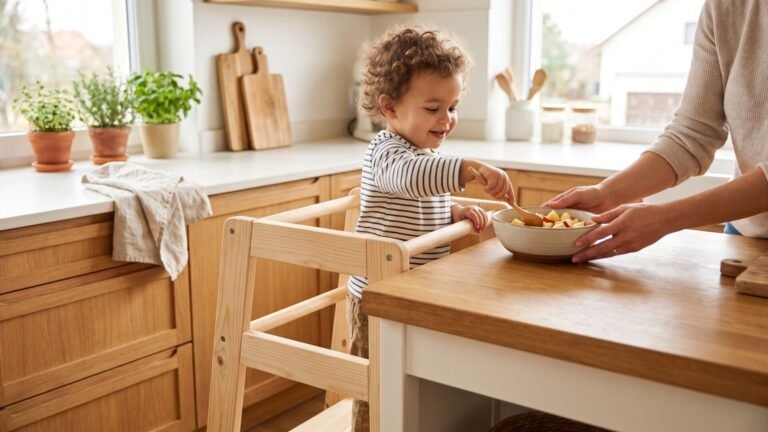
Two-year-olds are amazing little humans. They want to do everything themselves—put on their shoes, pour their own milk, climb into the car seat without help. Sometimes it’s messy. Sometimes it takes forever. But that fierce drive for independence is exactly what makes age two such a magical time for learning.
The Montessori method, developed by Dr. Maria Montessori, is built around this natural desire for autonomy. It emphasizes hands-on, self-directed play with realistic materials that help children master real-world skills. For a two-year-old, that means toys that let them button, zip, stack, sort, pour, and build—without an adult hovering or correcting every move.
This guide covers 15 of the best Montessori‑inspired toys for two‑year‑olds, each chosen to support independence, fine and gross motor development, problem‑solving, and creative thinking. Many of these toys are available through Melissa & Doug, LEGO, Seedling, Fun and Function, and other trusted retailers—look for links throughout the article to check current prices and availability.
What Makes a Toy Montessori‑Friendly for 2‑Year‑Olds
Not every wooden toy on Instagram is truly Montessori. The philosophy has a few core principles that help you tell the difference.
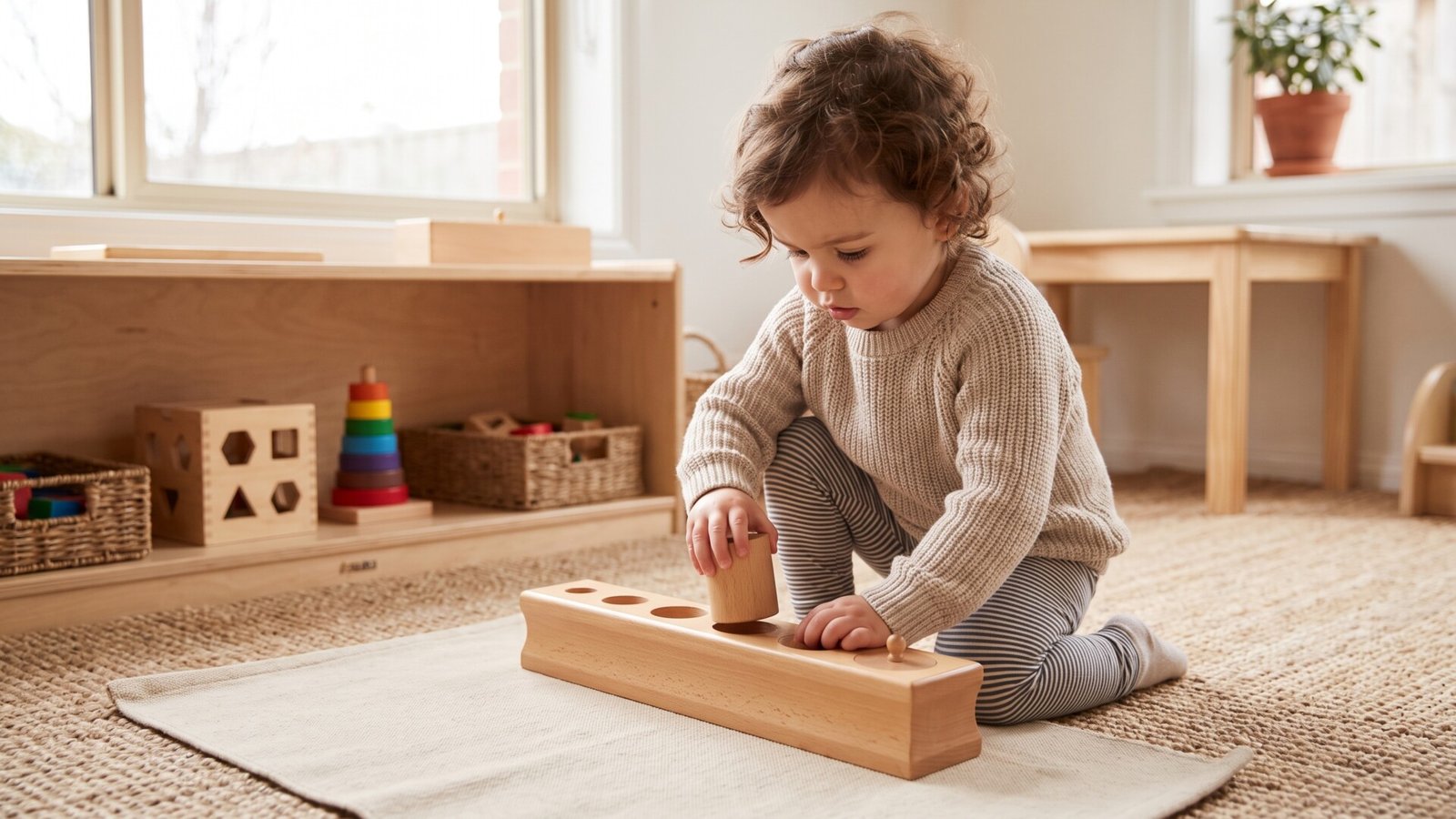
Simplicity – Montessori toys are intentionally simple. No flashing lights, no buzzing sounds, no voice that says “Good job!” every time a piece is placed. The child’s own sense of accomplishment is the reward. A wooden shape sorter, for example, lets the child figure out which shape fits where through trial and error.
Realistic materials – Montessori favoured natural materials like wood, metal, cotton, and wool. They provide richer sensory feedback than plastic and feel more like the real objects children see in daily life. A wooden kitchen set feels different from a bright plastic one—and it’s more likely to be treated with care.
Open‑ended play – The best Montessori toys don’t have a single “right” way to play. Stackable blocks become towers, bridges, fences, or imaginary cakes. A set of lacing beads can be sorted by colour, threaded in patterns, or used as pretend jewels. The child decides.
Self‑correction – Montessori materials are designed so the child can see their own mistake without an adult pointing it out. A puzzle piece that doesn’t fit, a shape sorter block that won’t go in—those are feedback loops. The child learns to adjust their approach independently.
For two‑year‑olds, these toys support key developmental domains: fine motor (grasping, twisting, lacing), gross motor (pulling, walking, balancing), cognitive problem‑solving (matching, sequencing, cause‑and‑effect), and—most importantly—independence (doing it myself).
When you’re shopping, look for toys that let your child lead. If you find yourself tempted to “help” every few seconds, it’s probably not a Montessori‑friendly toy. Step back, observe, and let the two‑year‑old figure it out. That’s where real confidence grows.
What Makes a Toy Montessori‑Friendly for 2‑Year‑Olds
Not every wooden toy on Instagram is truly Montessori. The philosophy has a few core principles that help you tell the difference.
Simplicity – Montessori toys are intentionally simple. No flashing lights, no buzzing sounds, no voice that says “Good job!” every time a piece is placed. The child’s own sense of accomplishment is the reward. A wooden shape sorter, for example, lets the child figure out which shape fits where through trial and error.
Realistic materials – Montessori favoured natural materials like wood, metal, cotton, and wool. They provide richer sensory feedback than plastic and feel more like the real objects children see in daily life. A wooden kitchen set feels different from a bright plastic one—and it’s more likely to be treated with care.
Open‑ended play – The best Montessori toys don’t have a single “right” way to play. Stackable blocks become towers, bridges, fences, or imaginary cakes. A set of lacing beads can be sorted by colour, threaded in patterns, or used as pretend jewels. The child decides.
Self‑correction – Montessori materials are designed so the child can see their own mistake without an adult pointing it out. A puzzle piece that doesn’t fit, a shape sorter block that won’t go in—those are feedback loops. The child learns to adjust their approach independently.
For two‑year‑olds, these toys support key developmental domains: fine motor (grasping, twisting, lacing), gross motor (pulling, walking, balancing), cognitive problem‑solving (matching, sequencing, cause‑and‑effect), and—most importantly—independence (doing it myself).
When you’re shopping, look for toys that let your child lead. If you find yourself tempted to “help” every few seconds, it’s probably not a Montessori‑friendly toy. Step back, observe, and let the two‑year‑old figure it out. That’s where real confidence grows.
The Top 15 Montessori Toys
2.1 Practical Life & Independence (Toys 1–5)
#1 Wooden Shape Sorter
Skills Targeted: Fine motor, problem‑solving, shape recognition
Affiliate: Melissa & Doug / Amazon
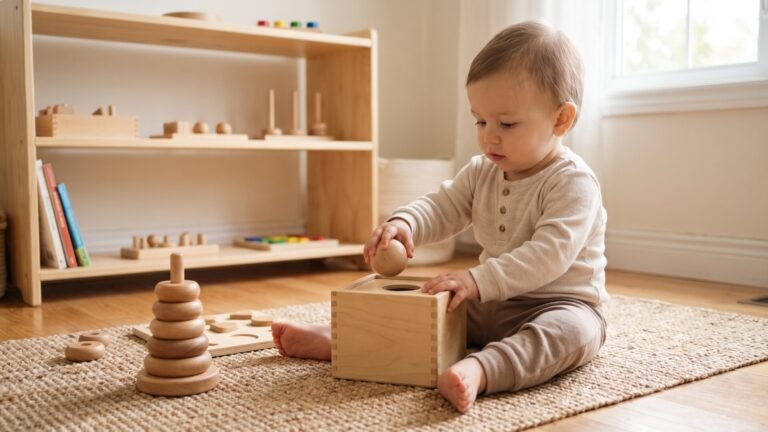
A classic wooden shape sorter is a cornerstone of Montessori play for two‑year‑olds. Unlike electronic sorters that light up and cheer, a simple wooden box with cut‑out shapes puts the child in control. They have to rotate the triangle, square, or circle until it aligns with the opening—and only then does it drop inside. That moment of success is entirely their own.
Look for sorters with rounded edges and chunky blocks that are easy to grasp. Some even have a small door on the side so the child can dump the blocks out and start over, which two‑year‑olds find endlessly satisfying.
Check Melissa & Doug shape sorters →
#2 Stackable Wooden Blocks
Skills Targeted: Spatial awareness, creativity, balance
Affiliate: LEGO / Melissa & Doug
A set of high‑quality wooden blocks might be the only toy you need for years. Two‑year‑olds start by stacking two or three blocks and watching them tumble—a wonderful lesson in cause and effect. By the time they turn three, they’ll be building bridges, walls, and whole cities.
Blocks are the ultimate open‑ended Montessori material. No instructions, no right or wrong way. Just wood, gravity, and imagination. Choose blocks that are smooth, sanded, and painted with non‑toxic dyes. Classic unit blocks or simple geometric shapes work best.
Shop Melissa & Doug block sets →
#3 Montessori Dressing Frame
Skills Targeted: Buttoning, zipping, snapping, self‑dressing
Affiliate: Fun and Function / BrightyToys
This is pure Montessori magic. A dressing frame is a small wooden frame with fabric panels and a real fastener—buttons, a zipper, a buckle, or snaps. Two‑year‑olds can practice opening and closing the fastener over and over without the frustration of wearing the garment.
Once they’ve mastered the frame, you’ll start seeing the transfer to real life. Suddenly they want to button their own sweater or zip their own jacket. It may take longer, but the pride in their face is worth every extra minute. Start with large buttons or a simple zipper, then introduce smaller fasteners as skill improves.
Explore Fun and Function dressing frames →
#4 Pull‑Along Wooden Toy
Skills Targeted: Gross motor, walking confidence, balance
Affiliate: Duncan Toys / Ryder Toys
Two‑year‑olds are often in a “walking with purpose” phase. A pull‑along toy—a wooden animal on wheels, a wagon, or a stacking cart—gives them a reason to keep moving. As they pull, they have to look back occasionally to see where the toy is, which develops spatial awareness and coordination.
Choose a toy that’s stable enough not to tip over easily. Wooden pull‑along dogs, alligators, or simple block carts are classic for a reason. Avoid strings that are long enough to become a strangulation hazard (keep them under 12 inches).
Check Ryder Toys pull‑along collection →
#5 Toddler Wooden Kitchen Set
Skills Targeted: Pretend play, hand‑eye coordination, real‑life imitation
Affiliate: ArchiesToys / Amazon
A two‑year‑old watches you cook, wash dishes, and set the table—and they want to do exactly the same thing. A small wooden kitchen set with a burner, oven, and little pots and pans lets them imitate those actions safely.
The best Montessori kitchen sets are scaled down but realistic: knobs that turn, a sink basin, and wooden or felt food that can be “cut” with a wooden knife. This kind of pretend play is not just cute; it’s a deep form of learning about routines, sequencing (first chop, then cook, then serve), and responsibility.
Browse toddler kitchen sets at ArchiesToys →
Cognitive & Problem‑Solving (Toys 6–10)
#6 Puzzle Board with Pegs
Skills Targeted: Concentration, matching, fine motor precision
Affiliate: Melissa & Doug / Seedling
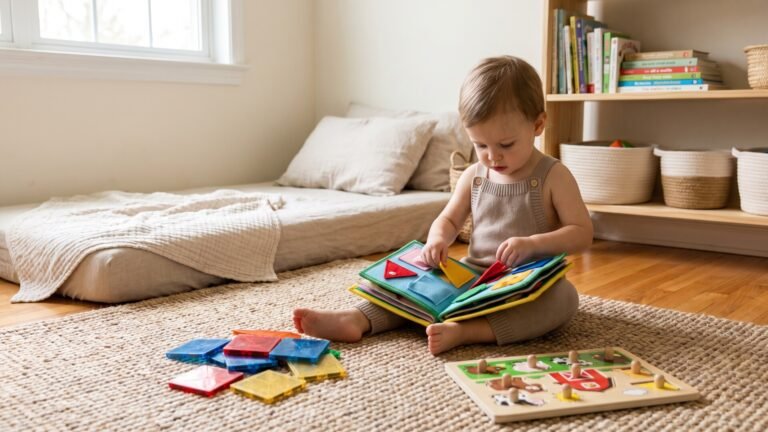
Peg puzzles are perfect for two‑year‑olds because each piece has a small knob that fits perfectly in their developing pincer grasp. The child sees a space shaped like an animal, a vehicle, or a fruit, and they have to find the matching piece and place it correctly.
The self‑correcting nature of puzzles is very Montessori. If the cow piece doesn’t fit in the tractor space, the child sees that immediately and tries again. Start with 4–6 pieces and work up to 10–12 as your child’s attention span grows.
Shop Melissa & Doug peg puzzles →
#7 Montessori Lacing Beads
Skills Targeted: Fine motor, sequencing, hand‑eye coordination
Affiliate: Fun and Function / Smiling Tree Toys
Lacing beads are a fantastic pre‑writing activity. A two‑year‑old holds a wooden needle or a stiff lace and threads large, chunky beads onto it. At first, they’ll just thread randomly, which is fine. Over time, they’ll start to notice patterns—big, small, red, blue—and you can gently suggest making a pattern together.
The act of lacing builds the same hand muscles and bilateral coordination that a child will later use to hold a pencil and button a shirt. Look for beads with smooth, sanded holes and a wooden “needle” that is blunt and safe.
Explore lacing bead sets at Fun and Function →
#8 Sorting & Counting Toys
Skills Targeted: Early math, classification, independence
Affiliate: LEGO / Target
Two‑year‑olds love to sort. It’s their way of bringing order to a chaotic world. A simple sorting tray with coloured cups or wooden bowls and a collection of objects (coloured bears, wooden fruit, nature finds) lets them decide how to organise things.
Some children sort by colour, others by size, others by type. There’s no wrong way. This is the foundation of early math—classification, one‑to‑one correspondence, and later, counting. You can also use sorting toys for “putting away” practice, which builds responsibility.
Check LEGO Duplo sorting sets →
#9 Cause & Effect Toys
Skills Targeted: Problem‑solving, cognitive development, prediction
Affiliate: VTech / LeapFrog (simple mechanical versions)
In true Montessori style, cause‑and‑effect toys should be mechanical rather than electronic. Think of a wooden marble run where the child drops a marble and watches it roll down ramps. Or a set of gears that turn together when one is cranked. Or a pop‑up toy where pushing a lever makes a wooden animal appear.
These toys teach that actions have consequences—a foundational scientific concept. Two‑year‑olds will repeat the action dozens of times, testing to see if the result is always the same. That’s the scientific method in miniature.
Shop mechanical cause‑and‑effect toys at LeapFrog →
#10 Sensory Play Bin
Skills Targeted: Tactile exploration, independent play, self‑regulation
Affiliate: Friendly Toy Box / Party Toyz
A sensory bin is simply a large container filled with a base material (rice, dried beans, sand, water beads) and small scoops, cups, and toys. Two‑year‑olds can pour, sift, bury, and discover entirely on their own.
Sensory play is deeply Montessori when it’s self‑directed. Provide the materials, set clear boundaries (the rice stays in the bin), and step back. The child will naturally explore textures, practice pouring and transferring, and enter a state of focused concentration.
Always supervise sensory bins closely to prevent mouthing of small objects. Rotate the base material every few weeks to maintain interest.
Get sensory bin supplies at Friendly Toy Box →
Creativity & Open‑Ended Play (Toys 11–15)
#11 Art & Craft Kits
Skills Targeted: Fine motor, creativity, self‑expression
Affiliate: Seedling / Amazon
Montessori art for two‑year‑olds is about the process, not the product. Large sheets of paper, chunky crayons, a pair of blunt‑tipped scissors (with supervision), and glue sticks let the child explore without pressure.
Seedling’s toddler art kits are thoughtfully designed with open‑ended prompts rather than rigid templates. A “create your own monster” kit might include googly eyes, pom‑poms, and glue—but no instructions on where to put them. That freedom is the whole point.
Encourage your child to choose their own colours, make their own marks, and decide when a piece is finished. Display their art at their eye level to show that their creative work is valued.
Browse Seedling toddler art kits →
#12 Musical Instruments
Skills Targeted: Auditory skills, rhythm, self‑expression
Affiliate: Tenacious Toys / BrightyToys
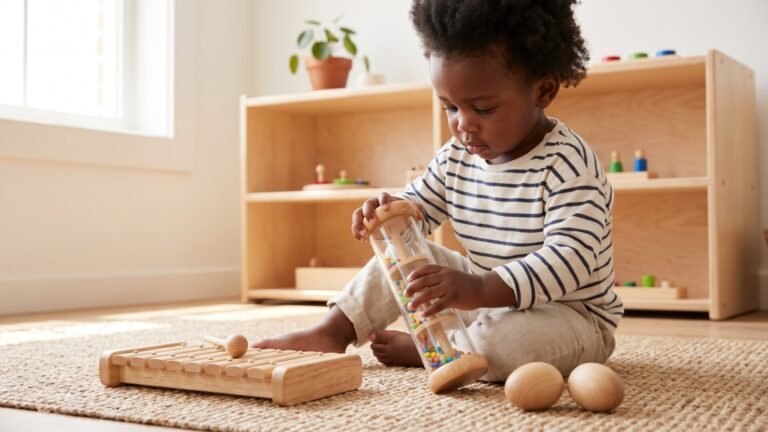
Montessori classrooms often include a small set of real (not plastic) musical instruments. A wooden xylophone, a pair of brass cymbals, a small drum, or a set of jingle bells. Two‑year‑olds can experiment with loud and soft, fast and slow, alone and together.
The key is providing instruments that produce a pleasant sound. Cheap plastic toys often sound tinny or harsh. A well‑made wooden shaker or a metal triangle has a clear, beautiful tone that invites careful listening.
Playing music also supports gross motor development (waving arms, stomping feet) and emotional expression. Let your child lead—they may want to play quietly one day and march loudly the next.
Shop Tenacious Toys musical instruments →
#13 Wooden Vehicles
Skills Targeted: Imaginative play, hand‑eye coordination, storytelling
Affiliate: Smiling Tree Toys / Ryder Toys
A simple wooden car, train, or boat can be anything a two‑year‑old imagines. It’s a race car zooming down a ramp of pillows. It’s a train carrying animals to the zoo. It’s a boat floating across a blanket sea.
Wooden vehicles are open‑ended and durable. Unlike licensed character toys, they don’t come with a pre‑written story. Your child invents the story themselves, which builds narrative skills and creativity.
Look for vehicles with moving wheels but no batteries. A wooden train with magnetic couplings lets the child connect cars and decide the length of the train.
Explore Smiling Tree Toys wooden vehicles →
#14 Building & Stacking Toys
Skills Targeted: Engineering skills, problem‑solving, spatial reasoning
Affiliate: LEGO Duplo / Melissa & Doug
LEGO Duplo blocks are larger than standard LEGO, perfect for two‑year‑old hands. They click together firmly and pull apart with a little effort—great for building hand strength.
Unlike some building toys, Duplo has intentional friction, so structures stay together. A two‑year‑old can build a tower as tall as themselves, then knock it down (which is also part of the learning). Over time, they’ll start building bridges, houses, and more complex structures.
Duplo is a wonderful bridge between wooden blocks and more advanced construction toys. The colourful, durable pieces are easy to clean and almost impossible to break.
Shop LEGO Duplo building sets →
#15 Eco‑Friendly Toddler Garden Kit
Skills Targeted: Responsibility, nature exploration, patience
Affiliate: Seedling / Friendly Toy Box
Two‑year‑olds can start learning where food comes from with a small gardening kit. A child‑sized watering can, a wooden trowel, and a few large seeds (beans or sunflowers) that can be planted in a pot on the windowsill.
The Montessori principle here is “care of the environment.” The child waters the seed each day, watches for the first sprout, and learns that their actions have real consequences. A tiny garden kit also builds fine motor skills (scooping soil, pressing seeds) and patience (waiting for growth).
Even if you don’t have outdoor space, a windowsill garden works beautifully. Seedling’s toddler garden kits include organic soil discs and fast‑growing seeds for almost instant gratification.
Find Seedling garden kits →
Comparison Table of the 15 Toys
| Toy | Best For | Material | Montessori Principle | Price Range | Affiliate Program |
|---|---|---|---|---|---|
| Wooden Shape Sorter | Fine motor | Wood | Self‑correction | $15–$25 | Melissa & Doug |
| Stackable Wooden Blocks | Creativity | Wood | Open‑ended play | $20–$30 | LEGO |
| Montessori Dressing Frame | Independence | Wood / Fabric | Practical life | $25–$40 | Fun and Function |
| Pull‑Along Wooden Toy | Gross motor | Wood | Movement & autonomy | $20–$35 | Duncan Toys |
| Toddler Wooden Kitchen Set | Role‑play | Wood | Real‑life simulation | $50–$100 | ArchiesToys |
| Puzzle Board with Pegs | Concentration | Wood | Problem‑solving | $15–$25 | Seedling |
| Montessori Lacing Beads | Fine motor | Wood | Sequencing | $12–$20 | Fun and Function |
| Sorting & Counting Toys | Early math | Wood/Plastic | Cognitive skills | $15–$30 | LEGO |
| Cause & Effect Toys | Problem‑solving | Plastic/Wood | Cognitive exploration | $20–$40 | VTech / LeapFrog |
| Sensory Play Bin | Tactile exploration | Mixed | Self‑directed play | $25–$50 | Friendly Toy Box |
| Art & Craft Kits | Creativity | Mixed | Open‑ended play | $15–$35 | Seedling |
| Musical Instruments | Auditory skills | Wood/Metal | Self‑expression | $20–$40 | Tenacious Toys |
| Wooden Vehicles | Imaginative play | Wood | Open‑ended play | $15–$25 | Smiling Tree Toys |
| Building & Stacking Toys | Problem‑solving | Plastic/Wood | Open‑ended construction | $20–$40 | LEGO Duplo |
| Eco‑Friendly Garden Kit | Responsibility | Eco materials | Nature exploration | $25–$50 | Seedling |
Tips for Using Montessori Toys to Encourage Independence
Buying the right toys is only half the battle. How you present them and how you interact (or don’t interact) makes all the difference.
Set up a toddler‑friendly environment
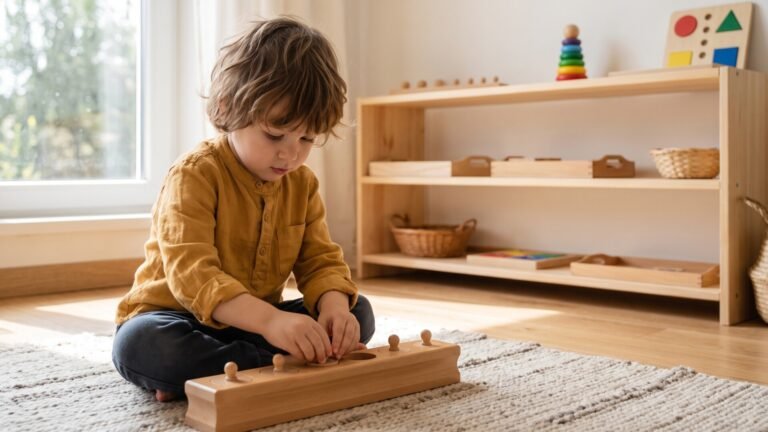
Place toys on low, open shelves where your two‑year‑old can see and reach everything without help. Use small trays or baskets to group related items (e.g., a tray with the shape sorter, a basket with the lacing beads). This “prepared environment” tells the child: these toys are for you, and you can choose any of them.
Encourage self‑directed play with minimal adult intervention
This is the hardest tip for many parents. When your child is focused on a toy, resist the urge to “help,” praise, or correct. Let them struggle a little. Let them make mistakes. Let them experience the satisfaction of solving a problem alone. Your job is to observe and keep them safe, not to entertain.
Rotate toys to sustain interest
Two‑year‑olds can be overwhelmed by too many choices. Keep only 6–8 toys available at a time, and put the rest in storage. Every week or two, swap in a few different toys. The “new” old toys will feel fresh, and your child will engage more deeply with each one.
Integrate practical‑life toys into daily routines
A dressing frame is great, but real life is better. Let your child button their own pajamas, zip their own lunch bag, and pour their own water from a small pitcher. The line between “toy” and “tool” is blurry in Montessori—and that’s exactly the point.
Link toys to developmental milestones
Watch for what your child is working on. If they’re obsessed with opening and closing containers, offer more threading or lacing toys to build fine motor strength. If they’re learning to walk confidently, bring out the pull‑along toy. The best Montessori toys grow with your child’s changing needs.
Safety & Age Considerations
Two‑year‑olds still explore the world with their mouths, so safety is non‑negotiable.
Choking hazards – Any toy with small parts that can fit through a standard toilet paper tube is a choking risk. Always check the manufacturer’s age recommendation, and supervise play with toys that include small pieces (like lacing beads).
Material safety – Look for toys made from non‑toxic, lead‑free wood and finished with water‑based paints or natural oils. Avoid cheap plastics that may contain BPA or phthalates. Fabrics on dressing frames should be securely attached and free of loose buttons that could be bitten off.
Supervision while encouraging autonomy – Independence doesn’t mean leaving your child alone in another room. Stay nearby, observe, and intervene only when safety is at risk. Montessori play is active, engaged supervision—not hovering, but present.
Frequently Asked Questions About Montessori Toys For 2-Year-Olds
What is the best Montessori toy for a 2‑year‑old?
The “best” toy depends on your child’s current interests and skills. However, toys that allow self‑correction (puzzles, shape sorters), open‑ended play (blocks, vehicles), and practical life skills (dressing frames, kitchen sets) are universally valuable. A set of stacking blocks is often a great starting point.
How many Montessori toys does a toddler really need?
Far fewer than you think. Ten to fifteen well‑chosen toys, rotated regularly, are more than enough. Too many toys can fragment attention and reduce the depth of play. Quality over quantity is a core Montessori principle.
Are wooden toys better than plastic for Montessori play?
Wooden toys are preferred because they offer richer sensory feedback (weight, texture, temperature) and usually last longer. However, high‑quality plastics (like LEGO Duplo) can also be used, especially for construction toys that require durability. The key is realism and simplicity, not the material itself.
Can Montessori toys be used for multiple age ranges?
Absolutely. A set of stacking blocks entertains a one‑year‑old (knocking down towers), a three‑year‑old (building complex structures), and a six‑year‑old (creating marble runs or pattern designs). Many Montessori toys are designed to grow with the child.
How do I encourage my toddler to play independently?
Set up a safe, accessible play space. Put out a few appealing toys. Then step back and let them choose. If they look to you for direction, resist the urge to jump in. Try saying, “You can play with any of these toys. I’ll be right here reading.” Gradually increase the time between check‑ins.
Are sensory bins considered Montessori toys?
Yes, when they are self‑directed and not overly chaotic. A simple bin of rice with a scoop and a cup invites independent exploration. A bin with dozens of tiny, themed plastic pieces can be overwhelming. Keep it simple, and let the child decide how to use the materials.
Can Montessori toys help prepare a child for preschool?
Definitely. Montessori toys build fine motor strength, concentration, problem‑solving, and independence—all skills that make the transition to preschool smoother. Children who are used to doing things for themselves often adapt more easily to classroom routines.
Where can I buy Montessori toys online with affiliate programs?
Many of the toys listed here are available through Melissa & Doug, LEGO, Seedling, Fun and Function, Amazon, Target, and other trusted retailers. Use the links in this article to check current prices and availability.
Conclusion
Two‑year‑olds are not “terrible”—they’re determined. That determination, when supported with the right tools, becomes confidence, competence, and a genuine love of learning. Montessori toys for this age aren’t about keeping your child busy; they’re about giving your child the keys to their own development.
A wooden shape sorter teaches that persistence pays off. A dressing frame turns a frustrating zipper into a game. A set of blocks becomes an entire world built by two small hands. These are the toys that say, “You can do it yourself.”
You don’t need to buy all fifteen at once. Pick one or two that speak to your child’s current passion—maybe the garden kit for a nature lover, the musical instruments for a little dancer, the lacing beads for a future builder. Watch how they respond. Then add more as their skills grow.
Ready to start your Montessori toy collection? Check prices and availability through our trusted partners using the links throughout this article. And remember: the imperfect, wobbly tower, the backwards button, the off‑key xylophone solo—those are the moments that matter most.