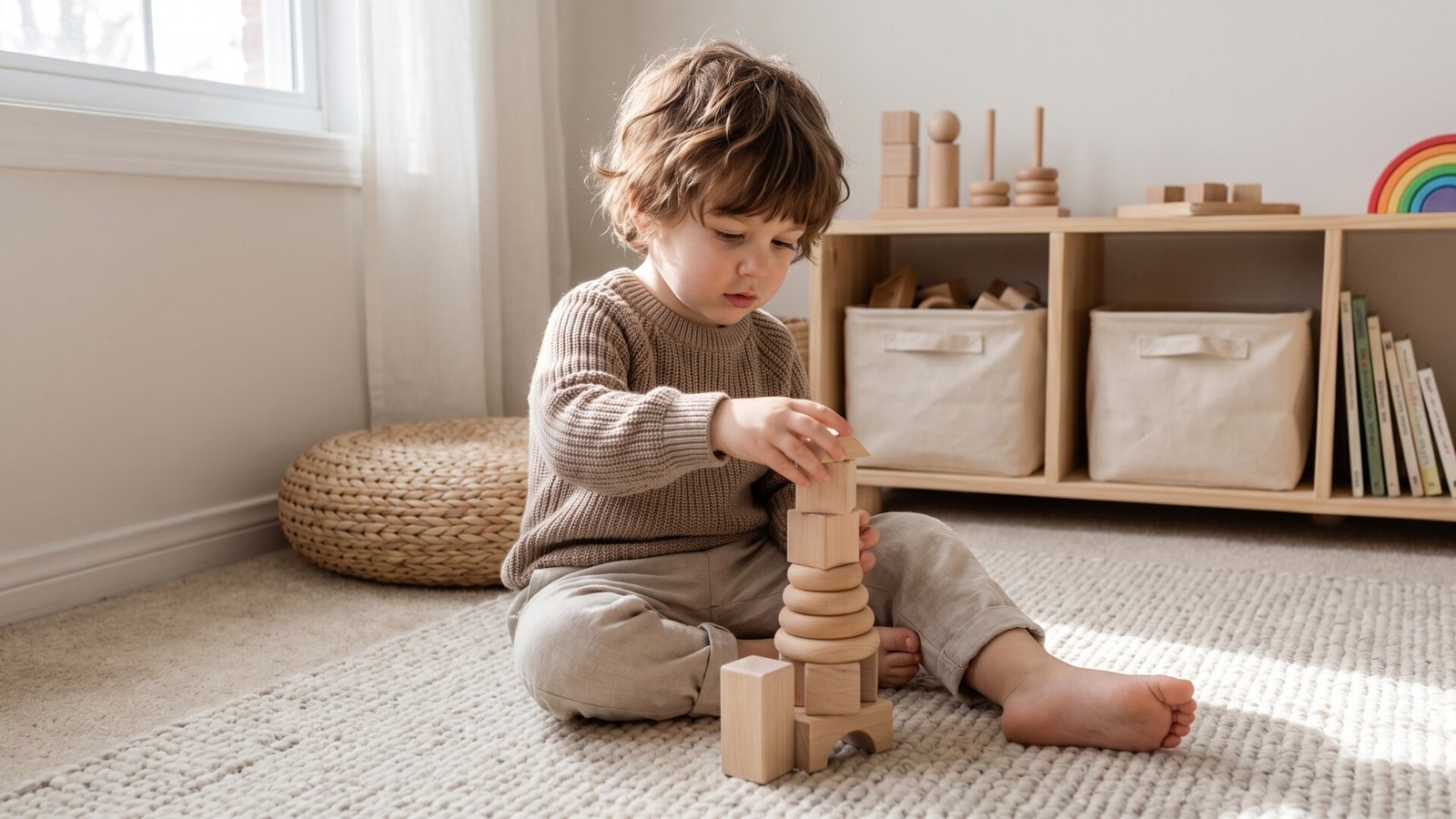
Quiet Time & Independent Play: A Parent’s Guide to Calm, Focused, Self-Directed Play
Every parent knows the feeling. The house is finally quiet. The constant requests have momentarily paused. And for a few blessed minutes—or if the stars align, an hour—your child is playing contentedly on their own, and you can breathe.
Those moments don’t happen by accident. Independent play is a skill, and like any skill, it develops with practice, encouragement, and the right conditions. Some children naturally gravitate toward solo play; others would happily have you as their entertainment director from sunrise to sunset. Either way, you can nurture the ability to play alone, and in doing so, give your child one of life’s most valuable gifts: comfortable solitude.
The benefits go far beyond the break you get (though that’s nothing to dismiss). Children who develop independent play skills build focus and concentration naturally. They learn to entertain themselves, which builds confidence and self-reliance. They process emotions through play, working through feelings and experiences in their own time and way. And they develop the capacity for quiet, which in our constantly stimulating world is becoming a superpower.
This guide explores the tools, activities, and strategies that support quiet time and independent play. Whether you’re just starting with a toddler who can’t stand being alone or looking to deepen an older preschooler’s capacity for focused play, you’ll find ideas here that respect both your child’s development and your need for the occasional moment of peace.
This article is part of the Play & Activity Ideas Hub. Make sure to check it out.
Calm-Down Corner Toys: Tools for Emotional Regulation in Preschoolers
Before children can play independently, they need to feel regulated. A dysregulated child—overtired, overstimulated, overwhelmed—cannot access the focused calm that independent play requires. This is where calm-down corners and their accompanying tools come in.
A calm-down corner isn’t a time-out spot or a punishment. It’s a designated space where children can go voluntarily when they need to regulate their emotions. Think of it as a emotional first-aid station—always available, never forced, stocked with tools that help children process big feelings and return to calm.
What belongs in a calm-down corner depends on your child and what helps them regulate. Some children need sensory input to calm down—soft textures to touch, weighted items to provide deep pressure, visual stimulation that soothes rather than agitates. Others need outlets for big feelings—something to hit safely, something to squeeze, something to tear. Still others need invitations to slow down—books that acknowledge feelings, breathing tools, quiet activities that don’t require problem-solving.
Sensory bottles deserve a place in every calm-down corner. Made simply with water, clear glue, and glitter in a sealed plastic bottle, they provide visual focus that mirrors the process of settling. Shake the bottle to represent big feelings in motion, then watch as the glitter slowly settles—just as feelings settle with time and attention. Children can shake them when upset and watch until the glitter lands, using the visual cue to guide their own calming.
Weighted lap pads or small weighted animals provide deep pressure input that calms the nervous system. The weight signals safety to the body, the same way a firm hug does. For children who seek physical input when upset, a weighted item offers regulation without requiring adult contact. Always choose weights appropriate for a child’s size and supervise initial use.
Breathing tools make abstract concepts concrete. Pinwheels, feathers, or bubbles encourage slow exhales—blow too hard and the pinwheel spins wildly or the bubble pops; blow gently and slowly, and you get the desired effect. Hoberman spheres (those expanding plastic balls) expand on inhale and contract on exhale, giving visual feedback for deep breathing. Simple breathing boards with traced paths let children follow the shape while breathing in and out.
Calm-down cards with simple strategies give children choices when they’re too dysregulated to think clearly. “Take three deep breaths” with a picture of breathing. “Hug your stuffed animal” with a comforting image. “Squeeze this ball ten times” with an illustration. Having choices visible and available prevents the paralysis that can come with big feelings.
Books about feelings belong in calm-down corners, but choose wisely. The best ones acknowledge that all feelings are valid while offering strategies for managing them. Books that name specific emotions help children identify what they’re feeling, which is the first step toward regulation. Board books with simple text work for young toddlers; longer stories with characters navigating feelings suit older preschoolers.
Connection to SEL is essential here. Social-emotional learning (SEL) encompasses the skills children need to understand and manage emotions, set goals, show empathy, establish relationships, and make responsible decisions. Calm-down corners support SEL by giving children tools to practice these skills independently. The ability to recognize when you need a break, choose a regulation strategy, and return to calm—these are SEL skills that serve children for life.
Encourage your child’s creativity, focus, and independence with carefully selected open-ended toys. Our guide, The Top 6 Open-Ended Toys for Independent Play (Ages 3–5), highlights the best options for solo play that foster problem-solving, imagination, and executive function. These toys are perfect for quiet moments at home, giving children the freedom to explore while developing essential skills.
Explore Calm-Down Corner Toys and SEL Tools
Quiet Activities for Preschoolers at Home
Once children can regulate, they need activities that invite sustained focus. The best quiet activities share common qualities: they’re engaging without being overstimulating, they can be done alone but don’t require reading complex instructions, and they have natural stopping points or can be paused and resumed.
Puzzles deserve their reputation as quiet-time champions. Floor puzzles for younger preschoolers build spatial reasoning and patience. Table puzzles with increasing piece counts challenge developing skills. Three-dimensional puzzles offer something new once traditional puzzles are mastered. The satisfaction of placing the final piece provides a natural sense of completion that children learn to anticipate and value.
Sorting and matching activities tap into preschoolers’ natural desire to organize their world. Buttons sorted by color, size, or number of holes. Animals grouped by habitat or size. Objects matched to pictures or silhouettes. These activities build classification skills that support mathematical thinking while providing quiet focus. Use ice cube trays, muffin tins, or compartmentalized boxes to contain the materials and create natural sorting spaces.
Lacing and threading develop fine motor skills while engaging attention. Wooden beads with laces, lacing cards with pictures, or simply threading dry pasta onto yarn (with tape at one end to create a “needle”) all work beautifully. The repetitive motion soothes many children, and the finished product—a necklace, a decoration, a gift—provides motivation to complete the task.
Pattern blocks and tangrams offer open-ended creation within structured systems. Wooden or plastic shapes in standard colors invite children to create designs, follow pattern cards, or invent their own. The geometric nature of the pieces means that even random creations have visual appeal. Storage is simple—everything fits back in its container, making cleanup part of the activity rather than a separate battle.
Magnetic play works as well at home as it does in the car. Magnetic building sets, magnetic dolls with changeable clothes, and magnetic boards with themed pieces all support quiet play that stays contained. The satisfying click of magnets connecting provides sensory feedback, and creations can be displayed on refrigerators or magnetic boards before being dismantled.
Connection to developmental skills runs through all these activities. Fine motor development happens naturally through lacing, sorting small items, and placing puzzle pieces. Cognitive skills like pattern recognition, classification, and spatial reasoning emerge through play. Language develops as children narrate their activities or simply hear the quiet that allows internal thought. Every quiet activity supports development across domains.
Explore More Quiet Activities for Preschoolers →
Independent Play Bins and Kits
Creating dedicated independent play bins simplifies the whole process. Each bin contains materials for a specific type of activity, and bins rotate based on what’s currently engaging your child. The rotation itself maintains novelty—materials put away for a few weeks feel fresh and exciting when they reappear.
The bin system works because it respects children’s need for variety while respecting parents’ need for containment. Clear bins let children see what’s inside; opaque bins create mystery and anticipation. Label bins with pictures for non-readers and words for emerging readers. Store most bins out of sight, rotating a selection every week or two.
Sensory bins provide deep engagement for children who learn through touch. A bin filled with rice, beans, sand, or water beads becomes a world to explore. Add scoops, small containers, toys that relate to a theme (dinosaurs in “fossil dig” sand, farm animals in “field” rice, ocean creatures in blue water beads). Set clear expectations about where sensory bins can be used—a vinyl tablecloth on the floor contains mess, and a small broom and dustpan kept nearby makes cleanup part of the activity.
Art bins contain everything needed for independent creation. Paper, child-safe scissors, glue sticks, developmentally appropriate markers or crayons, and collage materials (feathers, fabric scraps, yarn pieces) all fit in a single bin. Add idea cards with simple prompts—”draw something that makes you happy,” “cut and glue a creature,” “make a card for someone you love.” The bin format communicates that art is always available when the mood strikes.
Construction bins support building and engineering play. Magnetic tiles, wooden blocks, interlocking bricks, or simple wooden planks and blocks all work. Add challenge cards with specific prompts—”build a tower as tall as this bin,” “make a house for this small toy,” “create a bridge that spans this gap.” The bin keeps all pieces contained, and clean-up becomes sorting and counting practice.
Pretend play kits support imaginative solo play. A “doctor kit” bin with bandages, a toy stethoscope, and a small notebook for prescriptions. A “restaurant” bin with a notepad for orders, play food, and simple menus. A “zookeeper” bin with small animal figures and “enclosure” materials. The key is providing enough for rich play without so many pieces that cleanup overwhelms.
Quiet time bins specifically support the transition to calm. These might contain books and a small stuffed animal, a flashlight for reading in a fort, a simple puzzle, or a feelings journal for older preschoolers. The consistent message: quiet time is coming, and these special materials are only available then.
Connection to developmental skills varies by bin content, but the bin system itself supports development. Choosing a bin builds decision-making skills. Using materials independently builds self-reliance. Cleaning up and returning the bin builds responsibility and organization. The system teaches children that their play materials are their responsibility—a lesson that serves them well.
Explore Independent Play Bins and Kits
Montessori-Inspired Activities for Solo Play
The Montessori approach offers valuable insights for supporting independent play. At its heart is a deep respect for the child’s ability to direct their own learning, given the right environment and materials. Montessori-inspired activities share common characteristics: they’re developmentally appropriate, self-correcting, and designed for independent use.
Practical life activities transfer beautifully to independent play. Pouring activities—rice or beans between small pitchers, water in the kitchen with supervision—develop coordination and concentration. Spooning activities—moving small objects from one bowl to another with a spoon—build fine motor control. Folding cloths, opening and closing containers, and sorting silverware all engage children in meaningful work that builds real skills.
Sensorial materials invite focused exploration. Montessori-inspired sound cylinders (matching containers with different sounds) develop auditory discrimination. Color tablets for matching and grading build visual discrimination. Fabric squares for matching by texture develop tactile sensitivity. These materials isolate one quality for focused attention, helping children notice details they might otherwise miss.
Language materials support emerging literacy. Sandpaper letters combine visual, tactile, and kinesthetic learning—children trace the letter while saying its sound. Movable alphabet letters let children build words before they can write them. Object matching—matching small figures to picture cards or initial sound cards—builds phonemic awareness through play.
Math materials make abstract concepts concrete. Number rods, sandpaper numerals, and counters let children touch and manipulate quantity before moving to symbolic representation. Simple sorting and patterning activities build mathematical thinking naturally. The materials are designed to be self-correcting—children can see for themselves whether they’ve matched correctly or whether patterns make sense.
The prepared environment matters as much as the specific materials. Low shelves with carefully arranged activities invite choice. Trays that contain everything needed for an activity communicate that this work is complete and manageable. Child-sized furniture supports independence—children can access materials, use them comfortably, and return them without adult help.
Connection to developmental skills is embedded in every Montessori-inspired activity. Fine motor development happens through practical life and sensorial work. Cognitive skills develop through matching, sorting, and ordering. Language and math skills emerge naturally through concrete materials. And perhaps most importantly, children develop the ability to concentrate deeply—what Montessori called “normalization”—through engagement with materials that match their developmental needs.
Explore Montessori-Inspired Activities
Low-Prep Quiet Activities for Toddlers
Toddlers present unique challenges for independent play. Their attention spans are naturally short. They’re still developing the ability to play symbolically. And their drive for independence conflicts with their continued need for adult support. Low-prep activities that respect these realities work best.
Container play taps into every toddler’s natural interests. A collection of small containers with lids—plastic food containers, old yogurt cups with holes poked in lids, small boxes with openings—provides endless engagement. Toddlers will open, close, fill, dump, and repeat. Add a basket of small safe objects to fill containers with, and you’ve created an activity that occupies focused attention for surprising stretches.
Pillow and cushion play requires no special materials. Stack pillows, arrange cushions, create pathways, build forts. The physicality meets toddlers’ need for movement. The open-endedness invites creativity. And cleanup is as simple as returning things to their usual places. A stack of pillows in the corner of a room communicates that this activity is always available.
Treasure baskets deserve their reputation in toddler development. A basket filled with safe, interesting household objects—wooden spoons, metal measuring cups, silicone muffin liners, large corks, fabric scraps—invites exploration without prescribed outcomes. Toddlers examine, mouth, bang, and combine objects according to their own curiosity. Rotate contents regularly to maintain interest.
Sink or float play works beautifully in the kitchen or bathroom. Fill a basin or tub with water, gather objects that sink or float safely, and let toddlers experiment. Add a towel underneath for spills, and the activity contains itself. The scientific thinking happening during this play—predicting, testing, observing—is genuine cognitive development disguised as water play.
Sticky play fascinates toddlers. Contact paper taped to a wall or table with the sticky side out becomes a canvas for lightweight materials—tissue paper squares, fabric scraps, large feathers, craft foam shapes. Toddlers stick and unstick, arrange and rearrange, creating and destroying with equal satisfaction. When interest wanes, peel off the contact paper and throw everything away—cleanup is built into the activity’s end.
Connection to developmental skills happens naturally through all these activities. Object permanence develops through container play. Gross motor skills engage through pillow play. Sensory integration happens through treasure baskets. Scientific thinking emerges through sink or float. Language develops as you name objects and actions. And perhaps most importantly, toddlers practice being alone with their thoughts, which is the foundation of all independent play to come.
Explore Low-Prep Quiet Activities for Toddlers
Bringing It All Together: Supporting Quiet Time and Independent Play
After exploring all these specific activities and approaches, a bigger picture emerges. Independent play isn’t something you impose on children. It’s something you invite them into by creating the right conditions.
Start where your child is, not where you wish they were. A child who can’t play alone for five minutes needs support, not pressure. Sit nearby while they play, offering quiet presence without direction. Gradually increase distance as they build confidence. Celebrate small successes—”you played by yourself for five whole minutes!”—to build momentum.
Create the conditions for success. A consistent daily rhythm that includes predictable quiet time helps children anticipate and accept solo play. A prepared environment with accessible materials invites independent choice. Your own calm presence—reading a book nearby, doing quiet work of your own—models that solitude is valuable.
Trust the process. Some days will feel like failures. The activity you were sure would occupy an hour lasts three minutes. The child who played independently yesterday wants you glued to their side today. This is normal. Development isn’t linear, and capacity for independent play fluctuates with everything else in children’s lives.
Remember why this matters. The ability to be comfortably alone is a life skill, not just a parenting convenience. Children who learn to enjoy their own company carry that gift forever. They’ll be the teenagers who can entertain themselves without constant stimulation, the adults who don’t fear solitude, the people who know themselves because they’ve spent time with themselves.
Connection to the bigger picture brings us back to where we started. Quiet time and independent play support social-emotional learning by giving children space to process feelings. They support developmental skills across domains—fine motor, cognitive, language. And they support family life by creating rhythms that work for everyone.
The quiet moments matter. The focused play matters. The independent exploration matters. And you, by creating conditions for all of it, matter most of all.