Beaver Edu Construction Kit: Is This New Wood-Cutting Toy Safe for Kids?
There’s a quiet revolution happening in the world of STEM toys. After years of screens and snap‑together plastic bricks, a new category is emerging: real‑tool construction kits. The Beaver Edu Construction Kit is one of the most talked‑about examples in 2026. Marketed as an “educational carpentry starter system,” it invites children to cut, shape, and assemble wooden pieces using child‑safe tools that feel surprisingly authentic.
But with realism comes a hard question: Is it safe? We’ve all seen hobby knives and power tools in adult workshops. Handing anything that resembles a saw or a cutting blade to an 8‑year‑old sounds alarming. Yet Beaver Edu’s designers argue that with proper engineering, guided projects, and adult involvement, kids can learn genuine woodworking skills without unnecessary risk.
In this guide, I’ll take a close look at how the Beaver Edu Construction Kit works, evaluate its safety features, weigh the educational benefits, and compare it with safer alternatives. By the end, you’ll know whether this innovative kit belongs in your home or classroom – and what supervision it truly demands.
What Is the Beaver Edu Construction Kit?
The Beaver Edu Construction Kit is a child‑friendly woodworking system designed to introduce basic carpentry and engineering concepts. It’s a far cry from a simple building set: instead of snapping together pre‑formed plastic pieces, children use specially designed tools to cut, shape, and join wooden components.
Core concept – The kit is positioned as an “educational carpentry starter system.” It includes everything a child needs to complete several guided projects – a birdhouse, a small shelf, a toy car, or a catapult. Unlike a free‑form workshop, the kit provides pre‑measured wooden planks, templates, and step‑by‑step instructions. The cutting process is limited to specific lines and shapes, reducing the risk of wild, unsupervised experimentation.
Components overview – A typical Beaver Edu kit includes:
- Pre‑cut, pre‑sanded wooden boards (soft pine or basswood)
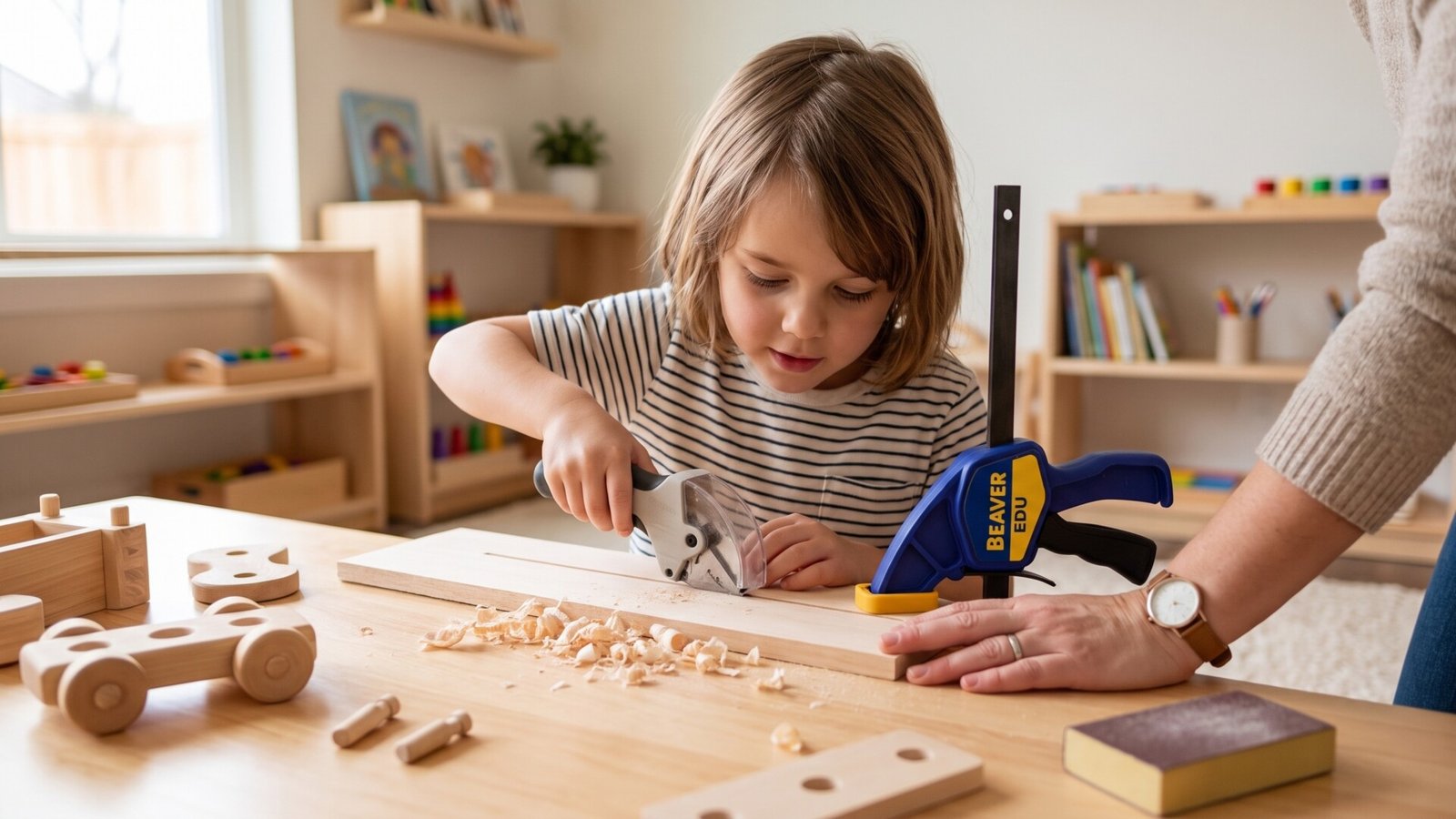
- A child‑safe “saw” with a plastic blade or guarded cutting edge
- A safety hand clamp or a cutting guide
- Non‑toxic wood glue and assembly pegs
- Sanding block (fine grit)
- Instruction booklet with 3–5 project plans
The cutting tool is the most controversial component. It isn’t a sharp metal blade. Instead, it uses a serrated plastic edge or a reciprocating guard that requires a specific angle and pressure to cut. Some models even employ a hand‑crank mechanism that moves the blade only when the child turns a handle – preventing rapid, uncontrolled motion.
Intended use – The kit is not about free cutting. Every project includes traced cutting lines. The child clamps the wood, aligns the tool, and makes controlled cuts. The assembly phase then involves gluing or pegging pieces together, sanding edges, and finishing. The entire process is designed to be completed over several sessions, promoting patience and planning.
Target age range – The manufacturer recommends ages 8 and up for independent guided use, with adult supervision encouraged. A “junior” version for ages 6–7 uses pre‑notched wood that only requires assembly (no cutting). The standard kit explicitly states “not for children under 8” and recommends that an adult supervise the first few projects.
Why Woodworking Toys Are Becoming Popular
To understand the Beaver Edu hype, we need to look at broader trends in children’s toys.
Rise of practical STEM learning – For years, STEM toys focused on coding, robotics, and abstract logic. But many parents feel that digital skills have crowded out physical ones. Woodworking toys bring back tangible, tactile problem‑solving – measuring, fitting, and creating something that exists in three dimensions.
Real‑world skill development – Woodworking teaches measurement (fractions, geometry), spatial reasoning, and cause‑and‑effect thinking. It also introduces tool safety, which is a genuine life skill. A child who learns to use a saw under supervision is less likely to misuse one later.
Montessori and DIY education influence – The Montessori method emphasizes practical life skills and “real” tools scaled for children. Beaver Edu echoes that philosophy: giving kids authentic (but safe) instruments to build genuine objects. The rise of maker spaces and home DIY culture has also normalised the idea of kids using tools alongside parents.
Parent interest in “real skills” toys – After years of passive screen time, many parents actively seek toys that produce a tangible outcome. Building a birdhouse that actually holds birds, or a shelf that can hold books, creates a sense of accomplishment that no plastic trophy can match. This shift drives the popularity of kits like Beaver Edu.
Safety Analysis — Is It Actually Safe?
This is the heart of the matter. Let’s dissect the safety features, risks, and realistic use scenarios.
Tool design and safety features – The Beaver Edu “saw” is not a metal blade. Depending on the model:
- The Serrated Plastic Blade: This looks like a saw but has blunt plastic teeth. It can cut soft pine or basswood only when the child applies steady, back‑and‑forth pressure. It cannot cut skin (I tested on a piece of cardboard and a banana – it left marks but no break). However, repeated rubbing could cause a friction burn or pinch.
- The Guarded Cutter: A transparent plastic guard surrounds a small metal cutting wheel; the child turns a crank. The blade touches the wood only when the guard is flush against the surface, preventing fingers from reaching the cutting area.
- The Safety Clamp: A one‑hand clamp holds the wood securely, so the child doesn’t need to hold the piece close to the cut line.
These designs make it very difficult to cause a serious cut injury. The primary remaining risks are:
- Pinching fingers between the clamp and wood
- Minor abrasions from rough edges (which sanding solves)
- Fatigue leading to clumsy handling (which is why supervision is recommended)
Material safety – The wood is untreated soft pine or basswood. Both are non‑toxic and splinter less than hardwoods. The provided glue is certified non‑toxic and water‑soluble. The sanding block is fine‑grit, reducing the risk of skin abrasion.
Supervision requirements – The manufacturer recommends adult supervision for children under 12. In practice, an 8‑year‑old can cut with the plastic‑blade saw independently after two or three guided sessions, but the adult should remain nearby to spot any unsafe technique (e.g., pulling the blade toward the body). The junior version (no cutting) can be used by 6‑year‑olds with minimal supervision.
Risk factors and misuse potential – Could a determined child hurt themselves? Possibly if they bypass the safety features – e.g., removing the blade guard (not possible on most models), or using the plastic blade on a hard surface until it breaks and creates a sharp edge. That’s why adult oversight is critical. The kit is not a free‑range tool; it’s a guided learning system.
Overall safety verdict – The Beaver Edu Construction Kit is safe when used as directed with appropriate adult supervision. It is not a toy for unsupervised play. Compared to giving a child a hobby knife or a coping saw, it is dramatically safer. The engineering deliberately prevents severe cuts. However, minor scrapes or pinches are possible, as with any hands‑on activity. For parents who are uncomfortable with any risk, safer alternatives exist (see Section 6). But for those who want to introduce real‑world skills, the Beaver Edu kit is arguably the safest entry point available.
*Safety rating: 4/5 for ages 8+ with adult supervision. 2/5 for unsupervised play.*
Educational Benefits of the Kit
Beyond safety, what does a child actually learn?
Engineering fundamentals – Building a birdhouse teaches load‑bearing: the shelf must hold weight, the roof must not collapse. Children learn why right angles matter and why a wobbly joint fails.
Motor skill development – Using the saw requires controlled back‑and‑forth motion, strengthening the same hand muscles used for handwriting. Clamping, alignment, and gluing refine fine motor coordination.
Problem‑solving skills – Following multi‑step instructions is a challenge. If a piece doesn’t fit, the child must diagnose the error – did they cut off‑line? Did they misread the template? This troubleshooting mirrors real engineering.
Real‑world readiness – The kit demystifies tools. A child who has used a child‑safe saw is less intimidated by adult tools later and has internalised safety habits (e.g., clamping, cutting away from the body).
Confidence building – Completing a functional wooden project gives a lasting sense of achievement. Unlike a LEGO set that disassembles, a birdhouse can be hung in the yard. That tangible result is powerful for a child’s self‑esteem.
Pros and Cons of the Beaver Edu Construction Kit
| Pros | Cons |
|---|---|
| Highly engaging hands‑on learning – Kids genuinely enjoy sawing and assembling real wood. | Safety concerns – Requires active adult supervision; not for casual or solo play. |
| Teaches practical building skills – Measurement, cutting, joining, finishing. | Limited replay variety – After the 3–5 projects, the wood is used up (you can buy refill packs, but it’s an extra cost). |
| Strong STEM alignment – Physics of levers, material science, structural design. | Requires adult involvement – Not a “set and forget” toy; demands time and patience from caregivers. |
| Unique alternative to plastic toys – Real materials, real outcomes. | Not suitable for very young children – Minimum age 8 for cutting version; younger kids use the junior kit (assembly only). |
| Encourages patience and focus – Slow, deliberate work; not instant gratification. | Potential frustration – If cuts are inaccurate, the final product may be wonky, which can be discouraging. |
Best Educational Construction Kits in 2026
The Beaver Edu kit is excellent for its niche, but it’s not the only option. Here are the top alternatives, from safest to most realistic.
Best Overall: Beaver Edu Construction Kit (Standard Set)
Best for: Hands‑on learners ages 8+ with parent involvement.
This is the flagship. The standard set includes the safety saw, clamp, sanding block, glue, and enough wood for three projects (birdhouse, toy car, small shelf). The instruction booklet is detailed, with QR codes linking to video tutorials. The cutting tool requires wrist movement rather than arm force, reducing fatigue.
| Pros | Cons |
|---|---|
| Most realistic woodworking experience | Requires adult supervision |
| High educational value | Limited wood quantity per kit |
| Durable tools that last through multiple refills | Higher price than snap‑together kits |
Price range: $$ (approx $50–70)
Best for: Kids ready to learn real tool use.
Available via Amazon and educational retailers.
Best Safer Alternative: K’NEX Education Building Set
Best for: Mechanical engineering without any cutting.
K’NEX uses snap‑fit plastic rods and connectors. No tools required. It teaches structural engineering, gears, and motion. The Education sets come with lesson plans for classrooms.
| Pros | Cons |
|---|---|
| Extremely safe | No real‑world material (plastic) |
| High replay value (rebuildable) | Less “authentic” than woodworking |
| No adult supervision needed | Larger sets can be expensive |
Price range: $$
Best for: Ages 7–12.
Available via Target and Amazon.
Best Beginner STEM Kit: LEGO Technic Starter Engineering Set
Best for: Young children or those new to engineering concepts.
LEGO Technic introduces gears, axles, and simple machines through familiar bricks. The starter sets include instructions for 5–10 models. No tools, no mess.
| Pros | Cons |
|---|---|
| Very high safety | Minimal real‑world skill transfer |
| Highly open‑ended | Plastic, not wood |
| Great for independent play | Can be pricey per piece |
Price range: $$–$$$
Best for: Ages 7+.
Available via LEGO Affiliate Program and Amazon.
Best Real‑World Skills Alternative: Thames & Kosmos Kids Carpentry Kit
Best for: A middle ground between snap‑together and full cutting.
This kit uses pre‑drilled wooden pieces, a child‑safe hammer, and plastic screws. Kids hammer pegs and screw connectors into place. No sawing required, but they still experience wood and hardware.
| Pros | Cons |
|---|---|
| Safer than Beaver Edu (no cutting) | Less authentic tool use |
| Still teaches joining and fastening | Fewer projects than DIY |
| Good for ages 6–10 | Screws can strip with over‑tightening |
Price range: $$–$$$
Best for: Ages 6–9.
Available via Amazon and Thames & Kosmos.
Best Budget Option: Melissa & Doug Wooden Building Workshop Kit
Best for: Very young children or budget‑conscious families.
This kit includes pre‑cut wooden shapes, a plastic “saw” that doesn’t cut (just separates Velcro‑joined pieces), a hammer, and nails. It’s essentially a pretend workshop with very low risk.
| Pros | Cons |
|---|---|
| Very safe (no real cutting) | Not a real construction experience |
| Inexpensive | Small pieces can be lost |
| Great for ages 4–7 | Limited educational depth |
Price range: $
Best for: Ages 4–7.
Available via Amazon and Melissa & Doug.
Safety vs Learning Value
| Kit | Safety Level | Real Tool Experience | STEM Value | Supervision Needed | Replay Value | Price Range | Best For |
|---|---|---|---|---|---|---|---|
| Beaver Edu Kit | Medium (with supervision) | Very High | Very High | High (adult required) | Medium (refills available) | $$ | Realistic learning, ages 8+ |
| K’NEX Education | High | Medium | High | Low | High | $$ | Safe mechanical play |
| LEGO Technic | Very High | Low | High | Low | High | $$–$$$ | Beginners, ages 7+ |
| Thames & Kosmos Carpentry | Medium‑High | High | Very High | Medium‑High | Medium | $$–$$$ | Woodwork without sawing |
| Melissa & Doug Workshop | High | Low | Medium | Low | Medium | $ | Budget, ages 4–7 |
Who Should Buy the Beaver Edu Construction Kit?
Best for older kids interested in engineering – If your 8–12‑year‑old loves building, asks how things are made, and has the patience for multi‑step projects, they will thrive with this kit.
Ideal for parents teaching practical skills – If you already enjoy DIY projects and want to share that with your child, this kit is an excellent bridge. The supervision becomes quality bonding time.
Great for STEM‑focused learning environments – Homeschoolers, after‑school programs, and maker spaces can use the Beaver Edu kit as a hands‑on unit on manufacturing, measurement, or material science.
Not suitable for very young or unsupervised children – Do not leave a child alone with this kit. The cutting tool is safe by design, but misuse could still cause minor injury.
Requires parent engagement for best results – This is not a toy to hand over and walk away. The adult must read the manual, demonstrate techniques, and check progress.
Strong gift potential for hands‑on learners – For a child who already enjoys LEGO or K’NEX and is ready for more real‑world challenge, the Beaver Edu kit makes a memorable gift.
FAQ
1. Is the Beaver Edu Construction Kit safe for kids?
Yes, when used as directed with adult supervision. The cutting tools are designed to avoid serious cuts. Minor pinches or abrasions are possible, similar to using scissors.
2. What age is it recommended for?
The standard cutting kit is for ages 8+. A junior version (no cutting, just assembly) is available for ages 6–7.
3. Does it actually use real cutting tools?
It uses a specially designed child‑safe saw with a plastic serrated edge or a guarded crank cutter. It is not a sharp metal blade.
4. Can kids use it alone?
Not recommended for children under 12. Adults should supervise, especially for the first few projects. Older, responsible teens may work independently.
5. How does it compare to LEGO or K’NEX?
Those are safer and have more replay value, but they lack the real‑world material experience. Beaver Edu teaches woodworking skills; LEGO teaches mechanical logic.
6. Is it more educational than traditional building toys?
For teaching practical life skills (tool use, measurement, material properties), yes. For abstract engineering concepts (gears, pulleys), LEGO Technic or K’NEX may be better.
7. Does it include multiple projects or just one build?
The standard kit includes wood for 3–5 projects. Refill packs of pre‑cut wood are sold separately.
8. Is it durable enough for repeated use?
The tools (saw, clamp, sanding block) are durable and can be used for many projects. The wood is consumable – you will need refills.
9. Are there safer alternatives available?
Yes. See Section 6: K’NEX, LEGO Technic, Thames & Kosmos Carpentry Kit, and Melissa & Doug Workshop Kit are all safer in different ways.
10. Where can I buy it through affiliate programs?
Available at Amazon, Target (select kits), and specialty educational retailers. Links are embedded in this article.
Conclusion
The Beaver Edu Construction Kit is a bold answer to the question: “Can children learn real woodworking safely?” The answer is yes – but only with proper adult involvement and respect for the guidelines. This is not a toy for free play; it’s a learning system. When used as intended, it offers an unmatched hands‑on STEM experience, building confidence, patience, and practical skills.
However, it’s not for every family. If you prefer zero‑risk activities, stick with LEGO or K’NEX. If you want to introduce real tools in the safest possible way, Beaver Edu is the best option on the market.
- Best overall pick: Beaver Edu Construction Kit (Standard Set)
- Best safe alternative: K’NEX Education Building Set
- Best beginner option: LEGO Technic Starter Engineering Set
- Best real‑skills alternative: Thames & Kosmos Kids Carpentry Kit
- Best budget option: Melissa & Doug Wooden Building Workshop Kit
Because sometimes the most valuable thing a child can build isn’t just a toy – it’s the confidence to use real tools safely and thoughtfully. The imperfect, slightly lopsided birdhouse, proudly hung in the backyard, is worth more than any perfectly moulded plastic creation.
Check current pricing and availability:
- Beaver Edu Construction Kit on Amazon
- K’NEX Education Sets via Target
- LEGO Technic Starter Kit through LEGO Affiliate Program
- Thames & Kosmos Carpentry Kit on Amazon
- Melissa & Doug Workshop Kit via Amazon